1. Background
Herbicides are used in agriculture to kill weeds or other plants that grow where they are not wanted. Triazine herbicides form a wide group of chemicals used for pre- and post-emergence weed control. The use of triazines was initiated in 1952. Today, more than 30% of all agricultural herbicides are triazines. S-triazine derivatives are among the most important selective herbicides. S-triazine, and their metabolites, are very toxic, highly persistent, have accumulation potential and remain in the environment for many years (1).
2-ethylamino-4-(isopropylamino)-6-(methyl-thio)-s-triazine with trade names Ametryn, Gesapax, Almulex, Ametrex and Evik belongs to the s-triazines herbicide family. It is used for the control of broad leaf and grass weeds in corn, sugarcane, banana, pineapple and plantains (2). The world health organization (WHO) classifies it as toxicity class II, which is moderately hazardous (3). Ametryn is moderately toxic to fish, slightly toxic to mammals and slightly to moderately toxic to freshwater animals. Ametryn has high water solubility (185 mg/L, 25◦C), thus, shows wide occurrence in surface and ground waters (4, 5).
Adsorption is considered to be an excellent and cost-effective method used for the removal of such hazardous compounds from polluted waters. A variety of methods have been reported for adsorption including activated carbon, clay minerals, biomaterials, zeolites, chitosan and others (6). Although activated carbon is widely used as an adsorbent yet it is relatively expensive (7).
Amongst the adsorption methods, natural zeolites as low-cost adsorbent and ion exchangers are widely distributed in the world. Physicochemical properties of zeolites including adsorption, ion exchange, molecular sieving and catalysis of different zeolites have made it an important sorbent for extracting and removal of hazardous compounds from air and water (6, 8). Zeolites have hydrated aluminosilicate structure as TO4 tetrahedral molecules. The chemical formula of zeolites is M x/n [AlxSiyO2 (x + y)] p H2O that M is (Na, K, Li) and/or (Ca, Mg, Ba, Sr), n is the cation charge; y/x = 1 - 6, p/x = 1 - 4. The primary building unit of zeolite is an aluminum ion or silicon in the centre of the tetrahedron with four oxygen atoms at the vertices, and isomorphic replacement of Si4+ with Al3+ produces a negative charge in the framework. The net negative charge is balanced by exchangeable monovalent or divalent cations in water solutions (9, 10). The absorption behaviour of zeolites depend on the structure, ion size, shape, charge in density, ionic charge and concentration of the external electrolyte solution. The properties of zeolite influence the adsorption process including chemical/structural makeup of the adsorbent, the Si/Al ratio, cation type, number and location. The properties of zeolite can be improved by changing pH, contact time, and adding surfactant for adsorption of various ions (6, 11, 12).
Natural zeolites, especially clinoptilolite seem to be the most effective adsorbents for removing and stabilizing pollutants (13). The structure of clinoptilolite was formed with open channels of 8 - 10 membered rings (14). Clinoptilolite is the most abundant in nature and can be found in Semnan, Miyaneh, Talheh, Roodehen, Taleghan, Tabas, Kerman and Zahedan cities of Iran (15, 16).
Response surface methodology (RSM) is a collection of statistical and mathematical methods that is useful for modelling and designing experiments, and finds optimal parameters. The RSM is based on box-behnken design (BBD) widely used to find the optimal conditions in a multivariable system with a limited number of experiments (17).
High-performance liquid chromatography (HPLC) and gas chromatography (GC) are considered as efficient methods to measure triazines herbicides in surface and ground water. Volatile s-triazines and their hydroxy derivatives cannot be detected by GC. High-Performance Liquid Chromatography is considered for determination of acidic pesticides, with high polarity, low volatility and thermal instabilities, because GC is only able to follow a prior derivatization step. In addition, triazine herbicides have strong absorption in the UV region (210 - 240 nm), thus they can be determined with UV detectors in a liquid chromatography process (1, 18).
2. Objectives
This work aimed to investigate the efficiency of natural zeolite nanoparticles as an adsorbent to remove ametryn from aqueous solutions. Response surface methodology based on BBD was used to optimize the operating factors for maximum ametryn removal by zeolite nanoparticles.
3. Materials and Methods
3.1. Reagents and Solutions
Ametryn was purchased from Sigma Aldrich. Methanol (HPLC grade), NaOH, HCl and H3PO4 were of analytical reagent grade (Merck, Germany). Experiments were carried out on double distilled water. Nylon syringe filter (17 mm, 0.2 µm) was purchased from Vertical (Thailand). The extraction cartridges were C18 (500 mg/6 mL) from Capital Co. of England.
3.2. Instruments and Characterization Methods
The mineralogical composition of the zeolite was determined by a Philips PW 1840 X-ray diffractometer, and the semi-quantitative analysis was based on the XRD pattern of disoriented powder sample, using the method described by Schultz (19). An X-ray fluorescence spectrometer (Bruker S4 Pioneer) was used to analyse all the elements in zeolite. Planetary ball-mill (Nano Shat PBM-210 model, Iran) was used to prepare the zeolite nanoparticles. Transmission electron microscope (LEO 906E model, Germany) and scanning electron microscope (LEO 1455VP model, Germany) were used to determine the size and the surface morphology of zeolite nanoparticles. The specific surface area and cation exchange capacity of the zeolite sample were measured by N2-BET sorption analysis and the NH4-acetate method. Also, the size of zeolite nanoparticles was measured with a dynamic light scattering particle size analyzer (Scatterscope 1 Codex model, Korea).
Ametryn concentration was measured according to the published method by Pinto et al.(1). A Shimadzu HPLC system (Kyoto, Japan) equipped with an injector with a 250 µm loop, LC-10ADVP pump, UV-Vis absorbance detector (SPD-10AVP model), column (150 mm × 4.6 mm, ODS (C18)-H-OL 5-34174 model) and guard column was used to separate and determinate the concentration of ametryn in water solutions. The mobile phase consisted of 60% / 40% (v/v) methanol and double distilled water, and the pH of the mixture was adjusted to 4.6 with 0.1 moL/L H3PO4 solution. The mobile phase flow rate was 1.2 mL/min. The injection volume was 200 µl and ametryn was detected by a UV detector, at a wavelength of 228 nm. The mobile phase was passed through a filter membrane (0.45 µm) with a Millipore system (Sartorius, Germany). A BEL engineering analytical balance (M124A model, Italy) was used to measure the amount of chemicals. A Metrohm pH-meter from Switzerland was used for measuring pH of solutions. A STUART orbital shaker (from England) was used for mixing the mixtures.
3.3. Preparation of Zeolite Nanoparticles
The zeolite sample was collected from Semnan region in the north-east of Iran. The method for preparing zeolite nanoparticles was performed according to published methods (14, 20). Zeolite powder was converted to zeolite microparticles by sieving in analytical sieves (270 mesh, 53 micron), for separating the particles ≤ 53 microns. The surface morphology of the zeolite microparticles was evaluated using a scanning electron microscope. Next, the zeolite nanoparticles were prepared by mechanical methods with planetary ball-mill equipment (350 rpm, 120 hours) of zeolite microparticles. The zeolite nanoparticles were stored in a desiccator.
3.4. Ametryn Removal
Primarily, we prepared a three-litre solution of ametryn in a 25 ppb concentration by double distilled water. The adsorption experiments were performed by mixing appropriate amounts of zeolite nanoparticles with 50 mL of this prepared solution. The pH was adjusted to the desired values using 0.1 moL/L NaOH or 0.1 moL/L HCl solutions. For each experiment, an appropriate amount of sorbent was added to 50 mL of solution and shaken at 250 rpm for 30 minutes at an appropriate temperature. Next, the solution was filtered with a filter paper and then ametryn content of the solution was determined using HPLC. All measurements were carried out with three replications and the results were given as averages. The ametryn removal percentage was calculated by the following equation:
Where Ci is the initial concentration of ametryn and Ceq is the equilibrium concentration of ametryn in each solution (mg/L), respectively.
3.5. Experimental Design
Response surfaces were generated with the Minitab (version 17) statistical analysis software. Box-Behnken experimental design was employed for the optimization of operational conditions for efficient ametryn removal of zeolite nanoparticles from aqueous solutions. To examine ametryn removal efficiency three independent variables including pH (6, 7 and 8), temperature (25, 35 and 45°C), and the amount of adsorbent (0.5, 1.25 and 2 g) were used. The percentage of ametryn removal was considered as the dependent variable (response). The experimental design and the results of all 15 experiments, including three centre points are shown in Table 1. Each experiment was performed in triplicates to verify reproducibility. The results were used to determine the 10 coefficients of the equation. This equation indicates the relationship between the response functions and the independent variables (pH, temperature and the amount of adsorbent). Usually the following second-order polynomial equation is applied in the response surface methodology and is expressed as:
Where Y is the response (percentage of ametryn adsorbed) and x1 (pH), x2 (temperature) and x3 (amount of adsorbent) are independent variables, x12, x22 and x32 are the squared variables; x1x2, x1x3 and x2x3 are the interaction variables; b1, b2 and b3 are linear coefficients; b11, b22 and b33 are the quadratic coefficients; b12, b13 and b23 are the interaction coefficients between independent variables; and b0 is the model constant, respectively. Analysis of variance (ANOVA) was performed based on the proposed model to find out the interaction between the variables and the responses.
Table 1.
Box-Behnken Design Matrix for Three Variables; Three Levels Together With Observed And Predicted Valuesa
| Exp. Run | X1 | X2 | X3 | Removal, % | Predicted |
|---|---|---|---|---|---|
| 1 | 7 | 45 | 2 | 39.48 | 40.09 |
| 2 | 6 | 35 | 2 | 57.91 | 53.48 |
| 3 | 8 | 25 | 1.25 | 13.91 | 10.09 |
| 4 | 7 | 35 | 1.25 | 20.94 | 21.17 |
| 5 | 7 | 45 | 0.5 | 13.02 | 11.67 |
| 6 | 7 | 25 | 0.5 | 12.08 | 11.47 |
| 7 | 7 | 35 | 1.25 | 20.71 | 21.17 |
| 8 | 8 | 35 | 2 | 17.72 | 20.18 |
| 9 | 6 | 45 | 1.25 | 32.75 | 36.56 |
| 10 | 7 | 25 | 2 | 29.45 | 30.8 |
| 11 | 7 | 35 | 1.25 | 21.86 | 21.17 |
| 12 | 8 | 45 | 1.25 | 16.62 | 13.54 |
| 13 | 6 | 25 | 1.25 | 27.44 | 30.51 |
| 14 | 8 | 35 | 0.5 | 3.46 | 7.88 |
| 15 | 6 | 35 | 0.5 | 20.48 | 18.02 |
ax1 (pH), x2 (temperature), and x3 (amount of adsorbent) are independent variable effects.
4. Results
4.1. Particle Size Analysis, XRD, XRF, SEM and TEM Study for Zeolite Nanoparticles
The results from the particle size analyzer showed that the distribution of particles was about 10-9 m; D (50) and D (90) were 5.94 and 9.34 nm, respectively. Figure 1A shows the SEM image for zeolite microparticles before modification. The TEM image for the zeolite nanoparticles showed that the surface morphology of samples was changed after modification in Figure 1B. It is clear that zeolite nanoparticles have a spheroidal shape and that their sizes were between 1 and 100 nm.
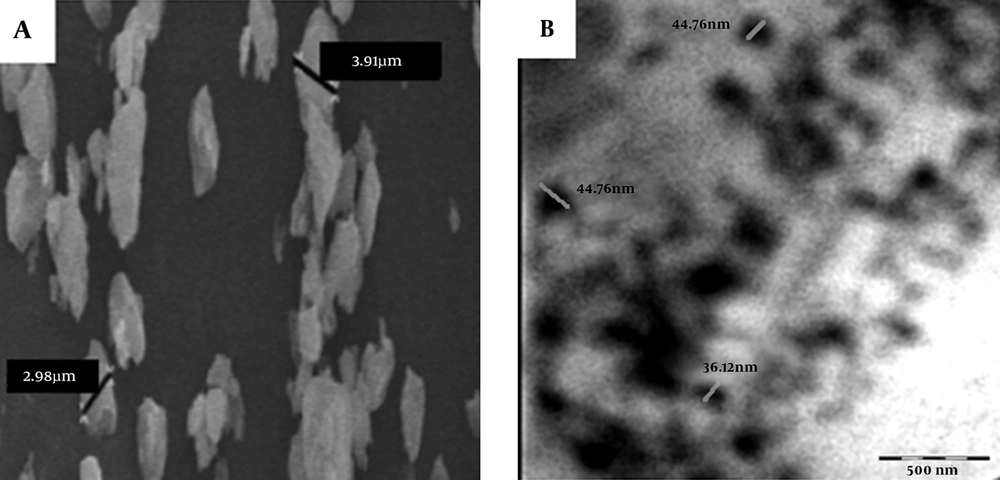
Figure 1.
The Image of Zeolite Particles Before and After Modification
The results from XRD pattern (Figure 2) showed that the zeolite sample was mainly composed of more than 80% clinoptilolite. Quartz and calcite were other components in the sample. Furthermore, XRF analysis showed that the zeolite sample contained 62.78% SiO2 and 9.02% Al2O3.The cation exchange capacity and the specific surface area of zeolite were 85 cmol (+) kg-1 and 34 m2 g-1, respectively. These results agree with a previous study about zeolites from the Semnan region of Iran (14).
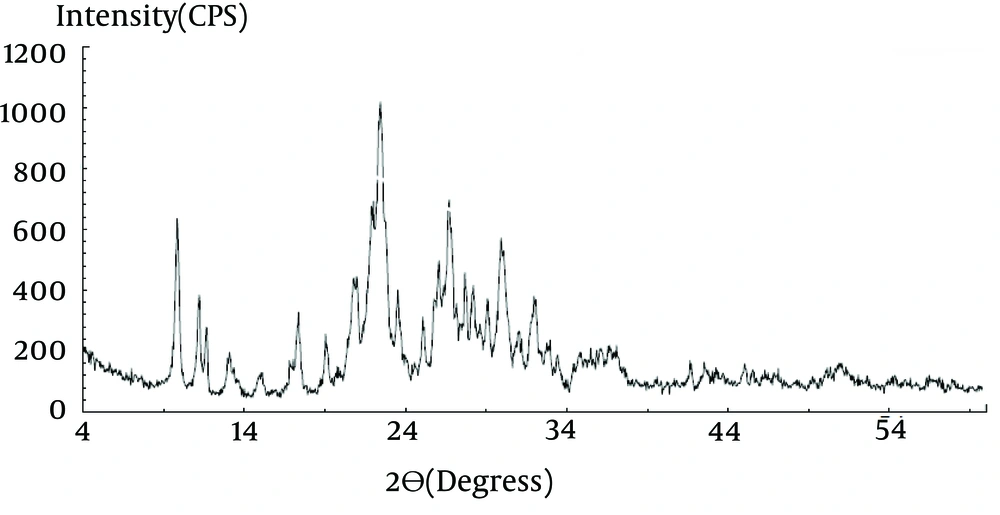
Figure 2.
The XRD Pattern of the Zeolite Sample
4.2. Box-Behnken Statistical Analysis
Analysis of variance (ANOVA) was used to determine the statistical significance of the independent variables and their interactions. The second-order polynomial coefficients and statistical parameters were obtained using the Minitab 17 software. Furthermore, ANOVA for the quadratic model of ametryn removal and importance of each coefficient were specified by T and P-values, and are listed in Table 2. Multiple regression analysis of the experimental data gave the following equation with 95% confidence:
Table 2.
Analysis of Variance for the Response Surface Reduced Quadratic Modela
| Term | Coefficient | SE Coefficient | T-Value | P-Value |
|---|---|---|---|---|
| Constant | 21.17 | 2.64 | 8.02 | 0.000 |
| X1 | -10.86 | 1.62 | -6.72 | 0.001 |
| X2 | 2.37 | 1.62 | 1.47 | 0.202 |
| X3 | 11.94 | 1.62 | 7.39 | 0.001 |
| X1 X1 | 1.45 | 2.38 | 0.61 | 0.569 |
| X2 X2 | 0.06 | 2.38 | 0.03 | 0.980 |
| X3 X3 | 2.27 | 2.38 | 0.96 | 0.383 |
| X1 X2 | -0.65 | 2.29 | -0.28 | 0.787 |
| X1 X3 | -5.79 | 2.29 | -2.53 | 0.049 |
| X2 X3 | 2.27 | 2.29 | 0.99 | 0.366 |
aX1, X2 and X3 are the pH, temperature and the amount of adsorbent.
Where Y is the removal percentage of ametryn, and as mentioned above X1, X2 and X3 are the pH, temperature and the amount of adsorbent. Regarding the P values (Table 2), the variables with the highest effects on ametryn removal efficiency were pH (P = 0.001) and amount of adsorbent (P = 0.001), while the temperature (P = 0.202) showed the lowest effect on ametryn removal efficiency. The F value of 12.29 and P > f value 0.006 implies that the model was significant (21). The results from the ANOVA revealed that the interaction effects of parameters were statistically significant (P < 0.05), except for temperature (P = 0.202); the interaction effect of pH and temperature (P = 0.787) and the interaction effect of temperature and amount of adsorbent (P = 0.366). The final predicted mathematical model in terms of significance of actual variables for ametryn removal (Y) by the zeolite nanoparticles is given below:
The regression coefficient for the model showed the goodness of fit of the model (R = 0.9568) and only about 4.32% of variation could not be explained by the model. The adjusted R of 0.8789 had reasonable agreement with the model. The maximum removal of ametryn was 57.91%.
4.3. Effect of Parameters on Ametryn Removal
Contour plots can show the contour lines of independent parameters that have the same response value Y. The contour plots of each variable against the rest of the experimental factors demonstrate the relationship of that variable with another factor in a constant value of a third variable. In all of the experiments, one factor was kept constant while the two others were changed. The main factors, which could affect the removal of ametryn by zeolite nanoparticles, were pH, temperature, and the amount of adsorbent. Based on BBD, the optimum values for independent variables of pH, temperature and amount of adsorbent were 6, 45°C and 2 g, respectively.
4.3.1. The Effect of pH
In order to investigate the effect of pH on adsorption capacity of zeolite for removal of ametryn, experiments were performed at different pH values ranging from 6 to 8. According to the results of this study, pH had effect on the surface charge of the sorbent in the solution. The ametryn adsorption capacity of zeolite nanoparticles increased with decreasing pH, and maximum adsorption efficiency was observed when the pH of the solution was 6. At pH 6, the strong adsorption can be explained by interactions between the N atoms of ametryn and functional aluminol/silanol groups of zeolite nanoparticles or hydrogen bonding between oxygen atoms of zeolite and ametryn. The combined effects of pH with temperature and amount of adsorbent are shown in Figure 3A and B. Figure 3 illustrates that the percentage of removal decreased, when pH was increased from 6 to 8, while the amount of zeolite and temperature levels were kept constant. Based on BBD, the highest uptake of ametryn should be at pH 6 as the optimum value. These results agree with a previous study about the removal of ametryn by soil containing wheat residue-derived char and wheat-residue-derived black carbon, which showed that the removal of ametryn increased under acidic conditions (2, 22, 23).
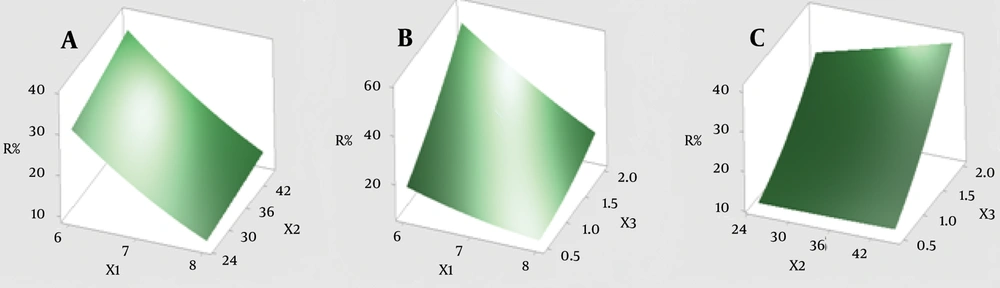
Figure 3.
A, Combined effect of x1 and x2; B, Combined effect of x1 and x3, and; C, Combined effect of x2 and x3.
4.3.2. Temperature
The influence of temperature on the adsorption of ametryn by zeolite nanoparticles was tested at temperatures ranging from 25°C to 45°C. Figure 3A and C show the combined effects of temperature, pH and adsorbent. The results show that when the temperaturewas increased, the removal percentage of ametryn also increased. Maximum removal of ametryn was at 43.3°C as the optimum value.
4.3.3. Adsorbent
It is obvious that the amount of adsorbent can play an important role in the adsorption process (24, 25). Figure 3B and C show the relationship between the amount of adsorbent with pH and temperature. The results showed that when the amount of adsorbent increased from 0.5 g to 2 g, while keeping the pH and temperature levels constant, the removal of ametryn increased. Based on BBD analysis, the optimum amount of adsorbent was 2 g. Therefore, when the amount of adsorbent increased, the number of adsorbent sites, functional groups and adsorption capacity also increased in the solution. Other studies have also shown that the adsorption capacity increases when the amount of adsorbent is increased (26-28).
4.4. Kinetic Studies
Contact time is an important parameter, which can influence the adsorption kinetics of an adsorbent (29-31). The effect of contact time on the adsorption of ametryn under optimal conditions (pH 6, temperature 45°C and the amount of adsorbent being 2 g) was studied. To describe the process of ametryn removal, three kinetic models including pseudo first-order, pseudo second-order, and intra-particle diffusion were evaluated to verify the kinetic mechanisms of adsorption. Equation 5 represents the pseudo first-order kinetic model:
Where k1 (1/minute) is the pseudo first-order rate constant of adsorption, t is the reaction time (minutes), qe and qt represent the adsorption capacity at equilibrium and time T (mg/g). The qt was calculated using the following equation:
Where C0 and Ce (mg/L) are the initial and equilibrium concentrations of ametryn in a solution. V is the volume of the solution (L) and w is the mass of adsorbent used (g).
The pseudo-second order model is presented by the following formula:
Where K2 (g/mg/min) is the rate constant of the pseudo second-order model. The intra-particle diffusion model is presented by the following formula:
Where kp (g/mg/min 1/2) is the intra-particle diffusion rate constant and c is the intercept.
Comparing the results of the kinetics models reveals that the pseudo-second-order model has the best agreement with the experimental data. The plot of t/qt against t (Figure 4) yielded a very good straight line and correlation coefficient (R = 0.9988). These results suggest that the adsorption capacity of ametryn is proportional to the number of active sites occupied on zeolite nanoparticles. The results showed that the adsorption rate was high at 10 minute (50.66% of the ametryn was adsorbed), yet after 120 minutes the ametryn adsorption rate of 64.12% under equilibrium conditions is no longer reached. The reason for this rapid adsorption was due to surface absorption between ametryn and surface functional groups of zeolite nanoparticles. These results are consistent with a previous study (2).
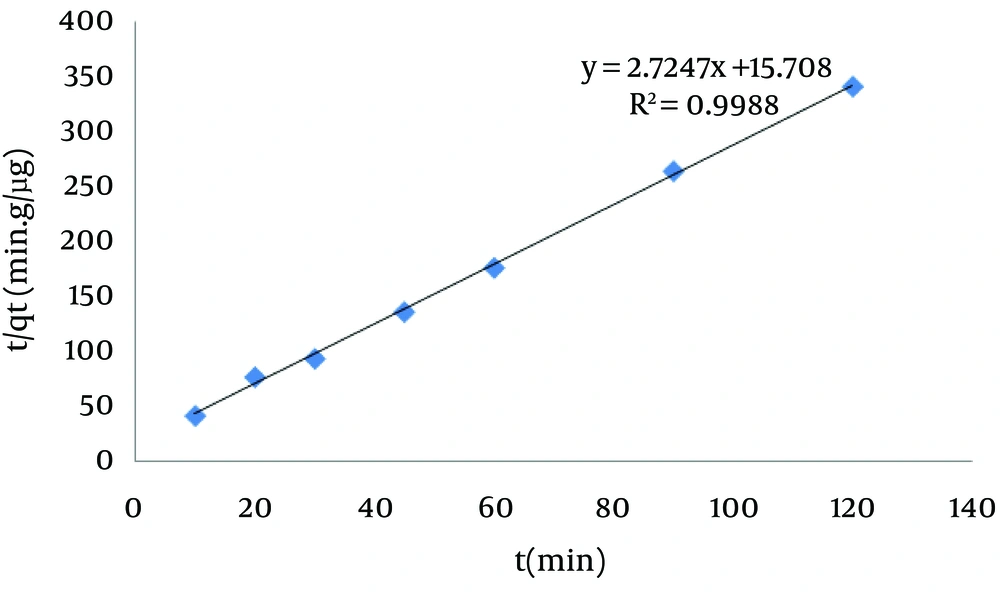
Figure 4.
Amount of adsorbent = 2 g; temperature= 45°C and pH = 6..
4.5. Adsorption Isotherms
The relationship between ametryn concentration and the amounts of adsorbed ametryn onto zeolite nanoparticles was studied with the Langmuir and Freundlich isotherm models. The Langmuir isotherm model predicts the maximum monolayer adsorption capacity of the adsorbent (32, 33). The Langmuir isotherm equation is as follows:
Where qe (mg/g) is the adsorption capacity of the adsorbent at equilibrium time, Ce (mg/L) is the equilibrium concentration of ametryn, qmax (mg/g) is the maximum adsorption capacity and b (L/mg) is the Langmuir constant. The Freundlich isotherm equation in linearized form is follows:
Where qe and Ce have the same definitions as the Langmuir equation. K (mg/g) is related to the adsorption capacity and 1/n (L/mg) is the energy of adsorption. If the value of n is between one and three, the effectiveness of adsorption is indicated. To study the adsorption capacity of zeolite nanoparticles towards ametryn, initial ametryn concentrations of 6.25, 12.5, 25, 50, 75 and 100 ppb under optimal conditions (pH 6, 2 g of adsorbent, temperature of 43.3°C and time of 45 minutes) were examined. The correlation coefficients for the Langmuir and Freundlich isotherms were 0.8786 and 0.9703, which indicate that the adsorption of ametryn onto zeolite nanoparticles can be better explained by the Freundlich model. The value of n (2.2), between one and three, and the value of K (0.18 mg/g) indicated good adsorption of ametryn onto zeolite nanoparticles. A previous study about adsorption of ametryn by Kishon river sediments and by Brazilian soil showed that the adsorption of ametryn model was Freundlich (34, 35).
5. Discussion
In this study the feasibility of zeolite as a low-cost adsorbent for the removal of ametryn from aqueous solution was investigated. The Box-Behnken statistical experiment design was used to show the removal process of ametryn by zeolite nanoparticles. The optimum conditions for maximum ametryn removal were pH 6, temperature of 43.3°C and adsorbent amount of 2 g. Kinetic studies have shown that the adsorption of ametryn onto zeolite nanoparticles was a relatively rapid process and can be described with the pseudo-second-order model. Adsorption isotherm was well fitted to the Freundlich model. Findings of this study indicated that the surface of zeolite nanoparticles have a high density of active sites for ametryn uptake. The mechanism of removal of ametryn by zeolite nanoparticles is by surface adsorption and might be explained by interaction between N atoms of ametryn and Si of zeolite or hydrogen bonding between oxygen atoms in zeolite structure by ametryn. The results showed that Iranian zeolite from Semnan, with low cost and abundant availability has a good potential to be used as an adsorbent for removal of ametryn from water and water aqueous solutions.