
1. Context
Triple-negative breast cancer (TNBC) is defined by the lack of significant expression of estrogen and progesterone receptors and human epidermal growth factor receptor 2 (HER2). It accounts for approximately 15% - 20% of breast cancers and is associated with high histological grade, early recurrence, central nervous system metastasis, and limited endocrine or HER2-directed treatment options. Despite its classification as a single clinical entity, TNBC is biologically heterogeneous and includes tumors with distinct genomic alterations, immune landscapes, stromal compositions, and therapeutic vulnerabilities (1-3).
Inflammation is increasingly recognized as a major driver of TNBC progression. In this context, inflammation should not be regarded solely as an acute host response to tissue injury. Rather, TNBC-associated inflammation is a dynamic network involving tumor cells, infiltrating leukocytes, cancer-associated fibroblasts, endothelial cells, extracellular matrix components, and soluble mediators. Cytokines, chemokines, lipid mediators, damage-associated molecular patterns, and inflammatory transcription factors collectively influence tumor growth, angiogenesis, invasion, metastasis, and treatment response (4-6). Triple-negative breast cancer may exhibit relatively high immunogenicity compared with several other breast cancer subtypes. This immunogenic phenotype is associated with genomic instability, increased mutational burden in a subset of tumors, expression of endogenous retroviral elements, and the presence of tumor-infiltrating lymphocytes (TILs). However, immune infiltration does not necessarily indicate effective antitumor immunity. In many TNBCs, the immune response is accompanied by T-cell exhaustion, defective antigen presentation, accumulation of regulatory and suppressive myeloid cells, and stromal exclusion of cytotoxic lymphocytes. Consequently, tumors may display an immune-inflamed phenotype while remaining functionally immunosuppressed (4-6).
The relationship between inflammation and immunity in TNBC is therefore complex. Inflammatory signals can promote the recruitment and activation of antitumor immune cells, but persistent or dysregulated inflammation may facilitate immune escape. The clinical relevance of this biology has become increasingly evident with the introduction of immune checkpoint inhibitors into TNBC treatment. Pembrolizumab combined with chemotherapy has improved outcomes in selected patients with early-stage or advanced TNBC, while the magnitude of benefit varies according to disease stage, PD-L1 status, treatment line, chemotherapy backbone, tumor burden, and the composition of the tumor microenvironment (7-9). These observations highlight the need for a more comprehensive understanding of the inflammatory and immune determinants of therapeutic response.
This review summarizes the molecular mechanisms underlying inflammation and immune dysregulation in TNBC, with emphasis on inflammatory signaling pathways, cellular components of the tumor microenvironment, biomarkers, immune escape, treatment resistance, and emerging therapeutic strategies.
2. Evidence Acquisition
This manuscript was prepared as a structured narrative review and evaluated using the Scale for the Assessment of Narrative Review Articles guidelines to ensure methodological validity, transparency, and comprehensive literature evaluation.
2.1. Search Strategy and Information Sources
A comprehensive literature search was conducted across international electronic databases, including PubMed/MEDLINE, Scopus, and Web of Science, and was supplemented by targeted searches in Google Scholar and ClinicalTrials.gov for recent ongoing or completed clinical trials. The search covered peer-reviewed articles published between January 2014 and August 2025. The search strategy combined controlled vocabulary, such as MeSH terms, with relevant free-text keywords: "triple-negative breast cancer" or "TNBC" AND ("inflammation" or "immune dysregulation" or "tumor microenvironment" or "TME (tumor microenvironment)" or "cytokine" or "chemokine" or "tumor-infiltrating lymphocytes" or "immunotherapy").
2.2. Eligibility Criteria and Study Selection
Eligible studies included original basic, translational, or clinical research involving human TNBC specimens, patient-derived models, or validated preclinical models; prospective and retrospective clinical trials focusing on immune-inflammatory pathways and immune checkpoint blockade; and landmark consensus guidelines and high-impact systematic reviews. Studies were excluded if they were unrelated to TNBC biology; focused exclusively on nonmalignant inflammatory breast conditions; lacked accessible full texts, robust mechanistic validation, or sufficient methodological transparency; or were duplicate reports or non-peer-reviewed conference abstracts.
3. Results
3.1. Literature Search
The initial electronic search of PubMed/MEDLINE, Scopus, Web of Science, and Google Scholar identified 428 records. After 112 duplicate entries were removed, 316 papers underwent title and abstract screening. Of these, 264 records were excluded because they were off-topic, focused on nonmalignant conditions, or lacked sufficient mechanistic data. The remaining 52 full-text articles were assessed for eligibility; 21 were excluded because of insufficient methodological transparency or duplicate cohorts. Finally, 31 studies met all inclusion criteria and were included in this narrative review for qualitative thematic synthesis.
3.2. Inflammatory Biology of Triple-Negative Breast Cancer
3.2.1. Tumor-Associated Inflammation as a Biological Continuum
The inflammatory microenvironment of TNBC is shaped by reciprocal interactions between malignant cells and the surrounding stromal and immune components. Tumor cells can release chemokines, cytokines, extracellular vesicles, and damage-associated molecular patterns that recruit myeloid cells and alter lymphocyte activity (10-13). In turn, infiltrating immune cells produce mediators that support tumor survival, angiogenesis, invasion, and immune evasion (11-14). Necrotic tumor areas, hypoxia, metabolic stress, and treatment-induced cell death can further amplify inflammatory signaling. The release of extracellular ATP, high-mobility group box 1 protein, mitochondrial DNA, and other damage-associated signals activates pattern-recognition receptors and innate immune pathways (12, 13). Depending on the cellular context and duration of activation, these responses may promote either immunogenic tumor destruction or chronic tumor-supportive inflammation (12-14). Triple-negative breast tumors can therefore be categorized along an immune continuum ranging from immune-desert tumors with minimal lymphocytic infiltration to immune-inflamed tumors with abundant TILs and active interferon signaling (11, 14). An intermediate immune-excluded phenotype is characterized by immune cells in the surrounding stroma but limited penetration into tumor nests (11). This spatial organization is particularly important because the functional effect of immune infiltration depends not only on the number of immune cells but also on their location, phenotype, activation state, and interaction with stromal barriers (11, 14).
3.2.2. NF-κB Signaling
Nuclear factor-kappa B (NF-κB) is a central regulator of inflammation in TNBC. It can be activated by TNF-α, IL-1β, Toll-like receptor signaling, oxidative stress, DNA damage, and oncogenic pathways. Upon activation, NF-κB induces the transcription of genes involved in cytokine production, cell survival, angiogenesis, invasion, and resistance to apoptosis (15-17).
Persistent NF-κB activation has been associated with increased expression of IL-6, IL-8, CCL2, COX-2, and other inflammatory mediators. These factors may facilitate recruitment of macrophages and myeloid-derived suppressor cells (MDSCs), promote cancer-associated fibroblast activation, and enhance epithelial-mesenchymal transition (EMT) (16-19). Nuclear factor-kappa B also interacts with hypoxia-inducible factors and STAT3, creating a self-reinforcing inflammatory circuit (17, 19, 20). NF-κB signaling may have both tumor-promoting and antitumor effects. Transient activation in immune cells can support innate immune responses, whereas sustained activation in tumor and stromal cells may support tumor growth and immune suppression (15, 17, 20). This context dependence represents a major challenge for the clinical development of NF-κB-directed therapies (15, 17).
3.2.3. IL-6/JAK/STAT3 Signaling
The IL-6/JAK/STAT3 axis is frequently dysregulated in aggressive breast cancers, including TNBC. Binding of IL-6 to its receptor activates Janus kinases and induces STAT3 phosphorylation. Activated STAT3 translocates to the nucleus and regulates genes involved in proliferation, survival, stemness, angiogenesis, and immune suppression (19, 21, 22).
Activation of STAT3 in tumor cells can increase resistance to chemotherapy and support cancer stem-cell characteristics. In immune cells, persistent STAT3 activity can inhibit dendritic-cell maturation, promote MDSC expansion, and contribute to an immunosuppressive macrophage phenotype (19-24). IL-6 and STAT3 may also suppress effective T-cell responses by promoting the expression of inhibitory molecules and reducing the production of antitumor cytokines (19, 23, 24). The IL-6/JAK/STAT3 pathway is closely connected with NF-κB signaling. NF-κB can induce IL-6 expression, whereas IL-6/STAT3 activity can sustain inflammatory gene expression and stabilize tumor-promoting cell states (22, 25). This reciprocal interaction suggests that simultaneous targeting of multiple inflammatory nodes may be more effective than inhibiting a single mediator (19, 22, 25).
3.3. Importance of Inflammatory Signaling Pathways in the Treatment of Triple-Negative Breast Cancer
Inflammatory signaling is increasingly recognized as a therapeutic determinant in breast cancer. Because TNBC lacks established endocrine and HER2-directed targets, treatment strategies largely depend on chemotherapy, immunotherapy, antibody-drug conjugates, and agents targeting DNA-damage response pathways. The efficacy of these treatments is strongly influenced by the inflammatory and immune composition of the tumor microenvironment. Inflammatory pathways regulate antigen presentation, T-cell recruitment, EMT, and metastatic dissemination (7, 14, 15).
The clinical benefit of immune-checkpoint blockade provides direct evidence for the therapeutic importance of tumor-associated inflammation in TNBC. In early-stage TNBC, adding pembrolizumab to neoadjuvant chemotherapy, followed by adjuvant pembrolizumab, significantly improved pathological complete response and event-free survival compared with chemotherapy alone (7, 8). Long-term follow-up also demonstrated an overall survival benefit, supporting the incorporation of immunotherapy into the treatment of high-risk early TNBC (26). These findings suggest that chemotherapy may not only exert direct cytotoxic effects but also enhance antitumor immunity through increased antigen release, immunogenic cell death, and remodeling of the tumor microenvironment.
In advanced TNBC, the benefit of pembrolizumab plus chemotherapy is particularly evident in tumors with higher PD-L1 expression, assessed using the combined positive score (CPS). In the KEYNOTE-355 trial, pembrolizumab combined with chemotherapy improved progression-free and overall survival in patients with PD-L1-positive disease, especially those with a PD-L1 CPS of at least 10 (27). This observation emphasizes that inflammatory and immune biomarkers can help identify patients most likely to benefit from immune-checkpoint inhibition. However, PD-L1 expression alone is insufficient to capture the complexity of the inflammatory tumor microenvironment, and its predictive value may vary according to assay, disease stage, treatment line, and chemotherapy partner. Several critical limitations characterize the reviewed literature.
3.3.1. Methodological Inconsistencies in Biomarker Quantification
Substantial heterogeneity across platforms, antibody clones, and scoring cutoffs, such as CPS, tumor proportion score, and immune cell (IC) scoring, for PD-L1 and stromal TIL assessments confounds direct cross-study comparisons.
3.3.2. Single-Target Mechanistic Paradigms
Most preclinical evaluations have explored the isolated pharmacological inhibition of single nodes using dedicated inhibitors, such as STAT3 or NF-κB inhibitors. Given the substantial biological redundancy and crosstalk governing inflammatory signaling networks, single-agent pathway blockade routinely triggers rapid compensatory feedback activation in alternative survival pathways.
Conventional two-dimensional in vitro assays and immunodeficient xenograft models fail to replicate the dense, physically protective extracellular matrix and complex stromal architecture involving cancer-associated fibroblasts that characterize the immune-excluded phenotype observed in human clinical biopsies.
4. Conclusions
Triple-negative breast cancer is a heterogeneous malignancy in which chronic inflammation and immune dysregulation promote tumor progression, metastasis, and resistance to therapy. Activation of NF-κB, IL-6/JAK/STAT3, COX-2/PGE2, and TGF-β pathways supports tumor-cell survival and EMT while suppressing effective antitumor immunity. KRT-related molecular programs may further reflect tumor heterogeneity, plasticity, and aggressive behavior. Although immune-checkpoint inhibitors have improved outcomes in selected patients, PD-L1 expression and TILs alone are insufficient for precise patient selection. Future progress will require integrated, biomarker-guided combination strategies targeting inflammatory signaling, immune suppression, and tumor-cell vulnerabilities to convert immune-resistant TNBC into a more treatment-responsive disease. Figure 1 summarizes the inflammatory tumor microenvironment in triple-negative breast cancer, highlighting mechanisms of immune dysregulation and potential therapeutic strategies and biomarkers.
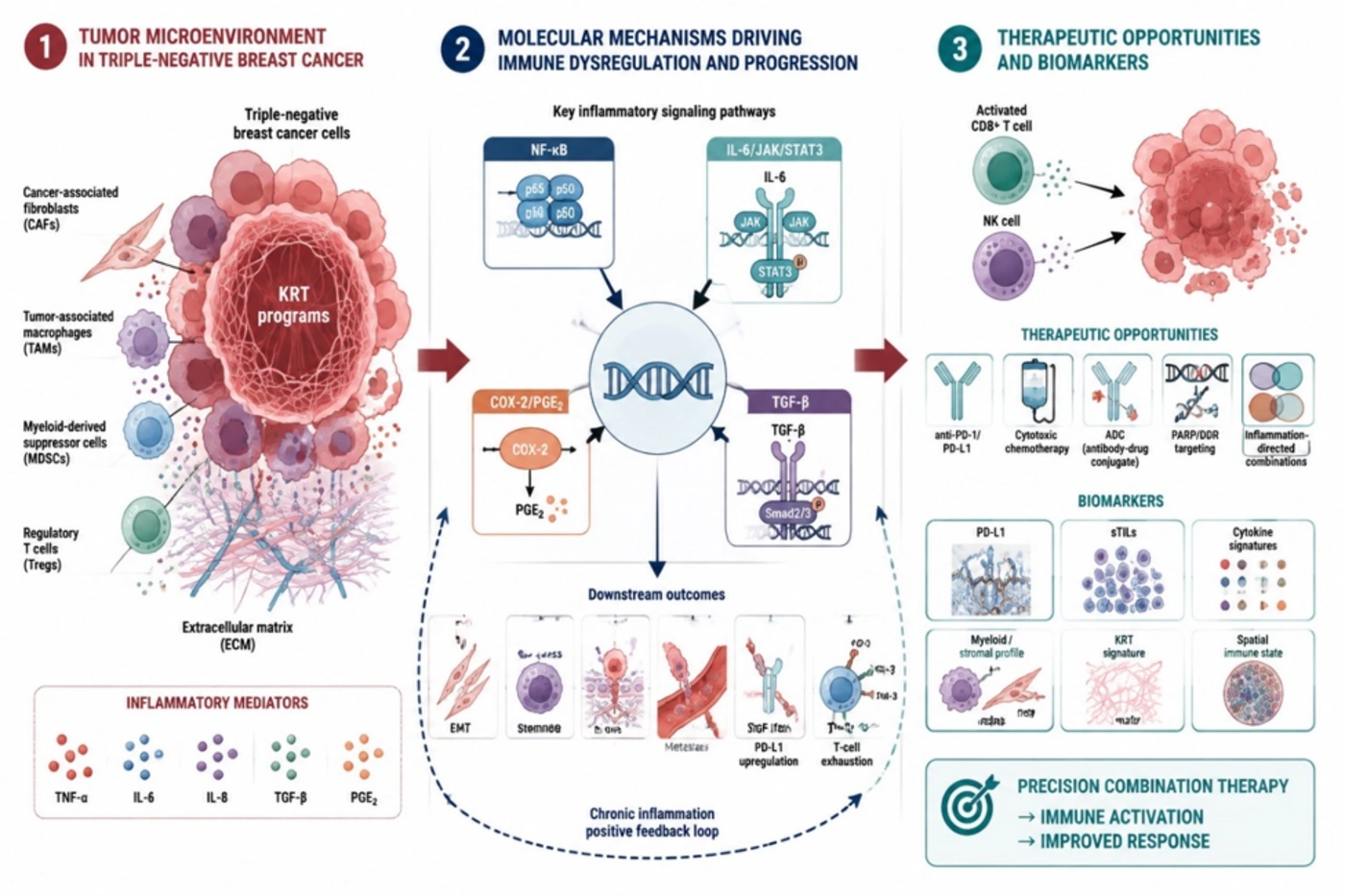
Figure 1.
Inflammatory signaling, immune dysregulation, and potential therapeutic strategies and biomarkers in triple-negative breast cancer.