
1. Background
Mental health problems are major risk factors for both morbidity and mortality, so that, for example, nearly one-third of the US adult population suffers from mental health disorders (1), and it is the third leading cause of death in the world. Based on the World Health Organization (WHO) report, the prevalence of hypertension was 33.44 per 100,000 population in Iran, ranking 67th in the world. Moreover, based on the national reports, 17.5% of Iranians aged 15 to 64 were suffering from hypertension in this year (2).
Death anxiety is a common issue in all societies that negatively affects our intellectual security (3). Fear of death is an emotional feeling that stimulates psychological stress (4). As an inevitable, unknown biological reality, death causes severe stress, particularly among elders (5). Hence, due to our instinct thinking about death is unavoidable. However, suffering from a chronic disease or spending the last days of life bring us back to the idea of death, which in turn causes more fear (6).
Cognitive emotion regulation (CER) is a psychological problem that causes death anxiety. CER strategies contain a set of conscious and unconscious cognitive and behavioral strategies that can reduce, maintain, or raise a particular emotion. People use various emotional strategies to cope with emotional experiences (7). Domaradzka and Fajkowska (8) reported that adaptive CER strategies were inversely associated with anxiety and depression. Moreover, the authors found a direct association between maladaptive CER strategies and anxiety and depression (8).
Another study conducted on diabetic patients reported that positive CER strategies had a diverse and significant relationship with anxiety, while negative CER strategies were negatively associated with anxiety (9). A study reported that mindfulness and CER strategies have important roles in decreasing stress among people with hypertension, which indicates the significance of attention to these factors in treating such patients (10). Cognitive flexibility is another factor that contributes to death anxiety. Psychological flexibility means communicating the present moment in order to adapt/persist on behaviors in the service of chosen values (11), which requires interacting with the present moment and the ability to distinguish oneself from inner thoughts and experiences (12). Flexible people are always curious about the inner and outer world and do not afraid of confronting new experiences (13). The abilities to understand difficult situations as manageable, substitute multiple justifications for life events, and create alternatives to hard situations are features of cognitive flexibility that allow the person to face emotional and social challenges properly (14). Studies (15) have shown that more cognitively flexibility individuals can better cope with the disease and adapt to pain, as well. For example, Safari Mousavi et al. (16) reported that cognitive flexibility and adaptive and maladaptive CER strategies were significantly correlated with depression, anxiety, and stress. In other words, those who are more cognitively flexible and use efficient emotion regulation strategies are optimistic about their problems, accept problems (instead of eliminating), respond appropriately to their surroundings, and move toward their values (16). Distress tolerance is defined as a meta-emotional construct that includes a person’s ability to tolerate, evaluate, and accept negative emotional experiences (17). As distress tolerance is associated with depression and anxiety, it can be examined by symptoms of these disorders. The most common symptoms include insomnia, headache, and fatigue, which can disrupt a person’s daily life (18). Moreover, people with low distress tolerance react more strongly to stress and anxiety compared to others (19). Several studies have emphasized the role of distress tolerance in the emergence of mental disorders (20). Low levels of distress tolerance are associated with increased risk for substance abuse disorders, medicine abuse, binge eating symptoms, and post-traumatic stress symptoms (21). Another study found that distress tolerance is associated with social anxiety disorder, generalized anxiety disorder, and obsessive-compulsive disorder (22). Onyedibe et al. (23) showed that distress tolerance is a significant predictor of hypertension. Although, they found that the level of distress tolerance is inversely associated with the risk of hypertension emergence.
Based on the literature, CER, cognitive flexibility, and distress tolerance play important roles in anxiety disorders. Although this association is investigated by several studies, according to the best knowledge of the authors, no study has examined the impact of these variables on death anxiety yet.
2. Objectives
Hypertension has a high prevalence in the general population of Iran. Since women are at increased risk of dying from hypertension (in Iran, 60% of hypertension-related deaths occur in women (24)) and due to their critical role in society, the current study aimed to assess the relationships between cognitive emotion regulation strategies, cognitive flexibility, and distress tolerance and death anxiety among women with hypertension.
3. Methods
3.1. Research Methods, Statistical Population, and Sample
This is a descriptive correlational study that was conducted on women with hypertension admitted to the hospitals in the city of Rasht in 2018. In total, 150 women were selected using the convenience sampling method. The sample size was calculated using the method used by Gall et al. (25), which selected 15 participants per each variable. The current study had four variables; therefore, the sample size 60 subjects was sufficient. Additionally, according to the formula proposed by Tabachnick et al. (26), i.e., n = 50 + 8. M, 82 subjects were sufficient for the present study. However, the sample size was increased to account for the attrition or loss to follow up. After admitting to the hospital, the objectives of the study were explaining to the eligible patients, and then if they were agreeing, patients were asked to fill the questionnaires. The authors did their best to follow the Declaration of Helsinki on ethical principles (27). Ethical considerations were respected, including patients’ confidentiality, obtaining informed consent, explaining participants about objectives of the study, respecting patients’ willingness to drop out any time, and confidentiality of data. Inclusion criteria were having a systolic hypertension above 140 and diastolic hypertension above 90, being female, being aged 30 to 60 years, having at least elementary school education, and having no background disease. Exclusion criteria were suffering from pain and discomfort, not willing to participate in the study, and having mental disorders (according to the subject’s statements or medications).
3.2. Questionnaires
3.2.1. The Death Anxiety Scale
This scale was designed by Templer in 1970. The DAS consists of 15 yes (1) - no (0) statements that should be answered using a five-point Likert scale with the anchors 1 (“strongly disagree”) to 5 (“strongly agree”) with a high score of 8, which indicates a high level of anxiety. Its construct validity was confirmed using the factor analysis method. To assess the reliability of the Death Anxiety scale (DAS), the test-retest method was used, which produced a correlation coefficient of 0.83 (28). Gholami et al. (29) reported a Cronbach’s alpha coefficient of 0.81 for this scale.
3.2.2. The Distress Tolerance Scale
The Distress Tolerance scale (DTS) (developed by Simmons and Gaher) is a 15-item scale composed of 4 subscales, namely: tolerance (1, 3, and 5), absorption (2, 4, and 15), appraisal (6, 7, 9, 10, and 12), and regulation (8, 13, and 14). Its scoring system is based on a five-point Likert-type scale, anchors 1 (“strongly agree”) to 5 (“strongly disagree”). One item (item number six) is reverse scored. Alpha coefficients of tolerance, absorption, appraisal, regulation, and the whole scale were 0.72, 0.82, 0.78, 0.70, and 0.82, respectively (30). Esmaeilinasab et al. (31) reported a Cronbach’s alpha of 0.67 for this scale. Its validity is assessed using the test-retest method, which produced a correlation coefficient of 0.81 for the whole scale as well as 0.71, 0.69, 0.77, and 0.73 for tolerance, absorption, appraisal, and regulation subscales, respectively.
3.2.3. The Cognitive Flexibility Inventory
It’s developed by Vander Wal and Dennis in 2010 and consists of 20 items. the cognitive flexibility inventory (CFI) is based on a seven-point Likert-type scale, ranging from 1 (“strongly disagree”) to 7 (“strongly agree”). The total score ranges from 20 to 140. Items 2, 4, 7, 9, 11, and 17 are reverse scored. The CFI has 3 subscales, namely controllability, alternatives, and behavioral justification (32). Its psychometric characteristics are investigated by Shareh et al. in an Iranian sample (33). The test-retest was used to assess the reliability, which produced correlation coefficients of 0.71, 0.72, 0.55, and 0.57 for the whole inventory, controllability, alternatives, and behavioral justification, respectively. In the present study, the Cronbach’s alpha coefficients were 0.90, 0.89, 0.87, and 0.55 for the whole inventory, controllability, alternatives, and behavioral justification, respectively.
3.2.4. The Cognitive Emotion Regulation Questionnaire
The Cognitive Emotion Regulation questionnaire (CERQ) consists of 18 items and 9 subscales. Responses are given based on a five-point Likert-type scale ranging from 1 (almost never) to 5 (almost always). Dimensions of the CERQ are as follows: putting into perspective, positive refocusing, positive reappraisal, acceptance, and refocus on planning are adaptive strategies and self-blame, other-blame, rumination, and catastrophizing. The CERQ should only be used for those aged 12 or higher, whether healthy or sick (34). In Iran, Hasani (35) evaluated its psychometric properties, and Cronbach's alpha coefficients were ranging from 0.68 to 0.82. Therefore, it had a favorable validity.
3.3. Statistical Analyses
Data were analyzed by SPSS using both descriptive (means and standard deviation) and inferential (the Pearson correlation coefficient and stepwise regression analysis) statistics.
4. Results
Demographic information of participants are shown in Table 1. Twenty one (14%) had elementary school degree, 37 (24.7%) middle school degree, 62 (41.3%) high school degree and diploma, and 30 (20%) had a university degree. Concerning the marital status, 16 (10.7%) were single, 112 (74.7%) married, 32 (21.3%) widow, and 2 (1.3%) divorced.
Table 1.
The Demographic Information Related to the Subjects Studieda
| Demographic Variable | Feature | Values |
|---|---|---|
| Education | Elementary school | 21 (14) |
| Middle school | 37 (24.7) | |
| High school and diploma | 62 (41.3) | |
| University degrees | 30 (20) | |
| Marital status | Single | 16 (10.7) |
| Married | 112 (74.7) | |
| Widow | 20 (13.3) | |
| Divorced | 2 (1.3) | |
| Occupation | Housewife | 71 (47.3) |
| Employee | 32 (21.3) | |
| Self-employed | 37 (24.7) | |
| Others | 10 (6.7) | |
| Age | Age range | 30 - 60 |
| Mean age | 42.23 | |
| Standard deviation | 7.97 |
aValues are expressed as No. (%).
In terms of occupation, 71 (47.3%) were housewives, 32 (21.3%) had a job, and 37 (24.7%) were self-employed. The youngest and oldest participants were 30 to 60 years, respectively. The mean age of participants was 42.23 years, with a standard deviation of 7.97.
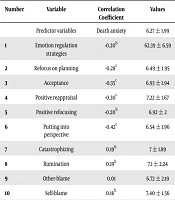
According to Table 2, the Pearson correlation coefficient indicated that emotion regulation strategies had a diverse significant relationship with death anxiety (r = -0.20). Among its adaptive subscales, refocus on planning (r = -0.28), acceptance (r = -0.35), positive reappraisal (r = -0.20), and putting into perspective (r = -0.42) had diverse significant relationships with death anxiety. Moreover, among its maladaptive subscales, catastrophizing (r = 0.19), rumination (r = 0.19), and self-blame (r = 0.16) had direct significant correlations with death anxiety. Other-blame was not significantly associated with death anxiety (r = 0.01). Besides, cognitive flexibility (r = 0.61), in general, and its subscales, i.e., controllability (r = -0.21), alternatives (r = -0.44), and behavioral justification (r = -0.23) had diverse significant relationships with death anxiety. The mean scores and standard deviations are shown in Table 2.
Table 2.
The Means, Standard Deviations, and the Pearson Correlation Coefficients of the Variablesa
| Number | Variable | Correlation Coefficient | Values |
|---|---|---|---|
| Predictor variables | Death anxiety | 6.27 ± 1.99 | |
| 1 | Emotion regulation strategies | -0.20b | 62.39 ± 6.59 |
| 2 | Refocus on planning | -0.28c | 6.49 ± 1.95 |
| 3 | Acceptance | -0.35c | 6.93 ± 1.94 |
| 4 | Positive reappraisal | -0.30c | 7.22 ± 1.67 |
| 5 | Positive refocusing | -0.20b | 6.92 ± 2 |
| 6 | Putting into perspective | -0.42c | 6.54 ± 1.96 |
| 7 | Catastrophizing | 0.19b | 7 ± 1.89 |
| 8 | Rumination | 0.19b | 7.1 ± 2.24 |
| 9 | Other-blame | 0.01 | 6.72 ± 2.19 |
| 10 | Self-blame | 0.16b | 7.40 ± 1.56 |
| 11 | Cognitive flexibility | -0.61c | 79.34 ± 22.26 |
| 12 | Controllability | -0.21c | 30 ± 7.33 |
| 13 | Alternatives | -0.44c | 47.30 ± 6.92 |
| 14 | Behavioral justification | -0.23c | 9.12 ± 2.82 |
| 15 | Overall distress tolerance | -0.21b | 38.64 ± 6.15 |
| 16 | Tolerance | -0.18b | 7.27 ± 1.41 |
| 17 | Absorption | 0.52c | 8 ± 1.74 |
| 18 | Appraisal | -0.15b | 15.56 ± 3.90 |
| 19 | Regulation | -0.17b | 7.62 ± 1.72 |
aValues are expressed as mean ± SD.
bSignificant at 0.05.
cSignificant at 0.01.
As shown in Table 2, distress tolerance (r = -0.21) had a diverse significant relationship with death anxiety. Among its subscales, tolerance (r = -0.18), appraisal (R = -0.15), and regulation (r = -0.17) had diverse significant correlations with death anxiety; however, absorption (r = 0.52) had a direct significant relationship with death anxiety. The stepwise regression analysis was used to examine the role of each predictor variable and its subscales in explaining the variance of the criterion variable (death anxiety). Before conducting this analysis, its assumptions were investigated.
According to Table 3, almost all variables’ skewness and kurtosis scores were in the range of +2 to -2; hence, the data distribution was normal. Furthermore, the tolerance index of the predictor variable and the variance inflation factor were both greater than 0.1 and smaller than 10; therefore, we did not violate the assumption of multicollinearity (28). Accordingly, the regression analysis was performed.
Table 3.
The Results of the Normality Tests
| Variable | Skewness | Kurtosis | Tolerance | Based on the VIF |
|---|---|---|---|---|
| Death anxiety | -0.72 | 0.42 | ||
| Emotion regulation strategies | -0.59 | 0.00 | 0.41 | 2.40 |
| Refocus on planning | -0.62 | -0.06 | 0.96 | 1.03 |
| Acceptance | -0.46 | -0.53 | 0.89 | 1.12 |
| Positive reappraisal | -0.59 | 0.14 | 0.32 | 3 |
| Positive refocusing | -1 | -0.17 | 0.92 | 1.07 |
| Putting into perspective | -0.46 | -0.67 | 0.89 | 1.12 |
| Catastrophizing | -0.60 | -0.34 | 0.67 | 1.49 |
| Rumination | -1 | -0.40 | 0.96 | 1 |
| Other-blame | -1 | -0.54 | 0.61 | 1.62 |
| Self-blame | -0.52 | -0.03 | 0.40 | 2.48 |
| Cognitive flexibility | 3 | -2 | 1 | 1 |
| Controllability | -0.20 | 0.07 | 0.87 | 1.13 |
| Alternatives | -1 | 0.00 | 0.58 | 1.70 |
| Behavioral justification | -0.91 | -0.17 | 0.97 | 1 |
| Overall score of distress tolerance | -0.61 | -0.29 | 0.10 | 9.84 |
| Tolerance | 0.34 | 0.48 | 0.60 | 1.64 |
| Absorption | -0.90 | 0.31 | 0.83 | 1.19 |
| Appraisal | -0.85 | 0.28 | 0.63 | 1.56 |
| Regulation | -0.71 | 0.39 | 0.86 | 1.16 |
According to Table 4, the results of the stepwise multivariate regression analysis showed that when predicting death anxiety via emotion regulation strategies, cognitive flexibility, and distress tolerance, in the first step, overall cognitive flexibility, rumination, absorption, refocus on planning, positive refocusing, alternatives, catastrophizing, positive reappraisal, and distress tolerance, respectively, entered the equation and could explain 71% of the variance in death anxiety (R2 = 0.71). Based on the significant level of the one-way analysis (F), the regression model was significant at all steps (P < 0.0005). Additionally, checking the variables’ standardized beta coefficients showed that overall cognitive flexibility had the strongest role in explaining death anxiety (beta = -0.67). The significance of the t value (P < 0.0005) a significant contribution.
Table 4.
The Results of the Stepwise Regression Analysis to Predict Death Anxiety via the Research Variables
| Step | Variable | R | R2 | Adjusted R2 | F | B | Beta | T | Sig |
|---|---|---|---|---|---|---|---|---|---|
| First | Overall cognitive flexibility | 0.61 | 0.38 | 0.37 | 92 | -0.05 | -0.61 | -5.59 | 0.0005 |
| Second | Rumination | 0.69 | 0.48 | 0.47 | 68.85 | 0.28 | 0.32 | 5.34 | 0.0005 |
| Third | Absorption | 0.74 | 0.55 | 0.54 | 61.40 | 0.34 | 0.29 | 4.95 | 0.0005 |
| Fourth | Refocus of planning | 0.78 | 0.61 | 0.60 | 58.29 | -0.25 | -0.24 | 4.71 | 0.0005 |
| Fifth | Positive refocusing | 0.79 | 0.63 | 0.62 | 50.62 | -0.14 | -0.15 | -2.87 | 0.0005 |
| Sixth | Alternatives | 0.81 | 0.66 | 0.65 | 47.54 | -0.06 | -0.22 | -3.50 | 0.001 |
| Seventh | Catastrophizing | 0.82 | 0.68 | 0.66 | 43.32 | 0.15 | 0.15 | 2.50 | 0.01 |
| Eighth | Positive reappraisal | 0.83 | 0.70 | 0.68 | 41.26 | -0.27 | -0.23 | 8.25 | 0.0005 |
| Ninth | Tolerance | 0.84 | 0.71 | 0.69 | 39.35 | 0.22 | 0.16 | 2.81 | 0.0005 |
5. Discussion
Based on the findings, CER strategies had significant and diverse associations with death anxiety. Moreover, refocus on planning, acceptance, positive reappraisal, and putting into perspective (adaptive strategies) had diverse significant relationships with death anxiety, catastrophizing, rumination, and self-blame (maladaptive strategies) had significant direct correlations with death anxiety. These findings are consistent results reported by some of the previous studies (6, 7, 36, 37) and inconsistent with others, for example, the study by Zare and Solgi (38). The observed discrepancy can be attributed to factors such as using different sample sizes or characteristics of participants. For example, Zare and Solgi (38) study has investigated university students with lower levels of exposure to stressful events, thoughts, and situations compared to the participants of the present study.
To explain these findings, it can be argued that when confronted with stressful situations, people who use positive strategies experience lower levels of anxiety. In other words, the negative association between adaptive cognitive regulation strategies and death anxiety can be attributed to the persons’ ability to change his/her view in the face of stressful events and paying attention to the positive and long-term outcomes, which in turn decreases the level of stress and helps the person to reframe the events to accept what cannot be controlled, which results in reduced stress. In contrast, those who employ negative strategies in stressful situations experience higher levels of anxiety, through hasty reactions, instead of using appropriate methods. The source of stress can be recognized by applying efficient emotion regulation strategies; that result in increased self-esteem and self-confidence as well as reduced anxiety and distress associated with hypertension (39).
The present study also showed that cognitive flexibility and its subscales had diverse and significant relationships with death anxiety. which is in line with the results of Ghodrati Mirkoohi et al. (40). To explain this finding, it can be argued that those with high anxiety think about the stressful situation as controllable events. Therefore, in the face of stressful events, such as thinking about death, they cannot come up with alternative positive thoughts to replace negative thoughts. Inflexible stylistics exacerbate the anxiety by creating biases in the reception of dysfunctional thoughts (41). In other words, those with flexible thinking can use appropriate justifications and accept challenging situations or stressful events, which in turn, causes experiencing less death anxiety compared to those with low flexibility (42).
Moreover, another important finding was the diverse significant relationship between distress tolerance and death anxiety. Among its subscales, tolerance, appraisal, and regulation had diverse significant relationships with death anxiety; however, absorption had a significant direct correlation. This finding is consistent with other studies (43). To explain this finding, it can be argued that when faced with a stressful situation, such as death, people interpret the negative emotions as if they will continue for a long time, are uncontrollable, will gradually exacerbate, and have no meanings. Besides, they think as the only ones who experience such emotions. On the other hand, they consider such events as intolerable (44). Not only negative emotions are important, but their interpretations and the applied strategies are also influential (45).
The current study had limitations, including only investigating women in the city of Rasht. Therefore, caution should be exercised when generalizing the results to other communities. Furthermore, cultural and ethnic issues also contribute to stressful events and how to deal with them. Also, the data were collected using self-report scales, which are prone to partiality because of unconscious defenses and bias in answering the items. Factors such as education, occupation, lifestyle, and levels of awareness, health information, and mental health literacy also affect the relationships between cognitive emotion regulation strategies, cognitive flexibility, and distress tolerance, and death anxiety.
5.1. Conclusions
This study revealed the significant impact of cognitive emotion regulation strategies, cognitive flexibility, and distress tolerance on the death anxiety in patients with hypertension. Death has always been an important concern of human beings, and thinking about it causes anxiety and stress, particularly for those with ill-health such as hypertension, which has psychological consequences. Therefore, the findings of the present study can be used by therapists to treat emotional and anxiety disorders. The authors recommend applying the aforementioned strategies to improve CER strategies, cognitive flexibility, and distress tolerance in women with hypertension. Besides, such skills can be transferred to patients through courses and workshops. Also, investigating the research hypothesis in practice in future studies would be useful. Additionally, the findings of the present study are in line with the results of previous research and theories related to these variables and their associations with hypertension. Finally, the authors recommend performing studies on both males and females.