


1. Background
Diagnosing an incurable disease such as cancer can lead to a deep existential crisis in everyday life, and threaten the future of patients and their families (1). It has been reported that even in the types of cancers for which there is an effective treatment, patients equate diagnosis of cancer with death because of misconceptions (2). Due to the fact that the disease is considered as a paralytic and incurable one in the society, and the person who is diagnosed with experiences anxiety because of unrealistic fear of death and reduced social energy, so that the need for frequent hospitalizations and constant worries for patients and their families, leads to mental disorders (3).
One of the most common psychological complications is anxiety, especially death anxiety. This type of anxiety can be described as an important psychological diagnoses in cancer patients (4).
Death anxiety is a persistent, abnormal and morbid fear from death or dying. This concept is also referred to as thanatophobia (fear of death) and necrophobeia (fear of corpse) (5). Psychological mediators can play a significant role in the treatment of cancers and their consequences. Believing in that cancer is disastrous makes it difficult to tolerate and reduces a person's resilience. In fact resilience, is the ability to come out of a negative experience (6). According to which, the person who faces failures, calamities and conflicts of life continues with extra effort and never gives up until he gains success (7). Better to say resilience can be considered a psychological concept that wants to explain how people cope with unexpected situations. With these characteristics, resilience not only increases a person's endurance and adaptability in dealing with the problem, but also, more importantly it maintains mental health and even promotes it (8).
Cognitive emotion regulation is a complex process that involves internal and external processes. This process is a responsible for controls, evaluates, and interprets of people's psychological reactions toward achieving their goals. Disorder in emotion regulation can lead to psychological damage such as anxiety and depression (9).
It has been years that researchers and doctors believe that poor emotion regulation or lack of emotional expression predicts to premature death due to cancer. Ramos et al. in a study called the protocol for the psychotherapeutic group Intervention, to alleviate post-traumatic stress disorder in breast cancer patients, psychotherapy has been reported as a leading role in cognitive regulation of the patient and his caretakers (10). Resilience is one of the variables of cognitive regulation of emotion, which can reduce many physical and psychological injuries in patients (9).
The threatening nature of cancer causes the spiritual needs of patients to increase dramatically. Spirituality can provide supportive resources for the individual. At the same time it can indirectly influence on the hope of psychological adjustment and increase it. These are feasible because spirituality is the dimension of man that shows his connection and integration with the universe. Communication and integration give a human hope and meaning and take him beyond the limits of time and place and financial possessions (11). Nelson et al. Showed that high levels of spiritual health with low levels of variables associated with mental disorders such as depression, hopelessness, and suicidal thoughts are associated with cancer patients (12). In general, the results of several studies have shown that people with cancer can cope with the symptoms of depression, anxiety and physical side effects and even the side effects of drugs in their body by turning to worship and communication with God Almighty (13). Vachon in a study in 2008 showed relationship between spirituality, and health of cancer survivors. They mentioned that cancer patients often use their spiritual beliefs as a way to gain meaning during illness and to recover from illness. They also use it as a way to deal with the concept of death (14). Hamid et al. in examining the relationship between spiritual intelligence and resilience in students, found that spiritual intelligence significantly predicts resilience and concluded; Providing supportive factors (such as religion and spirituality) for increasing mental health and spiritual intelligence can rise resilience (15).
In general, bearing in mind that one of the most important challenges patients with cancer face is death anxiety, and this variable plays a leading role in maintaining their mental health. Therefore, it is very important that predictors, correlations, variables and effective factors which Identify, measure and control the thanatophobia in these patients to help reduce death anxiety in their lives.
2. Objectives
In fact, the present study seeks to develop a model of the relationship between psychosocial factors and death anxiety through the mediation of resilience variables and predictors of emotion and spirituality and the effect of this model on the mental health of cancer patients.
3. Methods
The present study in terms of purpose is an applied research, in of implementation the category of descriptive-correlational research as part of and in terms based on the communication model and structural equations. The statistical population of this study consisted of all patients diagnosed with various types of cancer referred to the chemotherapy section of Imam Reza Hospital between the summer of 1398 (2020) until the winter of the same year. A total of 290 samples were selected using the available sampling method. The inclusion criteria for the samples are considered as: (1) at least two months from the time of diagnosis, (2) the minimum level of education - until the end of primary school-; and (3) at least 20 years of age and later. Exclusion criteria were defined as the duration of illness less than 2 months, psychological illnesses and mental disorders and a history of malignancy. It is worth mentioning that the researcher, after coordination with the university and the hospital in question, took action to provide the necessary explanations and attract the cooperation of respected physicians. The research tools were prepared in the form of a booklet. In a short letter at the beginning of the questionnaire booklet, participants were provided with information about the nature of the research, the confidentiality of the answers and the fact that the participation in the research is voluntary was noted. Volunteer patients answered the questionnaires while waiting to visit a physician.
3.1. Spirituality
Parsian and Dunning Spirituality Questionnaire (2009) was made by Parsian and Dunning to evaluate the importance of spirituality in people's lives and to measure its various dimensions (16). The Spirituality Questionnaire has 29 items and 4 subscales: Self-awareness, the importance of spiritual beliefs in life, spiritual activities, and spiritual needs. In Parsian’s research, the total Cronbach's alpha was 0.94 and for four of the subscales it was between 0.80 and 0.91 (16). In the study of Diaz Heredia et al. (2012), the overall Cronbach's alpha was 0.88, which determined the four subscales of 0.52 variance (17). Based on the study of Aminayi et al. (2015), the reliability of this test (Cronbach's alpha) was determined to be 0.90. They considered the validity and reliability of the Spirituality Questionnaire appropriate and claimed that it could be used to assess spirituality in Iranian society. Researches in this field has reported that the scales of this questionnaire have a suitable experimental and theoretical validity (18).
3.2. Emotion Regulation
The Cognitive Emotion Regulation Questionnaire Garnefski (CERQ) was compiled by Garnefski et al. (2001). This questionnaire is a multidimensional questionnaire and a self-report tool that has 36 items and has a special form for adults and children. The Cognitive Emotion Regulation Scale evaluates nine strategies; Self-blame, Acceptance, Rumination, Positive refocusing, Refocus on planning, Positive reappraisal, Putting into perspective, Catastrophizing, and the health of others. The Persian form of this scale has been validated by Samani and Joukar (2007). The results of alpha coefficient and retest for subscales of alpha coefficient for subscales of this questionnaire indicated the appropriate validity of this questionnaire (19). It has also been reported by Garnefski et al. (2002) in the range of 0.71 to 0.81 (20). Also, Samani and Jokar (2007) and Peyvastegar and Heidari Abdy (2008) reported the psychometric indices of this questionnaire with high coefficients (19) and (21).
3.3. Resilience
The Resilience Scale is the Connor & Davidson (2003) Resilience Scale (CD-RIS). This questionnaire was prepared by Connor and Dowson (2003) by reviewing the research sources of 1979 - 1991 in the field of resilience The Connor and Dowson Resilience Questionnaire has 25 items. Resilience is measured based on the components of personal competence/strength, trust in personal instincts, tolerance of negative emotions, restraint and spirituality in different people. Connor and Davidson reported a Cronbach's alpha resilience scale of 0.89. Also, the reliability coefficient obtained from the retest method in a 4-week interval was 0.87 (22). This scale has been standardized in Iran by Mohammadi (2007). He used Cronbach's alpha method to determine the reliability of Connor and Davidson resilience scale and reported a reliability coefficient of 0.89 (23). Samani and Sedighi (2010) used Cronbach's alpha to evaluate the reliability of the factors. The alpha coefficient for the mentioned disruptive factors was from 0.61 to 0.91 (24).
3.4. Death Anxiety
The Templar Death Anxiety Inventory (DAS) was used in this study. This questionnaire was designed by Templer in 1970 and has 15 questions and 5 dimensions (fear of death, fear of pain and illness, thoughts about death, transient and short life, fear of the future).
The validity and reliability of the questionnaire in Iran were examined by Rajabi and Bohrani (25). The validity of the instrument was assessed through construct validity and factor analysis as well as owner validity with two instruments of Death Anxiety Scale and Obvious Anxiety Questionnaire. Correlation between death anxiety and death anxiety scale was reported 40 and 43% with the manifest anxiety questionnaire. These were significant at the level of 0.01. Tomas-Sabado and Gomez-Benito Recorded its reliability using the re-test method of 0.76 and its internal stability of 0.83 (26). Studies on the validity of the Death Anxiety Scale show that this scale has an acceptable validity (0.73) (25). The content and face validity of this questionnaire has also been declared acceptable under the supervision of experts. So that Rajabi and Borhani in 2001 reported its internal consistency of 73% (25). Masoudzadeh et al. in 1380 (2002) in their research reported a 95% correlation coefficient of questions on the Templer Death Anxiety Scale (Figure 1) (27).
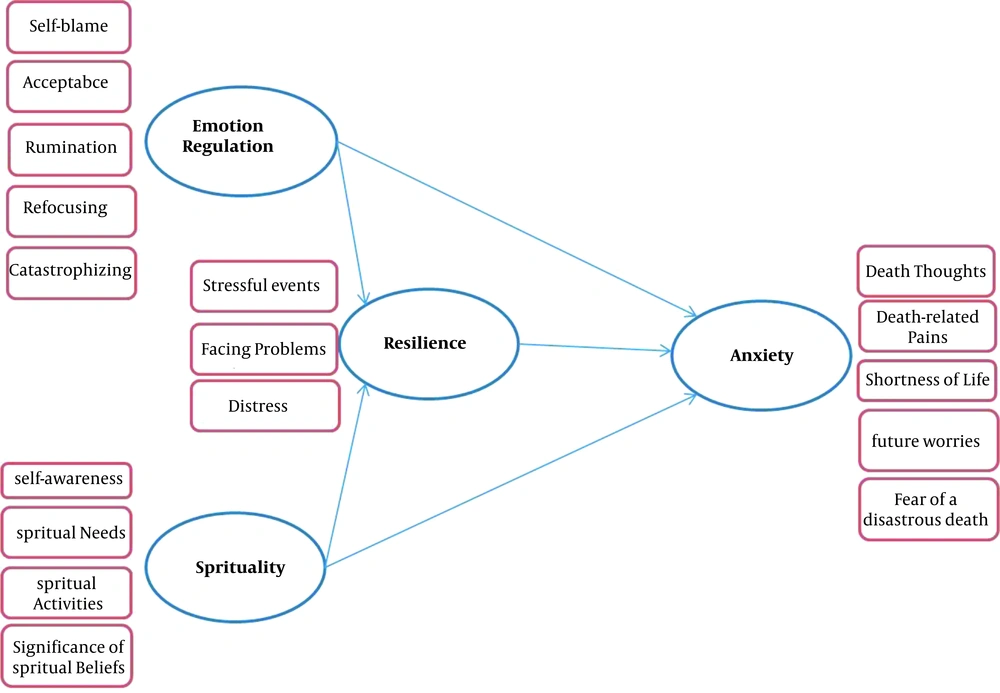
Figure 1.
Conceptual model of research
4. Results
The table below provides information on the frequency and frequency of the sample based on age, education, and type of disease, occupation, gender, duration of illness, marital status, religion and smoking.
Table 1.Descriptive Information of Statistical Sample
| Variables | No. (%) |
|---|---|
| Age | |
| Under 30 | 16 (6) |
| 31 - 40 | 63 (22) |
| 41 - 50 | 86 (30) |
| 51 - 60 | 68 (23) |
| 61 - 70 | 35 (12) |
| 71 and higher | 22 (8) |
| Education | |
| Illiterate | 44 (15) |
| Primary school | 69 (24) |
| Guidance school | 11 (4) |
| High school | 64 (22) |
| College | 102 (35) |
| Occupation | |
| Un-employed | 160 (55) |
| Employed | 130 (45) |
| Gender | |
| Male | 130 (45) |
| Female | 160 (55) |
| Marital status | |
| Single | 46 (16) |
| Married | 244 (84) |
| Type of disease | |
| Leukemia | 49 (17) |
| Gastrointestinal cancer | 94 (32) |
| Brain cancer | 17 (6) |
| Breast cancer | 61 (21) |
| Lung cancer | 13 (5) |
| Urinary tract cancer | 53 (18) |
| Other | 3 (1) |
| Duration of disease (y) | |
| 1 | 154 (53) |
| 2 | 52 (18) |
| 3 | 41 (14) |
| 4 | 30 (10) |
| 5 and up | 13 (5) |
| Smoking | |
| Yes | 81 (28) |
| No | 209 (72) |
Table 1 shows that more than half of people are under 50, 65% has high-school and under high-school education. The most common cancers were gastrointestinal cancers and then breast cancer. The population of women was more than men (55% were women). More than half of people were in the first year of diagnosis. Most cancer patients were married (84%) and 72% of the population are non-smokers. Table 2 presents the minimum, maximum, mean and standard deviation of the research variables.
Table 2.Descriptive Information of Research Variables
| Variables | Average | Standard Deviation | Minimum | Maximum |
|---|---|---|---|---|
| Emotion regulation | 40.56 | 5.89 | 0 | 63 |
| Spirituality | 84.08 | 10.80 | 29 | 116 |
| Resilience | 36.46 | 10.33 | 0 | 56 |
| Death anxiety | 7.96 | 2.05 | 0 | 15 |
In order to analyze the developed model, PLS 3.2.8 software was used. In this model, a total of 76 items (emotional regulation 18 items, spirituality 29 items, resilience 14 items and death anxiety 15 items) were included in the model. Emotional regulation has 9 components; spirituality has 4 components; death anxiety has 5 components and resilience has 2 components and all of them are of the type of latent reflective variables. First, first-order factor analysis (items as an index) was performed for the components, and then for the higher-order factor analysis component (components as an index). Model analysis was performed in three stages: in the first stage, the external model (measurement model), and in the second stage, the internal model (structural model), and in the third stage, the whole model was examined.
The results showed that the direct path of resilience to death anxiety was not significant. Also, the indirect pathways of emotional regulation to death anxiety and the mediating role of resilience were not significant. Therefore, in order to achieve a suitable model, these paths as well as items that did not have a suitable factor load with each of their variables and components were removed.
In the first step, item 8 in the resilience measurement variable and item 20 in the spirituality variable were removed from the final analysis due to the low factor load.
4.1. Measurement Model
Three criteria of reliability, convergent validity and divergent validity were used in the study of external models. In the reliability section, it is necessary to check the reliability at the level of the identifier and the latent variable. The reliability of the reagent was evaluated by measuring the factor loads and the reliability of the latent variables was evaluated by the combined reliability. Reliability at the representative level is the second power of the factor loads of the items, which must be at least 0.50, which means that at least half of the variance of the index is explained by the latent variable.
Therefore, factor loads greater than 0.7 are desirable and loads below 0.4 need to be eliminated. Factor loads between 0.4 and 0.7 can be eliminated if removing them increases the value of convergent validity (AVE) (28). Due to the fact that in reflective variables the indicators are related to a domain and have a high correlation with each other, so it is possible to replace them, deleting one or more items does not have much effect on content validity. The results show that all preserved items have good reliability (Table 3).
Table 3.Reliability and Validity Indicators of the External Model
| Concealed Variables (Second Level and First Level) | Combined Reliability (C.R) | Average Variance Extracted (AVE) | ||
|---|---|---|---|---|
| Death anxiety | 0.93 | 0.75 | ||
| Death thoughts | 0.90 | 0.81 | ||
| Fear of the future | 0.88 | 0.72 | ||
| Fear of pain | 0.90 | 0.75 | ||
| Fear of death | 0.90 | 0.74 | ||
| Transient time | 0.86 | 0.75 | ||
| Spirituality | 0.96 | 0.67 | ||
| Significance of beliefs | 0.92 | 0.75 | ||
| Self-awareness | 0.92 | 0.57 | ||
| Spiritual activities | 0.89 | 0.63 | ||
| Spiritual needs | 0.95 | 0.73 | ||
| Resilience | 0.96 | 0.70 | ||
| Behavioral | 0.93 | 0.72 | ||
| Cognitive/emotional | 0.95 | 0.68 | ||
| Cognitive regulation of emotion | 0.92 | 0.89 | ||
| Re-evaluation | 0.96 | 0.93 | ||
| Refocus planning | 0.94 | 0.89 | ||
| Positive reappraisal | 0.95 | 0.90 | ||
| Perspectives | 0.88 | 0.78 | ||
| Catastrophizing | 0.96 | 0.93 | ||
| Self-blame | 0.96 | 0.93 | ||
| Blame others | 0.95 | 0.91 | ||
| Rumination | 0.93 | 0.87 | ||
| Acceptance | 0.94 | 0.89 | ||
Cronbach's alpha and combined reliability are used to evaluate the reliability of latent variables. However, due to the conservatism of Cronbach's alpha and the same duration of illness of all reagents, in the partial least squares (PLS) method, more combined reliability is used (29). Combined reliability between 0.7 and 0.9 are considered as satisfactory values and values less than 0.6 and above 0.95 are considered as undesirable values.
In this model, the combined reliability of spirituality is 0.96, death anxiety is 0.93, cognitive regulation of emotion 0.92 and resilience 0.96 shows that the latent variables of the first and second levels have good combined reliability. The next step in evaluating the external model is to examine the convergent validity. The mean variance extracted is the convergent validity evaluation criterion means the mean of common variance between the latent variable and its references and the minimum acceptable value is 0.50 (30). In this convergent narrative model, the variability of spirituality has 0.67, death anxiety 0.75, cognitive regulation of emotion 0.89 and resilience 0.70 and all latent variables of the first and second levels have good convergent validity (Figure 2, Table 4).
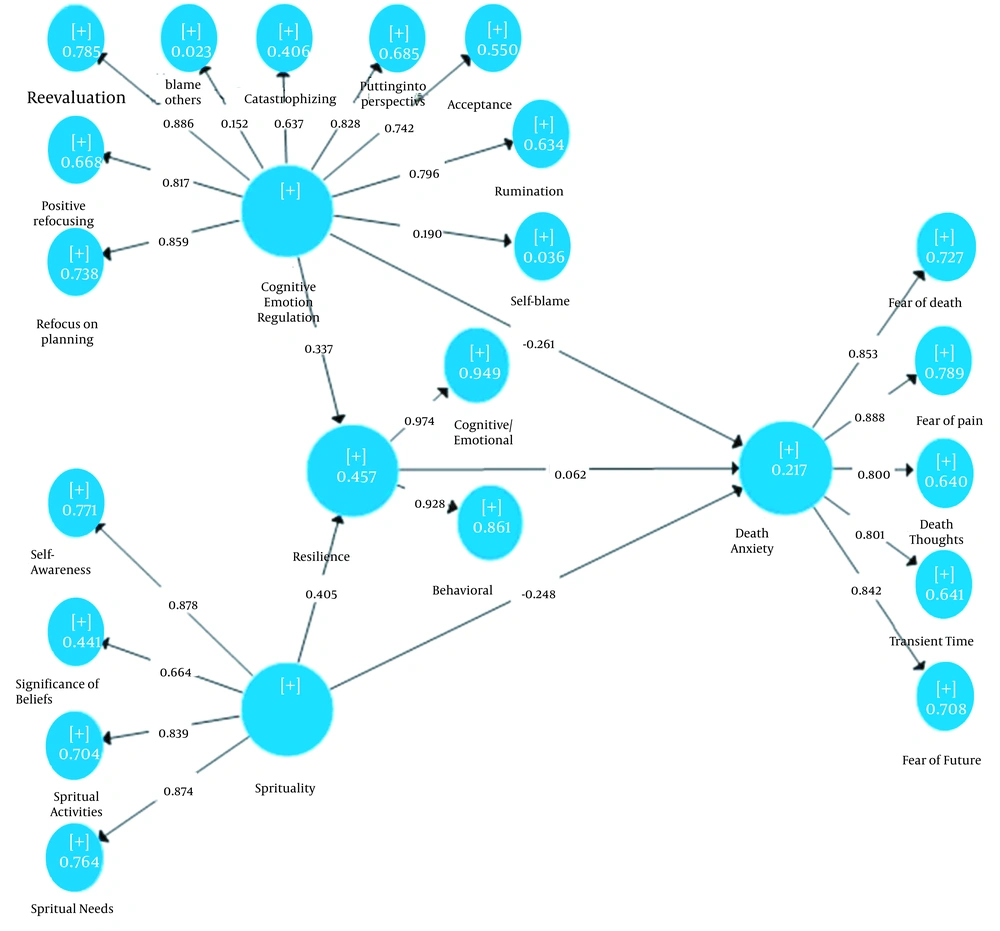
Figure 2.
Path diagram with standard coefficients
Table 4.Coherence Indices, Direct and Indirect Effects, and the Magnitude of the Impact of the Internal Research Model
| Route | Variance Inflation Factor (VIF) | Direct Effects | Effect Size (f2) | ||||
|---|---|---|---|---|---|---|---|
| Amounts | Assurance Distance | ||||||
| B | T | Sig | 2.5% | 97.5% | |||
| Death anxiety←emotion regulation | 1.969 | -0.362 | -0.362 | 0.001 | -0.441 | -0.228 | 0.025 |
| Death anxiety←spirituality | 1 | -0.478 | -0.478 | 0.001 | -0.512 | -0.211 | 0.094 |
| Resilience←emotion regulation | 1.761 | 0.320 | 0.320 | 0.001 | 0.208 | 0.481 | 0.005 |
| Resilience←spirituality | 1 | 0.490 | 0.490 | 0.001 | 0.252 | 0.526 | 0.264 |
| Death anxiety←resilience | 1 | -0.273 | -0.273 | 0.001 | -0.100 | -0.319 | 0.179 |
| Indirect Effects | |||||||
| Stress←resilience←emotion regulation | -0.087 | 4.745 | 0.001 | -0.032 | -0.107 | - | |
| Death←anxiety←resilience spirituality | -0.133 | 5.782 | 0.001 | -0.049 | -0.173 | - | |
5. Discussion
Awareness of cancer is a surprising and disturbing experience for everyone. In fact, with the knowledge of malignant and life-threatening disease, people's perception of life changes, so that numerous studies have shown that there is a close relationship between cancer and psychological states (31). Although cancer causes many psychological complications, it has recently been shown that stress has a profound effect on accelerating the progression and growth of various types of malignant tumors without actually causing them. Cancer has different changes, pressures and effects on the patient's life (32). This study was conducted to determine the fit of the structural model of the relationship between death anxiety with emotional regulation and spirituality to determine the mediating role of resilience. Calculation and analysis of fit models of the research model showed that the developed model fits well with the collected data.
The present study showed that emotional regulation has a negative and significant effect on death anxiety, meaning that the less cognitive regulation of emotion, the more death anxiety.
The results of many studies also showed that emotion regulation reduces death anxiety in cancer patients which was in line with our findings (33, 34). In explaining these findings, it should be noted that cancer patients have repressed and chronic emotions, have high levels of anxiety and psychological stress in both stages before and after diagnosis. Such patients need psychological interventions, including encouragement to express emotions and have a relationship with them. The mentioned approach in emotion regulation interventions has positive emotions in cancer patients. Also the use of coping solutions for eliminating negative emotion in order to cope with the disease, in cancer patients and in a way increases life expectancy and reduces death anxiety. Dealing with negative emotions may also be used in a variety of ways, such as maintaining self-confidence, providing a sense of purpose, peace of mind, and hope.
Emotion has a vital role in various aspects of life such as adapting to life changes and stressful incidents. Basically, emotion can be considered as biological reactions to situations that we consider as an important or challenging opportunity, and these biological reactions are accompanied by the response we give to environmental events, and it is natural that emotion regulation interventions cause a decline in death anxiety and subsequently increase the mental health of cancer patients. As a result, they experience less discomfort and stress and cope with those anxious events better (34).
The present study showed that spirituality has a negative and significant effect on death anxiety, meaning that the less spirituality, the more death anxiety.
According to our study in a research by Al-Sabwah and Abdel-Khalek (2006), the results showed that among some Muslims, there is a negative correlation between religion and spirituality with death anxiety (35). This means that in some Muslim societies, spiritual and religious attitudes were effective in reducing death anxiety, depression and hopelessness in advanced cancers (36). The results of Lo et al.'s (2014) research also show that finding the meaning of life and spirituality has an effect on reducing the death anxiety of cancer patients (37).
However, the findings of some studies showed that there was no significant correlation between cancer anxiety and the spritualty of cancer patients, including the study by Halici Kurtulan and Karaırmak (2016), Cohen et al. (2005), and French et al. (2017) which were inconsistent with our study (38-40). Also, in Wink (2006) research, an inverse correlation was reported between death anxiety and spirituality. It can be said that perhaps the correct definition of the nature of spirituality and how it relates to the concept of religion, does not exist in individuals’ minds. Even the conceptual structure of religion and spirituality has been considered synonymous in some texts, so that in many problems religion is a virtue and in many definitions the concepts are considered the same (41). However, spirituality is other than religion and is not only assessed by religious categories and is also related to past experiences and personality traits of individuals (42). But in most divine religions there is a negative relationship between healthy religiosity and death anxiety, which means that each of these two is considered as one of the other predictor variables, it is likely that religiosity in various ways causes a reduction death anxiety, such as belief in life after Death (39), the induction of symbolic immortality (43) and the meaning of life (44).
The present study showed that emotional regulation has a positive and significant effect on resilience, this means that the higher the cognitive regulation of emotion, the greater the resilience.
According to the findings of Loprinzi et al. (2011) (45), Antoni et al. (2009) (46), Antoni et al. (2006) (47), emotion regulation increases resilience in cancer patients, which is in line with the findings of our study. Elaborating on this result, it can be understood that emotions are socially useful and can be constructive in transmitting feelings to others, social interaction, maintaining, modifying, and regulate relationships with others. Emotion can be essential in mental health and its related variables such as resilience because emotions act as solutions to cope with the challenges, stresses, and problems of life. In other words, because emotions play an important role in life, emotion regulation as a therapeutic method in modulating emotions leads to effective coping with stressful situations (48) and increases activity in response to social situations (49). Therefore, emotion regulation intervention can play an important role in increasing resilience by informing the person about positive and negative emotions, accepting and expressing them in a timely manner.
The present study showed that spirituality has a positive and significant effect on resilience, meaning that the greater the spirituality, the more the resilience.
The findings of this study are consistent with the findings of Khodabakhshi Koolaee et al. (50) and Abdollahzadeh et al. (51). In their study, these researchers concluded that there is a significant relationship between spiritual intelligence and resilience. Moreover Hamid et al. found in their research that spiritual intelligence significantly predicts resilience and concluded that providing supportive factors (such as religion and spirituality) for increasing mental health and spiritual intelligence can lead to increased resilience (15). Ellison's study found that people with higher religious beliefs were more satisfied with life, happier, and less likely to have negative psychosocial consequences facing of unpleasant life events. On the other hand, looking at cancer patients and reducing the pain caused by the disease is one of the main concerns of the health and medical community (52). Increasing resilience in cancer patients can change a big part of their lives in a way that, the cancer patient will be able to act more carefully with the issues of his life. Since spirituality and resilience are one of the dimensions of human life, when people enter the counseling room; they do not leave their spirituality behind, but also bring their spiritual beliefs, practices, experiences, tidings, and spiritual challenges with them to the counseling and treatment room (51)
The present study showed that resilience has a negative and significant effect on death anxiety, meaning that the less resilience, the more death anxiety.
The return to a primary balance or the attainment of a higher balance in a more threatening conditions and thus leads to successful adaptation to life (8).
Mirzaeian Khamseh et al. (2016) also argue that there is a significant negative relationship between resilience and anxiety and its dimensions, suggesting that the more the resilience in cancer patients, the lower the anxiety of death and its dimensions, which is consistent with our study (53).
Resilience is a protective factor that acts as a kind of vaccination. People with high resilience use effective coping strategies in dealing with life issues and look at problems in such a way that they see problems as an opportunity to learn and grow (54). One of the reasons for the effectiveness of resilience training in reducing death anxiety and increasing life expectancy may be the development of coping strategies and better defense mechanisms in individuals. Most of these interventions change the style of people's attribution. People with high amounts of resilience face stressful events with optimism, assertiveness, and self-confidence. As a result, these events are seen as controllable. Optimistic attitudes make information processing more effective, and the individual adopts more active coping strategies and the ability of dealing with difficult situations increases. As a result, resilience increases an individual's flexibility, and this feature increases the adaptability of individuals to different situations (54).
5.1. Conclusions
Accordingly, the present study can be a practical help to decision makers and caregivers to further identify the challenges in promoting the mental health of cancer patients. It can also be a helping hand in the planning and interventions of treatment and nursing suggested that this model be used in the care and treatment of cancer patients.
Recommended by nurses and psychiatric nurses of the oncology and radio-oncology departments.
Educational programs should be considered in addition to medical programs to reduce death anxiety in cancer patients. These programs are for increasing emotion self-regulation, learning resilience skills and ways to promote spiritual health.


