
1. Background
Obesity is a global public health problem. Recent data show that more than 650 million adults worldwide are obese. Two critical risk factors for type 2 diabetes include overweight and obesity. Ninety percent of diabetic cases are related to being overweight, and it is believed that the association between obesity and diabetes is inherently related to insulin resistance (1). Despite research to understand the biology of obesity and energy balance, it is clear that existing knowledge has done little to prevent obesity and that many people worldwide still suffer from it (2). As an endocrine organ, adipose tissue affects glucose and lipid metabolism by releasing adipokines, inflammatory proteins, and free fatty acids (FFAs), which, in turn, impact glucose metabolism and change insulin signaling (3). Insulin resistance reduces the reaction to insulin from specific tissues, and decreases lipolysis inhibition in adipose tissue. This reduces skeletal muscle glucose uptake and helps increase hepatic glucose production (4).
Today, chemical drugs are used to treat different diseases. These drugs, in turn, leave many side effects in the long run. Therefore, recognizing and using effective compounds for the treatment of various diseases seems to be necessary. Different studies have shown that royal jelly supplement has the potential to cure various human diseases (5). Royal jelly is a yellowish-white substance secreted by worker bees jaw and submandibular glands and consumed by queen bees (throughout life) and larvae (during growth). Royal jelly contains compounds with biological activities, including essential amino acids, carbohydrates, fatty acids, minerals such as calcium, sodium, potassium, chromium, magnesium, nickel, and especially iron and vitamins, as well as nutrients required for body health.
Although insulin resistance-induced obesity is complex and multifactorial, the beneficial effects of exercise training on the prevention and treatment of the whole body have been well established. In people with insulin resistance, improving insulin activity on glucose metabolism is one of the main effects of exercise (6, 7). Regarding the effectiveness of exercise in insulin resistance, most people are recommended to do at least 30 min of mild to strenuous exercises at least five days a week or perform 20 min of strenuous physical activity at least three days a week, in addition to their everyday activities (8). Quality of life in people with diabetes is associated with some important variables. A study showed that caring behaviors such as exercise significantly predicted the quality of life in adults with diabetes. Therefore, it is essential to implement programs such as sports activities to improve the caring behaviors of people with diabetes (9).
Dianatinasab et al. studied the effect of aerobic and resistance exercises on the levels of blood glucose, insulin, and insulin resistance index in females. The results indicated a remarkable decrease in weight, blood glucose, insulin, and insulin resistance index (10). Chang et al. and Marinho et al. found that apart from weight loss, long-term endurance exercise improved insulin signaling pathways. Also, the positive impacts of exercise training on insulin functioning were identified. It was shown that insulin-resistance sensitivity improved after exercise (11, 12). In contrast, another research showed that high-intensity interval training (HIIT) did not significantly change blood sugar levels (13). Likewise, in another study, HIIT did not improve fasting glucose or postprandial glucose. Insulin levels also showed no significant change (14).
Because HIIT is performed with different intensities, duration, and frequencies, its effects on overweight, blood glucose, insulin, and insulin resistance index are not well defined. On the other hand, the results of the studies following different types of exercise training, including endurance, resistance, and HIIT, are highly contradictory and inconsistent. Hence, it is impossible to have a consistent and reliable understanding of the results due to the physiological conditions of the subjects and training conditions. Therefore, due to the importance of designing training protocols to attain better results from simultaneous HIIT and royal jelly supplementation, this study investigated the effect of HIIT with royal jelly consumption on glycemic indices of overweight and obese middle-aged men.
2. Objectives
The current study investigated the impact of HIIT with royal jelly consumption on glucose serum levels, insulin, and insulin resistance index of obese and overweight middle-aged males.
3. Methods
3.1. Subjects
As an applied study, this quasi-experimental research had four groups (one control group and three experimental groups). At first, an announcement was made to identify and invite obese and overweight middle-aged men in Gachsaran who wanted to perform sports activities to adjust their weight and improve their physiological conditions. In the next step, written consent forms were signed by all participants before participation. Among them, 60 people were selected and assigned randomly to four groups: (1) control, (2) training, (3) royal jelly supplementation, and (4) training + royal jelly supplementation.
Subjects in the training and training + royal jelly supplementation groups performed the training protocol, and the control group continued their daily activities without intervention. A briefing session was held initially in which the research conditions, including benefits and potential risks, were explained, the necessary recommendations were made, and consent was obtained from the subjects to participate in all stages of the research. During this study, subjects were asked not to participate in out-of-the-protocol activities and to inform the researcher in case of lifestyle change. Subjects were also asked to follow their usual diet following the pre-program research. Also, subjects were prohibited from taking any supplements, medications, or diet. Before starting the program, initial assessments of height, weight, and body environment were conducted in experimental conditions.
3.2. Training Protocol
The HIIT protocol included four 4-min intervals with 85 - 95% of the maximum heart rate (HRmax) intensity and 3-min bouts of active rest with an intensity of 60 - 70% HRmax. Subjects started the training with 85% HRmax, and 5% was added to the training intensity every week as the subjects improved. After the subjects attained 95% HRmax, the training condition was kept constant until the end of the protocol. Warming up and cooling down in each session were performed similarly for both training groups, including 15 min of mild aerobic activity with static and dynamic stretching. The subjects' HRmax was calculated by the formula: 220 – age (15, 16). Subjects in the royal jelly supplementation groups received 1000 mg capsules (Royall jelly Sofgel, Defenvit OPD Pharma) once daily with a fixed diet for eight weeks (17).
Blood sampling was conducted in two stages. First, it was performed at the training site by taking 8 cc of blood 48 h prior to the training program at 8:00 - 9:00 a.m. following approximately 10 hours of overnight fasting. The second stage of blood sampling was conducted 48 h after the termination of the last training session in the intervention groups with the same conditions as the initial test. In case of symptoms such as dizziness, fever, and nausea, and the absence from more than two sessions, the subjects were prevented from participating.
Before analyzing the data, the Kolmogorov-Smirnov test (KS) was used to determine the normality of research data distribution.
Fasting blood glucose was evaluated based on the glucose oxide method using Pars Azmun kits. Serum insulin concentration was assayed using ELISA. Insulin resistance was calculated using the HOMA-IR formula as follows (18):
3.3. Statistical Analysis
A dependent sample t-test was used for the inferential research data analysis to examine changes from the pretest to the posttest. Therefore, differences in the pre- and posttests were calculated to determine between-group differences. Moreover, the differences in changes were analyzed using one-way ANOVA and Tukey’s post hoc test. The obtained data were analyzed in SPSS software (version 22), and P-values less than 0.05 were considered statistically significant.
4. Results
The Shapiro-Wilk test indicated the normal distribution of research data in the four groups.
The correlated t-test results in Table 1 revealed that the posttest weight in the royal jelly (P = 0.01), training, and training + royal jelly groups significantly decreased compared with the pretest (P = 0.001). Also, based on Tukey's post hoc test, weight was much lower in the royal jelly (P = 0.01), training, and training + royal jelly groups than in the control group (P = 0.001).
Table 1.
Mean and Standard Deviation of Age, Height, and Weight in the Pre- and Posttests of the Study Groups
| Variables | Height (cm) | Weight (kg) Pretest | Weight (kg) Posttest |
|---|---|---|---|
| Control | 173.25 ± 0.30 | 90.16 ± 2.75 | 90.42 ± 3.09 |
| Royal jelly | 176.67 ± 0.50 | 90.83 ± 2.48 | 88.91 ± 2.28 a, b |
| Training | 175.42 ± 0.20 | 91.41 ± 2.55 | 88.83 ± 2.55 c, d |
| Training + royal jelly | 175.58 ± 0.01 | 91.33 ± 2.60 | 88.25 ± 3.26 c, d |
a Remarkable decrease compared with the control group (P < 0.01).
b Remarkable decrease compared with the pretest (P < 0.01).
c Remarkable decrease compared with the pretest (P < 0.001).
d Remarkable decrease compared with the control group (P < 0.001).
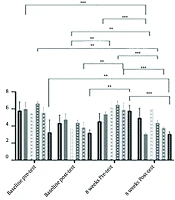
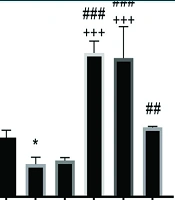
The dependent sample t-test suggested no significant difference between the pre- and posttests of HOMA-IR index (P = 0.18), blood glucose (P = 0.27), and insulin (P = 0.32) in the control group. However, the posttest HOMA-IR index (P = 0.001), blood glucose (P = 0.001), and insulin (P = 0.001) decreased remarkably in the royal jelly, training, and training + royal jelly groups compared to the pretest (Figures 1 - 3).
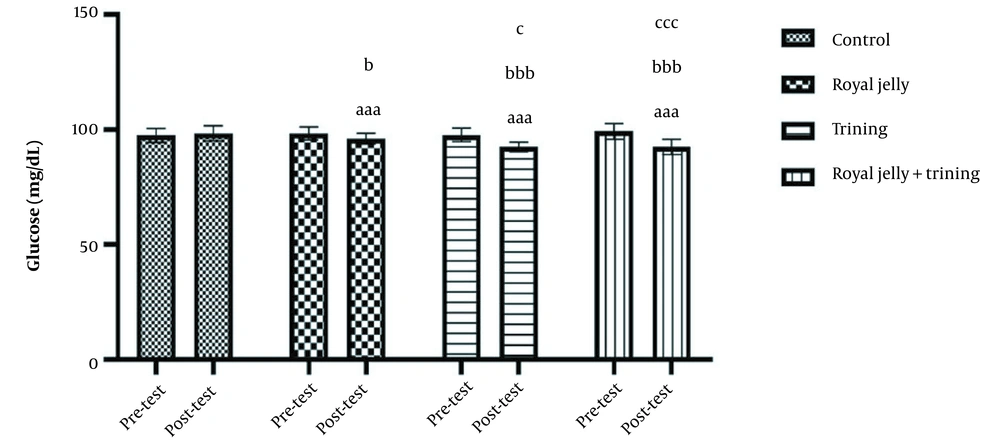
Figure 1.
Glucose levels in the four research groups; aaa (P = 0.001) Remarkable decrease compared with the pretest; b (P = 0.01) Remarkable decrease compared with the control group; bbb (P = 0.0001) Remarkable decrease compared with the control group; c (P = 0.01) Remarkable decrease compared with the royal jelly group; ccc (P = 0.0001) Remarkable decrease compared with royal jelly group.
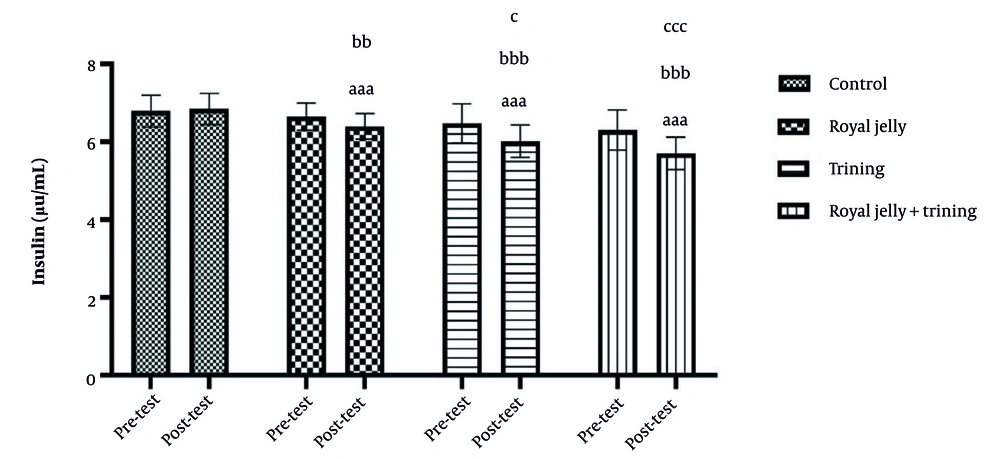
Figure 2.
Insulin levels in the four research groups; aaa (P = 0.001) Remarkable decrease compared with the pretest; bb (P = 0.001) Remarkable decrease compared with control group; bbb (P = 0.0001) Remarkable decrease compared with control group; c (P = 0.01) Remarkable decrease compared with royal jelly group; ccc (P = 0.0001) Remarkable decrease compared with royal jelly group.
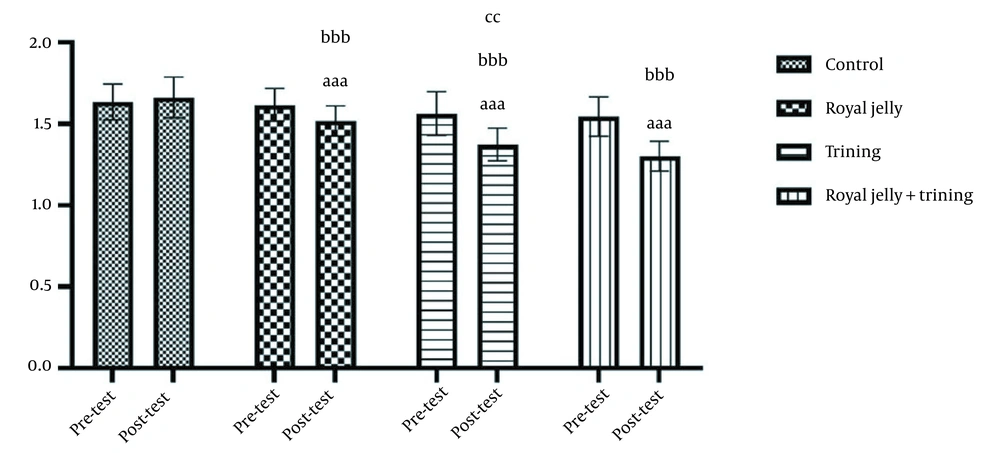
Figure 3.
HOMA-IR levels in the four research groups; aaa (P= 0.001) Remarkable decrease compared with the pretest; bbb (P = 0.0001) Remarkable decrease compared with the control group; cc (P = 0.001) Remarkable decrease compared with the royal jelly group; ccc (P = 0.0001) Remarkable decrease compared with the royal jelly group.
One-way ANOVA revealed significant differences in glucose (P = 0.001, F = 23.32), HOMA-IR index (P = 0.001, F = 47.85), and insulin (P = 0.001, F = 29.80) between the study groups. The results of the Tukey post hoc test showed a significant decrease in HOMA-IR (P = 0.0001), blood glucose (P = 0.01), and insulin (P = 0.001) in the royal jelly group compared to the control group. The results of the Tukey post hoc test showed a remarkable decrease in HOMA-IR (P = 0.0001), blood glucose (P = 0.0001), and insulin (P = 0.0001) in the training and training + royal jelly groups compared with the control group. Blood glucose (P = 0.01), insulin (P = 0.01), and HOMA-IR (P = 0.0001) were much lower in the training group than in the royal jelly group. Blood glucose (P = 0.0001), insulin (P = 0.0001), and HOMA-IR (P = 0.0001) were significantly lower in the training + royal jelly group than in the royal jelly group. Blood glucose (P = 0.37), insulin (P = 0.23), and HOMA-IR (P = 0.12) were not significantly different between the training + royal jelly and training groups (Figures 1 - 3).
5. Discussion
According to the results, there was a remarkable decrease in subjects' weight from the pretest to posttest in the royal jelly supplementation, training, and training + royal jelly supplementation groups. In contrast, blood glucose, insulin, and insulin resistance index showed a significant decrease between the post- as well as the pretest and posttest groups.
Alvarez et al. studied the role of HIIT in blood sugar, insulin, and insulin resistance index and reported that HIIT remarkably reduced these factors (19). These results confirm our study since we observed a decrease in blood sugar, insulin, and insulin resistance index following HIIT in overweight and obese middle-aged men. Training factors such as intensity, duration, frequency, and active or inactive rests could affect intensive interval training results. However, the main factor in HIIT is the intensity of exercise training, which can activate many physiological factors such as increased metabolism, increased number of mitochondria, and enzymes involved in energy production. These factors can increase blood sugar metabolism.
Little et al. and Grace et al. showed that HIIT improved insulin resistance (20, 21). Their results confirmed those of the present study since, in this study, insulin resistance reduced after eight weeks of HIIT.
Several factors, such as duration, intensity, frequency, and the principle of overload, should be considered when performing high-intensity training. Low-to-high-intensity interval exercises should be prescribed to involve subcutaneous and visceral adipose tissue because it has been shown that if they do not reduce body fat content (especially visceral fat), they will not be effective in improving insulin sensitivity. Therefore, training intensity and duration and changes in visceral fat content can improve insulin resistance and increase insulin sensitivity during or after interval training. Regarding the intensity of training, research has shown that high-intensity training, compared to low-intensity training, better improves insulin resistance (7, 22).
Another way to control weight, blood sugar, and insulin is to take supplements. Royal jelly supplementation can lead to physiological adjustments, including blood sugar and insulin levels. In this regard, a study showed that blood sugar and insulin resistance index decreased after interval training and royal jelly supplementation in diabetic rats following eight weeks of aerobic exercise (80 - 90% VO2 max and one-minute rest periods with 50 - 56% VO2max).
In contrast, the weight of the experimental and royal jelly supplementation groups revealed a high increase compared to the control group, and insulin levels also showed a remarkable increase (23). The study's results about glucose levels and insulin resistance index confirmed the findings of this study because, in both studies, a significant decrease in glucose and insulin resistance index is observed. Given the results, we observed a decrease in insulin levels, while in the reported study, an increase was reported. This discrepancy could be due to the type of subjects: In the reported study, the subjects were patients with type 2 diabetes and impaired insulin secretion and absorption, while in the present study, the subjects were overweight and obese middle-aged men. Regarding the cellular and molecular mechanisms of increasing glucose uptake by insulin through exercise, especially HIIT, it may be suggested that this increase may be related to some factors, such as GLUT4.
Glucose uptake into insulin target cells is carried out by the GLUT4 vector (24). In non-hormone-stimulated cells, GLUT4 molecules are enclosed within specific vesicles in the cytoplasmic environment and continuously move endosomically between the transgolgial surface and the tubulovesicular agents. Exercise can increase skeletal muscle GLUT4 expression. Increasing GLUT4 by exercise is essential for increasing muscle glucose transport capacity and provides an "immunity factor" that leads to metabolic homeostasis in response to exercise (25). It has also been shown that taking royal jelly supplements can activate proteins involved in intracellular energy levels, including AMP-activated protein kinase (AMPK). This protein activates energy levels through the mitochondria, which can regulate blood sugar and insulin through exercise. In this regard, Takahashi et al. showed that royal jelly supplementation increased endurance training. They also showed that consuming royal jelly increased essential enzymes, such as citrate synthase and beta-hydroxyacyl-CoA dehydrogenase, which are involved in the Krebs cycle and can increase energy production and metabolism by the body's muscles. Therefore, it has been shown that royal jelly supplementation activates the AMPK protein through endurance exercise training, which can lead to mitochondrial adaptations (26). Finally, it should be noted that to assess the physiological conditions of obese or overweight people following HIIT or taking royal jelly supplementation, other blood and/or cellular factors controlling obesity should be examined. Also, different types of exercise training, such as endurance, strength, and interval training, should be compared with each other in different conditions to provide more accurate results. On the other hand, other doses of oral supplements should also be considered.
5.1. Conclusions
The results showed that HIIT combined with royal jelly supplementation could improve factors such as blood sugar and insulin levels in obese or overweight people prone to cardiovascular disease and various types of diabetes. Also, following HIIT and royal jelly consumption, the insulin resistance index decreased, which could be significant for people with impaired insulin regulation. Eventually, taking supplements, especially royal jelly supplements, along with performing interval training, could regulate physiological factors in the body.