
1. Background
Elderliness is a stage of human life and evolution naturally associated with reduced mental, physical, and psychological abilities (1). The elderly population is increasing given the advancements in medical science (2) and increased life expectancy (3), which is called the silent revolution (4). Studies suggest that the number of people aged 65 or over worldwide will double in the next 40 years, with 52% of this increased population residing in developing Asian countries (5). Our country is no exception to this rule, given the increased elderly population in Iran. Iran is also moving toward an aging population due to reduced fertility, decreased mortality, and increased life expectancy. Iran's population over 65 increased from 3.9% in 1956 to 6.1% in 2016. It is predicted that the population over 65 in Iran will increase to 11% and 17% of the total population in 2036 and 2051, respectively. The elderly population of Iran will start increasing at a higher pace than in other regions and the world average after 2040, according to global estimations. Besides, it will exceed the global average elderly population increase by 2045 and the Asian average by the next five years. Therefore, paying attention to this population's health, mainly psychological health, is increasingly significant (6).
Research results have revealed that the elderly suffer from significant emotional disorders and problems such as anxiety, particularly death anxiety (7, 8). Death anxiety includes the thoughts, emotions, and fears associated with the end of life in which the individual experiences negative emotions, fear, and anxiety by thinking about death and dying (9). Death anxiety is more prevalent in the elderly than in other age groups (10, 11), but there are no accurate statistics on the prevalence of death anxiety in this age group. It appears that the elderly experience various emotions and stresses over their hospitalization or when their family takes care of them. Death anxiety can influence psychological health, particularly in the elderly (12). Zeraati et al. conducted a study to compare depression and death anxiety in the resident and non-resident elderly in nursing homes in Tehran in 2016. The results showed that depression and death anxiety were significantly higher among the elderly living in nursing homes than among the non-resident elderly. Therefore, according to the living conditions of the elderly in nursing homes, periodic psychiatric examinations and psychological interventions are essential to treat depression, relieve anxiety, and promote the life quality of the elderly (6). The increasing growth of the elderly and this age group's specific needs over hospital stays and outside the hospital, on the one hand, and the psychological and physiological changes in them, on the other hand, can make the elderly vulnerable to issues such as death, and death anxiety can influence this vulnerable group's life. Addressing death anxiety in the elderly population is imperative (13) because the elderly can be prone to death anxiety and psychological disorders due to the conditions their families impose on them, the inabilities due to increased age, and their care needs not being met. Thus, attention to death anxiety in this age group can increase their abilities and improve their performance in all aspects of their lives (14).
2. Objectives
The present study was conducted to determine death anxiety and associated factors in the hospitalized and non-hospitalized elderly in Ahvaz.
3. Methods
3.1. Study Design
In the present descriptive cross-sectional study, the statistical population included the hospitalized and non-hospitalized elderly aged 60 or above in Ahvaz.
3.2. Sample
The sample size was determined using Cochran's formula with p = q = 0.7 and z = 1.96. Thus, a sample size of 195 was calculated.
3.3. Procedure
Convenience sampling was conducted in May-September 2019. Non-hospitalized participants (n = 97) were selected from the retiree clubs, outpatient clinics, and Golestan and Imam Khomeini hospitals, while hospitalized participants (n = 98) were selected from hospitalized patients in Golestan and Imam Khomeini hospitals. Inclusion criteria were the age of 60 or above, the ability to communicate, not taking antidepressants, and emotional and physical ability to fill in the questionnaires. An incomplete questionnaire was the only exclusion criterion.
3.4. Tools
Data were collected through self-report using death anxiety evaluation and demographic characteristics questionnaires. The demographic characteristics questionnaire included age, gender, marital status, and education level. Collet & Lester's Death Anxiety questionnaire was used to assess death anxiety. This scale has 32 items and four subscales of death of self, dying of self, death of others and dying of others. Each subscale contains eight items. The items in each subscale are scored on a Likert scale from one to five. A score of one means no anxiety and a score of five means a lot of anxiety. Therefore, each person's overall score ranges from 32 to 160. A higher score scores higher than death anxiety (6). Lester & Collet reported the reliability of the subscales death of self, dying of self, death of others and dying of others to be 0.91, 0.89, 0.72, and 0.87, respectively, in 1990. The validity of this questionnaire's Persian version has also been determined and reported to be 0.68 using Cronbach's alpha (6).
3.5. Ethical Considerations
The present study is the result of research approved by the Ethics Committee of Ahvaz Jundishapur University of Medical Sciences (IR.AJUMS.REC.1397.918). All ethical considerations such as providing the participants with the required information, informed consent, voluntary participation, freedom of withdrawal, imposing no costs on participants, and information confidentiality were taken into account.
3.6. Data Analysis
Data were analyzed using SPSS 22 statistical software. In the present study, descriptive statistics including frequency, percentage, mean and standard deviation were used and analytical tests including independent t-test and chi-square were used.
4. Results
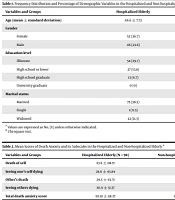
One hundred ninety-five elderly people with an average age of 66.06 ± 5.59 (60 to 88 years) participated in the study, the most of whom (61%) were male. Table 1 indicates the frequency of the demographic variables in the hospitalized and non-hospitalized elderly (Table 1).
Table 1.
Frequency Distribution and Percentage of Demographic Variables in the Hospitalized and Non-hospitalized Elderly a
| Variables and Groups | Hospitalized Elderly | Non-hospitalized Elderly | P-Value |
|---|---|---|---|
| Age (mean ± standard deviation) | 66.6 ± 7.73 | 65.4 ± 3.04 | 0.065 |
| Gender | 0.001 b | ||
| Female | 52 (26.7) | 24 (12.3) | |
| Male | 46 (23.6) | 73 (37.4) | |
| Education level | 0.001 b | ||
| Illiterate | 58 (29.7) | 11 (5.6) | |
| High school or lower | 27 (13.8) | 32 (16.4) | |
| High school graduate | 13 (6.7) | 33 (16.9) | |
| University graduate | 0 (0) | 21 (10.8) | |
| Marital status | 0.001 b | ||
| Married | 75 (38.5) | 91 (54.8) | |
| Single | 1 (0.5) | 1 (0.5) | |
| Widowed | 22 (11.3) | 5 (2.6) |
a Values are expressed as No. (%) unless otherwise indicated.
b Chi-square test.
Study results indicated that the mean score of death anxiety was 111.98 ± 19.27 for the hospitalized elderly and 100.002 ± 25.12 for the non-hospitalized elderly. According to the results, both hospitalized and non-hospitalized patients experienced higher anxiety in the two subscales of other's death and seeing others die than in the two subscales of the death of self and seeing themselves die. The independent t-test revealed that the two elderly groups were significantly different in the mean scores of death anxiety and all subscales, except for the death of others (Table 2).
Table 2.
Mean Scores of Death Anxiety and Its Subscales in the Hospitalized and Non-hospitalized Elderly a
| Variables and Groups | Hospitalized Elderly (N = 98) | Non-hospitalized Elderly (N = 97) | t | P-Value |
|---|---|---|---|---|
| Death of self | 23.6 ± 08.71 | 19.7 ± 18.34 | 3.86 | 0.001 b |
| Seeing one’s self dying | 28.6 ± 45.84 | 25.8 ± 28.49 | 2.86 | 0.001 b |
| Other’s death | 29.5 ± 93.71 | 28.7 ± 46.81 | 1.50 | 0.134 |
| Seeing others dying | 30.9 ± 51.37 | 27.7 ± 08.97 | 2.75 | 0.001 b |
| Total death anxiety score | 111.19 ± 98.27 | 100.25 ± 02.12 | 3.73 | 0.001 b |
a Values are expressed as mean ± standard deviation.
bt-test.
The independent t-test indicated that the total score of death anxiety and all subscales, except for the death of others, were higher in women than in men (Table 3).
Table 3.
Mean Scores of Death Anxiety and Its Subscales in the Elderly Males and Females a
| Variables and Groups | Women (N=76) | Men (N=119) | t | P-Value |
|---|---|---|---|---|
| Death of self | 22.7 ± 6.17 | 20.7 ± 20.22 | -2.28 | 0.023 b |
| Seeing one’s self dying | 28.7 ± 28.63 | 25.7 ± 98.88 | -2.10 | 0.044 b |
| Other’s death | 30.6 ± 92.56 | 28.6 ± 10.84 | -2.84 | 0.001 b |
| Seeing others dying | 30.8 ± 30.38 | 27.9 ± 84.03 | -1.90 | 0.055 |
| Total death anxiety score | 112.21 ± 13.95 | 102.23 ± 142.06 | -3.00 | 0.001 b |
a Values are expressed as mean ± standard deviation.
bt-test.
According to the ANOVA test, there was a statistically significant difference in total death anxiety and its subscales among the elderly with various education levels (Table 4).
Table 4.
Mean Scores of Death Anxiety and Its Subscales in the Elderly with Different Education Levels a
| Variables and Groups | Illiterate (N = 69) | High School or Lower (N = 59) | High School Graduate (N = 46) | Academic Graduate (N = 21) | F | P-Value |
|---|---|---|---|---|---|---|
| Death of self | 23.6 ± 26.91 | 20.6 ± 16.74 | 20.8 ± 54.08 | 18.6 ± 23.74 | 3.65 | 0.014 b |
| Seeing one’s self dying | 29.7 ± 65.29 | 26.7 ± 25.35 | 25.7 ± 19.84 | 23.8 ± 23.58 | 5.57 | 0.001 b |
| Other’s death | 29.6 ± 75.34 | 29.6 ± 37.70 | 29.7 ± 06.07 | 27.8 ± 23.43 | 0.73 | 0.531 |
| Seeing others dying | 30.7 ± 49.80 | 29.10 ± 47.79 | 27.7 ± 13.66 | 25.7 ± 04.08 | 2.83 | 0.039 b |
| Total death anxiety score | 113.19 ± 15.70 | 105.23 ± 27.78 | 101.23 ± 93.35 | 93.24 ± 76.83 | 4.95 | 0.002 |
a Values are expressed as mean ± standard deviation.
b Analysis of variance.
The chi-square test also indicated that the mean scores of death anxiety and its subscales were significant in married, single, and widowed elderly in the subscale of seeing others die. As single seniors experienced more death anxiety than married and widowed seniors (Table 5).
Table 5.
Mean Scores of Death Anxiety and Its Subscales in the Elderly with Various Marital Statuses a
| Variables and Groups | Married Elderly (N = 166) | Single Elderly (N = 2) | Widowed Elderly (N = 27) | χ2 | P-Value |
|---|---|---|---|---|---|
| Death of self | 21.7 ± 22.43 | 4 ± 17.24 | 20.6 ± 96.59 | 0.84 | 0.657 |
| Seeing one’s self dying | 26.7 ± 80.83 | 26.10 ± 5.60 | 27.8 ± 73.08 | 0.29 | 0.986 |
| Other’s death | 28.6 ± 83.96 | 5 ± 29.65 | 31.5 ± 51.98 | 2.80 | 0.246 |
| Seeing others dying | 28.8 ± 21.77 | 33.6 ± 5.36 | 32.8 ± 07.92 | 9.46 | 0.001 b |
| Total death anxiety score | 105.23 ± 07.38 | 26 ± 106.87 | 111.21 ± 92.10 | 2.45 | 0.293 |
a Values are expressed as mean ± standard deviation.
b Chi-square test.
5. Discussion
The present study investigated death anxiety and associated factors in the hospitalized and non-hospitalized elderly in Ahvaz. According to the results, moderate and high death anxiety was observed in all aspects (death of self, seeing death of self, death of others, and seeing others’ death) in the hospitalized and non-hospitalized elderly, but it was higher in the hospitalized elderly than in the non-hospitalized ones. On the other hand, in both groups, the anxiety caused by the death of others and seeing others’ death was higher than the anxiety caused by the death of self and seeing death of self. However, the comparison between the two hospitalized and non-hospitalized groups indicated that death anxiety was significantly higher in the hospitalized elderly than in the non-hospitalized ones but cannot be compared between them because of their different gender, marital status, and education level. To explain this result, one can argue that the elderly's living environment is influential in their health and lives. The elderly are mostly inclined to stay at home as a place that reminds them of their memories and value their independence in private life and the network of friends and neighbors (15). The vision that the elderly see in front of them is death. They feel that they have done everything they should have done and that they have no purpose in life (16). Being with family and receiving respect and attention can help maintain the feeling of usefulness in the elderly and improve their hope in life, which is something that the hospitalized elderly appears to lack (13).
According to the results, death anxiety was significantly higher in elderly females than in elderly males. Gender is among the influential factors affecting death anxiety. Other studies have also pointed out the relationship between gender and death anxiety. For instance, Depaola et al. stated that elderly females experienced higher anxiety than elderly males according to the multidimensional death anxiety scale (17).
Besides, the results indicated that education level influenced death anxiety, so the illiterate or low-educated elderly experienced higher death anxiety than the highly educated elderly. Lambert et al. also revealed a significant positive relationship between people's education level and death anxiety. Considering that a higher educational level ensures better job opportunities, which means higher income and social status, accumulating these factors can increase individuals' health (18). However, Sahebi and Ayatollahi reported no relationship between people's education level and psychological health. The differences in the economic and social conditions of the participants in the aforementioned study can justify this inconsistency (19).
Marital status is another factor influencing death anxiety in the elderly. In the present study, the single and widowed elderly experienced higher death anxiety than the married elderly. The married elderly experienced the lowest death anxiety, the single elderly experienced more, and the widowed elderly experienced the highest death anxiety. Mehri Nejad et al. also confirmed the aforementioned results. They reported that single and married women did not experience significantly different levels of death anxiety, while a significant difference was observed in death anxiety between single and married men (20). Moreover, Nabavi et al. demonstrated that the married elderly had better psychological health than the single and widowed elderly, which can be due to the destruction of the support system in the family and the feeling of isolation and loneliness in the elderly, which is a serious threat to their physical and mental health (5).
The limitations of the present study included the inconsistency between the two hospitalized and non-hospitalized elderly groups in terms of variables such as gender, education, and marital status, which made it challenging to compare death anxiety between the hospitalized and non-hospitalized groups. On the other hand, many sociological variables influencing the quality of life, such as socio-economic and cultural conditions, were not studied in the present study. Thus, future studies may take these variables into account. Besides, the relationship between death anxiety, education level, and gender must be studied more closely.
5.1. Conclusions
Results indicated that both the hospitalized and non-hospitalized elderly experience a moderate level of death anxiety. Various factors influence the death anxiety level in the elderly, including gender (female), hospitalization, marital status, and education level. Generally, the elderly hospitalized due to physical conditions feel death more, and this anxiety appears to be higher in women than men, people with lower education levels than highly educated people, and lonely people than those living with their spouses.
The results can be used to plan for appropriate methods to reduce the anxiety of the hospitalized elderly and prevent hospitalization complications. Providing counseling appropriate to the elderly and helping them control their anxiety are suggested.