
1. Background
Cancer is one of the most common diseases worldwide and the second leading cause of death after cardiovascular disease (1). According to the latest statistics obtained by GLOBOCAN in 2020, cancer accounts for 14.2% of all deaths in the world (2). As reported by the latest studies, cancer is the third leading cause of death in Iran after cardiovascular disease and accidents (3). Among all cancers, gastric cancer is the fifth most prevalent one and the fourth most pernicious one in the world (2). There are more serious and drastic statistics in Iran as, according to the latest statistics, this cancer is the first and second most rampant cancer among Iranian men and women, respectively (2). It is likely that the incidence of gastric cancer will increase by 38% by 2025 (4).
Gastric cancer has a poor prognosis, and most patients usually recognize it when the cancer has metastasized to most parts of their body (5). Insufficient knowledge about the common signs and symptoms of gastric cancer, together with the lack of early symptoms, has caused patients not to seek screening for it and to notice it in the final stages of the disease (6-8). It should be noted, however, that if the cancer is diagnosed in the early stages of the disease, the complications caused by it and the mortality rate will be reduced (6), and the survival rate will increase significantly (9).
Timely diagnosis requires sufficient knowledge of individuals about different aspects of the disease (6). Based on the results of a study conducted in Iran, the knowledge of the public about gastric cancer risk factors, signs and symptoms, prevention methods, and the significance of timely diagnosis and treatment are regrettably low (10). Similarly, it was indicated in several studies in China, Korea, and Saudi Arabia that the public has a poor knowledge of gastric cancer and its related risk factors (7, 11, 12).
Moreover, according to the results of studies, gastric cancer and its mortality rate in young individuals have a growing trend compared to the last five decades (13). Genetic changes, environmental factors, and especially unhealthy lifestyles, such as smoking, inappropriate diet, obesity, low physical activity, and alcohol consumption, are among the factors that make young individuals susceptible to this type of cancer (13-15). In order to reduce the rate of gastric cancer and its mortality, young individuals need to have an adequate level of knowledge and practice (10, 13). Several studies have recently indicated in Iran that smoking has increased among the young generation, especially Iranian students (16, 17). High alcohol consumption has also been reported among Iranian students in other studies (18, 19). Furthermore, the rate of obesity, overweight, and consumption of high-salt and high-fat foods is critically growing among most Iranian students (20-22).
In the literature review, no study was found that investigated the knowledge and attitude of students in the field of gastric cancer. However, the results of a recent study in Saudi Arabia, which was conducted with the aim of determining the knowledge, attitude, and perceived barriers regarding colorectal cancer screening practices and risk factors among medical students, showed that Saudi medical students have limited knowledge of colorectal cancer risk factors of and a poor attitude toward colorectal cancer screening (23). As a great portion of the young population of any country, students are considered to be important and dynamic pillars of education at the societal level. This is crucially important for the students of medical sciences who are considered health ambassadors of society and are expected to have more appropriate knowledge, attitude, and practice than ordinary individuals with regard to the prevention of risk factors of life-threatening diseases. Nevertheless, the high prevalence of risk factors among this population group can be an alarm for the growing trend of gastrointestinal cancers, including gastric cancer, in the near future.
Gastric cancer in young adults has had a decreasing trend over time in most countries, and only about 5% of gastric cancer cases occur before the age of 40 years (13). However, according to the latest statistics published about the prevalence of gastric cancer in 2020, the prevalence of this type of cancer is increasing in Iran (24), especially among young individuals (3). Additionally, gastric cancer is the fifth most common cancer in Khuzestan province, Iran (25). Therefore, its growing trend in Iran, especially in Khuzestan province, and the financial and medical burdens it imposes on the health and treatment system make the researchers carry out further investigations to discover the causes of the disease and the factors related to the correct practice in preventing this type of cancer. Moreover, our knowledge in this regard can facilitate the implementation of educational programs whose aim is the prevention and timely screening of the disease.
2. Objectives
The present study aimed to determine the knowledge, attitude, and practice of medical students regarding gastric cancer.
3. Methods
3.1. Design and Sample
This study was a cross-sectional, descriptive correlational investigation conducted during the 2021 - 2022 academic year at Ahvaz Jundishapur University of Medical Sciences, Ahvaz, Iran. The inclusion criteria consisted of being a student at Ahvaz Jundishapur University of Medical Sciences and consenting to participate in the study. An informed consent form and a link to the Google survey were sent through social media groups, such as WhatsApp and Telegram, for 800 students, and consecutive sampling over a period of one month enrolled 558 students in the study. The response rate was 69.7%.
3.2. Measurements
The data were collected through four self-reported instruments.
3.2.1. Demographic-Clinical Information Questionnaire
This questionnaire included variables of gender, age, academic field, and clinical practice.
3.2.2. Knowledge Questionnaire
The knowledge questionnaire comprised 29 items with four subscales: Risk factors (8 items), warning signs (9 items), prevention (9 items), and treatment (3 items). Each item has 3 options “true”, “I do not know”, and “false”, which are assigned 1, 0, and 0 marks, respectively. The total score ranges from 0 to 29, with a higher score indicating a high knowledge. Ratings on the scale are divided into three levels: Poor knowledge (0 - 13.99), moderate knowledge (14 - 23.99), and good knowledge (24-29). The knowledge questionnaire was previously developed and validated by Mansour-Ghanaei et al. in 2012. The reliability of this questionnaire was estimated using Cronbach’s alpha coefficient above 0.7 for all subscales (10). In the present study, the reliability of the questionnaire and its subscales were satisfactory using Cronbach’s alpha coefficient within the range of 0.71 - 0.82.
3.2.3. Attitude Questionnaire
The attitude questionnaire was a researcher-made tool that was prepared based on the review of related articles (7) and using the opinions of expert professors. The questionnaire comprised 18 items with four subscales: Screening (3 items), risk factors (5 items), dangerous symptoms (5 items), and prevention (5 items). The individuals’ responses were rated on a 5-point Likert scale from 1 (strongly disagree) to 5 (strongly agree). Overall scores on the scale range from 18 to 90, with higher scores indicating better individuals’ attitudes. Scale scores are divided into three levels: Poor attitude (18 - 47.99), moderate attitude (48 - 77.99), and good attitude (78 - 90). To verify the face validity and content validity of the questionnaire, the opinions of 12 oncology specialists were used. Quantitative content validity was confirmed with the content validity ratio (CVR) of 0.66 - 1 and the content validity index (CVI) of 0.83 - 1. Additionally, the reliability of the questionnaire and its subscales using Cronbach’s alpha coefficient was within the range of 0.68 - 0.79.
3.2.4. Practice Questionnaire
The practice questionnaire was a researcher-made tool that was prepared based on the review of related articles (26) and using the opinions of expert professors. The questionnaire comprised 11 items that examined the practice level of individuals in relation to gastric cancer prevention behaviors. The individuals’ responses were rated on a 5-point Likert scale ranging from 1 (always) to 5 (never). Overall scores on the scale vary from 11 to 55, with higher scores indicating better individual practice. Scale scores are categorized into three levels: Poor practice (11 - 28.99), moderate practice (29 - 46.99), and good practice (47 - 55). Quantitative content validity was confirmed with the CVR of 0.83-1 and CVI of 0.91 - 1. Additionally, the reliability of the questionnaire was 0.72 using Cronbach’s alpha coefficient.
3.3. Data Analysis
Data analysis was conducted using SPSS software (version 22). A parametric test was used because the Kolmogorov-Smirnov test showed that the data distribution was normal. The independent sample t-test and analysis of variance (ANOVA) were used to examine the statistical difference between mean knowledge, attitude, and practice scores in nominal demographic variable subgroups. The relationship between outcome variables (knowledge, attitude, and practice) was estimated by Pearson correlation coefficients. Finally, stepwise-selection multiple linear regression analyses of the practice of medical science students were applied to determine its predictors (P-value for entry < 0.05).
3.4. Ethical Considerations
This study was approved by the Ethics Committee of Ahvaz Jundishapur University of Medical Sciences (ethics code: IR.AJUMS.REC.1401.149). Ethical considerations, such as obtaining approval from the relevant authorities, explaining the purpose of the study to participants, ensuring data confidentiality, and obtaining verbal consent from samples, were adhered to.
4. Results
A total of 558 medical sciences students were included in the study. The mean age of the students was 21.93 ± 2.61 years. Most of the students (51.6%) were male, and 44.8% were paramedical students. Table 1 shows student demographic characteristics according to the mean levels of knowledge, attitude, and practice. Table 1 shows that there were no significant differences between categories of the demographics in terms of the mean level of students’ practice, except for the variable of age (P = 0.03) and variables of clinical practice (P = 0.002) and academic field (P = 0.001) in terms of the mean level of the knowledge. No significant differences were observed between categories of the demographics in terms of the mean level of attitude, except for the academic field (P = 0.002) (Table 1).
Table 1.
Demographic Variables of Medical Science Students Based on Outcome Variables, Knowledge, Attitude, and Practice in Medical Science Students (N = 558) a
| Variables | No. (%) | KoR | KoS | KoP | KoT | Total Knowledge | ATSC | ATR | ATS | ATP | Total Attitude | Practice |
|---|---|---|---|---|---|---|---|---|---|---|---|---|
| Age (y) | ||||||||||||
| < 22 | 282 (50.5) | 6.01 ± 1.30 | 4.87 ± 2.39 | 6.71 ± 1.86 | 1.95 ± 1.08 | 19.55 ± 4.94 | 12.10 ± 1.62 | 20.09 ± 2.78 | 19.13 ± 3.26 | 18.62 ± 3.37 | 69.97 ± 8.15 | 41.06 ± 3.93 |
| ≥ 22 | 276 (49.5) | 5.95 ± 1.34 | 5.17 ± 2.27 | 6.71 ± 1.75 | 2.21 ± 0.97 | 20.06 ± 4.90 | 12.13 ± 1.76 | 19.32 ± 2.41 | 19.62 ± 3.05 | 17.71 ± 3.16 | 68.80 ± 6.89 | 40.30 ± 4.38 |
| P-value | 0.60 | 0.12 | 0.97 | 0.003 | 0.21 | 0.84 | 0.001 | 0.07 | 0.001 | 0.06 | 0.03 | |
| Gender | ||||||||||||
| Female | 270 (48.4) | 6.07 ± 1.14 | 4.90 ± 2.29 | 6.73 ± 1.65 | 2.08 ± 1.00 | 19.79 ± 4.45 | 12.02 ± 1.61 | 19.77 ± 2.51 | 19.24 ± 3.11 | 18.30 ± 3.30 | 69.34 ± 7.30 | 40.72 ± 3.82 |
| Male | 288 (51.6) | 5.90 ± 1.46 | 5.13 ± 2.37 | 6.69 ± 1.94 | 2.07 ± 1.07 | 19.81 ± 5.34 | 12.21 ± 1.76 | 19.66 ± 2.74 | 19.50 ± 3.22 | 18.06 ± 3.30 | 69.44 ± 7.82 | 40.64 ± 4.48 |
| P-value | 0.143 | 0.24 | 0.81 | 0.91 | 0.95 | 0.18 | 0.62 | 0.34 | 0.39 | 0.88 | 0.83 | |
| Clinical practice | ||||||||||||
| Yes | 260 (46.6) | 6.11 ± 1.27 | 5.28 ± 2.25 | 6.83 ± 1.74 | 2.26 ± 0.97 | 20.50 ± 4.73 | 12.26 ± 1.79 | 19.51 ± 2.66 | 19.58 ± 3.20 | 17.99 ± 3.32 | 69.35 ± 7.45 | 40.5 ± 4.50 |
| No | 298 (53.4) | 5.87 ± 1.35 | 4.79 ± 2.38 | 6.61 ± 1.85 | 1.92 ± 1.06 | 19.20 ± 5.02 | 12.00 ± 1.59 | 19.88 ± 2.60 | 19.19 ± 313 | 18.33 ± 3.28 | 69.42 ± 7.68 | 40.86 ± 3.86 |
| P-value | 0.03 | 0.01 | 0.14 | < 0.001 | 0.002 | 0.07 | 0.09 | 0.15 | 0.21 | 0.91 | 0.33 | |
| Academic field | ||||||||||||
| Nursing and midwifery | 143 (25.6) | 6.22 ± 1.16 | 5.34 ± 2.21 | 7.01 ± 1.72 | 2.33 ± 0.93 | 20.91 ± 4.55 | 12.49 ± 1.73 | 20.04 ± 2.80 | 19.90 ± 3.27 | 18.18 ± 3.51 | 70.64 ± 7.48 | 40.90 ± 4.50 |
| Health | 53 (9.5) | 5.62 ± 1.63 | 3.94 ± 2.22 | 6.49 ± 1.68 | 1.96 ± 1.03 | 18.01 ± 4.53 | 11.81 ± 1.77 | 19.13 ± 2.95 | 18.15 ± 3.17 | 17.96 ± 3.65 | 67.05 ± 8.42 | 39.98 ± 4.16 |
| Para-medicine | 250 (44.8) | 5.91 ± 1.30 | 4.84 ± 2.35 | 6.57 ± 1.81 | 2.01 ± 1.04 | 19.35 ± 5.04 | 11.93 ± 1.70 | 19.46 ± 2.45 | 18.99 ± 3.04 | 18.22 ± 3.09 | 68.61 ± 7.42 | 40.88 ± 4.14 |
| Medicine | 112 (20.1) | 6.00 ± 1.35 | 5.52 ± 2.31 | 6.75 ± 1.91 | 1.97 ± 1.11 | 20.25 ± 4.99 | 12.22 ± 1.51 | 20.13 ± 2.54 | 20.13 ± 3.02 | 18.16 ± 3.33 | 70.66 ± 7.17 | 40.30 ± 3.77 |
| P-value | 0.02 | < 0.001 | 0.10 | 0.009 | 0.001 | 0.006 | 0.01 | < 0.001 | 0.96 | 0.002 | 0.33 |
Abbreviations: SD, standard deviation; KoR, knowledge of risk factor; KoS, knowledge of symptoms; KoP, knowledge of prevention; KoT, knowledge of treatment; ATSC, attitude toward screening; ATR, attitude toward risk factor; ATS, attitude toward symptoms; ATP, attitude toward prevention.
a Values are expressed as mean ± SD unless otherwise indicated.
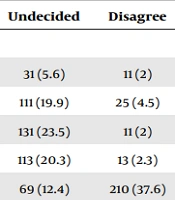
The frequency of answers given to the questions of gastric cancer knowledge is shown in Table 2, and the frequency of answers given to attitude and practice variables is shown in Table 3. Based on the results, 92.7% of the students considered a nitrate-containing diet as one of the risk factors for gastric cancer. More than 40% of the students also believed that Helicobacter infection and smoking play a substantial role in the incidence of gastric cancer; nevertheless, the consumption of vegetables can prevent gastric cancer. More than 35% of students also believed that gastric cancer could be prevented. Moreover, according to the results related to the practice of students showing preventive behaviors, more than 70% of the students did not use cigarettes, hookah, or alcohol at all.
Table 2.
Frequency of Answers of Medical Science Students Given to the Questions of Gastric Cancer Knowledge a
| Knowledge Questions | Yes | Don’t Know | No |
|---|---|---|---|
| A diet high in spicy and smoked foods can cause gastric cancer. | 452 (81) | 88 (15.8) | 18 (3.2) |
| Nitrate-containing diets, such as sausage and nonsense, might contribute to gastric cancer. | 517 (92.7) | 40 (7.2) | 1 (0.1) |
| Chemical freezing of food might be a risk factor for gastric cancer. | 413 (74) | 140 (25.1) | 5 (0.9) |
| Smoking contributes to gastric cancer. | 460 (82.4) | 64 (11.5) | 34 (6.1) |
| Drinking cold water affects gastric cancer. | 241 (43.2) | 245 (43.7) | 72 (13.1) |
| Alcohol consumption contributes to gastric cancer. | 485 (86.9) | 55 (9.9) | 18 (3.2) |
| Gastric infection is a risk factor for gastric cancer. | 454 (81.4) | 94 (16.8) | 10 (1.8) |
| A family history of gastric cancer is a cancer risk factor. | 485 (86.9) | 60 (10.8) | 13 (2.3) |
| Weight loss is a symptom of gastric cancer. | 365 (65.4) | 180 (32.3) | 13 (2.3) |
| Dysphagia is observed in gastric cancer. | 283 (50.7) | 208 (37.3) | 67 (12) |
| Early satiety is a symptom of gastric cancer. | 275 (49.3) | 257 (45.9) | 26 (4.8) |
| Bloating is a symptom of gastric cancer. | 220 (39.4) | 296 (53) | 42 (7.6) |
| Hematemesis is observed in gastric cancer. | 414 (74.2) | 134 (24) | 10 (1.8) |
| Joint pain and dark skin are signs of gastric cancer. | 152 (27.2) | 349 (62.6) | 57 (10.2) |
| Gastric cancer causes bloody stool. | 365 (65.4) | 156 (28) | 37 (6.6) |
| Recurrent nausea and vomiting are symptoms of gastric cancer. | 445 (79.9) | 104 (18.6) | 9 (1.5) |
| Gastric cancer causes anemia. | 379 (67.9) | 159 (28.5) | 20 (3.6) |
| Fresh fruits and vegetables prevent gastric cancer. | 487 (87.3) | 64 (11.5) | 7 (1.2) |
| Antibiotics used to treat gastric infections prevent gastric cancer. | 294 (52.7) | 222 (39.8) | 42 (7.5) |
| Smoking cessation is effective in preventing gastric cancer. | 469 (84.1) | 78 (14) | 11 (1.9) |
| Abstinence from alcohol is effective in preventing gastric cancer. | 497 (89.1) | 54 (9.6) | 7 (1.3) |
| Eating fresh food helps prevent gastric cancer. | 482 (86.4) | 70 (12.5) | 6 (1.1) |
| Preventing dental infections can prevent gastric cancer. | 279 (50) | 271 (48.6) | 8 (1.4) |
| Avoiding frozen foods can prevent gastric cancer. | 418 (74.9) | 139 (24.9) | 1 (0.2) |
| If you have a family history of gastric cancer, other family members should be followed up. | 495 (88.7) | 53 (9.5) | 10 (1.8) |
| Eating spicy and smoked foods reduces the incidence of gastric cancer. | 149 (26.7) | 83 (14.9) | 326 (58.4) |
| Gastric cancer can be treated. | 363 (65.1) | 163 (29.2) | 32 (5.7) |
| Surgery is used for the management of gastric cancer. | 361 (64.7) | 180 (32.3) | 17 (3) |
| Chemotherapy and radiation therapy are effective in treating gastric cancer. | 439 (78.7) | 113 (20.3) | 6 (1) |
a Values are expressed as No. (%).
Table 3.
Frequency of Answers of Medical Science Students Given to the Questions of Gastric Cancer Attitude and Practice a
| Strongly Agree | Agree | Undecided | Disagree | Strongly Disagree | |
|---|---|---|---|---|---|
| Attitude questions | |||||
| In my opinion, gastric cancer can be prevented. | 199 (35.7) | 316 (56.6) | 31 (5.6) | 11 (2) | 1 (0.2) |
| In my opinion, gastric cancer can be treated. | 116 (20.8) | 304 (54.5) | 111 (19.9) | 25 (4.5) | 2 (0.4) |
| In my opinion, early gastric cancer can be diagnosed by screening. | 136 (24.4) | 278 (49.8) | 131 (23.5) | 11 (2) | 2 (0.4) |
| In my opinion, the consumption of smoked food causes gastric cancer. | 172 (30.8) | 257 (46.1) | 113 (20.3) | 13 (2.3) | 3 (0.5) |
| I think alcohol consumption does not have any role in gastric cancer. | 34 (6.1) | 51 (9.1) | 69 (12.4) | 210 (37.6) | 194 (34.8) |
| I think that the consumption of pickles can cause gastric cancer. | 76 (13.6) | 178 (31.9) | 238 (42.7) | 58 (10.4) | 8 (1.4) |
| I think that smoking can cause gastric cancer. | 229 (41) | 237 (42.5) | 73 (13.1) | 18 (3.2) | 1 (0.2) |
| I think that Helicobacter pylori infection can cause gastric cancer. | 225 (40.3) | 208 (37.3) | 110 (19.7) | 12 (2.2) | 3 (0.5) |
| I think weight loss can be a symptom of gastric cancer. | 150 (26.9) | 244 (43.7) | 149 (26.7) | 13 (2.3) | 2 (0.4) |
| I think dysphagia can be a symptom of gastric cancer. | 111 (19.9) | 210 (37.6) | 205 (36.7) | 29 (5.2) | 3 (0.5) |
| I think anemia can be a symptom of gastric cancer. | 174 (31.2) | 223 (40) | 147 (26.3) | 12 (2.2) | 2 (0.4) |
| I think hematemesis can be a symptom of gastric cancer. | 144 (25.8) | 278 (49.8) | 129 (23.1) | 5 (0.9) | 2 (0.4) |
| In my opinion, early satiety can be a symptom of gastric cancer. | 115 (20.6) | 195 (34.9) | 231 (41.4) | 16 (2.9) | 1 (0.2) |
| To my mind, eating fresh vegetables can prevent gastric cancer. | 232 (41.6) | 247 (44.3) | 70 (12.5) | 6 (1.1) | 3 (0.5) |
| In my opinion, quitting smoking can help prevent gastric cancer. | 217 (38.9) | 239 (42.8) | 239 (42.8) | 89 (15.9) | 13 (2.3) |
| I suppose that eating frozen foods can prevent gastric cancer. | 69 (12.4) | 105 (18.8) | 142 (25.4) | 158 (28.3) | 84 (15.1) |
| I suppose that eating spicy foods can prevent gastric cancer. | 46 (8.2) | 81 (14.5) | 170 (30.5) | 182 (32.6) | 79 (14.2) |
| I suppose that eating salty foods can prevent gastric cancer. | 41 (7.3) | 48 (8.6) | 246 (44.1) | 152 (27.2) | 71 (12.7) |
| Always | Very Often | Sometimes | Rarely | Never | |
| Practice questions | |||||
| I eat smoked food. | 3 (0.5) | 24 (4.3) | 260 (46.6) | 192 (34.4) | 79 (14.2) |
| I include vegetables in my diet. | 85 (15.2) | 223 (40) | 207 (37.1) | 35 (3.6) | 8 (1.4) |
| I smoke cigarettes. | 10 (1.8) | 14 (2.5) | 31 (5.6) | 57 (10.2) | 446 (79.9) |
| I smoke hookah. | 4 (0.7) | 14 (2.5) | 49 (8.8) | 68 (12.2) | 423 (75.8) |
| I take salt with food. | 62 (11.1) | 158 (28.3) | 196 (35.1) | 115 (20.6) | 27 (4.8) |
| I exercise or walk for at least 30 minutes a day. | 87 (15.6) | 136 (24.4) | 196 (35.1) | 104 (18.6) | 35 (6.3) |
| I drink alcohol. | 2 (0.4) | 7 (1.3) | 43 (7.7) | 53 (9.5) | 453 (81.2) |
| I take pickles with food. | 16 (2.9) | 71 (12.7) | 232 (41.6) | 173 (31) | 66 (11.8) |
| I include fruits in my diet. | 120 (21.5) | 228 (40.9) | 191 (34.2) | 15 (2.7) | 4 (0.7) |
| I eat fast food. | 20 (3.6) | 93 (16.7) | 316 (56.6) | 114 (20.4) | 15 (2.7) |
| I have regular eating habits. | 53 (9.5) | 200 (35.8) | 210 (37.6) | 74 (13.3) | 21 (3.8) |
a Values are expressed as No. (%).
The mean score of knowledge with four subscales, attitude with four subscales, and practice are shown in Table 4. The mean scores of knowledge, attitude, and practice were 19.80 ± 4.92, 69.39 ± 7.57, and 40.68 ± 4.17, respectively. In total, 11.1%, 61.5%, and 27.4% of students had poor, moderate, and good knowledge, respectively. Additionally, 85.3% and 14.7% of students had a moderate and good attitude, respectively. Moreover, 93.2% and 6.8% of students had moderate and favorable practice, respectively.
Table 4.
Descriptive Data for Outcome Variables, Including Knowledge, Attitude, and Practice, in Medical Science Students (N = 558)
| Outcome Variables | Mean ± SD | Range in the Scales |
|---|---|---|
| KoR | 5.9857 ± 1.32229 | 0 - 8 |
| KoS | 5.0233 ± 2.33569 | 0 - 9 |
| KoP | 6.7151 ± 1.80946 | 0 - 9 |
| KoT | 2.0842 ± 1.03705 | 0 - 3 |
| Total knowledge | 19.8082 ± 4.92939 | 0 - 29 |
| ATSc | 12.1237 ± 1.69616 | 3 - 15 |
| ATR | 19.7168 ± 2.63428 | 5 - 25 |
| ATS | 19.3781 ± 3.16943 | 5 - 25 |
| ATP | 18.1774 ± 3.30264 | 5 - 25 |
| Total attitude | 69.3961 ± 7.57221 | 18 - 90 |
| Practice | 40.6846 ± 4.17406 | 11 - 55 |
Abbreviations: SD, standard deviation; KoR, knowledge of risk factor; KoS, knowledge of symptoms; KoP, knowledge of prevention; KoT, knowledge of treatment; ATSC, attitude toward screening; ATR, attitude toward risk factor; ATS, attitude toward symptoms; ATP, attitude toward prevention.
4. Results
A correlation matrix was created as a prerequisite for regression analysis. A significant positive correlation was observed between practice with knowledge (r = 0.15, P < 0.001) and attitudes (r = 0.21, P < 0.001). In addition, a significant positive correlation was established between knowledge and attitude (r = 0.59, P < 0.001) (Table 5).
Table 5.
Correlation Matrix Between Variables of Knowledge, Attitude, and Practice in Medical Science Students
| Variables | r (P-Value) | |||||
|---|---|---|---|---|---|---|
| ATSc | ATR | ATS | ATP | Total Attitude | Practice | |
| KoR | 0.207 (< 0.001) | 0.459 (< 0.001) | 0.397 (< 0.001) | 0.163 (< 0.001) | 0.433 (< 0.001) | 0.131 (0.002) |
| KoS | 0.215 (< 0.001) | 0.359 (< 0.001) | 0.657 (< 0.001) | 0.145 (< 0.001) | 0.511 (< 0.001) | 0.069 (0.102) |
| KoP | 0.272 (< 0.001) | 0.475 (< 0.001) | 0.384 (< 0.001) | 0.240 (< 0.001) | 0.492 (< 0.001) | 0.184 (< 0.001) |
| KoT | 0.331 (< 0.001) | 0.178 (< 0.001) | 0.279 (< 0.001) | 0.029 (0.492) | 0.273 (< 0.001) | 0.084 (0.048) |
| Total knowledge | 0.327 (< 0.001) | 0.505 (< 0.001) | 0.621 (< 0.001) | 0.207 (< 0.001) | 0.599 (< 0.001) | 0.153 (< 0.001) |
| ATSc | 1 | 0.398 (< 0.001) | 0.432 (< 0.001) | 0.01 (0.816) | 0.548 (< 0.001) | 0.124 (0.03) |
| ATR | 0.398 (< 0.001) | 1 | 0.540 (< 0.001) | 0.349 (< 0.001) | 0.815 (< 0.001) | 0.183 (< 0.001) |
| ATS | 0.432 (< 0.001) | 0.540 (< 0.001) | 1 | 0.151 (< 0.001) | 0.769 (< 0.001) | 0.126 (0.003) |
| ATP | 0.01 (0.816) | 0.349 (< 0.001) | 0.151 (< 0.001) | 1 | 0.623 (< 0.001) | 0.168 (< 0.001) |
| Total attitude | 0.548 (< 0.001) | 0.815 (< 0.001) | 0.769 (< 0.001) | 0.623 (< 0.001) | 1 | 0.217 (< 0.001) |
| Practice | 0.124 (0.03) | 0.183 (< 0.001) | 0.126 (0.003) | 0.168 (< 0.001) | 0.217 (< 0.001) | 1 |
Abbreviations: KoR, knowledge of risk factor; KoS, knowledge of symptoms; KoP, knowledge of prevention; KoT, knowledge of treatment; ATSc, attitude toward screening; ATR, attitude toward risk factor; ATS, attitude toward symptoms; ATP, attitude toward prevention.
Multiple linear regression analyses with a stepwise method were run to determine the predictors of practice in medical sciences students (Table 6). The results showed that the level of the overall attitude of medical sciences students (β = 0.167, P < 0.001) and knowledge of prevention (β = 0.102, P = 0.032) were significantly associated with the practice of medical sciences students. The model explained 5% of the variance in practice in the prevention of gastric cancer (F = 16.18, P < 0.001). The model also showed that improved attitude was associated with up to 0.092 improvements in practice levels, and increased prevention knowledge was associated with up to 0.235 improvements in practice levels.
Table 6.
Summary Results of Multiple Linear Regression Analyses with Practice as Dependent Variables
| Model | R | R2 | AdjR2 | Independent Variables | B | SE | β | t | P |
|---|---|---|---|---|---|---|---|---|---|
| Practice | 0.23 | 0.05 | 0.05 | Constant | 32.71 | 1.59 | - | 20.5 | < 0.001 |
| Total attitude | 0.092 | 0.026 | 0.167 | 3.52 | < 0.001 | ||||
| KoP | 0.235 | 0.109 | 0.102 | 2.154 | 0.032 |
Abbreviation: KoP, knowledge of prevention.
5. Discussion
This cross-sectional study was conducted to determine the levels of knowledge, attitude, and practice of students of Ahvaz Jundishapur University of Medical Sciences. This study also aimed at determining the predictive role of knowledge and attitude toward the practice of students regarding gastric cancer prevention.
As indicated by the results of the study, the majority of the students (55.4%) had moderate knowledge in the area of gastric cancer. This result is consistent with the results of studies conducted by Almaghrabi et al. and Huang et al. in Saudi Arabia and China, respectively (11, 27). In contrast to the results of the current study, the participants had little knowledge about gastric cancer in studies conducted by Aldosari et al. (28) and Liu et al. (7). These various results can be due to the different populations of these studies. All participants of the present study were students of medical sciences who are usually familiar with the basic concepts of cancer in their textbooks. However, the study population of the aforementioned studies consisted of the ordinary members of the society, who naturally have less knowledge than medical students.
Moreover, based on the results of the present study, the students had a good knowledge of the risk factors of gastric cancer. More than 93% of students considered a nitrate-containing diet as a perilous risk factor, and more than 80% of them believed that factors such as alcohol consumption, smoking, and family history were the most important risk factors for gastric cancer. Mahdi et al. conducted a study to specify the knowledge level of individuals undergoing screening for colon and gastric cancers. In this study, 90.3%, 84.3%, and 67% of the participants confirmed the role of alcohol consumption, smoking, and family history in the spread of gastric cancer, respectively (26). In Almaghrabi et al.’s study, more than 50% of the participants found alcohol and smoking as effective risk factors for gastric cancer (11). Since environmental factors and family history play a crucially significant role in the incidence of cancers, especially gastric cancer, an increase in knowledge about risk factors provides a good opportunity for preventing the disease and its related complications (8).
The results of the present study also indicated that students with higher levels of knowledge about risk factors had better practice in gastric cancer preventive behaviors; accordingly, about 81.2% of them stated that they did not use alcohol. Moreover, 79.9% and 75.8% of the students with higher levels of knowledge refused to smoke cigarettes and hookah, respectively. In Aldosari et al.’s study, 97% and 87% of the participants abstained from alcohol consumption and smoking, respectively, which is consistent with the present study’s results (28). The emphasis of this finding is on the necessity of promoting individuals’ level of knowledge in order to improve their practice. However, an important finding in the present study was the problem of insufficient knowledge with regard to the warning signs and symptoms. Although the students were familiar with the risk factors, they did not have adequate knowledge about some warning signs, such as abdominal fullness and early satiety, as the main symptoms of gastric cancer (29). Therefore, the aforementioned signs were not considered threatening from the viewpoint of the participants. Insufficient related knowledge in this area can be worrying as it can delay the diagnosis of the disease. As such, students might need to be educated about the warning signs of gastric cancer. In line with the current study’s results, Liu et al. showed in their study that their participants suffered from inadequate knowledge regarding the warning signs and considered this lack of knowledge as an important factor in the late diagnosis of gastric cancer (7).
Based on our knowledge, this is the first study in Iran that examines the practice of participants regarding gastric cancer preventive behaviors. In the present study, more than 92% of the participants have moderate practice with regard to the prevention of gastric cancer, which, considering their moderate knowledge and attitude, was somewhat predictable. In reviewing the literature, there was no study measuring the practice of individuals regarding gastric cancer protective behaviors. However, the results of other studies conducted on other types of cancer were indicative of the poor practice of individuals in showing protective behaviors (30-33), which is not consistent with the results of the present study. This discrepancy might be due to the different sorts of cancers examined in various studies. Gastric cancer is almost a known type of cancer, and its preventive factors are greatly known to the public, particularly medical students; therefore, it is not surprising that they have better practice in this regard. Nevertheless, more than 50% of the students reported that they sometimes eat fast food, and more than 40% of them also used pickles and smoked foods occasionally. Additionally, about 40% of the participants used salt almost regularly with their daily food. Given the fact that these are the main risk factors of gastric cancer (8), there can be an alarm for the increased prevalence of gastric cancer among young individuals in the future.
In this study, a significant difference was observed between some dimensions of knowledge, attitude, and practice among various age groups (< 22 and ≥ 22 years); accordingly, any increase in age could increase individuals’ knowledge of gastric cancer treatment significantly. This can be due to the fact that the knowledge of individuals improves with the increase of their age. However, the noteworthy point in this study was that the older the participants, the weaker their attitude and practice with regard to preventive behaviors and risk factors of gastric cancer. Since cancers are age-related diseases and they become more probable with the increase of age (34), this issue is of particular importance. As such, it is required to design interventions that can create a more appropriate attitude toward preventive behaviors in individuals and improve their practice.
Furthermore, as revealed by the results of the current study, students with experience of working in the hospital and students in clinical fields, such as medical and nursing students, have more knowledge than other students. This finding is not surprising as it could be attributed to the nature of the field of study and the education provided in clinical environments. It has also been shown in similar studies that being in clinical settings improves the knowledge of the participants (10, 35).
Examining the knowledge, attitude, and practice of the students showed no significant difference in these elements in terms of gender. This result has been supported by some previous studies (11, 12, 26-28). However, according to some studies, the knowledge of women is higher than men, which is probably due to the more interaction of women with healthcare systems as women are more worried about the health of their family members (7, 10). However, further studies should be conducted to talk with more certainty about the effect of gender on the level of knowledge, attitude, and practice.
Based on the results of the present study, there was a significantly positive relationship between the three variables of knowledge, attitude, and practice. Given the regression results, the total score of attitude and the dimension of knowledge predicted 5% of the practice variable in the area of knowledge. The regression model indicated that every increase in the total score of attitude improved the rate of practice by 0.09, and every increase in the score of knowledge and the prevention dimension promoted the rate of practice by 0.23. In line with the results of the present study, Romli et al. demonstrated in their study a positive and significant relationship between the level of knowledge and attitude and individuals’ practice regarding cervical cancer screening (36). Similarly, in a study by Alghamdi et al., the knowledge and attitude of participants had an effect on their practice with regard to colorectal cancer screening (37). This finding is supported by the KAP theory. This theory argues that the increased level of knowledge can change one’s attitude, which, in turn, will cause changes in one’s practice and behavior (38). The results of the studies conducted in this regard have shown that KAP-based training can increase and improve individuals’ knowledge, attitude, and practice (39, 40).
5.1. Strengths and Limitations of the Study
Measuring practice in the study is one of the present study’s strengths. To the best of our knowledge, this is the first study to measure the practice levels of medical sciences students in the field of prevention behaviors of gastric cancer. This study has several limitations. First, although the questions were tried to be as clear and obvious as possible, some of them were subjective (e.g., questions related to spices) in the sense that the participants might have a different perception of them. Moreover, as the present study was conducted on academics and medical students, its results might not be generalizable to all members of society. Finally, response bias can occur when participants respond to self-reported questionnaires.
5.2. Conclusions
As the results of the present study showed, the students of Ahvaz Jundishapur University of Medical Sciences have a moderate knowledge, attitude, and practice regarding gastric cancer prevention. The results also indicated that attitude had the biggest contribution to predicting the practice of students, and their knowledge of prevention was the next predictor of their practice level. Therefore, holding educational programs to increase individuals’ knowledge (especially with regard to warning signs and symptoms) and creating a positive attitude that can, consequently, improve their practice in primary prevention is useful. Given the significance of this disease and inadequate studies conducted in this area, it is suggested to carry out further studies on larger and more general populations.