
1. Background
Thalassemia is recognized as the most common inherited hemoglobinopathy disorder worldwide (1). This disorder is categorized into three clinical symptom-based groups: Minor, intermediate, and major (2). Its prevalence is the highest in some regions, such as South and Southeast Asia, the Middle East, Mediterranean countries, and Central Africa (3). As of 2018, there were approximately 30,000 individuals living with thalassemia in Iran, with an additional 1,000 individuals being diagnosed each year. These statistics underscore the significance of thalassemia in Iran (4).
Children afflicted with thalassemia require regular blood transfusions to prevent anemia-related complications and skeletal abnormalities. This lifelong and intricate treatment regimen can impact their emotional well-being, daily activities, family experience, vocational skills, and overall quality of life (5).
The World Health Organization defines quality of life as an individual’s perception of life, encompassing their values, aspirations, standards, and interests. There is a direct correlation between illness and quality of life, particularly in cases of chronic diseases. Physical ailments and symptoms can directly influence all facets of an individual’s quality of life (6). In a study by Hemmatipour et al., thalassemia patients reported a good quality of life (5). However, a study conducted in India by Shaligram et al. revealed that more than 74% of individuals with thalassemia major experienced a poor quality of life (7).
To enhance health and quality of life, the family-centered empowerment model has been developed, focusing on the role of the individual and other family members (8). The goal of empowerment is to bolster trust and positive adaptability, instilling hope and helping individuals regain a sense of control over their lives while aiding others in achieving their goals (9).
Educating family members based on the family-centered empowerment model has proved invaluable in disease prevention and management (10). When individuals are aware of the disease and its potential complications, they might feel vulnerable. At this stage, knowledge and attitudes among both the patient and the family need to be heightened. Rooted in family systems theory, this model places parents in a pivotal role in decision-making. The active participation of families in caring for their ailing children is a core element of this model (4).
Today, with the proliferation of communication technologies, new avenues for education have emerged. Consequently, the fusion of information and communication technology with the educational process facilitates learning and communication for clients, thereby enhancing their quality of life (11). Mobile learning, a subset of e-learning, offers learners easier access to educational content compared to other forms of e-learning (12, 13). Research in this field strongly supports this notion. El-Gayar et al.’s study, for instance, highlights the beneficial impact of mobile phone applications on the self-care practices of diabetic patients (14). Similarly, the research findings of Hemmatipour et al. demonstrate that the use of the family-centered empowerment model through multimedia instruction increases parental awareness and self-efficacy while improving the quality of life for these children (5).
2. Objectives
Recognizing the significance of family awareness and involvement in caring for these patients, this study aimed to investigate the impact of implementing the family-centered empowerment model via mobile learning on the quality of life of 6-12-year-old children with thalassemia.
3. Methods
3.1. Study Design and Population
This study employed a quasi-experimental design with pre-test and post-test evaluations conducted in 2021. The research population for this study comprises parents of children aged 6 - 12 years diagnosed with thalassemia major who were referred to the Thalassemia Center of Shafa Hospital in Ahvaz, Iran.
3.2. Sampling
From a pool of 172 individuals with medical records at this clinic, subjects were selected through convenience sampling based on the inclusion criteria (i.e., age range of 6 - 12 years, willingness to cooperate, parents acting as primary caregivers, literacy in reading and writing, and the primary caregiver’s ability to use a mobile phone) and the exclusion criteria (i.e., the presence of chronic diseases, mental disorders, patient’s death, and non-participation in two training sessions). The participants were then randomly allocated into two groups: The intervention group (n = 86) and the control group (n = 86), using a random allocation method with quadruple blocks. The subjects were matched in terms of age, gender, and disease duration (Figure 1). The sample size was determined to be 82 individuals per group using G*Power software (version 3.1), taking into account mean differences, standard deviations, a 95% confidence interval, and an 80% test power accounting for the potential dropout rate. Finally, 86 individuals were selected for each group.
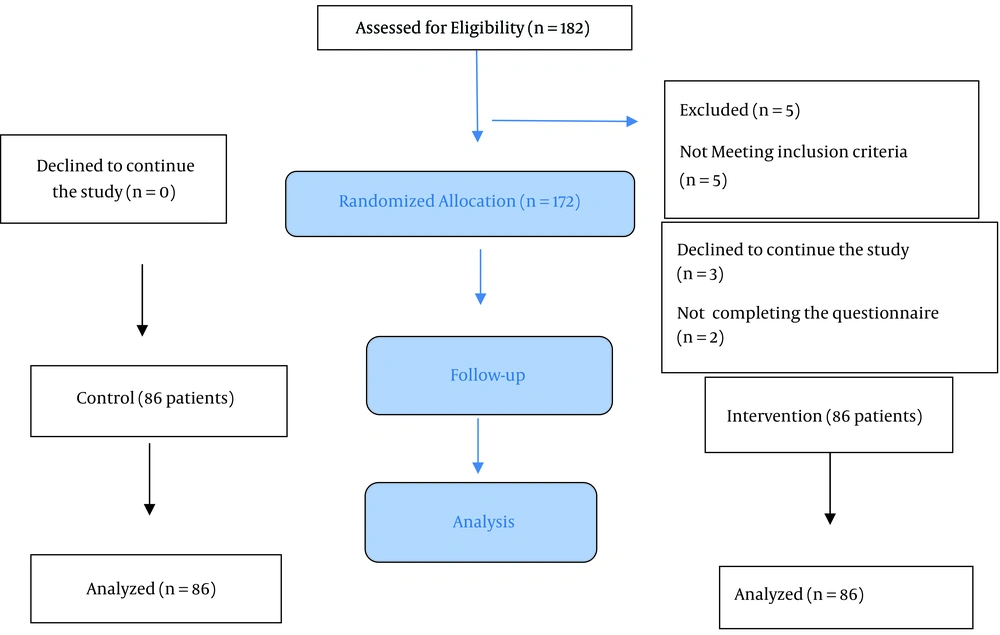
Figure 1.
CONSORT diagram of the participant selection and follow-up
3.3. Data Collection Tools
The data collection tools in this study included a demographic information form (including age, gender, duration of disease, and parents’ education), the Pediatric Quality of Life Inventory (Ped-SQL), and a researcher-made questionnaire to assess parents’ awareness and self-efficacy about the disease.
The Ped-SQL (15) consists of 23 items across 4 dimensions: Physical (8 items), emotional (5 items), social (5 items), and academic (5 items) health. Responses are recorded on a five-point Likert scale, namely never (0), rarely (1), sometimes (2), often (3), and always (4). A higher score indicates more problems and a lower quality of life. This questionnaire was translated and culturally normalized by Yaghmaei et al., and the reliability of the questionnaire was reported as 88% (16). In the present study, the reliability of the questionnaire was determined to be 89% based on Cronbach’s alpha.
The questionnaire used to assess parents’ awareness and self-efficacy was designed by a researcher in collaboration with two hematologists specializing in thalassemia. The awareness questionnaire comprises 30 four-choice items covering topics related to the nature of the disease, nutrition, complications, and prevention. A score of 1 is assigned to a correct answer, and a score of 0 is assigned to an incorrect answer. The scores are divided into three levels: Low (0 - 10), medium (11 - 20), and high (21 - 30).
The self-efficacy questionnaire consists of 17 five-choice statements with Likert scoring options, including never (0), rarely (1), sometimes (2), often (3), and always (4). The scores for self-efficacy are also divided into three levels: Low (0 - 22), medium (23 - 45), and high (46 - 68). The validity and reliability of the content of these questionnaires were approved by 10 university staff members with expertise in the subject of the study. For each question, the content validity ratio (CVR) exceeded 0.42, and the content validity index (CVI) exceeded 0.79, indicating acceptable content validity. The reliability of the questionnaires was assessed using Cronbach’s alpha, with a reliability coefficient of 87% and 83% for the awareness questionnaire and the self-efficacy questionnaire, respectively.
3.4. Intervention
In this study, a family-centered empowerment model based on mobile learning was adopted to achieve the goals (5, 17). To implement the program, after obtaining consent from the parents, an educational channel and an educational group were created on authorized national platforms. In these platforms, one family member of each patient was granted permission to enter, and it was closely monitored for control. The educational channel served as a one-way platform, delivering educational content virtually. However, the educational group was designed for interaction, questions, answers, feedback, and the exchange of opinions within the intervention group.
The second stage (intervention stage) was conducted exclusively for the test group; nevertheless, the control group received standard care. During this stage, the family-centered empowerment model was implemented in the intervention group once a week.
The first stage (perceived threat): This stage involves sending educational content in various formats, such as video, images, and audio files, to mobile phone platforms. The aim was to increase awareness and knowledge about the nature of the disease, emphasizing critical topics, such as physiology, symptoms, complications, prognosis, nutrition, and drug treatment of thalassemia. The participants received this content, and a total of 5 sessions were scheduled to cover different subjects. Weekly feedback was obtained through question-and-answer sessions and group discussions within the designated virtual space following the conclusion of each session.
The second stage (enhancement of self-efficacy): This stage focuses on improving self-efficacy among patients and their active family members. Three additional sessions, lasting 45-60 minutes each, were conducted by the researcher. These sessions included practical demonstrations of the necessary skills in a hospital setting, followed by the delivery of the skills via mobile phone. The goal was to enable patients to actively engage in the care program by correctly performing these skills under the supervision of their parents.
The third stage (increasing self-esteem through educational participation): This stage involved a problem-solving program conducted as two 45-60-minute group discussions within the virtual space. The participants shared their experiences related to the contents of the previous sessions and engaged in problem-solving processes. They proposed solutions to various challenges, and the best solution was selected collectively. Feedback on the educational materials was also evaluated during this stage. Family caregivers were encouraged to actively participate in teaching their patients about relevant issues and to motivate them to help themselves.
The fourth stage (evaluation) comprised 2 parts: Process evaluation and final evaluation. In each session, oral questions were used to ensure that participants had learned the content from the previous sessions. The final evaluation took place one and a half months after the last empowerment session (the third session). It involved completing the Ped-SQL questionnaire and the parents’ awareness and self-efficacy questionnaires in both the intervention and control groups, which were administered by sending a questionnaire link (17).
3.5. Ethical Considerations
After obtaining approval and confirmation from the Ethics Committee of Ahvaz Jundishapur University of Medical Sciences, under the research ethics code of IR.AJUMS.REC.1397.513, the researcher visited the thalassemia center. Written permission was obtained from the Research Vice-Chancellor of Ahvaz Jundishapur University of Medical Sciences, and written consent was obtained from the participants. Discussions about the intervention procedures were held, and contact information was collected. Subsequently, the Ped-SQL questionnaire was provided to the patients; however, the awareness and self-efficacy questionnaires were given to the active family members.
To uphold ethical standards throughout the research, once the study was completed, all educational content was shared with the patients and families in the control group during a public meeting. Additionally, offline software was provided to them for installation on their mobile phones. To prevent information exchange between the two distinct patient groups, the intervention group received blood transfusions on even days; nevertheless, the control group received blood transfusions on odd days according to the designated schedule.
3.6. Statistical Analysis
Data analysis was performed using SPSS software (version 21). Due to the non-normal distribution of the data, the Mann-Whitney U test was utilized to compare groups, the Wilcoxon test was used to compare the mean levels of variables, and the Pearson correlation coefficient was employed to assess relationships between variables. A P-value < 0.05 was considered statistically significant.
4. Results
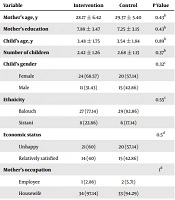
The present study included 176 pediatric patients diagnosed with thalassemia, with 72 (86.41%) of them being male. The mean age of the participants was 8.22 ± 5.24 years, and the mean duration of the disease was 5.75 ± 3.65 years (Table 1). The study’s findings demonstrated that before the intervention, 40 parents (46.5%) in the intervention group had a poor level of awareness. However, after the intervention, 69 parents (80.2%) exhibited a good level of awareness. The Wilcoxon test, used to assess the effect of the educational intervention, indicated a statistically significant increase in the intervention group only. Furthermore, the Mann-Whitney U test revealed that this increase was also significant when compared to the control group (P < 0.001).
Table 1.
Frequency and Percentage of Demographic Variables of the Participantsa
| Variables | Intervention Group | Control Group |
|---|---|---|
| Child gender | ||
| Female | 50 (29.6) | 50 (29.6) |
| Male | 36 (20.93) | 36 (20.93) |
| Parents’ education | ||
| School education | 36 (50.0) | 36 (50.0) |
| High school diploma | 35 (40.69) | 25 (14.53) |
| Academic education | 15 (20.83) | 25 (14.53) |
| Parents’ occupation | ||
| Self-employed | 40 (23.25) | 21 (12.20) |
| Employee | 16 (9.30) | 12 (6.97) |
| Worker | 30 (17.44) | 27 (15.69) |
| Child age (y) | 8.22 ± 5.24 | 9.57 ± 5.58 |
| Duration of disease | 5.75 ± 3.65 |
a Values are expressed as frequency (%) or mean ± standard deviation.
This study also investigated the self-efficacy level of parents in the intervention group before the intervention, with 60 individuals (69.7%) demonstrating poor self-efficacy. Following the intervention, 66 individuals (76.7%) showed improvement to a good level of self-efficacy. Nevertheless, the self-efficacy level of the control group remained poor in 56 individuals (65.1%) both before and after the intervention. The Wilcoxon test was used to assess the effect of the educational intervention, revealing a statistically significant increase in the intervention group (P = 0.002). Additionally, the Mann-Whitney U test showed that this increase was also significant when compared to the control group (P < 0.001) (Table 2).
Table 2.
Comparison of the Frequency and Mean Level of Awareness and Self-efficacy of Parents Before and After Intervention Between Intervention and Control Groups a
| Variables | Intervention Group | Control Group | P-Value Using the Mann-Whitney U Test |
|---|---|---|---|
| Awareness level | |||
| Before intervention | 0.174 | ||
| Poor | 40 (46.5) | 45 (52.3) | |
| Moderate | 35 (40.6) | 30 (34.8) | |
| Good | 11 (12.7) | 11 (12.7) | |
| Total | 11.45 ± 2.96 | 11.75 ± 3.78 | |
| After intervention | < 0.001 b | ||
| Poor | 0 (0) | 45 (52.3) | |
| Moderate | 15 (17.4) | 30 (34.8) | |
| Good | 69 (80.2) | 11 (12.7) | |
| Total | 23.80 ± 4.82 | 11.75 ± 3.78 | |
| P-value using the Wilcoxon test | < 0.001 b | 0.54 | |
| Self-efficacy level | |||
| Before intervention | 0.371 | ||
| Poor | 60 (69.7) | 56 (65.1) | |
| Moderate | 12 (13.9) | 19 (22.0) | |
| Good | 14 (16.2) | 11 (12.7) | |
| Total | 48.65 ± 13.02 | 36.85 ± 4.65 | |
| After intervention | < 0.001 b | ||
| Poor | 12 (13.9) | 56 (65.1) | |
| Moderate | 18 (20.9) | 19 (22.0) | |
| Good | 66 (76.7) | 11 (12.7) | |
| Total | 61.10 ± 18.28 | 36.85 ± 4.65 | |
| P-value using the Wilcoxon test | 0.002 | 0.731 |
a Values are expressed as frequency (%) or mean ± standard deviation.
b P value was significant.
Regarding the variable of children’s quality of life, the results of the study indicated that 54 (62.7%) of the children who received the intervention exhibited a good level of quality of life following the intervention; however, both before and after the educational intervention, the quality of life of 46 (53.4%) of the children in the control group was reported to be poor. The Mann-Whitney U test was employed to determine that the children’s quality of life exhibited a statistically significant increase compared to the control group (P < 0.001) (Table 3). The study findings suggest that some variables, such as age, gender, duration of the disease, and parents’ educational level, did not have a statistically significant effect on the awareness, self-efficacy of parents, and quality of life of the children (P < 0.05).
Table 3.
Comparison of the Frequency and Mean Quality of Life of Children Before and After Intervention Between Intervention and Control Groups a
| Variables | Intervention Group | Control Group | P-Value Using the Mann-Whitney U Test |
|---|---|---|---|
| Quality of life of children | |||
| Before intervention | |||
| Poor | 13 (15.1) | 46 (53.4) | < 0.001 b |
| Moderate | 34 (39.5) | 22 (25.5) | |
| Good | 39 (45.3) | 18 (20.9) | |
| Total | 17.45±4.01 | 14.45 ± 3.01 | |
| After intervention | |||
| Poor | 10 (11.6) | 46 (53.4) | < 0.001 b |
| Moderate | 22 (23.2) | 22 (25.5) | |
| Good | 54 (62.7) | 18 (20.9) | |
| Total | 53.70 ± 12.06 | 14.45 ± 3.01 | |
| P-value using the Wilcoxon test | < 0.001 b | 0.606 |
a Values are expressed as frequency (%) or mean ± standard deviation.
b P value was significant.
5. Discussion
The findings of the present study suggest that the utilization of mobile learning as an educational approach had a significant effect on the quality of life of children, leading to an improvement in their overall quality of life. The study’s results showed a significant improvement in the quality of life of the intervention group following the intervention and when compared to the control group. A study conducted by Ghazisaeedi et al. demonstrated a favorable impact of caregivers’ mobile phone usage on the quality of care provided to children diagnosed with cerebral palsy (18). According to a study by Franck et al. in California, United States, the utilization of a novel mobile application can be an efficient and valuable means of promoting parental involvement in caregiving (19).
Additionally, in a study by Hemmatipour et al., the use of a family-centered empowerment model based on multimedia training has been associated with an increase in the quality of life of thalassemia patients (5). It is worth noting that in Borhani et al.’s study, the implementation of this model had a significant positive effect on the quality of life of thalassemia patients in both the intervention and control groups (20). However, in Dehnoalian et al.’s study, the implementation of this model had no effect on the physical dimension and general health of children with thalassemia, which is not consistent with the present study’s results (21). According to the researchers, this inconsistency with the results of the present study might be attributed to the number of training sessions, the economic situation, the method of training, and the different tools used to measure the quality of life in the studies. In the current study, this model was implemented using mobile phones and the PedS-QL quality-of-life measurement tool. However, other studies have used the SF-36 questionnaire. The employment of a family-centered empowerment model utilizing mobile devices has the potential to generate enthusiasm and engagement among children afflicted with chronic illnesses and their respective families (22). Disease management methods and the use of educational interventions can provide more detailed information for patients and their caregivers compared to traditional care. Furthermore, empowerment programs increase self-confidence in patient self-care (23).
The findings indicated that the utilization of a mobile phone-based approach to implementing the family-centered empowerment model resulted in a significant improvement in the awareness levels of parents in the intervention group, compared to pre-intervention, which was statistically significant. The observed increase in awareness was significant in comparison to the control group. No significant changes were noted in the control group. A study by Varni et al. demonstrated a favorable impact of mobile learning on self-care behavior awareness of 91 patients diagnosed with thalassemia major (24). According to a study by Rhee et al., the utilization of mobile phones resulted in enhanced awareness and self-regulation among 50 individuals diagnosed with type 2 diabetes in terms of medication adherence, dietary habits, and blood glucose regulation (25). Children who suffer from chronic diseases rely on their guardians for medical care, including medication administration. If those parents possess inadequate expertise in this regard, they might encounter challenges with adhering to medication schedules and managing the disease. According to Ross, the utilization of mobile devices in this field presents a noteworthy prospect for enhancing parental education with greater accessibility and lower expenses (26).
The present study revealed that the family-centered empowerment model through mobile learning resulted in a significant enhancement of self-efficacy solely in the intervention group. Furthermore, this increase was found to be statistically significant when compared to the control group. In a study by Shamsizadeh et al., 58 patients diagnosed with type 2 diabetes were examined for the effect of mobile phone usage on their self-efficacy in managing diabetes. The results indicated a positive correlation between the two variables (27). In a study by Hemmatipour et al., the use of this model based on multimedia showed an increase in the self-efficacy of parents (5). According to a study by Rhee, the utilization of mobile phones as a means of education has resulted in a significant improvement in the self-efficacy of individuals suffering from asthma (25). The objective of self-efficacy in the context of thalassemia disease is associated with the development of self-assurance in the precise comprehension of the disease and its related symptoms. In the present study, self-efficacy is important in the empowerment of the parents in recognizing risk factors and the use of chelating agents. According to Chen and Li, research on empowerment has demonstrated its efficacy in enhancing the quality of life for individuals with chronic diseases (28).
5.1. Limitations
One of the limitations of this study is the strict control of the samples from training based on other educational methods and resources and the counseling sessions they received in routine care programs. Differences in psychological characteristics, interpersonal interactions with patients, and variations in individuals’ motivations and personalities are factors that cannot be controlled by the researcher but might affect learning, self-efficacy, and, subsequently, empowerment.
5.2. Conclusions
The results of the current study indicated that the adoption of mobile-based empowerment facilitates the identification of shortcomings and the development of resilience among parents of children with thalassemia. This, in turn, has led to an enhancement in the quality of life of these children, as their parents have become more aware and self-efficacious. The present investigation concerns the family empowerment initiative implemented among parents of children diagnosed with thalassemia, which has yielded favorable outcomes. It is recommended that this program be implemented on a broader scale for parents and other family members and that advanced and practical technologies be incorporated in clinical settings.