
1. Background
Patients hospitalized in intensive care units (ICUs) are prone to malnutrition due to the stress caused by trauma, the special environment of the ICU, and hormonal changes in their body (1). Therefore, nutritional support is considered necessary and vital. The prevalence of malnutrition in developing and developed countries is 70% and 50%, respectively, and in ICU patients, it is generally 10 - 70%. The prevalence of malnutrition in Iranian ICUs is estimated at 43% (2, 3). An important factor such as proper nutrition reduces infection, improves tissue repair, improves muscle strength, enhances the isolation process of patients, reduces the stay in the ICU, and decreases mortality (4).
The knowledge and ability of ICU nurses have a special role in patient nutrition, which ranges from identifying susceptible or malnourished patients to participating in standard nutrition protocols to treat or prevent malnutrition. Carrying out the process of feeding patients requires key nursing skills and sufficient knowledge about nutrition to prevent the development of clinical complications of malnutrition in critically ill patients (5).
Currently, patients hospitalized in ICUs, due to their inability to meet their nutritional needs, often need to have a feeding tube inserted. In these patients, the artificial feeding method is necessarily used, which includes enteral tube and intravenous feeding. Studies and evidence show that enteral feeding is preferable to intravenous feeding (6). The most commonly used feeding tubes are nasogastric tubes, which are used in a wide range of ICUs (7).
In fact, the implementation of tube feeding is one of the responsibilities of nurses, and if it is combined with good nursing care and management, it will play a key role in the success of this supportive feeding method (8). The role of nurses in tube feeding includes: Placing a nasogastric tube, prescribing food and medicine, preventing complications related to tube feeding, and checking the patient's response to tube feeding. Since the role of nurses is vital in tube feeding and patient care, their knowledge and performance regarding tube feeding will be effective on the clinical consequences of patients (9).
It is essential that all members of the healthcare team in the ICU, especially nurses, have adequate nutrition knowledge. Ensuring that patients receive proper enteral nutrition can help them recover (10). Using a nurse-based feeding protocol can help improve the delivery of enteral nutrition in patients without increasing gastrointestinal symptoms or intra-abdominal blood pressure (11).
A number of studies conducted show that nurses do not have enough knowledge about tube feeding, and the performance and nursing care of patients with tube feeding is often based on previous training and habits. However, for the implementation of this method of feeding and the best care, nurses must receive the necessary training related to tube feeding in a standard way (12).
The results of studies by Ahmadli et al. (13) as well as Mehrnoosh et al. (14) in Iran showed that the average performance score of nurses in this case was at an average level. In Shahin et al.'s study, examining the knowledge and performance of Egyptian nurses regarding enteral nutrition in the ICU, only 15 nurses out of 85 had adequate knowledge about enteral nutrition (15). In the study of Al Kalaldeh et al., the level of knowledge and responsibility of Jordanian nurses regarding enteral nutrition showed that nurses exhibited a higher level of knowledge and responsibility in relation to the prevention of complications and nutritional evaluation compared to monitoring and achieving goals (16). The findings of Jahantigh et al. in a descriptive study in Zahedan, the center of one of the eastern provinces of Iran, showed that the performance of nurses in tube feeding in the ICU is below average (17).
Considering the importance of nutrition, especially tube feeding in patients hospitalized in ICUs, and the close relationship between the knowledge and skills of nurses, as well as the awareness and optimal performance of nurses, it seems necessary to improve the level of awareness and performance of nurses by providing the necessary training in this field. Choosing the right educational method that aligns with the purpose, educational content, and culture of the audience is one of the most important actions in the planning process for education (18).
The use of educational methods such as face-to-face education always brings significant costs, while the use of electronic education can reduce these educational costs. With the help of electronic and virtual learning, educational justice is achieved, and learning opportunities are provided for people at any time and in any place, regardless of their budget (19).
New styles of educational activities have emerged, which today are called electronic learning (e-learning) (16). "e-learning," as a new mechanism, emphasizes the wide and varied use of educational methods. One of the basic principles of electronic education is the selection and use of tools that suit the learner's situation to improve the quality of education. By using various tools and advanced technologies, e-learning aims to enhance the quality and quantitative development of educational activities (20).
Among the common methods in electronic education, we can mention teaching through social networks. e-learning involves the use of software such as Facebook, WhatsApp, Telegram, etc. (16).
Today, social networks play an active role in people's lives worldwide. Social networks are internet-based platforms where people, groups, and organizations gather based on shared characteristics and topics. The increase in internet use in Iran is significant, with Iranian users ranking fifth in the use of these networks (21). Globally, the use of Telegram and WhatsApp in countries such as the United States, Russia, Italy, and Spain follows that of Iranian users (22).
Some other benefits of using social media include increased access to people regardless of age, education, race, or place of residence, as well as boosting self-confidence and a sense of ownership. Moreover, the WhatsApp social network provides the capability of simultaneous interaction, enabling the evaluation of learner interest and responsiveness. Consequently, this method has higher efficiency compared to traditional methods. For nurses who face challenges in attending face-to-face training workshops, social networks such as WhatsApp prove to be highly effective (23).
By using electronic training courses such as WhatsApp, there is no need for a physical training space for employees, which can significantly reduce the costs associated with creating and maintaining the training space (16). The reason for choosing WhatsApp software in this study was its ease of use and availability for most people in society, as well as the conditions at the time of conducting this research during the COVID-19 pandemic. Therefore, this research was conducted with the aim of determining the effect of e-learning through WhatsApp software on the knowledge and performance of ICU nurses regarding tube feeding.
2. Objectives
- Comparing the level of knowledge of nurses regarding tube feeding before and after the intervention in two intervention and control groups in the special care department
This section involves assessing and comparing the knowledge levels of nurses about tube feeding in both the intervention and control groups before and after the intervention.
- Comparing the performance level of nurses in relation to tube feeding before and after the intervention in two intervention and control groups in the special care department
3. Methods
3.1. Study Design, Setting, and Definition
This quasi-experimental study was conducted with a pretest-posttest design between October 2020 and September 2022, after approval from the ethics committee (code number: IR.AJUMS.REC.1399.852) of the research vice-chancellor of Ahvaz University of Medical Sciences. The administrative process was carried out in the ICUs of Imam and Golestan hospitals in Ahvaz city, Iran. The research objectives, process, intervention details, freedom to withdraw from the study, and confidentiality of personal information were explained in detail to the participating nurses, and informed consent forms were signed by them.
The inclusion criteria were having at least a bachelor's degree in nursing and performing at least two cases of tube feeding for patients before and after the intervention. The exclusion criteria included transfer to another department, non-participation in two or more sessions of the virtual workshop, or failure to read the educational materials.
The sample size was calculated based on the results of previous studies (13, 16) using the following formula with a 95% confidence interval and a power of 90%: S1 = 33.1, S2 = 54.3, X1 - X2 = 22, Z1-α/2 = 1.96, Z1-β = 1.28
Participants were recruited and divided into two groups—control and intervention—using the random allocation method with permutation blocks. Data were collected through a questionnaire and a checklist to record the baseline knowledge and performance levels of nurses regarding tube feeding.
The knowledge level questionnaire was completed by the researcher using the interview method during tube feeding, before any intervention, for both control and intervention groups. Similarly, the performance level checklist was completed through observation during tube feeding, prior to any intervention, for both groups.
To ensure reliability, a research assistant simultaneously completed the performance level checklist separately from the researcher during the observation process. The Kappa coefficient was then calculated to assess inter-rater reliability. Upon determining that the Kappa value was greater than 0.7, indicating satisfactory agreement, the researchers proceeded to observe the nurses' performance using the relevant checklist.
The intervention was conducted by compiling educational content based on standard guidelines for tube feeding in ICUs. The content was reviewed by five experts in the field, and their corrective suggestions were incorporated. The intervention consisted of 8 training sessions, each lasting 45 minutes, conducted by the researcher in the form of offline PowerPoint presentations and online question-and-answer discussions via WhatsApp. The sessions were scheduled at times convenient for the participants, with two sessions held per week. The training content included the following topics: Nutrition and its importance in ICU patients, the importance of macronutrients (carbohydrates, protein, fat, and water) and micronutrients (vitamins and minerals), enteral nutrition, its benefits, and complications, the role and importance of nurses in tube feeding, indications, contraindications, benefits, and side effects of tube feeding, nursing care before, during, and after tube feeding, and nursing care before, during, and after administering medication through the feeding tube. The control group did not receive any training. Two weeks after completing the training, the knowledge questionnaire and performance checklist were administered again for both the control and intervention groups. These assessments were completed by the researcher and a research assistant (a staff member from the same location). To ensure the accuracy of assessing nurses' actual performance in tube feeding, the performance checklist was completed without prior notice to the participants.
3.2. Data Collection
The data collection tools included questionnaires on demographic characteristics and the assessment of nurses' knowledge and awareness regarding tube feeding, as well as a checklist for tube feeding, designed by Ahmadli et al. (13).
The demographic information form included age, sex, race, educational qualification, marital status, work experience, and department name. The tube feeding knowledge assessment questionnaire consisted of 25 questions. Each correct answer was awarded 1 point, while each wrong answer received 0 points. The score ranges were as follows: 0 - 33 (poor), 34 - 66 (moderate), and 67 - 100 (good) (13). The performance checklist for tube feeding included 31 items covering measures before, during, and after the implementation of tube feeding. Each item in the checklist was scored based on four criteria: Correctly done (2 marks); incorrectly done (1 mark); not done (0 marks); not applicable (neutral and removed).
The content validity ratio (CVR) of the knowledge questionnaire was calculated as 0.72, and for the performance checklist, it was 0.85 (13).
3.3. Statistical Analysis
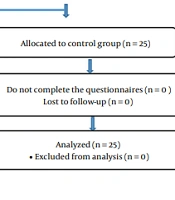
Data analysis was performed using descriptive-analytical statistics with SPSS version 22 statistical software. Descriptive statistics, including percentage, frequency distribution, mean, and standard deviation, were used. Analytical statistical tests, such as paired t-test, independent t-test, chi-square test, and covariance analysis, were applied to analyze the data. A significance level of 0.05 was considered (Figure 1).
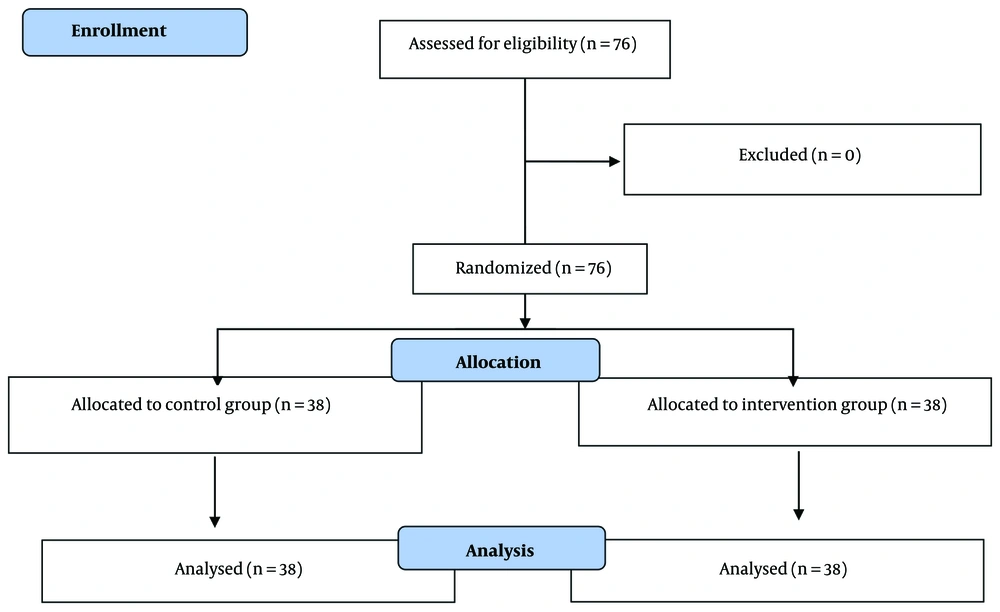
Figure 1.
Study flow diagram
4. Results
4.1. Patient Characteristics and Clinical Data
The demographic information of participants was analyzed separately for the intervention and control groups. The results indicated that the highest percentage of participants in both groups were women (89.5% in the control group and 63.2% in the intervention group). Most participants worked rotating shifts (86.8% in the control group and 84.2% in the intervention group). Additionally, the majority of nurses in both groups had a bachelor's degree (92.1% in the control group and 97.4% in the intervention group).
Statistical analysis showed no significant difference between the two groups in terms of shift work status, employment status, level of education, average age, years of service, or clinical work experience in the ICU (P = 0.5). However, there was a significant difference between the two groups regarding gender (P = 0.014) (Table 1).
Table 1.
Comparison of Demographic Characteristics of Intervention and Control Groups a
| Qualitative Variables | Control Group | Intervention Group | P-Value |
|---|---|---|---|
| Gender | 0.014 b | ||
| Man | 4 (10.5) | 14 (36.8) | |
| Woman | 34 (89.5) | 24 (63.2) | |
| Shift work | 0.99 b | ||
| Fix morning shift | 5 (13.2) | 6 (15.8) | |
| Rotating shift | 33 (86.8) | 32 (84.2) | |
| Level of education | 0.615 b | ||
| BSc. | 35 (92.1) | 37 (97.4) | |
| MSc. | 3 (7.9) | 1 (2.6) | |
| Age (y) | 33.157 ± 6.09 | 33.00 ± 7.43 | 0.920 c |
| Years of service | 9.78 ± 5.78 | 8.82 ± 6.75 | 0.515 c |
| Clinical experience in ICU | 6.61 ± 5.42 | 5.66 ± 5.67 | 0.472 c |
a Values are presented as No. (%) or mean ± SD.
b Chi-square.
c Independent t-test.
4.2. Outcomes
Data analysis revealed a statistically significant difference in the average baseline knowledge scores between the control and intervention groups (P = 0.013), with the control group scoring higher than the intervention group at the outset. After the intervention, the results indicated a significant difference between the two groups (P = 0.002), but this time, the knowledge score of the intervention group was higher than that of the control group.
Using a paired t-test, it was found that there was no statistically significant difference in the knowledge scores before and after the study in the control group (P = 0.279). However, in the intervention group, there was a statistically significant difference in knowledge scores before and after the intervention (P < 0.001), with the post-intervention knowledge score being higher than the pre-intervention score (Table 2).
Table 2.
Comparison of Mean Knowledge Scores Before and After the Intervention in Both Studied Groups a
| Variables | Control Group | Intervention Group | P-Value b |
|---|---|---|---|
| Before | 15.62 ± 2.57 | 13.81 ± 3.49 | 0.013 |
| After | 15.05 ± 2.40 | 17.73 ± 4.56 | 0.002 |
| P-value c | 0.279 | < 0.001 | - |
a Values are presented as mean ± SD.
b Independent t-test.
c Paired t-test.
To compare the knowledge score after the intervention while controlling for confounding effects and the potential influence of the pre-intervention knowledge score, analysis of covariance (ANCOVA) was utilized. After controlling for the effect of gender, the average knowledge score post-intervention in the intervention and control groups was found to be statistically significant (P = 0.001) (Table 3).
Table 3.
Comparison the Mean Knowledge Scores After the Intervention in Two Intervention and Control Groups by Controlling the Effect of Gender a
| Variables | F | P-Value |
|---|---|---|
| Gender | 0.564 | 0.455 |
| Group (intervention and control) | 13.27 | 0.001 |
a Covariance test.
The results showed no statistically significant difference in the mean baseline performance scores between the control and intervention groups (P = 0.833). However, a statistically significant difference was observed in the performance scores after the intervention between the two groups (P < 0.001), with the intervention group scoring higher than the control group.
Using the paired t-test, it was determined that there was no statistically significant difference in performance scores before and after the intervention in the control group (P = 0.137). In contrast, there was a statistically significant difference in the intervention group’s performance scores before and after the intervention (P < 0.001). Specifically, the performance scores in the intervention group were higher after the intervention compared to before the intervention (Table 4).
Table 4.
Comparison of Mean Performance Scores Before and After the Intervention in the Intervention and Control Groups a
| Variables | Control Group | Intervention Group | P-Value b |
|---|---|---|---|
| Before | 53.28 ± 9.47 | 53.68 ± 6.57 | 0.833 |
| After | 50.50 ± 8.02 | 60.05 ± 3.10 | < 0.001 |
| P-value c | 0.137 | < 0.001 | - |
a Values are presented as mean ± SD.
b Independent t-test.
c Paired t-test.
By controlling for the confounding effects and the potential influence of the pre-intervention performance score, the analysis of covariance (ANCOVA) test was employed. After adjusting for the effect of gender, the difference in the average performance score post-intervention between the intervention and control groups was found to be statistically significant (P = 0.001) (Table 5).
Table 5.
Comparison of the Mean Performance Score After the Intervention in Two Control and Intervention Groups by Controlling the Effect of Gender
| Variables | F | P-Value a |
|---|---|---|
| Gender | 0.690 | 0.409 |
| Group (intervention and control) | 45.25 | < 0.001 |
a Covariance test.
5. Discussion
In line with the results of the present research, Rolls et al.'s study confirmed that social media facilitates individual professional development, access to clinical knowledge, and optimal practice, thereby enhancing the delivery of effective and high-quality nursing care in ICUs (24). Similarly, Hasanian et al.'s study, which aimed to determine the effect of virtual space-based electronic training of nurses on compliance with X-ray protection principles, demonstrated a significant increase in the average knowledge score of nurses after the intervention (18).
Pimmer et al.'s study, which focused on the effect of using WhatsApp software on knowledge, resilience, and professional isolation during the transition from being a student to a health professional, also confirmed improvements in knowledge, flexibility, and a reduction in professional isolation (25).
Jalili et al.'s study further demonstrated that social media-based training on the knowledge and practice related to the assessment of preterm infant behavior among nurses was more effective than the CD-based method. The findings of these studies align closely with the results of the present study (26).
Jalali et al. also confirmed that e-learning can be an effective method for enhancing nurses’ perception and knowledge of developmental care for preterm infants (27). However, the results of Zahid et al.'s study in Saudi Arabia, which aimed to compare the effects of education based on a mobile application versus the routine method on the knowledge and behavior of oral hygiene in students, showed that while both groups improved in all aspects of oral hygiene, there was no statistically significant difference between the groups in the frequency and duration of brushing (P = 0.037). Additionally, the study found that using the mobile application was more challenging compared to traditional lectures, highlighting the need for improvements in the app (28).
Comparing the performance level of nurses regarding tube feeding before and after the intervention in both groups showed no statistically significant difference in the average performance scores before the intervention. However, this difference became statistically significant after the intervention, with the performance scores of the intervention group being higher than those of the control group.
The study by Chang, which aimed to compare the effects of simulation-based technology and mobile software on the learning and cognitive load of nursing students, showed that the mobile application group achieved higher performance scores and reported greater satisfaction than the simulation group (29). Similarly, Kim and Park, in a systematic review on the impact of smart mobile learning in nursing, concluded that this learning approach enhances nurses' performance and skills. They suggested that mobile learning can be used as an alternative or complementary method to improve nursing education (30).
In contrast, Zahid et al.'s study in Saudi Arabia revealed no significant differences in behavioral performance between the mobile software-based learning group and the routine method group. Furthermore, in two aspects—frequency and duration of brushing—students in the mobile software group scored lower than those in the traditional method group (28).
As evidenced by the results of the present study and other research, mobile-based methods not only enhance knowledge but also improve performance. The high costs associated with face-to-face teaching methods, such as simulation, have posed challenges in skills training. Based on these findings, mobile media messages can serve as a suitable and supportive solution for learning skills alongside traditional face-to-face methods.
5.1. Limitations
The COVID-19 pandemic and the adverse mental and emotional conditions of ICU nurses, combined with the implementation of this study in only two centers, make generalization to other settings cautious. Additionally, verifying that participants in both groups did not use other educational resources during the intervention period relied on self-reports, which may have influenced the results to some extent. Therefore, it is recommended to conduct further research in other settings.
5.2. Conclusions
The results of the present study demonstrated that training via WhatsApp can significantly enhance the knowledge and performance scores of ICU nurses in the area of tube feeding. One key challenge in the continuing education of nurses is their shift work, which often prevents them from attending in-person educational programs and limits access to opportunities for face-to-face learning. The high costs associated with in-person teaching methods, such as simulation, also present challenges for skill acquisition. Based on the findings of this study, distance learning through WhatsApp can be considered an effective and supportive solution for teaching clinical skills.