
1. Background
Restless legs syndrome (RLS), or Willis-Ekbom disease, is a neurological disorder characterized by unpleasant sensations such as crawling, tingling, creeping, or itching in the legs, particularly at rest. The RLS often leads to an irresistible urge to move the legs, making it difficult to fall asleep and causing insomnia (1, 2). According to the diagnostic and statistical manual of mental disorders (DSM-5), RLS is one of the most common sleep disorders and significantly impacts quality of life (3). The International Restless Legs Syndrome Study Group (IRLSSG) has established minimal criteria for diagnosing this disorder: Uncomfortable sensations in the legs; a constant need to move them to alleviate discomfort; symptoms worsening at night or during periods of rest; and improvement from moving or getting up (4, 5).
The prevalence of RLS varies between 3.9% and 14.3% in general populations and increases with age (6). Surprisingly, while 80% of patients seek medical help for their symptoms, only 6% receive a diagnosis for RLS. Even after diagnosis, only 13% are treated with appropriate medications (7, 8). Research indicates that RLS is associated with other mental and physical conditions such as depression, anxiety (9), cardiovascular disorders (10, 11), chronic obstructive pulmonary disease (COPD) (12), chronic pain (13), and decreased cognitive functioning (14).
The RLS has two main types: Primary and secondary. The primary form has a genetic component and is potentially linked to abnormalities in dopamine pathways in the brain. Secondary RLS is associated with underlying medical conditions such as iron deficiency anemia, pregnancy, chronic kidney disease, peripheral neuropathy, specific medication usage, Parkinson's disease, and multiple sclerosis (15).
Underdiagnosing RLS can be due to limited knowledge about its epidemiological characteristics in different societies. Epidemiological studies indicate variations in the prevalence of RLS, including differences in comorbidity profiles among various ethnic groups and geographic populations. In Iran, studies have reported differing prevalence rates of RLS in both the general population and individuals with various underlying health conditions (4, 16, 17). While RLS can significantly affect sleep quality and contribute to anxiety and stress, the relationship between RLS and depression remains unclear (17). Given the inconsistent findings regarding the connection between RLS, sleep disorders, and depression, as well as the limited data available on the Iranian population, further research in this area appears to be essential. To our knowledge, this study is the first to investigate the prevalence of RLS among individuals who consulted a sleep clinic for the evaluation of sleep disorders.
2. Objectives
The present study aimed to assess the prevalence of RLS and identify comorbidities associated with the disorder.
3. Methods
This cross-sectional study was conducted on 399 patients clinically diagnosed with RLS who were referred to the Sleep Clinic Registry of Mashhad University of Medical Sciences from 2019 to 2024. For all patients referred to the sleep clinic, the necessary questionnaires were completed by a trained technician and reviewed by a sleep fellowship at the first visit. The study protocol was approved by the Ethics Committee of Mashhad University of Medical Sciences (IR.MUMS.MEDICAL.REC.1403.346). All participants provided written informed consent.
After conducting detailed history-taking, physical examinations, and collecting sociodemographic data, data registry checklists consisting of three main sections — baseline characteristics, comorbidity profile, and a screening questionnaire for selected sleep disorders — were completed. In the baseline characteristics section, we gathered information on age, gender, level of education, marital status, and employment status. Additionally, we recorded participants’ smoking history (cigarette or hookah) and categorized their level of education into three levels: Below diploma, diploma, and above diploma education. Marital status was classified as single or married, while employment status was reported as unemployed or employed.
For the screening section, we used various questionnaires to evaluate aspects such as RLS criteria based on the guidelines developed by the IRLSSG for diagnosing RLS (18). Individuals who met all four criteria were considered RLS positive and included in our study: An urge to move limbs due to uncomfortable leg sensations, a constant need to move legs to relieve uncomfortable sensations, symptoms worsening at night or during rest periods, and improvement of the urge to move by getting up or moving. Patients with incomplete data were excluded.
The Epworth Sleepiness Scale (ESS) is a self-reported instrument used to assess daily sleepiness. It consists of eight questions that evaluate the likelihood of falling asleep in various situations, with scores ranging from 0 to 3. A total score of 10 or more suggests significant daily sleepiness (19). In 2013, researchers in Iran evaluated the scale and found it to be a reliable and valid tool for assessing daily sleepiness (20).
The Pittsburgh Sleep Quality Index (PSQI) is a questionnaire developed in 1989 by Buysse et al. to measure sleep quality and differentiate between individuals with good and poor sleep. It comprises 19 self-report items that assess different aspects of sleep quality, including duration, disturbances, efficiency, latency, and daytime dysfunction (21). In 2014, the psychometric properties of the Persian version of the PSQI were assessed, and its Cronbach's alpha was determined to be 0.91, indicating acceptable reliability (22).
The Insomnia Severity Index (ISI) is a questionnaire developed by Bastien et al. in 2001 to assess the severity of insomnia symptoms (23). It consists of seven items that evaluate various aspects of insomnia, with the total score calculated by summing the individual scores for each item, ranging up to 28. Higher scores indicate more severe insomnia. A score of 7 - 14 represents subthreshold insomnia, while a score above 14 indicates manifest insomnia (23).
The Depression Anxiety Stress Scales (DASS-21) is a self-report questionnaire designed to measure the severity of depression, anxiety, and stress symptoms. It includes 21 items divided into seven for each domain, with responses scored on a 4-point scale from "Did not apply to me at all" to "Applied to me very much or most of the time". The Persian translation of DASS-21 has been validated (24).
3.1. Data Analysis
This study utilized descriptive statistics, including mean, standard deviation, minimum and maximum values, and frequency. Data normality was assessed using the Shapiro-Wilk test. An independent two-sample t-test was employed to examine the relationship between binary qualitative variables and the quantitative RLS score. A one-way ANOVA test was used to analyze the relationship between qualitative variables with more than two categories and the RLS score. The Pearson correlation coefficient test was applied to explore the relationship between quantitative variables. Univariate logistic regression was used to identify the influencing factors in increasing the risk of developing severe RLS. Multivariate regression by the method of forward likelihood ratio (LR) was performed. Data analysis was conducted using STATA version 7 software, with a significance level set at less than 0.05.
4. Results
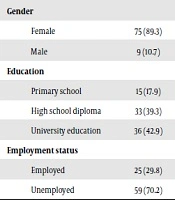
The present study screened a total of 4,261 consecutive patients who were referred for sleep disorders, and 399 patients were diagnosed with RLS, representing a prevalence rate of 9.2% among all patients. The mean age of patients in this study was 46.38 ± 15.78 years. Of the patients, 52.04% were male, and 47.96% were female. The majority of patients were married (82.65%), had education levels higher than a high school diploma (42.57%), and were unemployed (50.68%). The chief complaint for patients’ visits was insomnia (31.63%). Furthermore, 65.90% of patients had a positive family history of sleep disorder problems.
In terms of lifestyle and health conditions, 12.11% of the patients were smokers, 0.77% consumed alcohol, 5.15% used drugs, 25.00% had hypertension, 10.20% had type 2 diabetes, and 10.71% had hypothyroidism (Table 1). Rare variants of RLS identified in this registry included restless head, back, abdomen, bladder, and perineum syndrome, accounting for 11 cases (3.6%) among our patients. The mean age in this group was 44.26 ± 5.6 years, and 8 patients were female.
Table 1.
Mean Distribution of Demographic and Clinical Variables in Restless Legs Syndrome Patients
| Variables | N | Mean ± SD | Min-Max | 95% CI of Mean |
|---|---|---|---|---|
| Age | 392 | 46.38 ± 15.78 | 2 - 86 | 44.81 - 47.94 |
| BMI | 371 | 27.08 ± 5.06 | 14.49 - 45.67 | 26.56 - 27.59 |
| Hours of sleep per night | 338 | 5.56 ± 2.42 | 1 -12 | 5.30 - 5.81 |
| PSQI | 392 | 8.09 ± 4.53 | 0 - 18 | 7.64 - 8.54 |
| ESS | 392 | 7.32 ± 5.28 | 0 - 24 | 6.79 - 7.84 |
| ISI | 392 | 14.6 ± 8.56 | 0 - 28 | 13.75 - 15.45 |
| Depression | 392 | 13.74 ± 12.41 | 0 - 42 | 12.51 - 14.97 |
| Anxiety | 392 | 12.35 ± 11.15 | 0 - 42 | 11.24 - 13.46 |
| Stress | 392 | 18.5 ± 13.39 | 0 - 42 | 17.18 - 19.83 |
| RLS score | 392 | 17.45 ± 12.63 | 0 - 40 | 16.20 - 18.71 |
Abbreviations: BMI, Body Mass Index; PSQI, Pittsburgh Sleep Quality Index; ESS, Epworth Sleepiness Scale; ISI, Insomnia Severity Index; RLS, restless legs syndrome; CI, confidence interval.
In terms of sleep quality, based on the PSQI questionnaire, 72.19% reported poor sleep quality. Regarding sleepiness status, based on the ESS questionnaire, 24.23% of patients were affected by excessive sleepiness. For insomnia status, according to the ISI questionnaire, 35.20% of patients had moderate insomnia and 24.23% had severe insomnia. Concerning RLS, based on the RLS questionnaire, the results showed 34.18% of patients suffered from severe RLS (Table 1). Additional details concerning demographic and clinical variables are presented in Tables 1 and 2.
Table 2.
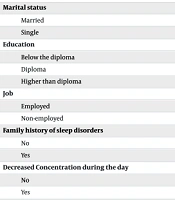
Frequency Distribution of Demographic and Clinical Variables in Restless Legs Syndrome Patients
| Variables and Classes | No. (%) |
|---|---|
| Sex | 204 (52.04) |
| Male | |
| Female | 188 (47.96) |
| Marital status | 324 (82.65) |
| Married | 68 (17.35) |
| Single | |
| Education | 78 (26.35) |
| Below the diploma | 92 (31.08) |
| Diploma | 126 (42.57) |
| Higher than diploma | |
| Job | 180 (49.32) |
| Employed | 185 (50.68) |
| Unemployed | |
| The chief complain | 124 (31.63) |
| Insomnia | 13 (3.32) |
| Excessive sleepiness | |
| Abnormal movement during sleep | 12 (3.06) |
| Snoring | 92 (23.47) |
| Other | 151 (38.52) |
| Family history Sleep disorders | 133 (34.1) |
| Decreased concentration during the day | 209 (56.95) |
| Cigarettes smoking | 47 (12.11) |
| Alcohol consumption | 3 (0.77) |
| Drugs history | 20 (5.15) |
| Hookah smoking | 13 (3.35) |
| Hypertension | 98 (25.0) |
| Diabetes mellitus | 40 (10.2) |
| Hypothyroidism | 42 (10.71) |
| Hyperlipidemia | 81 (20.66) |
| Sleep latency in the past month (min) | 145 (37.47) |
| < 15 | 51 (13.18) |
| Until 30 | 68 (17.57) |
| Until 60 | 123 (31.78) |
| > 60 | |
| PSQI | 109 (27.81) |
| Good sleep quality | 283 (72.19) |
| Poor sleep quality | |
| ESS | 297 (75.77) |
| Normal | 95 (24.23) |
| Abnormal-sleepiness | |
| ISI | 89 (22.7) |
| Absence of insomnia | 70 (17.86) |
| Sub-threshold insomnia | 138 (35.2) |
| Moderate insomnia | 95 (24.23) |
| Severe insomnia | |
| RLS | 120 (30.62) |
| Mild | |
| Moderate | 81 (20.66) |
| Severe | 134 (34.18) |
| Very severe | 57 (14.54) |
Abbreviations: DM, diabetes mellitus; PSQI, Pittsburgh Sleep Quality Index; ESS, Epworth Sleepiness Scale; ISI, Insomnia Severity Index; RLS, restless legs syndrome.
The results showed that the mean RLS score for men and women was 15.71 ± 13.19 and 19.35 ± 11.72, respectively, with statistical significance (P = 0.004). For the variable "sleep latency", results indicated that the mean RLS score was significantly higher in individuals who took 60 minutes or more to fall asleep compared to others (P < 0.001) (Table 3). Additionally, a significant negative correlation was observed between the RLS score and the duration of sleep at night (P < 0.001) (Table 4).
Table 3.
Relationship Between the Restless Legs Syndrome Score and Demographic and Clinical Variables in Restless Legs Syndrome Patients
| Variables and Classes | N | Mean ± SD | 95% CI of Mean | P-Value |
|---|---|---|---|---|
| Sex | 0.004 | |||
| Male | 204 | 15.70 ± 13.19 | 13.89 - 17.52 | |
| Female | 188 | 19.34 ± 11.72 | 17.66 - 21.03 | |
| Marital status | 0.502 | |||
| Married | 324 | 17.64 ± 12.67 | 16.26 - 19.03 | |
| Single | 68 | 16.51 ± 12.43 | 13.55 - 19.48 | |
| Education | 0.536 | |||
| Below the diploma | 78 | 16.76 ± 13.03 | 13.87 - 19.67 | |
| Diploma | 92 | 18.42 ± 12.28 | 15.90 - 20.94 | |
| Higher than diploma | 126 | 18.69 ± 12.04 | 16.58 - 20.80 | |
| Job | 0.094 | |||
| Employed | 180 | 16.75 ± 12.85 | 14.87 - 18.63 | |
| Non-employed | 185 | 18.94 ± 12.14 | 17.19 - 20.70 | |
| Family history of sleep disorders | 0.548 | |||
| No | 257 | 17.26 ± 12.78 | 15.70 - 18.83 | |
| Yes | 133 | 18.07 ± 12.25 | 15.99 - 20.16 | |
| Decreased Concentration during the day | 0.287 | |||
| No | 158 | 16.93 ± 12.43 | 14.99 - 18.88 | |
| Yes | 209 | 18.33 ± 12.46 | 16.64 - 20.03 | |
| Cigarettes smoking | 0.220 | |||
| No | 341 | 17.24 ± 12.50 | 15.92 - 18.58 | |
| Yes | 47 | 19.65 ± 13.39 | 15.82 - 23.50 | |
| Alcohol consumption | 0.305 | |||
| No | 385 | 17.48 ± 12.64 | 16.22 - 18.75 | |
| Yes | 3 | 25.0 ± 8.0 | 15.92 - 34.08 | |
| Past drug history | 0.443 | |||
| No | 368 | 17.42 ± 12.66 | 16.13 - 18.73 | |
| Yes | 20 | 19.65 ± 11.88 | 14.42 - 24.88 | |
| Hookah smoking | 0.384 | |||
| No | 375 | 17.64 ± 12.67 | 16.36 - 18.93 | |
| Yes | 13 | 14.53 ± 11.06 | 8.50 - 20.57 | |
| Hypertension | 0.252 | |||
| No | 294 | 17.87 ± 12.43 | 16.45 - 19.30 | |
| Yes | 98 | 16.18 ± 13.17 | 13.57 - 18.80 | |
| DM | 0.191 | |||
| No | 352 | 17.17 ± 12.50 | 15.86 - 18.48 | |
| Yes | 40 | 19.92 ± 13.59 | 15.70 - 24.15 | |
| Hypothyroidism | 0.660 | |||
| No | 350 | 17.35 ± 12.73 | 16.01 - 18.69 | |
| Yes | 42 | 18.26 ± 11.80 | 14.68 - 21.84 | |
| Hyperlipidemia | 0.712 | |||
| No | 311 | 17.33 ± 12.78 | 15.91 - 18.76 | |
| Yes | 81 | 17.91 ± 12.05 | 15.28 - 20.55 | |
| Sleep latency in the past month (min) | < 0.001 | |||
| < 15 | 145 | 13.11 ± 12.98 | 10.99 - 15.23 | |
| 15 - 30 | 51 | 17.15 ± 12.39 | 13.75 - 20.57 | |
| 30 - 60 | 68 | 19.54 ± 11.44 | 16.82 - 22.27 | |
| > 60 | 123 | 21.54 ± 11.23 | 19.55 - 23.54 |
Abbreviations: DM, diabetes mellitus; CI, confidence interval.
Table 4.
Correlation Between the Restless Legs Syndrome Score and Demographic and Clinical Variables in Restless Legs Syndrome Patients
| Variables | N | Correction Coefficient | P-Value |
|---|---|---|---|
| Age | 392 | -0.032 | 0.520 |
| BMI | 371 | 0.022 | 0.670 |
| Hours of sleep per night | 338 | -0.199 | < 0.001 |
| PSQI | 392 | 0.332 | < 0.001 |
| ESS | 392 | -0.006 | 0.899 |
| ISI | 392 | 0.320 | < 0.001 |
| Depression | 392 | 0.233 | < 0.001 |
| Anxiety | 392 | 0.260 | < 0.001 |
| Stress | 392 | 0.320 | < 0.001 |
Abbreviations: BMI, Body Mass Index; PSQI, Pittsburgh Sleep Quality Index; ESS, Epworth Sleepiness Scale; ISI, Insomnia Severity Index.
Furthermore, the results demonstrated a significant correlation between the RLS score and the PSQI score, ISI score, and scores of depression, anxiety, and stress. As the RLS score increased, the PSQI score, ISI score, and scores for mood disorders, including depression, anxiety, and stress, also increased significantly (P < 0.05). This indicates a worsening condition in terms of sleep quality, insomnia, depression, anxiety, and stress (Table 4). No significant statistical relationship was observed between other demographic and clinical variables and the RLS score.
In the present study, the univariate logistic regression model was used to identify baseline variables predicting more severe RLS (Table 5). In the regression model, an increase in sleep latency in the past month, poor sleep quality, more severe insomnia, depression, anxiety, and stress were associated with an increase in the severity of RLS. An increase in hours of sleep per night was associated with a decrease in the severity of RLS. In multivariate regression by the method of forward LR, only sleep latency in the past month of more than 60 minutes compared to less than 15 minutes was entered into the final model (β = 2.600, 95% CI: 1.077 - 0.277; P = 0.034).
Table 5.
Univariate Logistic Regression Model to Identify Baseline Factors Influencing the Risk of Developing Severe Restless Legs Syndrome in Patients
| Variables | Univariate | |
|---|---|---|
| P-Value | OR (95% CI) | |
| Sex | ||
| Male | Ref | - |
| Female | 0.058 | 1.470 (0.987 - 2.190) |
| Age | 0.727 | 1.002 (0.990 - 1.015) |
| BMI | 0.382 | 1.018 (978 - 1.060) |
| Marital status | ||
| Married | Ref | - |
| Single | 0.271 | 0.744 (0.439 - 1.260) |
| Job | ||
| Employed | Ref | - |
| Unemployed | 0.129 | 1.376 (0.911 - 2.077) |
| Family history of sleep disorders | ||
| No | Ref | - |
| Yes | 0.690 | 1.089 (0.716 - 1.655) |
| Decreased concentration during the day | ||
| No | Ref | - |
| Yes | 0.259 | 1.269 (0.839 - 1.920) |
| Cigarettes smoking | ||
| No | Ref | - |
| Yes | 0.123 | 1.628 (0.876 - 3.027) |
| Alcohol consumption | ||
| No | Ref | - |
| Yes | 0.547 | 2.096 (0.188 - 23.305) |
| Drugs history | ||
| No | Ref | - |
| Yes | 0.580 | 1.291 (0.522 - 3.188) |
| Hookah smoking | ||
| No | Ref | - |
| Yes | 0.836 | 0.890 (0.294 - 2.697) |
| Hypertension | ||
| No | Ref | - |
| Yes | 0.771 | 1.070 (0.678 -1.691) |
| DM | ||
| No | Ref | - |
| Yes | 0.243 | 1.482 (0.765 - 2.869) |
| Hypothyroidism | ||
| No | Ref | - |
| Yes | 0.250 | 1.461 (0.766 - 2.788) |
| Hyperlipidemia | ||
| No | Ref | - |
| Yes | 0.527 | 1.171 (0.718 - 1.910) |
| Sleep latency in the past month (min) | ||
| < 15 | Ref | - |
| 15 - 30 | 0.142 | 1.620 (0.851 - 3.085) |
| 30 - 60 | 0.119 | 1.589 (0.887 - 2.845) |
| > 60 | < 0.001 | 2.725 (1.660 - 4.473) |
| Hours of sleep per night | 0.002 | 0.865 (0.789 - 0.948) |
| PSQI | ||
| Good sleep quality | Ref | - |
| Poor sleep quality | < 0.001 | 2.749 (1.721 - 4.390) |
| ESS | ||
| Normal | Ref | - |
| Abnormal-Sleepiness | 0.590 | 0.880 (0.554 - 1.399) |
| ISI | ||
| Absence of insomnia | Ref | - |
| Sub-threshold insomnia | 0.761 | 0.901 (0.462 - 1.760) |
| Moderate insomnia | 0.002 | 2.411 (1.387 - 4.190) |
| Severe insomnia | < 0.001 | 3.872 (2.100 - 7.138) |
| Depression | < 0.001 | 1.033 (1.016 - 1.051) |
| Anxiety | < 0.001 | 1.045 (1.025 - 1.065) |
| Stress | < 0.001 | 1.040 (1.024 - 1.057) |
Abbreviations: DM, diabetes mellitus; PSQI, Pittsburgh Sleep Quality Index; ESS, Epworth Sleepiness Scale; ISI, Insomnia Severity Index; CI, confidence interval.
5. Discussion
We found a prevalence rate of 9.2% for RLS, which was similar to other studies, but it was slightly higher than in Fereshtehnejad et al.'s study in Iran. This variation was expected as his study was population-based (4, 6). Other studies have reported prevalence rates ranging from 5.5% to 11% in adult Caucasian populations, whereas prevalence rates are lower for Asian populations, ranging from 1% to 7.5% (25). In the Eastern Mediterranean WHO region, only one study with a sample size (n = 2,682) reported a prevalence rate of 8.4% in the general population in Saudi Arabia (26).
According to our research findings, RLS was slightly more prevalent in men, while women exhibited higher severity of RLS symptoms. However, previous studies have shown inconsistent results, with some reporting a higher prevalence in females — up to twice as much — and others finding no gender differences. These observations diverge from earlier research on Saudi Arabian (26) and Turkish populations (27).
Our results demonstrated an increase in sleep latency and a decrease in total sleep time and sleep quality. The RLS is recognized for disrupting sleep patterns and quality. The RLS patients often struggle to fall asleep and stay asleep, leading to fragmented sleep, insomnia, and excessive daytime sleepiness (1, 13). According to the ESS, The present study failed to show an increase in daytime sleepiness. Conditions like RLS or periodic limb movement disorder may disrupt sleep quality without necessarily affecting daytime drowsiness measured by ESS. It is essential to consider potential factors when interpreting the relationship between RLS and ESS scores in Iranian patients.
Our results showed that as the RLS score increased, the scores for mood disorders, including depression, anxiety, and stress, also increased significantly. In the study by Sevim et al., patients with RLS were found to have much higher levels of anxiety and depression symptoms compared to the control subjects. Additionally, a possible link between the severity of RLS and the severity of anxiety and depression symptoms was observed (9). Similarly, Winkelmann's study indicated a clear association between RLS and a higher risk of depression and anxiety, as well as more severe anxiety/depression scores. Individuals with RLS had a higher lifetime prevalence of major depressive and panic disorder compared to those without RLS symptoms. The odds ratios indicated a strong association between panic disorder and RLS. These findings suggested the need for increased awareness of the mental health implications of RLS (8).
A study of 317 psychiatric inpatients found a prevalence of RLS at 16.4%, significantly higher than the estimated 5 - 10% in the general population. The severity of RLS was rated as moderate to severe according to the IRLSSG (28). Another study reported that the prevalence of RLS was higher in patients using antidepressants compared to the general population. Additionally, patients who received combined drug treatment had a 4.7-fold increase in RLS (29).
Electroencephalogram (EEG) studies have shown differences in brain function between patients with RLS and controls, suggesting a dissociated vigilance in RLS similar to changes seen in major depression. Dopamine agonists have been effective in reducing symptoms of both RLS and depression, indicating a potential role of dopaminergic dysfunction (30). Treating mood disorders in RLS patients is challenging. Selective serotonin reuptake inhibitors (SSRIs) can exacerbate RLS symptoms due to their effects on serotonin levels in the brain, which can influence motor activity. Antidepressants with dopaminergic effects might provide relief for RLS symptoms (16). For patients experiencing depression or anxiety disorders alongside RLS, healthcare providers may consider a careful combination approach that includes both antidepressants and dopamine agonists.
In our sleep clinic, 11 patients were diagnosed with restless symptoms in organs other than the legs, with the majority of these patients being female. Understanding rare variants of RLS is crucial for accurately diagnosing diseases. The literature contains numerous case reports about these variants (31), highlighting the importance of recognizing that this condition is not limited to leg symptoms. These variants can be challenging to diagnose due to their atypical presentations. A thorough clinical history and symptom assessment are crucial.
The present study had some limitations. First, the study's cross-sectional nature limits its ability to establish causality between RLS and mood or sleep disorders. Second, the study is limited to a single sleep clinic registry in Iran, which may limit the generalizability of the findings to broader populations. Lastly, the lack of objective measures may introduce reporting bias. Incorporating objective measures like actigraphy could enhance diagnostic accuracy.
We recommend for future research the conduction of longitudinal studies to better establish causality between RLS and associated mood or sleep disorders. Expanding research to include multiple sleep clinics across different regions or countries could improve the generalizability of the findings. Utilizing objective measures such as actigraphy, polysomnography, or neurophysiological assessments in future studies is also recommended.
5.1. Conclusions
The RLS significantly affects individuals’ mental health factors, including sleep quality, insomnia score, depression, anxiety, and stress. Understanding how various classes of antidepressant drugs interact with RLS is vital for optimizing treatment strategies for patients experiencing both mood disorders and sleep disturbances associated with RLS. It is essential to note that restlessness resembling RLS can manifest in various parts of the body.