
1. Background
Breast cancer (BrCa) is a major global public health concern because of its high morbidity and mortality (1). Among Saudi women (SaW), mortality increased from 201 in 1990 to 1,190 in 2021 (2). Mammogram screening is the most effective method for early detection and for reducing BrCa mortality (1, 3). However, adherence among SaW aged 40 years or older remains low. Nationally, only 6.5% (N = 2,786) reported ever having had a mammogram (2), with similarly low rates reported in the Makkah region (50%) (4).
Studies have reported several factors associated with inadequate mammogram screening utilization among SaW. Many studies have examined this phenomenon primarily in terms of awareness of BrCa and mammography (2, 5). Inadequate awareness of BrCa and mammogram screening has been reported in all regions of Saudi Arabia (6-20). In a survey distributed across all Saudi regions (N = 3,245), 58% of participants reported poor awareness of BrCa and mammogram screening. Studies conducted in large cities in Saudi Arabia also reported low levels of awareness among SaW, including 67% in Makkah (N = 400) and 71% in Dammam (N = 150). However, only three studies have examined the association between BrCa awareness and mammogram uptake among SaW; all reported negative associations (7, 16).
Health beliefs, particularly perceived benefits of and barriers to mammograms, have been associated with mammogram screening utilization among Arab SaW (7-9, 12, 15). Women are less likely to undergo screening when perceived barriers outweigh perceived benefits (11, 15). These barriers encompass multiple dimensions. Among SaW, fear is one of the most frequently reported obstacles, with several studies identifying fear of receiving a BrCa diagnosis as a primary concern (7, 9, 10). Pain has also been identified as a significant deterrent, discouraging adherence to regular mammogram screening among 49% (207/423) and 15% (75/506) of participants in two studies (9, 10). Similarly, SaW who perceived mammogram screening as painful demonstrated substantially lower uptake rates: 56% in the Makkah region (260/465) and 11% nationally (357/3,245) (6, 9).
Despite the availability of free healthcare services, mammogram screening rates remain low (6, 9, 12). Previous studies suggest that mammogram utilization is influenced by multiple interrelated factors (6, 13), but most research has focused mainly on BrCa awareness and mammogram screening (5, 6, 9, 10). However, awareness alone does not adequately predict mammogram screening utilization, as health beliefs also play a role. In Saudi Arabia, this relationship remains underexplored.
1.1. Theoretical Framework
This study was guided by the Health Belief Model, which posits that individuals are more likely to use health screening, such as mammography, when they perceive greater benefits than barriers and have higher awareness of screening (11). Based on this theoretical framework, SaW's levels of BrCa awareness and their health beliefs, including perceived benefits of and barriers to mammogram screening, were expected to influence mammogram uptake.
2. Objectives
This study hypothesized that, compared with their counterparts, SaW who reported higher levels of BrCa awareness, greater perceived benefits of mammography, and lower perceived barriers would be more likely to have ever undergone a mammogram and/or to adhere to recommended mammography screening.
3. Methods
3.1. Study Design and Setting
This quantitative cross-sectional study used an online survey administered by the researchers for data collection. The Ethics and Institutional Review Board at the Faculty of Nursing, King Abdulaziz University (reference number 2B.83), approved the study.
3.2. Recruitment and Data Collection
A convenience sample of SaW was recruited from the outpatient clinics at King Abdulaziz University Hospital, a major tertiary care facility with a capacity of 1,002 beds, located in the Makkah region of Saudi Arabia. While potential participants were in the waiting area, the researchers approached them and explained the purpose of the study, along with its potential risks and benefits. Participants were also informed of their right to withdraw from the study at any time without any consequences.
Women who expressed initial interest were screened for eligibility based on the following criteria: 1) female sex, 2) Saudi nationality, 3) age 40 years or older, which is the recommended age range for mammogram screening in Saudi Arabia, and 4) residence in the Makkah region. Women with a personal history of breast cancer were excluded because this could influence mammogram screening uptake.
Eligible participants were invited to complete an online survey administered by the researchers, and informed consent was obtained electronically before participation. Data collection was conducted between January 13, 2024, and April 26, 2024. All data were deidentified, assigned unique serial numbers, and securely stored on a password-protected computer accessible only with authorized login credentials.
The required sample size of 247 women was estimated using G*Power software, informed by findings from Hasnain et al. (8), who used a culturally adapted Champion Health Belief Model scale among Arab and Muslim women. Based on their results related to perceived mammogram benefits and barriers, this sample size was deemed sufficient to detect a small to medium effect size, corresponding to an odds ratio (OR) of 0.5 or less or 1.9 or greater. The calculation used an alpha level of 0.05 (alpha = 0.05) and a statistical power of 0.95 (beta = 0.05).
3.3. Instruments
3.3.1. Outcome Variables
Two primary outcomes measuring mammogram uptake were evaluated: 1) ever having had a mammogram and 2) having had a mammogram within the past year (adherence to mammogram screening). Both outcomes were assessed using self-reported yes/no questions.
3.3.2. Independent Variables
Two independent variables were included in this study: 1) BrCa awareness and 2) perceived health beliefs.
3.3.2.1. Breast Cancer Awareness
Breast cancer awareness was measured using the BrCa Awareness Measure (14), which includes two subscales assessing BrCa warning signs and BrCa risk factors. Each subscale consists of 10 yes/no items scored 0 for incorrect and 1 for correct answers, with total scores ranging from 0 to 10. Higher scores indicate greater awareness, with scores of 8 or higher classified as indicating a high level of awareness (14). The tool was developed by Cancer Research UK and King's College London and has demonstrated strong validity and reliability (alpha = 0.84 for risk factors and 0.88 for warning signs) (14). It has also been translated and used among Arab women (8, 15, 16). In this study, the subscales showed high reliability (alpha = 0.96 for warning signs and 0.888 for risk factors).
3.3.2.2. Perceived Health Beliefs
Health beliefs were measured using the modified Champion Breast Health Tool (17), which includes two subscales: perceived mammogram benefits (4 items) and perceived mammogram barriers (23 items). Items were rated on a 5-point Likert scale ranging from strongly agree (scored 5) to strongly disagree (scored 1). Scores range from 4 to 20 for benefits and 23 to 115 for barriers, with higher scores indicating stronger perceived benefits or barriers. The tool was culturally adapted and translated into Arabic for Arab women and has shown good reliability in previous studies (8, 15). In this study, the tool also demonstrated high reliability (alpha = 0.871 for benefits and alpha = 0.958 for barriers).
3.4. Data Analysis
Data were analyzed using IBM SPSS Statistics version 28.0. Descriptive analyses were used to summarize sociodemographic characteristics. Logistic regression was conducted to evaluate associations between the independent variables and each outcome.
Sociodemographic covariates were included in the logistic regression models if they 1) were theoretically associated with mammogram utilization based on previous studies and 2) showed an association with the outcome at P ≤ 0.2 in the preliminary bivariate analysis. For the first outcome, covariates included age and health insurance, whereas for the second outcome, age and education level were included (2, 6, 12, 18-20). Age has been identified in previous studies as a significant factor associated with ever having obtained a mammogram and adherence to screening (9, 12, 20). Access to healthcare services, including health insurance, has been shown to predict ever having obtained a mammogram (18, 19). Adherence to mammogram screening has also been associated with higher levels of education in three studies (6, 9, 19).
Bivariate logistic regression analyses were conducted to examine the association between each independent variable and the outcomes. Variables that were statistically significant in the bivariate analyses were then included in the multivariable logistic regression models while controlling for selected sociodemographic covariates. All variables were entered using the forced-entry method. Statistical significance was set at P < 0.05, with 95% confidence intervals (CIs).
4. Results
4.1. Sample Characteristics
A total of 281 Saudi women were recruited. Of these, 264 (93.9%) agreed to participate in the study, and 251 were included in the final analysis. Thirteen responses were excluded due to missing data on the primary outcomes, health beliefs, or BrCa awareness variables. Most participants (67.7%) were aged 40 to 49 years. Nearly half (47.8%) had four or more children. Approximately 32% had completed high school, and 41.8% were unemployed (Table 1).
Table 1.
Sociodemographic Characteristics of Participants (N = 251)
| Characteristics | Count | Percentage (%) |
|---|---|---|
| Age | ||
| 40 - 49 | 170 | 67.7 |
| 50 - 59 | 68 | 27.1 |
| ≥ 60 | 13 | 5.2 |
| City of residency | ||
| Jeddah | 200 | 79.7 |
| Mecca | 39 | 15.5 |
| Alqunfutha | 12 | 4.7 |
| Level of education | ||
| High school | 81 | 32.3 |
| College degree | 51 | 20.3 |
| Bachelor's degree | 103 | 41.0 |
| Master's degree | 11 | 4.4 |
| PhD degree | 5 | 2.0 |
| Employment status | ||
| Not working | 105 | 41.8 |
| Government job | 93 | 37.1 |
| Private sector | 39 | 15.5 |
| Personal business | 14 | 5.6 |
| Monthly household income (Saudi riyals) | ||
| ≤ 5000 | 30 | 12.0 |
| 6000 to 10000 | 108 | 43.0 |
| 11,000 to 15,000 | 71 | 28.3 |
| ≥ 15,000 | 42 | 16.7 |
| Number of children | ||
| None | 19 | 7.6 |
| One | 19 | 7.6 |
| Two | 38 | 15.1 |
| Three | 55 | 21.9 |
| Four or more | 120 | 47.8 |
| Male physician | 19 | 7.6 |
| Having health insurance | ||
| Yes | 166 | 66.1 |
| No | 85 | 33.9 |
| Ever having had a mammogram | ||
| Yes | 74 | 29.5 |
| No | 177 | 70.5 |
| Having had a mammogram within the previous year | ||
| Yes | 36 | 13.9 |
| No | 215 | 85.7 |
4.2. Mammogram Utilization
Participants who reported ever having had a mammogram comprised 29.5% of the sample; however, only 13.9% had had their most recent mammogram within the previous year (Table 1).
4.3. Descriptive Statistics of Breast Cancer Awareness and Health Belief Variables
Participants demonstrated low to moderate knowledge of breast cancer signs and symptoms (mean = 5.2, SD = 1.6) and lower knowledge of risk factors (mean = 4.1, SD = 2.8). Perceived mammogram benefits were relatively low (mean = 8.2, SD = 1.9), whereas perceived barriers were comparatively high (mean = 85.4, SD = 12.6). Overall, these findings indicate limited awareness, low perceived benefits, and high perceived barriers regarding mammogram screening (Table 2).
Table 2.
Descriptive Statistics of Breast Cancer Knowledge and Health Belief Variables
| Variables | Range | Mean | SD |
|---|---|---|---|
| Breast cancer signs and symptoms | 0 - 10 | 4.7 | 1.6 |
| Breast cancer risk factors | 0 - 10 | 4.1 | 2.8 |
| Perceived mammogram benefits | 4 - 20 | 8.2 | 1.9 |
| Perceived mammogram barriers | 23 - 115 | 85.4 | 12.6 |
4.4. Breast Cancer Awareness and Mammogram Utilization
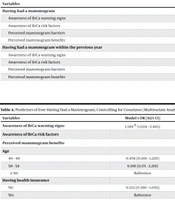
For ever having had a mammogram, women with greater awareness of BrCa warning signs were significantly more likely to undergo mammography (OR = 2.499, P = 0.001), and those aware of risk factors were more than 3 times as likely to undergo mammography (OR = 3.439, P = 0.001; Table 3). These associations remained significant after controlling for sociodemographic characteristics (Table 4). Awareness also predicted mammogram adherence, as women with higher awareness of warning signs and risk factors were more likely to have had a mammogram within the past year (OR = 2.274, P = 0.001; OR = 2.296, P = 0.001; Table 3); these effects remained significant after controlling for sociodemographic characteristics (Table 5).
Table 3.
Predictors of Ever Having Had a Mammogram and Having Had a Mammogram Within the Previous Year (Bivariate Analysis) (N = 251)
| Variables | P-Value | OR | 95% CI |
|---|---|---|---|
| Having had a mammogram | |||
| Awareness of BrCa warning signs | 0.001 | 2.499 | 1.631 - 3.501 |
| Awareness of BrCa risk factors | 0.001 | 3.439 | 2.022 - 5.579 |
| Perceived mammogram barriers | 0.058 | 0.827 | 0.508 - 1.011 |
| Perceived mammogram benefits | 0.001 | 2.351 | 1.468 - 3.581 |
| Having had a mammogram within the previous year | |||
| Awareness of BrCa warning signs | 0.001 | 2.274 | 1.343 - 3.484 |
| Awareness of BrCa risk factors | 0.001 | 2.296 | 1.268 - 4.158 |
| Perceived mammogram barriers | 0.330 | 0.804 | 0.517 - 1.248 |
| Perceived mammogram benefits | 0.078 | 1.588 | 0.508 - 1.011 |
Table 4.
Predictors of Ever Having Had a Mammogram, Controlling for Covariates (Multivariate Analyses) (N = 251) a
| Variables | Model 1 OR (95% CI) | Model 2 OR (95% CI) | Model 3 OR (95% CI) |
|---|---|---|---|
| Awareness of BrCa warning signs | 1.589 b (1.024 - 2.465) | ||
| Awareness of BrCa risk factors | 1.840 b (1.031 - 3.284) | ||
| Perceived mammogram benefits | 1.870 c (1.2 - 2.914) | ||
| Age | |||
| 40 - 49 | 0.459 (0.016 - 1.220) | 0.588 (0.113 - 1.334) | 0.696 (0.085 - 1.028) |
| 50 - 59 | 0.916 (0.171 - 2.219) | 0.961 (0.184 - 2.413) | 0.826 (0.134 - 1.833) |
| ≥ 60 | Reference | Reference | Reference |
| Having health insurance | |||
| No | 0.553 (0.280 - 1.093) | 0.566 (0.285 - 1.124) | 0.510 (0.259 - 1.004) |
| Yes | Reference | Reference | Reference |
a Each model included one main independent variable while controlling for selected covariates (age and health insurance) using the forced-entry method.
b P < 0.05.
c P < 0.01.
Table 5.
Predictors of Having Had a Mammogram Within the Previous Year, Controlling for Covariates (N = 251) a
| Variables | Model 1 OR (95% CI) | Model 2 OR (95% CI) |
|---|---|---|
| Awareness of BrCa warning signs | 2.036 b (1.191 - 3.481) | |
| Awareness of BrCa risk factors | 2.288 c (1.137 - 4.606) | |
| Age | ||
| 40 - 49 | 1.989 (0.189 - 13.378) | 1.924 (0.201 - 14.492) |
| 50 - 59 | 2.919 (0.309 - 23.053) | 3.574 (0.347 - 26.012) |
| ≥ 60 | Reference | Reference |
| Level of education | ||
| High school | 0.949 (0.082 - 10.951) | 1.241 (0.088 - 13.066) |
| College degree | 1.913 (0.140 - 19.413) | 1.498 (0.143 - 21.831) |
| Bachelor's degree | 1.652 (0.097 - 11.412) | 1.862 (0.106 - 13.865) |
| Master's degree | 7.842 (0.522 - 108.526) | 9.973 (0.620 - 145.169) |
| PhD degree | Reference | Reference |
a Each model included one main independent variable while controlling for selected covariates (age and level of education) using the forced-entry method.
b P < 0.01.
c P < 0.05.
4.5. Perceived Health Beliefs and Mammogram Utilization
Women who perceived greater mammogram benefits had twice the likelihood of ever having had a mammogram (OR = 2.351, P = 0.001), as shown in Table 3. In addition, perceived mammogram benefits remained a significant predictor of ever having had a mammogram after controlling for sociodemographic characteristics (Table 4, Model 3). However, perceived mammogram benefits did not predict mammogram adherence.
5. Discussion
This study examined factors associated with mammogram utilization among Saudi women. The results showed low screening rates: 29.5% had ever undergone a mammogram, and 13.9% had undergone one within the past year. Similar findings have been reported in Saudi Arabia, where approximately 29% of women reported ever having a mammogram and 29.5% had undergone one within the past year (18).
This study found that perceived mammogram benefits predicted ever having a mammogram but did not predict adherence to screening. Similarly, low perceived benefits have been reported as a barrier to mammogram adherence among Saudi and Jordanian women (6, 21). Across these cross-sectional studies, perceived benefits were associated with having a mammogram at least once but not with continued adherence. One possible explanation is that women with higher perceived mammogram benefits may have received recommendations from healthcare providers or been exposed to facilitating factors such as educational campaigns. Previous studies have shown that these facilitators are associated with obtaining a mammogram at least once (6, 9, 12). Thus, enhancing perceived benefits alone may be insufficient to sustain screening adherence, and addressing barriers to mammogram uptake, such as the limited availability of qualified healthcare providers, remains essential. Nevertheless, this study was limited in its ability to examine the interplay of these factors among SaW. Therefore, longitudinal and interventional studies are needed to assess how changes in perceived benefits, alongside facilitators and barriers, influence future screening utilization.
In this study, Saudi women showed low awareness of BrCa. Only 26% reported high awareness of BrCa risk factors, and 31% reported high awareness of warning signs, whereas the majority had low awareness. Similar findings have been reported across several Saudi cities, demonstrating low levels of BrCa awareness among women (4, 6, 13, 18).
Despite the low BrCa awareness observed, awareness remained a significant predictor of both ever having had a mammogram and recent utilization after adjustment for selected sociodemographic factors. Similarly, a study in Jordan found that higher BrCa awareness was associated with increased mammogram utilization (20). Future research should further examine this relationship using longitudinal designs.
Although BrCa awareness was the strongest predictor of mammogram utilization among Saudi women, knowledge alone may be insufficient to improve screening. Other health beliefs also influenced utilization. In this study, BrCa risk-factor awareness was negatively associated with perceived mammogram barriers (r = -0.10, P < 0.02) and positively associated with perceived benefits (r = 0.21, P < 0.05) (see supplementary table). These modest correlations suggest that multiple factors shape mammogram utilization. Therefore, efforts to increase awareness should also address barriers and promote positive health beliefs to improve screening participation.
5.1. Limitations
This study has several limitations that warrant consideration. First, the use of convenience sampling among SaW in the Makkah region may limit the generalizability of the findings to other regions and populations with more diverse sociodemographic characteristics. Second, the sample was predominantly urban and relatively well educated, which may limit the generalizability of the findings to rural populations and women with lower levels of education. Third, the association between education level and mammogram uptake should be interpreted with caution. The large OR observed for women with a master's degree, accompanied by wide CIs, suggests potential instability of the estimate due to the small number of participants in this subgroup. In addition, the reference group (≥ 60 years) included a relatively small number of participants (n = 13, 5.2%), which may have resulted in unstable estimates. Future studies with larger and more balanced educational and age subgroups are needed to provide more stable and precise estimates. Fourth, reliance on self-reported data introduces the potential for recall and social desirability biases, particularly regarding mammogram screening history and health beliefs. Fifth, this study was limited in its ability to examine the dynamic role of facilitators and barriers, such as physician and nurse recommendations and fear, within health beliefs. Therefore, longitudinal studies with larger and more demographically diverse samples are needed to better understand these relationships. Despite these limitations, the study provides important insights into the complex factors associated with mammogram screening uptake among Saudi women.
5.2. Conclusions
This study contributes to the growing body of literature examining factors associated with mammography uptake among SaW. The findings demonstrated that overall uptake was low, with fewer than one-third of women ever undergoing screening and an even smaller proportion adhering to annual recommendations. Significant predictors included sociodemographic factors, BrCa awareness, and health beliefs. Drawing on the study findings, several recommendations can be made for practice, policy, and future research. Given that awareness of BrCa risk factors and signs and symptoms is a significant and persistent predictor of ever having obtained a mammogram and adherence to screening, the implementation of periodic national awareness campaigns at the governance level is recommended. These campaigns should be integrated with strategies that address perceived benefits of and barriers to mammography, as experienced by women, to enhance mammogram uptake among SaW. Such efforts should aim not only to improve knowledge but also to address health beliefs that influence women's behaviors toward mammogram utilization. Physicians and nurses should also integrate periodic mammogram recommendations and BrCa education into routine care visits to encourage uptake and shift women from one-time screening toward consistent adherence. Finally, future research should include larger, more diverse samples across Saudi Arabia and incorporate qualitative approaches to explore how health beliefs shape mammogram uptake behaviors. Such efforts will provide deeper insights and support the design of interventions tailored to SaW.