
1. Background
The incidence of nosocomial infections in high-risk hospital units such as the intensive care unit (ICU) is increasing annually and is an important public health challenge due to difficulties with treatment and implementation of infection control measures. Moreover, patients admitted to ICUs are 5 to 10 times more likely to acquire a nosocomial infection than those in general wards. It is documented that nosocomial infections can increase ICU, mortality, and hospital costs (1). A wide range of infectious agents are associated with nosocomial infections in ICUs, but it is reported that Gram-positive bacteria are more frequent than Gram-negative ones in this context (2, 3). Although the agents of nosocomial infections vary in incidence and type between different ICUs, Staphylococcus aureus is the most common cause of nosocomial infection considered to be linked to severe illness and death (1, 2).
In ICUs, due to the use of multiple antibiotic therapies, resistance to commonly used antibiotics is prevalent. The pathogenesis of methicillin-resistant S. aureus (MRSA) strains are related to the expression of different virulence factors including (i) toxins and enzymes such as staphylokinase, toxic shock syndrome toxin-1 (TST-1), hemolysin (alpha, beta, gamma, and delta), Panton-Valentine leukocidin (PVL), exfoliative toxins (eta, etb), staphylococcal enterotoxins (SEs), and lipase; (ii) adhesions such as collagen binding protein (can), clumping factor (clf), fibronectin binding protein (fnb), and elastin-binding protein (ebp) (2). During the past several decades, S. aureus has developed resistance to many commonly used antibiotics; therefore, nowadays infections associated with MRSA are considered as serious threats in ICUs (1).
Methicillin-resistance is mediated by the expression of β-lactamase or an altered form of penicillin-binding protein-2 (namely PBP2a, also referred to as PBP2’) encoded by mecA gene. The mec gene is carried within staphylococcal cassette chromosome mec (SCCmec) (4). A complex of the SCCmec gene contains: a. mec gene complex and its regulators containing mecA gene, IS431mec, and regulatory genes, b. cassette chromosome recombinase (ccr) genes composed of recombinase genes ccrA and ccrB or ccrC that encode recombinase and mediate the insertion and excitation of SCCmec into and from the chromosomes, and c. the Junkyard (J) area (J1, J2, and J3), which, as a nonessential component of the cassette, is located between and around the mec and ccr complexes (4, 5).
Eleven different SCCmec (I-XI) types were identified based on the mec gene and ccr gene complexes. According to the literature, SCCmec types I, II, and III are mostly found among hospital-acquired MRSA (HA-MRSA), while SCCmec types IV and V are the prominent types among community-acquired MRSA (CA-MRSA). These 2 MRSA groups can be distinguished by some of their virulence factors and also epidemiologic, phenotypic, and genotypic characteristics (1, 5, 6). Methicillin-resistant S. aureus strains demonstrate a wide pattern of resistance to β-lactams and other therapeutic options such as macrolides, lincosamides, and aminoglycosides (7). Resistance to aminoglycosides is mediated by aminoglycoside-modifying enzymes (AMEs) such as aminoglycoside acetyl transferases (AACs), aminoglycoside phosphotransferases (APHs), and aminoglycoside nucleotidyl transferases (ANTs) (8, 9).
Mupirocin is used to treat different types of staphylococcal skin infections. Resistance to mupirocin is mediated by mupA and mupB genes (10). The macrolide antibiotics, as protein synthesis inhibitors, are widely employed to treat staphylococcal infections. Resistance to macrolides is mediated by erm genes with the ribosomal binding site modification mechanism and msr genes with active efflux mechanism (11-13). The emergence and spread of various types of antibacterial resistance genes contribute to the resistance problem and treatment failure (14).
2. Objectives
The current study aimed at (i) characterizing the antibiotic resistance pattern, toxin, and adhesion profiles of MRSA isolated from ICUs and investigating these isolates by SCCmec typing.
3. Methods
3.1. Ethics Statement
The current study was approved by the ethics committee of Shahid Beheshti University of Medical Sciences, Tehran, Iran (IR.SBMU.SM.REC.1395.43770).
3.2. Bacterial Isolation and MRSA Screening
The current cross sectional study, conducted from April 2016 to March 2017, investigated 200 MRSA strains isolated from various clinical samples of patients hospitalized in ICUs. Methicillin-resistant S. aureus strains were isolated from wound (n = 86; 43%), blood (n = 38; 19%), catheter (n = 25; 12.5%), pus (n = 21; 10.5%), urine (n = 15; 7.5%), ear (n = 8; 4%), and body fluids (n = 7; 3.5%). The isolates were identified as S. aureus based on colony morphology, Gram staining, production of catalase, tube coagulase test, and growth patterns on mannitol salt agar and DNase plates. Staphylococcus aureus isolates were subjected to polymerase chain reaction (PCR) for the nucA gene (1). All strains were screened phenotypically for methicillin susceptibility using cefoxitin (30 µg) and oxacillin (1 µg) discs on Mueller-Hinton agar plates supplemented with 4% NaCl according to the guidelines of Clinical and Laboratory Standard Institute (CLSI) (15). All MRSA strains confirmed by phenotypic methods were subjected to PCR for mecA gene (16). Isolates confirmed as MRSA were stored in tryptic soy broth (TSB; Merck, Germany) containing 20% glycerol at -70°C for further molecular testing.
3.3. Antibacterial Susceptibility Testing
Antibiotic susceptibility was performed on all the isolates by the Kirby-Bauer disc diffusion procedure as recommended by CLSI for a panel of 16 antibiotics such as ciprofloxacin (CIP 5 µg), penicillin (PG 10 µg), ceftriaxone (CRO 30 µg), amikacin (AK 30 µg), kanamycin (K 30 µg), tetracycline (T 30 µg), clindamycin (CD 2 µg), erythromycin (E 15 µg), linezolid (LZD 30 µg), teicoplanin (TEC 30 µg), quinupristin-dalfopristin (SYN 15 µg), tobramycin (TN 10 µg), gentamicin (GM 10 µg), and trimethoprim-sulfamethoxazole (TS 2.5 µg). The minimum inhibitory concentration (MIC) for vancomycin and mupirocin was determined with E-test strips (bioMerieux, France) based on the manufacturer’s instructions. The D-test method was performed using clindamycin (2 μg) and erythromycin (15 μg) disks spaced 15 to 26 mm apart.
According to the CLSI guidelines, strains with flattening of the zone of inhibition adjacent to the erythromycin disk (D-zone) and/or any growth in well containing 4 μg/mL erythromycin and 0.5 μg/mL clindamycin were classified as inducible macrolide-lincosamide-streptogramin B (inducible MLSB resistance; iMLSB) resistance, while constitutive MLSB (cMLSB) phenotype was defined as the isolates resistant to both erythromycin and clindamycin. Isolates with D-test negative pattern were classified as MS-resistant phenotypes (15). Multidrug resistance (MDR) is defined as resistance to at least 3 or more unique antibiotic classes in addition to beta-lactams (17). All the antibiotic disks used in the current study were supplied by Mast, UK. Staphylococcus aureus ATCC25923 and ATCC29213 were used as the quality control strains in antimicrobial susceptibility testing experiments.
3.4. Adhesion, Antibiotic Resistance, and Toxin Encoding Genes Detection
Genes encoding adhesions (spa, can, bbp, ebp, fnbB, fnbA, clfB, clfA), drug resistances (ermA, ermB, ermC, mupA, msrA, msrB, tetM, ant (4΄)-Ia, aac (6΄)-Ie/aph (2˝), aph (3΄)-IIIa) and toxins (etb, eta, pvl, tst) were targeted by PCR using specific primers listed in Table 1.
Table 1.
Primers Used in the Study
| Target | Primer | Primer Sequence (5’ → 3’) | Product Size (bp) | Reference |
|---|---|---|---|---|
| nucA | F | GCGATTGATGGTGATACGGTT | 270 | (1) |
| R | AGCCAAGCCTTGACGAACTAAAGC | |||
| mecA | F | AGAAGATGGTATGTGGAAGTTAG | 583 | (16) |
| R | ATGTATGTGCGATTGTATTGC | |||
| luk-PV | F | TTCACTATTTGTAAAAGTGTCAGACCCACT | 180 | (18) |
| R | TACTAATGAATTTTTTTATCGTAAGCCCTT | |||
| tsst-1 | F | TTATCGTAAGCCCTTTGTTG | 398 | (16) |
| R | TAAAGGTAGTTCTATTGGAGTAGG | |||
| eta | F | GCAGGTGTTGATTTAGCATT | 93 | (19) |
| R | AGATGTCCCTATTTTTGCTG | |||
| etb | F | ACAAGCAAAAGAATACAGCG | 226 | (19) |
| R | GTTTTTGGCTGCTTCTCTTG | |||
| fnbA | F | CACAACCAGC AAATATAG | 1362 | (2) |
| R | CTGTGTGGTAATCAATGTC | |||
| fnbB | F | GGAGAAGGAATTAAGGCG | 813 | (2) |
| R | GCCGTCGCCTTGAGCGT | |||
| clfA | F | GTAGGTACGTTAATCGGTT | 1586 | (2) |
| R | CTCATCAGGTTGTTCAGG | |||
| clfB | F | TGCAAGATCAAACTGTTCCT | 596 | (2) |
| R | TCGGTCTGTAAATAAAGGTA | |||
| cna | F | AGTGGTTACTAATACTG | 744 | (20) |
| R | CAG GAT AGA TTG GTTTA | |||
| bbp | F | CAGTAAATGTGTCAAAAGA | 1055 | (21) |
| R | TACACCCTGTTGAACTG | |||
| ebp | F | CAATCGATAGACACAAATTC | 526 | (21) |
| R | CAGTTACATCATCATGTTTA | |||
| ant(4΄)-Ia | F | AATCGGTAGAAGCCCAA | 135 | (14) |
| R | GCACCTGCCATTGCTA | |||
| aac(6΄)-Ie/aph(2˝) | F | CCAAGAGCAATAAGGGCATACC | 222 | (14) |
| R | CACACTATCATAACCACT | |||
| aph(3΄)-IIIa | F | CTTGATCGAAAAATACCGCTGC | 269 | (14) |
| R | TCATACTCTTCCGAGCAAA | |||
| ermA | F | TATCTTATCGTTGAGAAGGGATT | 139 | (11) |
| R | CTACACTTGGCTGATGAAA | |||
| ermB | F | CTATCTGATTGTTGAAGAAGCATT | 141 | (11) |
| R | GTTTACTCTTGGTTTAGGATCAAA | |||
| ermC | F | AATCGTCAATTCCTGCATGT | 299 | (12) |
| R | TAATCGTGGAATACGGGTTTG | |||
| msrA | F | GGCACAATAAGAGTG TTTAAAGG | 940 | (13) |
| R | AAGTTATATCATGAATAGATTGTCCTGTT | |||
| msrB | F | TATGATATCCATAATAATTATCCAATC | 595 | (13) |
| R | AAGTTATATCATGAATAGATTGTCCTGTT | |||
| mupA | F | CCCATGGCTTACCAGTTGA | 1158 | (10) |
| R | CCATGGAGCACTATCCGA | |||
| tetM | F | AGTGGAGCGATTACAGAA | 158 | (19) |
| R | CATATGTCCTGGCGTGTCTA |
3.5. Identification of SCCmec Types by Multiplex PCR
The multiplex-PCR amplification was performed for SCCmec typing using specific primers previously described by Boy et al. (6). SCCmec types were identified by comparing the banding patterns of MRSA to ATCC 10442 (SCCmec type I), N315 (SCCmec type II), 85/2082 (SCCmec type III), MW2 (SCCmec type IVa), WIS (SCCmec type V), as the reference strains.
4. Results
4.1. Antibiotic Resistance
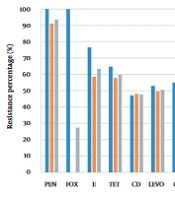
Antibiotic susceptibility testing was performed on 200 non-duplicate MRSA isolates. One hundred and ninety-five (97.5%) isolates were resistant to penicillin, 156 (78%) to tetracycline, 155 (77.5%) to kanamycin, 150 (75%) to gentamicin, 114 (57%) to erythromycin, 100 (50%) to amikacin, 96 (48%) to clindamycin, 90 (45%) to ciprofloxacin, 86 (43%) to tobramycin, 72 (36%) to ceftriaxone, 36 (18%) to mupirocin, 35 (17.5%) to trimethoprim- sulfamethoxazole, and 19 (9.5%) to quinupristin-dalfopristin. All of the isolates were susceptible to vancomycin, teicoplanin, and linezolid. The results of vancomycin MIC were as follows: 65 (32.5%), 48 (24%), and 87 (43.5%) isolates had MICs of 0.5, 1, and 2 µg/mL, respectively. In addition, 35 (17.5%) MRSA isolates were resistant to mupirocin of which 11 (31.4%) were high-level mupirocin- resistant (HLMUPR).
The results of antibiogram and MIC showed that 58 (29%) isolates were susceptible to both clindamycin and erythromycin, cMLSB and iMLSB phenotypes were observed in 88 (44%) and 26 (13%) isolates, respectively. Finally, 8 (4%) isolates were resistant to clindamycin and susceptible to erythromycin. The results of the susceptibility testing classified the MRSA strains into 9 groups. Antimicrobial susceptibility testing revealed that all the isolates were MDR. Resistance profiles and clinical samples isolated from patients hospitalized in ICU are presented in Table 2.
Table 2.
Distribution of Different Clinical Samples and Resistance Profiles in MRSA Species Isolated From ICUs
| Number of Drugs | Resistance Profile | Number of Isolates (%) | Type of Samples (N; %) |
|---|---|---|---|
| 10 | PG, K, GM, CRO, TN, CIP, CD, MUP, TS, SYN | 8 (4) | W (8; 100) |
| 9 | PG, K, GM, T, CIP, TN, CRO, MUP, SYN | 6 (3) | W (6; 100) |
| 8 | PG, K, E, T, CD, AK, TN, CRO | 31 (15.5) | C (9; 29.1), U (8; 25.8), W (5; 16.1), P (5; 16.1), B (4; 12.9) |
| 7 | PG, K, GM, TN, CRO, MUP, TS | 22 (11) | W (12; 54.6), P (10; 45.4) |
| K, GM, CIP, AK, CRO, TS, SYN | 5 (2.5) | W (4; 80), B (1; 20) | |
| 6 | PG, K, GM, E, T, CD | 38 (19) | W (17; 44.7), B (10; 26.3), U (7; 18.5), P (4; 10.5) |
| PG, K, GM, T, E, CIP | 26 (13) | C (8; 30.8), E (7; 26.9), BF (6; 23.1), B (5; 19.2) | |
| PG, K, E, CD, AK, TN | 19 (9.5) | B (8; 42.2), W (7; 36.8), P (2; 10.5), C (2; 10.5) | |
| 4 | PG, GM, CIP, AK | 45 (22.5) | W (27; 60), B (10; 22.2), C (6; 13.4), E (1; 2.2), BF (1; 2.2) |
Abbreviations: AK, amikacin; B, blood; BF, body fluids; C, catheter; CD, clindamycin; CIP, ciprofloxacin; CRO, ceftriaxone; E, erythromycin; E, ear; GM, gentamicin; K, kanamycin; MUP, mupirocin; P, Pus; PG, penicillin; SYN, quinupristin-dalfopristin; T, tetracycline; TN, tobramycin; TS, trimethoprim-sulfamethoxazole; U, urine; W, wound.
4.2. The Distribution of Resistance Genes
Among the investigated resistance genes, the most prevalent one was ant(4΄)-Ia (147; 73.5%) followed by aac (6’)-Ie/aph (2’) (121; 60.5%), tetM (115; 57.5%), msrA (74; 37%), aph (3΄)-IIIa (73; 36.5%), ermA (69; 34.5%), msrB (48; 24%), ermB (34; 17%), ermC (30; 15%), and mupA (11; 5.5%). Among 26 isolates with iMLSB resistance phenotype, ermA, ermB, ermC, msrA, and msrB genes were detected in 20 (76.9%), 18 (69.2%), 12 (46%), 10 (38.5%) and 15 (57.7%) isolates, respectively. Of the 88 (44%) strains with the cMLSB phenotype, ermA, ermB, ermC, msrA, and msrB genes were found in 45 (51.1%), 15 (17.1%), 18 (20.5%), 48 (54.5%), and 22 (25%) isolates, respectively. Regarding the presence of aminoglycoside-resistant genes, ant(4’)-Ia was the most prevalent resistance gene (73.5%) among the tested isolates. Co-existence of ant(4’)-Ia and aac(6’)-Ie/aph(2’’) genes was detected in 78 isolates (39%), co-existence of the ant(4΄)-Ia, aph(3΄)-IIIa, and aac(6΄)-Ie/aph(2˝) in 38 isolates (19%), ant(4΄)-Ia, and aph(3΄)-IIIa in 30 isolates (15%) and aph(3΄)-IIIa, and aac(6΄)-Ie/aph(2˝) in 5 isolates (2.5%). The ant(4΄)-Ia gene was detected only in 1 isolate (0.5%).
4.3. Presence of Adhesion Encoding Genes
With regard to the presence of genes coding for adhesions, the dominant gene was clfA (187; 93.5%) followed by clfB (180; 90%), fnbA (163; 81.5%), fnbB (154; 77%), can (102; 51%), ebp (93; 46.5%), and bbp (5; 2.5%) genes. Distribution of adhesion genes among 200 MRSA strains isolated from patients hospitalized in ICUs is presented in Table 3.
Table 3.
Virulence Patterns in MRSA Strains Isolated From Clinical Samples in ICUs
| Toxin Genes | N (%) | Type of Samples (N; %) |
|---|---|---|
| tst, pvl, eta, etb | 5 (2.5) | W (2; 40), B (1; 20), C (1; 20), BF (1; 20) |
| tst, pvl, eta | 14 (7) | B (6; 42.9), W (5; 35.7), P (2; 14.2), C (1; 7.2) |
| tst, pvl, etb | 4 (2) | W (4; 100) |
| tst, pvl | 20 (10) | W (8; 40), B (4; 20), U (3; 15), E (3; 15), P (2; 10) |
| tst | 80 (40) | W (30; 37.5), B (15; 18.7), C (11; 13.7), U (9; 11.3), P (8; 10), E (5; 6.3), BF (2; 2.5) |
| Adhesion genes | ||
| clfA, clfB, fnbA, fnbB, can, ebp | 85 (42.5) | W (49; 57.6), B (10; 23.5), C (9; 10.6), P (7; 8.3) |
| clfA, fnbA, fnbB, can, ebp, bbp | 4 (2) | W (1; 25), BF (2; 50), P (1; 25) |
| clfA, clfB, fnbA, can, ebp, bbp | 1 (0.5) | B (1; 100) |
| clfA, clfB, fnbA, fnbB | 63 (31.5) | W (32; 50.8), B (14; 22.2), C (9; 14.3), U (8; 12.7) |
| clfA, clfB, fnbA, can | 10 (5) | C (7; 70), W (2; 20), U (1; 10) |
| clfA, fnbB, can, ebp | 2 (1) | W (2; 100) |
| clfA, clfB | 21 (10.5) | P (10; 47.6), E (5; 23.8), B (3; 14.3), BF (3; 14.3) |
| clfA, ebp | 1 (0.5) | P (1; 100) |
| Resistance genes | ||
| ant(4΄)-Ia, aac(6΄)-Ie/aph(2˝), aph(3΄)-IIIa, tetM, ermA, ermB | 30 (15) | W (15; 50), B (10; 33.3), C (2; 6.7), E (3; 10) |
| ant(4΄)-Ia, aph(3΄)-IIIa, tetM, msrA | 30 (15) | W (18; 60), B (10; 33.3), C (2; 6.7) |
| ant(4΄)-Ia, aac(6΄)-Ie/aph(2˝), tetM, ermA, ermC, msrA, msrB | 28 (14) | W (15; 53.6), B (8; 28.6), C (3; 10.7), P (2; 7.1) |
| ant(4΄)-Ia, aac(6΄)-Ie/aph(2˝), tetM | 22 (11) | W (10; 45.5), B (5; 22.7), C (5; 22.7), E (2; 9.1) |
| ant(4΄)-Ia, aac(6΄)-Ie/aph(2˝) | 19 (9.5) | W (12; 63.2), B (4; 21), BF (2; 10.5), U (1; 5.3) |
| ant(4΄)-Ia, aac(6΄)-Ie/aph(2˝), aph(3΄)-IIIa, mupA, msrA, msrB | 8 (4) | W (8; 100) |
| ant(4΄)-Ia, aac(6΄)-Ie/aph(2˝), ermA, msrB | 6 (3) | W (2; 33.3), C (2; 33.3), U (2; 33.3) |
| aac(6΄)-Ie/aph(2˝), aph(3΄)-IIIa, ermA, msrA, msrB, tetM | 5 (2.5) | W (2; 40), B (1; 20), C (1; 20), P (1; 20) |
| ant(4΄)-Ia, aac(6΄)-Ie/aph(2˝), ermB, msrA, mupA | 3 (1.5) | W (3; 100) |
| ant(4΄)-Ia, ermC | 1 (0.5) | U (1; 100) |
| ermB, msrB, ermC | 1 (0.5) | W (1; 100) |
Abbreviations: B, blood; BF, body fluids; C, catheter; E, ear; P, Pus; U, urine; W, wound.
4.4. Detection of Toxin Encoding Genes
Among the 200 MRSA isolates analyzed in the current study, the most frequent toxin genes were tst (123; 61.5%), pvl (43; 21.5%), eta (19; 9.5%), and etb (9; 4.5%), respectively. Distribution of toxin encoding genes among MRSA species isolated from clinical samples of patients hospitalized in ICU is presented in Table 3.
4.5. Distribution of SCCmec Types
The multiplex-PCR to determine SCCmec types showed that 113 (56.5%) isolates belonged to SCCmec type III, 50 (25%) to SCCmec type IV, 22 (11%) to SCCmec type II, and 15 (7.5%) to SCCmec type I. It is noteworthy that all the isolates carrying pvl, eta, and etb encoding genes belonged to SCCmec IV, while isolates harboring tst-1 gene were distributed among SCCmec type III (40.7%), SCCmec type IV (35%), SCCmec type II (14.6%), and SCCmec type I (9.7%). Of the 11 (5.5%) HLMUPR-MRSA strains, 6 isolates (54.5%) carried SCCmec type III, 4 isolates (36.4%) SCCmec type II, and 1 isolate (9.1%) SCCmec type I. Of the 26 isolates with iMLSB phenotype, 17 isolates belonged to SCCmec type III (65.4%) and 9 (34.6%) to SCCmec type IV. Isolates with cMLSB phenotype were distributed among SCCmec type III (26; 29.5%), SCCmec type IV (25; 28.4%), SCCmec type II (22; 25%), and SCCmec type I (15; 17.1%). The distribution of adhesion, toxin, and resistance encoding genes among different SCCmec types is summarized in Table 4.
Table 4.
Distribution of MRSA Virulence Genes Among Different SCCmec Types
| Toxin, Adhesion and Resistance Gene | Type of SCCmec | Total, N (%) | |||
|---|---|---|---|---|---|
| I, N (%) | II, N (%) | III, N (%) | IV, N (%) | ||
| tst | 12 (9.8) | 18 (14.6) | 50 (40.6) | 43 (35) | 123 (61.5) |
| pvl | 0 (0) | 0 (0) | 0 (0) | 43 (100) | 43 (21.5) |
| eta | 0 (0) | 0 (0) | 0 (0) | 19 (100) | 19 (9.5) |
| etb | 0 (0) | 0 (0) | 0 (0) | 9 (100) | 9 (4.5) |
| clfA | 12 (6.5) | 18 (9.6) | 110 (58.8) | 47 (25.1) | 187 (93.5) |
| clfB | 14 (7.8) | 22 (12.2) | 110 (61.1) | 34 (18.9) | 180 (90) |
| fnbA | 9 (5.5) | 19 (11.7) | 89 (54.6) | 46 (28.2) | 163 (81.5) |
| fnbB | 15 (9.8) | 21 (13.6) | 80 (51.9) | 38 (24.7) | 154 (77) |
| can | 11 (10.8) | 14 (13.7) | 31 (30.4) | 46 (45.1) | 102 (51) |
| ebp | 15 (16.1) | 8 (8.6) | 59 (63.5) | 11 (11.8) | 93 (46.5) |
| bbp | 1 (20) | 1 (20) | 1 (20) | 2 (40) | 5 (2.5) |
| ant (4΄)-Ia | 5 (3.4) | 9 (6.1) | 83 (56.5) | 50 (34) | 147 (73.5) |
| aac (6΄)-Ie/aph (2˝) | 8 (6.6) | 14 (11.6) | 74 (61.1) | 25 (20.7) | 121 (60.5) |
| tetM | 3 (2.6) | 9 (7.8) | 92 (80) | 11 (9.6) | 115 (57.5) |
| msrA | 5 (6.7) | 17 (23) | 43 (58.1) | 9 (12.2) | 74 (37) |
| aph (3΄)-IIIa | 12 (16.4) | 3 (4.1) | 40 (54.8) | 18 (24.7) | 73 (36.5) |
| ermA | 8 (11.6) | 19 (27.5) | 19 (27.5) | 23 (33.4) | 69 (34.5) |
| msrB | 5 (10.4) | 5 (10.4) | 14 (29.2) | 24 (50) | 48 (24) |
| ermB | 12 (35.3) | 0 (0) | 13 (38.2) | 9 (26.5) | 34 (17) |
| ermC | 2 (6.7) | 3 (10) | 14 (46.7) | 11 (36.6) | 30 (15) |
| mupA | 1 (9.1) | 4 (36.4) | 6 (54.5) | 0 (0) | 11 (5.5) |
| Total | 15 (7.5) | 22 (11) | 113 (56.5) | 50 (25) | 200 (100) |
5. Discussion
In the current study, wound (43%) and blood (19%) samples were the most common specimens in line with previous studies that reported MRSA isolates responsible for the majority of wound and blood infections in hospitalized patients (2, 14). The MRSA strains are usually resistant to macrolides, lincosamides, aminoglycoside, and approximately all currently available beta-lactam antimicrobial agents such as penicillin and cephalosporins (17, 22, 23). Accurate susceptibility data are important to appropriate treatment options. In the current study, the most resistant pattern among MRSA strains was observed in beta-lactam antibiotics including penicillin (97.5%) followed by tetracycline (78%), kanamycin (77.5%), gentamicin (75%), erythromycin 114 (57%), amikacin (50%), and clindamycin, while antibiotics such as vancomycin, teicoplanin, and linezolid had good activity against MRSA infections and these results were largely in line with the findings of Goudarzi et al., (23) and Ko et al. (24).
Although vancomycin-resistant S. aureus isolates are reported in many parts of the world, the results of susceptibility testing revealed that all isolates were susceptible to vancomycin and inhibited at ≤ 2 µg/mL consistent with other studies in Iran (25) and those of other countries (19, 26), which reported that MRSA was almost always susceptible to the mentioned antibiotics. This could be explained by the successful implementation of infection control programs and appropriate use of antibiotics in clinics. Aminoglycosides play a significant role in the treatment of numerous infections, especially staphylococcal infections. In line with the study by Ko et al. (24) and a study carried out in Iran by Rasahidi et al. (14) an increased resistance rate to aminoglycosides such as kanamycin (77.5%), gentamycin (75%), amikacin (50%), and tobramycin (43%) were also reported in the current study.
Molecular analysis of aminoglycosides resistance genes showed that ant (4΄)-Ia was dominant in 73.5% of the isolates followed by aac (6΄)-Ie/aph (2˝) (60.5%) and aph (3΄)-IIIa (6.5%). Reported rate of ant (4΄)-Ia, which conferred resistance to kanamycin in the current study (73.5%), was relatively higher than 42.2% reported from Iran by Rahimi et al. (27) and 24% by Ardic et al. (28) from Turkey. The majority of the isolates carrying this gene (90.3%) were also resistant to kanamycin. The second most frequent AME detected in the current study was aac (6΄)-Ie/aph (2˝) (60.5%), conferring gentamicin resistance, which was lower than the rate reported by previous study in Tehran, Iran (81.1%) and higher than the ones reported in Turkey (28%) (28).
In the current study, the rate of aph (3΄)-IIIa (6.5%) was relatively low, which was close to that of the study carried out in Japan (8.9%) (29), but was lower than those of Turkey (66%) (28) and Iran (19). In line with other studies, it was detected that gentamicin-susceptible isolates harbored aac(6′)/aph(2′′) gene (4.1%) and kanamycin-susceptible isolates harbored ant(4′)-Ia gene (3.4%). In contrast to the results of the study by Rahimi et al. (27) which reported aac(6′)/aph(2′′) gene as the dominant AME gene in comparison to 2 others, ant(4′)-Ia and aph(3′)-IIIa, it was determined that ant (4΄)-Ia gene was dominant in the current study isolates (73.5%). Unfortunately, resistance to mupirocin as an effective antibiotic in eradication of nasal carriage of S. aureus and treatment of different types of staphylococcal skin infections is increasing (10).
The resistance rate to mupirocin varied from 17.5% in the current study to 25% in the previous study in Iran (30), 5% in India (31), 1.6% in Greece (32), and 2.6% in Jordan (33). In the current study, 5.5% of MRSA isolates carried mupA gene and were confirmed as HLMUPR MRSA. This finding was contrary to the observations reported from Iran by Shahsavan et al. (30) (25%) and Gonzalez-Dominguez from Spain (34) (27.2%). Low prevalence of HLMUPR MRSA strains was previously reported in Korea (1.8%) (35). Unrestricted policies that allow improper and widespread utilization of mupirocin for long periods in hospitals and health care settings and the origin of the isolates and clinical samples are the most important causes of variation in the incidence rate of resistance to mupirocin in MRSA isolates (30-32). In all, the high resistance rate of mupirocin presented in the current study emphasized that using mupirocin in clinical practice should be modified.
The macrolide antibiotics as a protein synthesis inhibitor are widely employed to treat staphylococcal infections. Based on in vitro susceptibility data, 114 (57%) isolates were resistant to erythromycin and 96 (48%) isolates resistant to clindamycin. The percentage of iMLSB resistance in the current study was relatively low (13%), which was higher than the previous findings reported from Iran (4.18%) (36) and USA (37) (7%) and was lower than those of Turkey (18%) (38) and Canada (35.3%) (39). In line with other studies, an increased resistance rate of cMLSB phenotype was observed among the current study isolates (44%). In the current study, the frequency of cMLSB phenotype was higher than that of iMLSB phenotype alongside the findings obtained by Ghanbari et al. (36). In the current study, the strains exhibiting iMLSB resistance phenotype carried the following genes: ermA (76.9%), ermB (69.2%), ermC (46%), msrA (38.5%), and msrB (57.7%).
The tetM was the third most commonly detected antibiotic resistance gene among the tested isolates, which included 57.5% of the strains. This finding was in line with those of Dormanesh et al. (40) that showed tetK (89.18%), mecA (71.62%), msrA (56.75%), and tetM (54.05%) as the most commonly detected antibiotic resistance genes in their study. As shown in Table 4, the most prevalent toxin encoding gene was tst (61.5%), which was in agreement with those of the other studies (1, 22, 23). In the current study, pvl genes were detected in 21.5% of the tested isolates. Previous studies reported the prevalence of 2% to 35% of pvl genes among MRSA strains (7, 23). Regarding the frequency of the exfoliative toxins, the results revealed that eta was more common (9.5%) than what was reported in Colombia (3%) (41) and the previous study in Iran (2), while it was lower than the rate reported in Turkey (19.2%) (42). In line with the current study findings, low frequency of etb gene was reported in several investigators (41, 42).
It was documented that biofilm formation in S. aureus is regulated by the expression of several adhesion genes. As shown in Table 4, the most prevalent gene was clfA (187; 93.5%) followed by clfB (180; 90%), fnbA (163; 81.5%), fnbB (154; 77%), can (102; 51%), ebp (93; 46.5%), and bbp (5; 2.5%). This finding was in line with that of the study by Ghasemian et al. (43) reporting high prevalence of clfA and clfB genes in their study. Similar to the studies previously reported (2, 43), in the current study, the frequency of fnbA and fnbB genes were relatively high indicating the important role of these genes in colonization of MRSA. Results obtained in the current study showed that the frequencies of ebp (46.5%) and can (51%) encoding genes were different from those of Ghasemian et al. (43) for can (78%) and ebp (7%) genes. This variation in the frequency of can and ebp genes in MRSA isolates can be described by the type of clinical isolates and factors affecting gene regulation, which may be important in the prevalence of these genes for colonization.
Regarding the frequency of SCCmec types, the current study results revealed that the majority of tested isolates belonged to SCCmec type III (56.5%) followed by SCCmec type IV (25%), SCCmec type II (11%), and SCCmec type I (7.5%). These findings were in agreement with the previous reports regarding the predominance of SCCmec III in most Asian countries (24), China (44) and Brazil (45). This SCCmec type was previously reported as the most prevalent type in Iran by several investigators (46, 47). High frequency of SCCmec type III in the current study highlighted the hospital origin of these strains. As mentioned earlier, SCCmec type IV was the second most-common SCCmec type identified in the current study (25%). It is noteworthy that all the isolates carrying pvl, eta, and etb encoding genes belonged to this type, while isolates harboring tst-1 gene were distributed among different SCCmec types with the majority of SCCmec type III (40.7%). It should be noted that resistance to antibiotics and MDR pattern were more prevalent among isolates with SCCmec type III than SCCmec type IV. These results confirmed similar observations reported by Ko et al. (24) and other studies (48-50).
6. Conclusion
In summary, the results of the current study indicated that SCCmec type III was predominant among MRSA strains isolated from patients hospitalized in ICUs. In general, it was observed that a coexistence of adhesion, resistance, and toxin genes could be associated with genetic background of the isolates. High occurrence of resistance genes among isolates emphasized that antibiotic resistance was still a major problem in hospitals and infection control measures should be prioritized in ICUs.