1. Background
Because of the ever-increasing resistance of pathogenic microorganisms, sensitivity of patients to some antibiotics, and inability of controlling infectious diseases, the research to find new antimicrobial compounds in biological sources has kept its importance up to the present time (1). Various antibiotics have been found in numerous microorganisms from different habitats. Soil bacteria and fungi play an important role in the production of antibiotics (2, 3). Structure and diversity of these microorganisms depend on various factors such as the available nutrient resources, soil texture, plants cover, and soil pH (4). Actinomycetes are Gram-positive, usually filamentous, immobile, and often obligate aerobes with aerial mycelia whose DNA base composition includes 67% - 78% G + C (5). These bacteria are very important in biotechnology industries due to their ability to produce secondary metabolites.
About 75% of all the known commercially and medicinally useful antibiotics are obtained from Streptomyces (6, 7). Streptomyces are one of the most important groups of Actinomycetes that can survive under a broad range of harsh conditions in soil and they are a crucial source for a wide range of biologically active compounds (6). It is estimated that Streptomyces species have a potential to produce over 150,000 different bioactive compounds (8). These metabolites not only include antibiotics, but also engage extracellular enzymes, antiviral herbicides, antitumor, and anticancer drugs.
These metabolites may be the most various, particular, and complicated substances with excellent properties and usually low toxicity (6). It seems that large genome of these bacteria allows them to respond to specific needs and therefore produce diverse metabolites (9). The production of antimicrobial compound in Streptomyces spp. is greatly influenced by various fermentation parameters such as available nutrients (10), pH, temperature (11), mineral salts (12), precursors (13), and inducers (14). These parameters can be varied from organism to organism (15).
2. Objectives
The aim of this study was to isolate and identify a strain of Streptomyces from unexplored environments and evaluate its antimicrobial products.
3. Methods
3.1. Materials
Various inorganic salts (CaCO3, FeSO4, K2HPO4, MgSO4, NaCl, KNO3, CoCl2, NH4NO3, and NaNO3), Mueller-Hinton agar, starch, glycerol, peptone, malt extract, dextrin, meat extract, yeast extract, tryptone, and soy meal were purchased from Merck (Darmstadt, Germany). Liquid solvents (ethyl acetate, dichloromethane, and chloroform) were prepared from Dr. Mojallali Chemical Lab. DNA Extraction Kit was purchased from FastDNA® SPIN Kit (Qbiogene, Canada). The PCR reagents were purchased from CinnaGen (CinnaGen Co. Iran). The F/R primers were purchased from DenaZiat (Mashhad, Iran). All other chemicals used were of analytical grade.
3.2. Soil Sampling
Soil samples were taken under sterile conditions from the depth of 10 cm in the Telar forests (Iran north, 52°53´ E, 36°28́´ N). Ten grams of the soil sample were put in 90 mL of physiological serum, centrifuged at 150 rpm for 30 minutes, and placed in a warm water bath at 65°C for 15 minutes (16). Starch Casein Agar (per 1.0 L: 10 g starch, 0.02 g CaCO3, 0.01 g FeSO4, 2 g K2HPO4, and 15 g agar) (17) and Glycerol Casein Agar (per 1.0 L: 10 g glycerol, 0.3 g casein, 2 g K2HPO4, 0.01 g FeSO4, 0.05 g MgSO4, 0.02 g CaCO3, 2 g NaCl, and 2 g KNO3, and 15 g agar) (2) culture media were used to isolate Actinomycetes. To prevent fungal growth, the antibiotic cycloheximide at 100 μg/mL was used. The culture media were incubated at 25 - 30°C for 2 - 4 weeks, and then analyzed for the presence of Actinomycete colonies.
3.3. Biochemical and Molecular Characterization
Morphological, physiological, and biochemical characteristics of the ACS52 strain such as growth at various temperatures and pH, presence of hydrolytic enzymes including amylase, gelatinase, protease, cellulase, urease, citratase, and tyrosinase, and fermentation of some sugars were studied (18). Extraction of genomic DNA was performed using FastDNA® SPIN Kit from fresh and purified culture medium according to the manufacturer’s instructions. The 16S rRNA gene was amplified using primers 27F and 1492R. PCRs were carried out with 1.5 mM MgCl2, 10X buffer, 0.2 mM dNTP, 0.5 mM of each primer, and 0.6 unit of Taq polymerase under the conditions as follows: initial denaturation at 95˚C for 120 s, 35 cycles of denaturation at 95°C for 30 seconds, annealing at 49°C for 30 seconds, and the extension at 72°C for 90 seconds and 30 seconds.
The PCR products were purified and sequenced at Macrogen, South Korea. The obtained sequences were compared with NCBI and Ez-Taxon. The 16S rRNA sequences of ACS52 were aligned with the published sequences of related species using the Clustal W software, and were analyzed using the Maximum Likelihood pattern in the MEGA software 6.0. Bootstrap analysis was used to evaluate the tree topology by performing 1000 resamplings.
3.4. Preliminary Screening
The ACS52 strain was cultured in the centers of the Mueller-Hinton agar plates and incubated at 25°C for 96 hours. The Gram-positive pathogens including Staphylococcus aureus PTCC1431 (U), S. epidermidis PTCC1435, S. saprpphyticus PTCC1440, S. intermedius, S. chromogenes, Methicillin resistant S. aureus, S. aureus (D), Listeria monocytogenes PTCC1298, Bacillus subtilis PTCC1365 and Gram-negative pathogens including Salmonella typhimurium ATCC14028, Pseudomonas aeruginosa PTCC1074, Escherichia coli (R) PTCC1399, E. coli O157: H7 NCTC 12900, E. coli (H), E. coli (I), Acinetobacter (F), Acinetobacter (G), and Klebsiella were used as test bacteria. A standard concentration of the test bacteria was streaked perpendicular to the antagonist on the agar medium. The plates were incubated at 37°C for 18 - 24 hours (19), and the growth inhibition zones were measured in mm.
3.5. Selection of the Seeding and Fermentation Media for Antibiotic Production
Two media for seed culture and three media for fermentation were studied to select the best fermentation media for antibiotic production. The seed culture media included Medium A (per 1.0 L: Malt extract 10 g, Yeast extract 4 g, Glucose 4 g) (20) and Medium B (per 1.0 L: Peptone 10 g, Malt extract 10 g, Glycerol 10 g) (20), while the fermentation media were Hickey-Tresner Medium (per 1.0 L: Dextrin 10 g, Meat extract 1 g, Yeast extract 1 g, Tryptone 2 g, CoCl2 0.02 g) (18), Glycerol Soy Meal (per 1.0 L: Glycerol 15 g, Soy meal 10 g, NaCl 5 g, CaCo3 1 g, CoCl2. 7 H2O 0.001 g) (21), and Glycerol Medium (per 1.0 L: Glycerol 30 g, Casein peptone 2 g, NaCl 1 g, K2HPO4 1 g, MgSO4. 7H2O 0.5 g) (21). The pH of media was adjusted at seven.
Two milliliter of the spore suspension was inoculated to 80 ml of the seed medium and incubated at 30°C for 42 - 48 hours at the speed of 200 rpm. The culture media were then examined for the absence of spores and contamination, and presence of growing hyphae. Then, 2 mL of the seed culture was inoculated to 40 ml of the fermentation medium, and incubated at 30°C for 7 days at the speed of 200 rpm. The fermentation broth was centrifuged at 10000 rpm for 20 minutes and filtered (0.22 µm). 100 μL of standard concentrations from bacterial pathogens were spread on the Muller-Hinton agar medium. Using sterile stainless steel cylinders, wells were formed in the Muller-Hinton agar. 100 μL of the fermentation broth was transferred to the wells and incubated at 37°C for 24 hours and inhibition zones were measured (22).
3.6. Extraction of Antibacterial Activity
The antimicrobial compound was extracted from the fermentation medium by three liquid solvents including ethyl acetate, dichloromethane, and chloroform. The fermentation broth was centrifuged at 4000 rpm for 20 minutes at 4°C. The supernatant was separated and divided into tree equal volumes. The each portion mixed with equal volume of solvent-liquid and the mixture (media and solvent) was shaken for 1 hour and kept stationary for 15 minutes to separate the organic phase from the aqueous phase. The organic phase that contained the antimicrobial compound was concentrated in rotary vacuum evaporator at 35°C in low pressure and kept at 4°C (23).
3.7. In Vitro Antibacterial Assay
The antibacterial activity of the solvent extract of ACS52 was determined by the disc diffusion method against the pathogens bacteria (24). 100 μL of overnight culture of the pathogen was spread on the Muller-Hinton agar medium. 250 μL of each organic fraction was added gradually to paper discs (Padtan Teb Co. Iran). The paper disk was transferred to the Muller-Hinton agar culture. Each organic solvent was added to paper disc with an equal load of pathogen cell and used as control. The culture media were incubated at 35°C for 18 - 24 hours, and diameter of inhibition zone was measured.
3.8. Optimization of the Fermentation Medium
For optimization, all variables were kept constant on a contract basis at any stage of optimization, and only the effect of one variable was studied to determine its optimal level. In the next step, the optimized variable in the previous step was used as a basis.
The different carbon sources (glucose, dextrose, starch, and glycerol) were investigated by adding each at the concentration of 1% w/v. To determine the optimum concentration of the best carbon source, 0.5, 1, 1.5, 2, 2.5, and 3% concentrations (w/v) were added (25). Then, the effects of various nitrogen sources (peptone, tryptone, yeast extract, ammonium nitrate, sodium nitrate, soybean extract, and malt extract, 0.2% w/v) were also investigated. Next, the different concentrations of the most effective nitrogen source were used at 0.2, 0.4, 0.6, 0.8, 1, 1.2, and 1.6% w/v (25). The different conditions of culture at various pH levels (4, 6.5, 7, 8, and 9), temperatures (15, 20, 25, 30, and 37°C) (26), inoculation rates of the seed culture medium to the fermentation medium (2.5, 5, 7.5, 10, 12.5, and 15%), and incubation time (4, 5, 6, 7, 8, 9 and 10 days) were also studied. The fermentation culture was centrifuged at 4000 rpm for 20 minutes at 4°C (27).
3.9. Statistical Analysis
All experiments were replicated three times. One- way analysis of variance (ANOVA) at the 95% confidence level was performed using R software (28).
4. Results
The Streptomyces sp. strain ACS52 that was obtained from soil samples in the Telar forests of northern Iran was 99.8% similar to Streptomyces spiroverticillatus. The GenBank accession of sequence was KT232070. Table 1 presents the physiological and biochemical characteristics of Streptomyces sp. strain ACS52. This strain was able to hydrolyze starch and cellulose but not able to hydrolyze casein, urea, gelatin, or citrate. ACS52 was a facultative psychrophilic and alkalophilic Streptomyces sp. strain. The phylogenetic tree obtained by the maximum likelihood algorithm is shown in Figure 1.
Table 1.
Biochemical Characteristics of Streptomyces sp. strain ACS52 Isolated From Soil Samples of Telar Forest, North of Iran
| Biochemical Characteristics | Sugar Fermentation | Growth Temperature (°C) | Growth pH | ||||
|---|---|---|---|---|---|---|---|
| Catalase test | + | Glucose | + | 4 | + | 5 | - |
| Gelatin hydrolysis | - | Lactose | + | 20 | + | 7 | + |
| Starch hydrolysis | - | Sucrose | + | 25 | + | 9 | + |
| Cellulose hydrolysis | + | 30 | + | ||||
| Casein hydrolysis | - | 37 | + | ||||
| Tryptophan hydrolysis | - | 55 | - | ||||
| Urease test | - | ||||||
| Melanin production | - | ||||||
| H2S production | + |
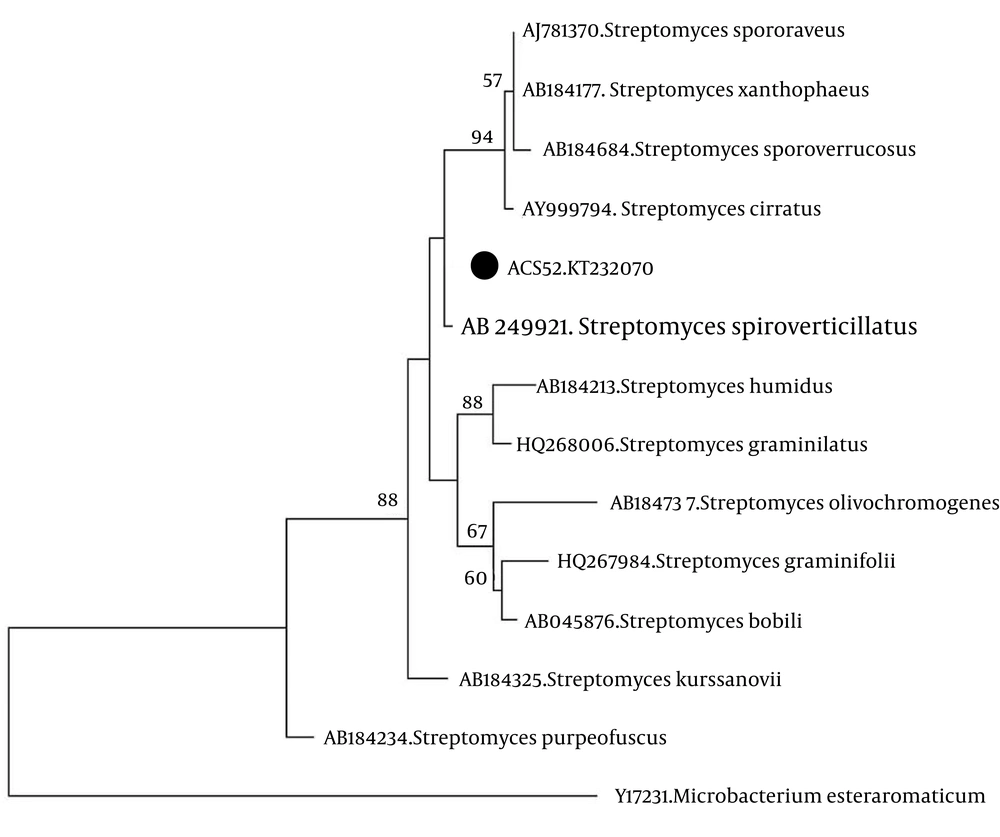
Figure 1.
Clustering was performed using the maximum likelihood method with 1000 bootstraps. Microbacterium esteraromaticum was chosen as out-group.
Primary screening of ACS52 for its antibacterial activity revealed that it had antibiotic activity against a broad spectrum of pathogenic bacteria as well as some antibiotic resistant bacteria found at a city hospital (Table 2). Average diameter of growth inhibition zone against Gram-positive and Gram-negative bacteria was 25 ± 0.06 and 22.5 ± 0.11 mm, respectively. S. epidermidis PTCC1435 and Methicillin resistant S. aureus among the Gram-positive bacteria, and E.coli (H) and Klebsiella among the Gram-negative bacteria showed the most sensitivity in the primary screening. Results indicated there were no significant differences between the various seed culture used to produce antibacterial compounds (P = 0.21), but the fermentation media were drastically different in the amount of the produced antibacterial compounds. The glycerol soy meal culture was particularly different from the other media (P < 0.0001).
Table 2.
| Gram Positive | Zone Inhibition | Gram Negative | Zone Inhibition |
|---|---|---|---|
| Staphylococcus aureus PTCC1431 (U) | 25 ± 0.05 | Salmonella typhimurium ATCC14028 | 23 ± 0.15 |
| S. aureus (D) | 23 ± 0.05 | Escherichia coli (R) PTCC1399 | 23 ± 0.11 |
| Methicillin resistant S. aureus | 28 ± 0.11 | E.coli O157: H7 NCTC12900 | 21 ± 0.15 |
| S. intermedius | 24 ± 0.05 | E.coli (H) | 27 ± 0.11 |
| S. chromogenes | 22 ± 0 | E.coli (I) | 19 ± 0 |
| S. saprophyticus PTCC1440 | 27 ± 0 | Acinetobacter (F) | 21 ± 0.17 |
| S. epidermidis PTCC1435 | 3 ± 0 | Acinetobacter (G) | 21 ± 0.1 |
| Listeria monocytogenes PTCC1298 | 23 ± 0.15 | Pseudomonas aeruginosa PTCC1074 | 22 ± 0.2 |
| Bacillus subtilis PTCC1365 | 19 ± 0.17 | Klebsiella (ESBLs) | 25 ± 0 |
aThe bacteria with standard reference were obtained from a microbiology laboratory at Ferdowsi University of Mashhad, and other bacteria were collected from antibiotic resistant strains at Ghaem hospital in Mashhad.
bValues are expressed as mean ± SD.
Table 3 presents diameters of inhibition zones of the fermentation broth fraction extracts by the various organic solvents. Results showed that ethyl acetate was the best solvent for antibiotic extraction compared to the other solvents. Various factors were evaluated using one factor at a time to optimize the conditions for the production of antibacterial compound by ACS52 strain. The optimization results revealed that Streptomyeces sp. strain ACS52 could grow in all of the studied culture media, but these media had different effects on the inhibition zones. Statistical analysis showed that complex carbon sources such as glycerol and starch were more effective than monomer ones. Raising the concentration of the glycerol from 0.5 to 2% increased the production of the antibacterial compound; however, the production rate decreased when the concentration exceeded 2%. Among the different nitrogen sources examined, yeast extract, tryptone, and sodium nitrate prevented the production of the antibacterial compound, while the maximum production was observed in the presence of soybean extract and peptone (Figure 2).
Moreover, the highest inhibition zone was observed for the culture at pH 7.0. Streptomyeces sp. strain ACS52 grew in a wide range of temperature, but the highest inhabitation zone was observed when it was cultivated at 25°C while the zone declined at 30°C and 37°C. Finally, 10% v/v inoculation rate led to the maximum antibacterial production (Figure 3).
Table 3.
Diameter of Inhibition Zones of Different Fermentation Medium Extracts (mm)
| Aqueous Phase | S. chromogenes | S. chromogenes | MRSA | S. aureus (U) | B. subtilis | E. coli (H) | E.coli (I) | E.coli O157: H7 | E.coli (R) | S. typhimurium | P. aeruginosa |
|---|---|---|---|---|---|---|---|---|---|---|---|
| Ethyl acetate | 18 | 18 | 20 | 20 | 15 | 12 | 15 | 18 | 14 | 15 | 18 |
| Dichloromethane | 12 | 17 | 18 | 15 | 12 | 11 | 15 | 13 | 12 | 15 | 15 |
| Chloroform | 12 | 12 | 18 | 12 | 12 | 0 | 13 | 0 | 0 | 7 | 11 |
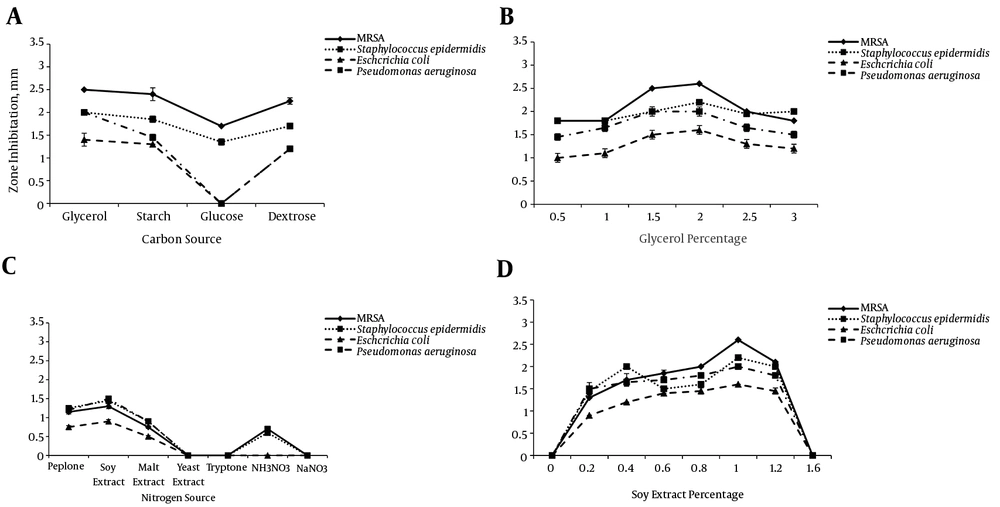
Figure 2.
Cultivation was performed at 30°C and pH 7. Vertical bars represent standard deviation (n = 3).
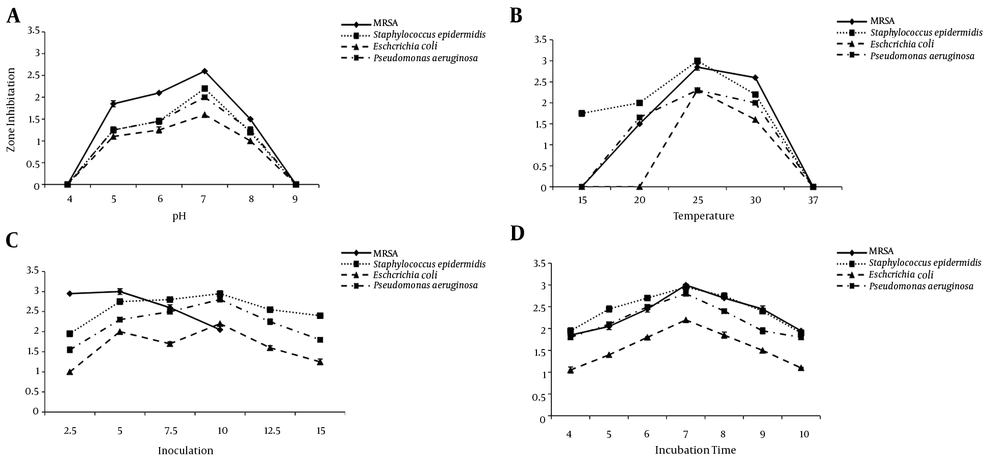
Figure 3.
Vertical bars represent standard deviation (n = 3).
5. Discussion
Because of the indiscriminate use of drugs, drug resistance has turned into one of the biggest problems of human societies. This confusion has led to the study of the ability of microorganisms to control diseases and evaluate their secondary products in order to find new pharmaceutical and medical compounds (24). Actinomycetes, especially Streptomyces, are one of the major bacterial groups in biotechnological industries due to their ability to produce various types of secondary metabolites (29, 30). In the present study, Streptomyces sp. ACS52, with a broad range of antibacterial activities, was selected for optimization of its antibacterial properties. The ACS52 isolate grew at both 4°C and 37°C, and therefore was considered as a cold tolerant bacterium. The antibacterial activity of Actinomycetes may stem from the fact that they produce numerous enzymes that can affect various structures of pathogens and control their growth. The production of these enzymes under extreme conditions, in comparison with normal conditions, gives unique features to the enzymes, and may lead their effectiveness to be improved against pathogens. The cold tolerant bacteria can be suitable candidates for research to find new antibacterial compounds (31).
The present study showed the Streptomyeces sp. strain ACS52 had the capability to produce an antibacterial compound against all of the studied Gram-positive and Gram-negative pathogens, although the average diameter of inhibition zone was higher for Gram-positive bacteria. The fermentation culture could show significant effects in the antibacterial activity (23).
Numerous solvents were used in this study to extract the antibacterial compounds. Ethyl acetate extract (as a non-polar solvent) had maximum antibacterial activity compared to dichloromethane and chloroform extracts (as polar solvents). Therefore, the antibacterial compound produced by Streptomyeces sp. strain ACS52 probably has non-polar structure. The results of the optimization of culture conditions indicated that the highest antibacterial production was observed at culture pH of 7, inoculation rate of 10%, and incubation time of 7 days (168 hours) at 25°C. These results are quite comparable with those reported in other studies (27, 32, 33). The results obtained under the optimal culture conditions showed that the antibacterial compound production was lowest in the presence of glucose (especially against Gram-negative bacteria). However some of researches showed that the addition of glucose to the culture medium increased the production of antibiotic activity (34). In this regard, a research carried out by Abdelwahed (27) indicated starch directly related to the increased inhibition zones.
The present study showed that Streptomyeces sp. strain ACS52 has a broad spectrum antibacterial activity against both Gram-positive and Gram-negative bacteria. It also revealed that the optimization of culture conditions is effective in increasing the production of antibacterial compound. Further investigation on the purification and characterization of antibacterial compound produced by this strain would lead to some products useful in pharmaceutical applications.