1. Background
Giardiasis is caused by Giardia lamblia, a flagellated pathogen that causes diarrhea in children. This intestinal disease is suffered worldwide, and the rate of giardiasis cases is between 1 and 25% in different parts of the world (1). The parasite causes not only diarrhea, but also intestinal malabsorption and weight loss, especially in children (2). Appropriate chemical drugs are available for giardiasis treatment for example, metronidazole, furazolidone, tinidazole and quinacrine, etc., but some patients who used them reported drug resistance, low efficacy, and various negative side effects as a result (3).
Giardia is transmitted by cysts that are resistant and not easily destroyed. Therefore, various methods are suggested for eliminating them, including one proposed by the WHO: the use of herbs and natural foods (4). Many experiments were conducted in order to find alternative treatments for Giardia without the negative side effects of chemical drugs. For example, a study was conducted regarding the effects of essential oil and hydroalcoholic extract from some herbs garlic, thyme and Artemisia annua on Giardia cysts in vivo and in vitro (5).
Ozonated olive oil (OZO) consists of organic, extra-virgin, cold-pressed olive oil made by ozone injection. This process involves ozone bubbling into the oil for an extended period of time. The OZO is commonly used as a topical cream for skin conditions. This cream stimulates the growth of skin cells, as well as sterilizes, increases wound healing, and reduces inflammation in insect bites. It can also be used as a natural underarm deodorant and can treat chronic periodontitis as an adjunctive therapy to scaling and root planning (6, 7).
2. Objectives
The aim of the present study was to investigate the effect of ozonized organic extra-virgin olive oil on a G. lamblia cyst.
3. Methods
3.1. Extra-Virgin Organic Olive Oil Preparation
The OZO was prepared at the Fadak integrated Agro-Industrial company in the Qom province in Iran. This preparation was based on international standards confirmed by the WHO. The kinds of olive oil indices included the following characteristics:
- Acidity: 0.7 NaOH 0.1 normal/g of oil by the iodometric method.
- Peroxide: 9 meq o2/kg of oil.
- Density: 0.92 g/mL of oil.
- Linolenic acid: 0.7%.
3.2. Ozonization Method
The olive oil was ozonized by the department of pharmacology at the Ferdowsi University of Medical Sciences in Mashhad, Iran. The ozone generator used in this study was Cornell, producing 35 g per hour of ozone with a 3% outer reactor, a 99.9% oxygen inlet, and an air cooling system. Organic extra-virgin olive oil samples were placed in an ozone generator for 12, 24, 36, 48, and 60 hours, and ozone was injected. This ozonized olive oil was sent in standard condition to the laboratory of parasitology at Arak University of Medical Sciences.
3.3. Preparation and Purification of Giardia Cysts
Stool samples were collected from the health center of Arak city. Giardia lamblia cysts were isolated from the heavily infected stool samples, and sucrose gradient flotation techniques were used for cyst purification. The collected cysts were washed twice by normal saline and kept in +4°C until use.
3.4. Exposure Groups
Seven groups of triple tubes containing Giardia cysts were used for the OZO experiment. All the tubes contained 500 μL of Giardia cyst suspension. 500 μL OZO with 32, 64, 96, 128, and 160 ozone concentrations were added to the first group up to the fifth group, respectively. The same volume of non-ozonized olive oil and normal saline were added to the sixth and seventh groups, which were considered control groups. The tubes were placed at room temperature. Every four hours, the mortality rate of the Giardia cysts was measured until it reached 100%; this mortality rate was reported with a o.1% eosin staining method and an optical microscopy.
3.5. Statistics
All statistical analyses were performed using SPSS ver.18.0 software. The amount of time it took for each group to achieve a 100% mortality rate was studied using a survival analysis based on Kaplan-Meier methods. To compare the amount of time to the total fertility rate in seven groups, different survival tests were applied, including Log-Rank, Breslow, and Torone-Ware.
4. Results
4.1. Ozonation Result
The ozone concentrations of the olive oil samples were 32, 64, 96, 128, and 160 mg/gram, based on ozone absorption, respectively.
4.2. Giardia Cysts
The suspension containing collected cysts from the stool samples consisted of 5 × 10³Giardia cysts per microliter.
4.3. Exposure Results
The results of the experiments revealed that the first five groups’ mortality rate of Giardia cysts was 100% in 100 hours (Figures 1 and 2). However, in the control groups (the sixth and seventh groups), the mortality rate of the cysts did not reach 100% during the same amount of time. On the one hand, as shown in Figure 1, with an increase in the ozone concentration in the olive oil, the mortality rate of the cysts also increased. On the other hand, the probability of survival in the fifth group was less than in the other groups. The mean times of mortality in all the groups were compared with one another, and the results showed a significant difference among them (P ≤ 0.0.5).
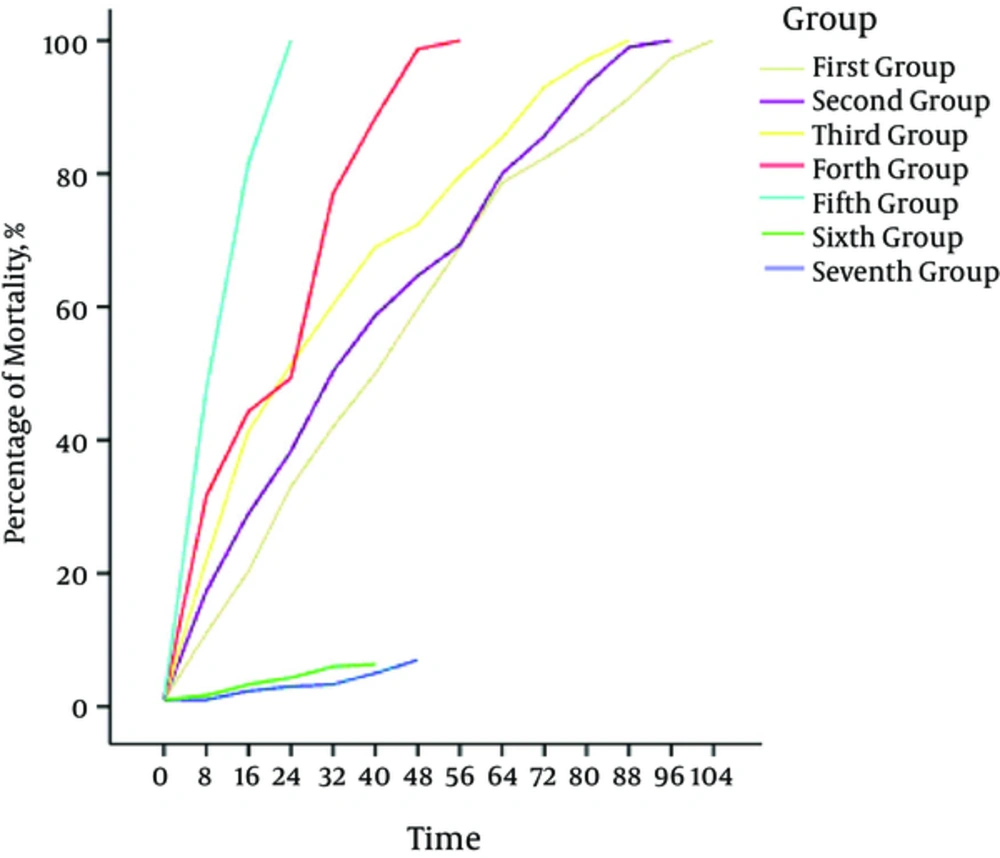
Figure 1.
Diagram of the Mortality Rate of the Giardia Cysts for Seven Groups
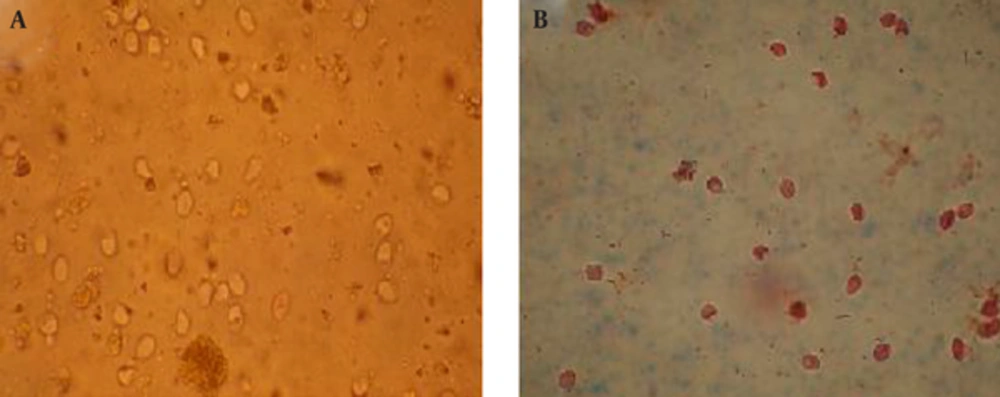
Figure 2.
A, Before exposure to the ozonized olive oil (100% live cysts); B, after exposure to the ozonized olive oil (100% dead cysts).
5. Discussion
Giardia lamblia is the cause of giardiasis. The disease has worldwide distribution, but it is reportedly most prevalent among children living in tropical regions. This disease usually has mild symptoms, but it can convert to a chronic disease and lead to malabsorption, weight loss, and eventually failure to thrive (FTT) (1, 2). The current drugs for treating this health problem are metronidazole, furazolidone, tinidazole, and quinacrine, but they have many negative side effects (3). Consequently, researchers are looking for new ways to treat the disease without these side effects, such as using natural materials derived from plants, since most of these materials are safe and even consumed as food (8, 9). The effects of several extracts and essential oils of plants were tested on G. lamblia. For example, the essential oil and extract of Allium paradoxium, Achyrocline satureioides, Eugenia uniflora, Foeniculum vulgare and Psidium guajava can help increase the mortality rate of Giardia cysts. Also, A. satureioides extract resulted in the maximum cytotoxic effect on Giardia cysts (7, 10). The effect of garlic extract on Giardia was also evaluated; the results showed that this extract (8 mg/mL) eliminated 75% of G. lamblia cysts after three hours and 100% of them after eight hours (6, 11, 12).
Overall, the OZO therapeutic effect was studied in various research investigations. Kim et al. evaluated the topical therapeutic effect of OZO on acute cutaneous wound healing in a guinea pig model. The results showed that using topical OZO can accelerate skin wound healing in a guinea pig (13). In addition, Patel et al. examined the OZO effect on a drug-resistant periodontal disease. The results of this study revealed that individuals who underwent periodontal surgery combined with ozone therapy had the best clinical conditions (14).
Ozonized sunflower oil (OZS) is another natural treatment option; its anti-fungal and antibacterial effect was confirmed by some researchers, as well as its success in increasing the mortality rate of Giardia (15). Also, the effects of ozonized water (OZW) and ozonized vegetable oil (OZV) were compared on patients with giardiasis. The results of this comparison showed that the effect of OZV is faster than that of OZW, because all of the patients treated with OZV recovered in only three days (16).
Ozone is converted to oxygen and a free oxygen atom after breaking down, and the atom acts against different structural parts of different pathological agents, especially bacteria and fungi as free radicals, in order to show its decontamination effects. Today, hyperbaric oxygen is used as a complementary therapy in surgical wards to treat infectious wounds, particularly diabetic foot ulcers. According to various research investigations, the oxygen atoms released by ozone acted like oxygen free radicals generated by neutrophils and macrophages as the first line of the immune system defense (13, 17). Instability in the environment is the main problem for this gas, so after production, it shows decontamination effects only through direct contact. It can be kept for one to three years under conditions with the same effects; if the gas is blown into vegetable oils, a free oxygen atom is produced with the former properties and is storable.
Ozone can be stored for 15 to 20 minutes in the open air and one to three hours in the water, and it has a higher durability in oil, particularly olive oil (14, 17). Based on various studies, OZO can be stored for a year at room temperature and for three to four years in the refrigerator; extra-virgin and organic olive oil has even greater effects and durability due to its lack of additives and toxins (17). The results obtained from the current study showed the effect of OZO on the mortality rate of Giardia cysts: An increasing ozone concentration shortened the death time of the cysts, because the mortality rate is dependent on the concentration of ozone in the olive oil. The olive oil has a high durability status and consumes the cysts as food, so there seem to be no limitations for using OZO in a clinical trial study; thus, its effect will be clear in vivo.
Bases on the results of the current study, it can be concluded that ozone, which is used as ozonized organic extra-virgin olive oil with a high durability, has a significant effect on G. lamblia.