
1. Background
Cetirizine is a selective, second-generation histamine H1-receptor antagonist with a rapid onset, a long duration of action, and a low potential for interactions with drugs metabolized by hepatic cytochrome P450 (1, 2). It is used to treat allergic rhinitis and chronic urticaria and generally exhibits lower central nervous system penetration than first-generation antihistamines (3, 4).
Cetirizine is a zwitterion across the physiological pH range, with modest, constant octanol/water lipophilicity (log D ≈ 1.5 at pH 7.4) and a low volume of distribution (5, 6). Its oral bioavailability exceeds 70%, and its daily therapeutic dose is 5 - 10 mg (1, 2). However, sedation, interindividual variability, and the need for sustained symptom control support investigation of nonoral delivery approaches.
Transdermal delivery avoids first-pass metabolism and may improve convenience and compliance (11, 12). Efficient skin delivery requires an appropriate lipophilic–hydrophilic balance, a molecular weight generally below 500 Da, and sufficient thermodynamic activity in the vehicle (13). Microemulsions are thermodynamically stable, optically clear systems that can enhance skin delivery by increasing drug solubilization, modifying stratum corneum lipids, and improving drug partitioning into the skin (14-18).
Oleic acid and Transcutol P are widely used permeation enhancers. Oleic acid can disrupt lipid packing in the stratum corneum, whereas Transcutol P may increase drug solubility and partitioning (18-21). This research group has applied oleic acid/Transcutol P systems to celecoxib, vitamin B12, sildenafil citrate, methimazole, valproic acid, and doxepin (22, 25-33), as well as to naproxen microemulsions (23) and to the liposomal and ocular delivery of curcumin, quercetin, and naringenin (24, 26, 34). Enhancer effects on cetirizine skin permeability, including those of oleic acid, Tween 80, and propylene glycol, have also been characterized by DSC and FTIR (10). Thus, the novelty of the present work lies not in the platform itself but in the factorial identification of the composition variables that control cetirizine flux and in the mechanistic interpretation of combined diffusion and partitioning enhancement.
2. Objectives
This study aimed to formulate and optimize cetirizine-loaded microemulsions based on oleic acid and Transcutol P; to evaluate their physicochemical properties, in vitro release, and ex vivo rat skin permeation; and to identify the formulation variables and transport mechanisms responsible for improved transdermal delivery.
3. Methods
3.1. Materials
Cetirizine was purchased from Abidi Pharmaceutical Company (Tehran, Iran). Transcutol P was supplied by Gattefosse (France). Tween 80, Span 20, propylene glycol, oleic acid, and monobasic and dibasic potassium phosphate were obtained from Merck (Germany). All solvents and reagents were of analytical grade.
3.2. Solubility Studies
The solubility of cetirizine in oils (oleic acid and Transcutol P), surfactants (Tween 80 and Span 20), and the cosurfactant (propylene glycol) was measured by adding excess drug to 2 mL of each solvent, stirring at 20 °C for 24 h, centrifuging, and analyzing the clear supernatant using a validated UV spectrophotometric method.
3.3. UV Method and Validation
Cetirizine was quantified by UV spectrophotometry. Standard solutions were prepared in methanol (λmax = 238 nm) and in water/0.1 N NaOH (λmax = 230 nm); the aqueous phosphate-buffer assay was performed at 230 nm. The method was validated for linearity, precision, accuracy, limit of detection, limit of quantification, and sink conditions (Table 1).
Table 1.
UV Spectrophotometric Method Validation for Cetirizine (Aqueous Medium, 230 Nm)
| Parameter | Value |
|---|---|
| Wavelength (λmax) | 230 nm (aqueous); 238 nm (methanol) |
| Linearity range | 2 - 20 µg·mL-1 |
| Regression equation | A = 0.0340C − 0.0294 |
| Coefficient of determination (R2) | 0.9993 |
| Intra-day precision (%RSD) | 1.67% |
| Inter-day precision (%RSD) | 1.58% |
| Accuracy (% recovery) | 99.8% |
| LOD | 0.17 µg·mL-1 |
| LOQ | 0.50 µg·mL-1 |
| Sink conditions | Confirmed (receptor < 10% of saturation) |
3.4. Animals
Male Wistar rats (10 - 12 weeks, 150 - 170 g) were obtained from the Central Animal House of Ahvaz Jundishapur University of Medical Sciences. Animals were housed in standard cages under a 12:12 h light/dark cycle, with ad libitum access to food and water. Abdominal skin was excised after anesthesia and euthanasia, cleaned of subcutaneous fat using cold acetone, and adjusted to a thickness of 250 ± 20 µm using a digital micrometer. Skin sections were randomly allocated to release and permeation experiments.
3.5. Experimental Design and Preparation
A two-level full-factorial design with three variables was used: oil content (5% and 50%), water content (5% and 10%), and S/C ratio (1:1 and 3:1), with cetirizine fixed at 1% (w/w), below its saturation solubility to maintain complete solubilization. The oil phase consisted of oleic acid/Transcutol P, the surfactant phase consisted of Tween 80/Span 20, and propylene glycol was used as the cosurfactant. The formulation design is shown in Table 2. Each formulation was prepared by dissolving cetirizine in the oil phase, mixing it with the surfactant-cosurfactant blend, and titrating with distilled water to form a clear microemulsion (23).
Table 2.
Two-Level Full-Factorial Design of Cetirizine Microemulsions a
| Formulation | Oil | Water | S/C ratio |
|---|---|---|---|
| ME-CET-1 | 50% (+) | 10% (+) | 3:1 (+) |
| ME-CET-2 | 50% (+) | 10% (+) | 1:1 (−) |
| ME-CET-3 | 50% (+) | 5% (−) | 3:1 (+) |
| ME-CET-4 | 50% (+) | 5% (−) | 1:1 (−) |
| ME-CET-5 | 5% (−) | 10% (+) | 3:1 (+) |
| ME-CET-6 | 5% (−) | 10% (+) | 1:1 (−) |
| ME-CET-7 | 5% (−) | 5% (−) | 3:1 (+) |
| ME-CET-8 | 5% (−) | 5% (−) | 1:1 (−) |
a Levels were coded as low (−) and high (+): oil 5% (−)/50% (+), water 5% (−)/10% (+), and S/C 1:1 (−)/3:1 (+). Cetirizine was fixed at 1% (w/w).
3.6. Characterization
Droplet size and polydispersity index (PDI) were measured using a particle-size analyzer (Scatter Scope 1 Quidex, South Korea), and the refractive index was measured using an Abbe refractometer. Viscosity was determined using a Brookfield DV-II+ Pro viscometer, and pH was measured at 25 °C.
3.7. Release and Skin Permeation
Release and permeation were evaluated using standing Franz cells (effective area, 4.906 cm2; receptor, 35 mL phosphate buffer, pH 7.4, 37 ± 0.5 °C, 200 rpm), yielding a skin-surface temperature of approximately 32 - 35 °C. For release, a cellulose membrane was placed between the donor and receptor compartments. For permeation, full-thickness abdominal rat skin was mounted with the stratum corneum facing the donor compartment. Samples were withdrawn at predetermined time points up to 24 h for release and up to 72 h for permeation, replaced with fresh receptor medium, and analyzed by UV spectrophotometry. Jss, the permeability coefficient (P), lag time (Tlag), diffusion coefficient (D), and enhancement ratios (ERflux = Jss,form/Jss,control; ERD = Dform/Dcontrol) were calculated from cumulative permeation profiles (23).
3.8. Physical and Chemical Stability
Physical stability was assessed at 4, 25, and 37 °C for 6 months by weekly inspection for transparency, phase separation, and changes in droplet size, and by centrifugation (10,000 rpm, 30 min). Chemical stability was assessed by measuring cetirizine content at 0, 3, and 6 months.
3.9. Statistical Analysis
Data are presented as mean ± SD (n = 3). Factor effects on Jss were analyzed using two-level full-factorial ANOVA (Minitab 17), including the three main effects and their interactions. Effect estimates, coefficients, and P values are reported, with P < 0.05 considered statistically significant.
4. Results
4.1. Solubility
Cetirizine solubility was highest in Tween 80 among the surfactants and in the oleic acid-Transcutol P combination among the oils (Table 3), supporting their selection. The 1% (w/w) load is below the aqueous saturation solubility and well below the solubility in the selected oil/surfactant mixture, thereby maintaining sink conditions in the dispersed phase and minimizing the risk of crystallization.
Table 3.
Solubility of Cetirizine in Formulation Components (Mean ± SD, mg/mL, 20 °C)
| Component | Role | Solubility (mg/mL) |
|---|---|---|
| Oleic acid | Oil phase | 7.2 ± 0.1 |
| Transcutol P | Oil phase | 6.8 ± 0.2 |
| Oleic acid + Transcutol P | Oil phase | 11.9 ± 0.1 |
| Span 20 | Surfactant | 9.5 ± 0.1 |
| Tween 80 | Surfactant | 22.3 ± 0.2 |
| Propylene glycol | Cosurfactant | 19.3 ± 0.15 |
| Water | - | 10.0 ± 0.2 |
4.2. Factorial Design and Physicochemical Properties
Droplet sizes ranged from 14.94 to 46.15 nm, with PDI < 0.5, and were essentially unchanged after 6 months. Viscosity ranged from 235 to 642 cps and increased with higher oil content and lower water content (both P = 0.001). pH ranged from 4.12 to 5.55 and was significantly affected by water content (P = 0.008) (Table 4).
Table 4.
Droplet Size, PDI, Size After 6 Months, Viscosity, and pH of Cetirizine Microemulsions (Mean ± SD)
| Formulation | Size (nm) | PDI | Size 6 mo (nm) | Viscosity (cps) | pH |
|---|---|---|---|---|---|
| ME-CET-1 | 24.9 ± 1.25 | 0.39 ± 0.02 | 25.0 ± 0.5 | 376 ± 1.06 | 4.12 ± 0.01 |
| ME-CET-2 | 14.94 ± 2.5 | 0.38 ± 0.01 | 15.8 ± 0.2 | 356 ± 1.04 | 4.43 ± 0.01 |
| ME-CET-3 | 20.45 ± 2.2 | 0.39 ± 0.01 | 21.3 ± 0.1 | 604 ± 1.29 | 5.18 ± 0.02 |
| ME-CET-4 | 46.15 ± 2.4 | 0.40 ± 0.02 | 47.10 ± 0.01 | 642 ± 1.21 | 5.13 ± 0.008 |
| ME-CET-5 | 41.45 ± 1.3 | 0.41 ± 0.01 | 41.9 ± 0.5 | 320 ± 1.02 | 4.13 ± 0.03 |
| ME-CET-6 | 26.95 ± 0.27 | 0.41 ± 0.01 | 26.98 ± 0.2 | 344 ± 1.11 | 4.30 ± 0.008 |
| ME-CET-7 | 35.5 ± 1.1 | 0.40 ± 0.005 | 35.8 ± 0.1 | 235 ± 1.08 | 4.99 ± 0.02 |
| ME-CET-8 | 18.95 ± 0.95 | 0.39 ± 0.01 | 19.5 ± 0.3 | 388 ± 1.16 | 5.55 ± 0.025 |
4.3. Release
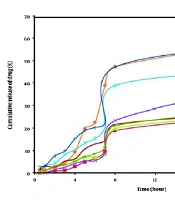
Release profiles over 24 h are shown in Figure 1, and release kinetics are summarized in Table 5. ME-CET-6 showed the highest 24-h release (72.21%), whereas ME-CET-3 showed the lowest release (51.19%). Release data were fitted to the zero-order, first-order, Higuchi, Korsmeyer-Peppas, and Log-Wagner models.
Table 5.
Best-Fit Release Kinetic Model, r2, and 24-H Cumulative Release (Q24) of Cetirizine Microemulsions
| Formulation | Best-fit Model | r2 | Q24 (%) |
|---|---|---|---|
| ME-CET-1 | Higuchi | 0.9353 | 61.47 |
| ME-CET-2 | First-order | 0.9547 | 65.36 |
| ME-CET-3 | First-order | 0.9737 | 51.19 |
| ME-CET-4 | First-order | 0.9718 | 57.11 |
| ME-CET-5 | First-order | 0.9192 | 66.49 |
| ME-CET-6 | Korsmeyer-Peppas | 0.9820 | 72.21 |
| ME-CET-7 | Log-Wagner | 0.9740 | 54.83 |
| ME-CET-8 | Log-Wagner | 0.9757 | 59.36 |
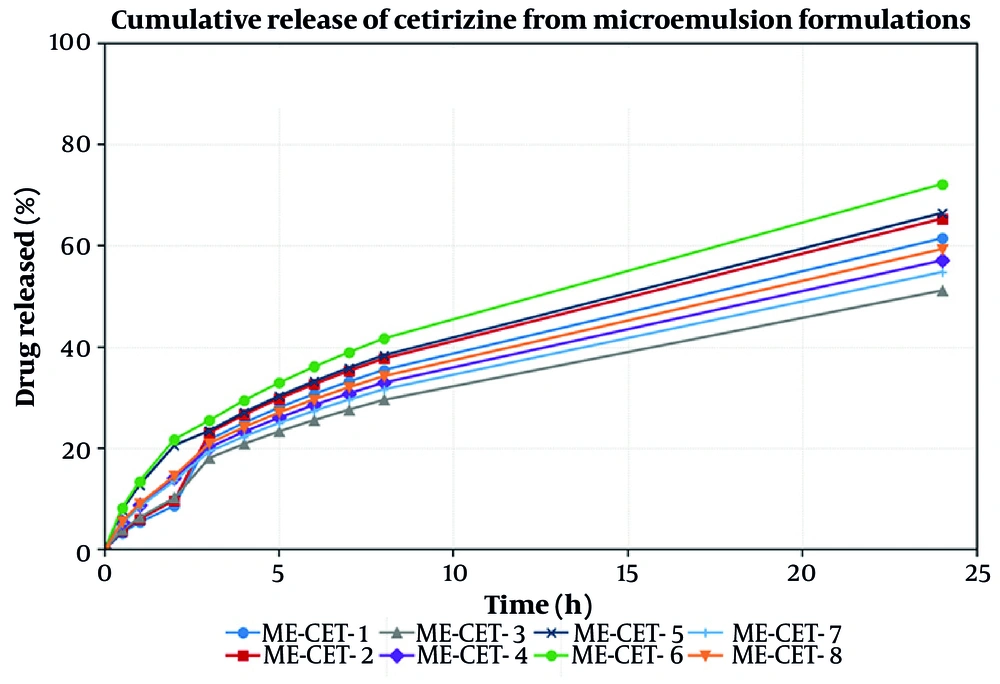
Figure 1.
Cumulative release of cetirizine from microemulsion formulations over 24 h (mean ± SD, n = 3).
For ME-CET-6, the Korsmeyer-Peppas model yielded the highest adjusted r2 (0.982); the modest first-order fit (0.877) indicates a non-first-order mechanism, consistent with diffusion/relaxation-coupled release.
4.4. Skin Permeation
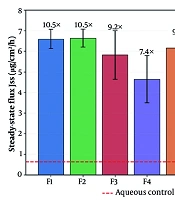
Permeation parameters are shown in Table 6. All microemulsions increased flux relative to the control. ME-CET-6 provided the highest flux (0.0431 ± 0.003 mg·cm-2·h-1) and permeability coefficient (0.051 ± 0.001 cm·h-1), representing an approximately 4.6-fold increase over the control (0.0093 mg·cm-2·h-1). The steady-state flux is shown in Figure 2.
Table 6.
Skin-Permeation Parameters of Cetirizine Microemulsions and Aqueous Control (Mean ± SD, N = 3)
| Formulation | Jss (mg·cm-2·h-1) | D (cm2·h-1) | P (cm·h-1) | Tlag (h) |
|---|---|---|---|---|
| Control | 0.0093 ± 0.001 | 0.0236 ± 0.003 | 0.0314 ± 0.001 | 0.0836 ± 0.001 |
| ME-CET-1 | 0.0325 ± 0.001 | 0.0673 ± 0.001 | 0.039 ± 0.001 | 0.056 ± 0.002 |
| ME-CET-2 | 0.0257 ± 0.005 | 0.0402 ± 0.013 | 0.0308 ± 0.005 | 0.335 ± 0.011 |
| ME-CET-3 | 0.0247 ± 0.002 | 0.1755 ± 0.018 | 0.029 ± 0.001 | 0.772 ± 0.082 |
| ME-CET-4 | 0.0248 ± 0.001 | 0.1222 ± 0.011 | 0.029 ± 0.001 | 0.167 ± 0.138 |
| ME-CET-5 | 0.0401 ± 0.004 | 0.124 ± 0.0108 | 0.048 ± 0.001 | 1.089 ± 0.094 |
| ME-CET-6 | 0.0431 ± 0.003 | 0.112 ± 0.002 | 0.051 ± 0.001 | 1.201 ± 0.03 |
| ME-CET-7 | 0.0391 ± 0.002 | 0.044 ± 0.0529 | 0.046 ± 0.001 | 1.96 ± 0.076 |
| ME-CET-8 | 0.036 ± 0.001 | 0.135 ± 0.024 | 0.0432 ± 0.001 | 1.01 ± 0.186 |
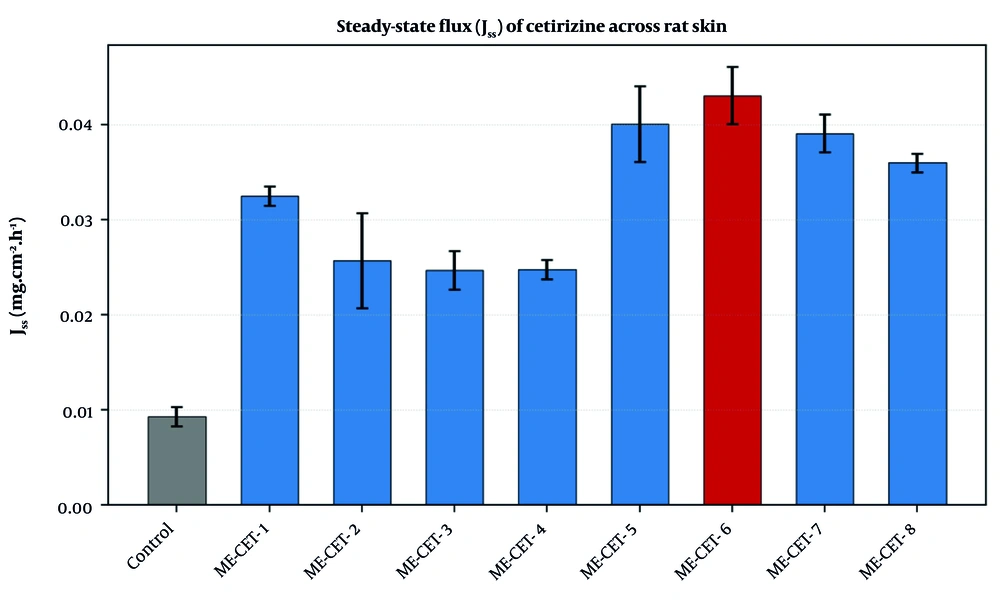
Figure 2.
Steady-state flux (Jss) of cetirizine across rat skin (mean ± SD, n = 3). ME-CET-6 (highlighted) showed the highest flux.
Enhancement ratios are summarized in Table 7. Following re-examination, ERD was recomputed consistently as Dformulation/Dcontrol (Dcontrol = 0.0236 cm2·h-1). Corrected ERD exceeded 1 for all formulations (up to 7.44 for ME-CET-3), and ERflux reached 5.42 for ME-CET-6.
Table 7.
Corrected Enhancement Ratios for Flux (ERflux) and Diffusion (ERD = Dform/Dcontrol) Relative to the Aqueous Control (Mean ± SD)
| Formulation | ERflux | ERD (Corrected) |
|---|---|---|
| ME-CET-1 | 4.09 ± 0.14 | 2.85 ± 0.36 |
| ME-CET-2 | 3.22 ± 0.45 | 1.70 ± 0.59 |
| ME-CET-3 | 3.11 ± 0.11 | 7.44 ± 1.21 |
| ME-CET-4 | 3.12 ± 0.15 | 5.18 ± 0.81 |
| ME-CET-5 | 5.05 ± 0.15 | 5.25 ± 0.81 |
| ME-CET-6 | 5.42 ± 0.12 | 4.75 ± 0.61 |
| ME-CET-7 | 4.92 ± 0.06 | 1.86 ± 2.25 |
| ME-CET-8 | 4.53 ± 0.19 | 5.72 ± 1.25 |
4.5. Effect of Formulation Variables on Flux
The factorial ANOVA of Jss is shown in Table 8, with the fitted model Jss = 0.0340 − 0.000281(oil) + 0.000440(water) + 0.00185(S/C). Oil content had the strongest significant effect (P = 0.001), followed by the S/C ratio (P = 0.015). Water content was not significant (P = 0.119). The main-effects plot is shown in Figure 3.
Table 8.
Factorial ANOVA of Effects on Steady-State Flux (Jss) a
| Term | Coefficient | Effect | P value | Significance |
|---|---|---|---|---|
| Constant | 0.0340 | - | - | - |
| Oil (%) | −0.000281 | −0.01264 | 0.001 | Significant |
| Water (%) | +0.000440 | +0.00220 | 0.119 | NS |
| S/C ratio | +0.00185 | +0.00370 | 0.015 | Significant |
a Effect = coefficient × factor range.
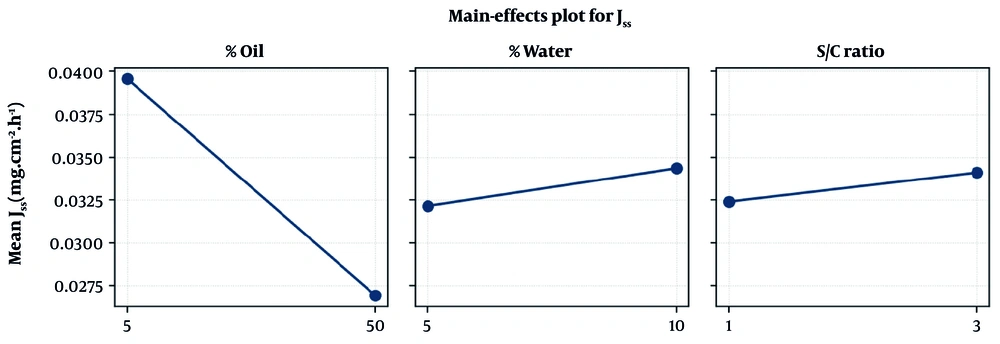
Figure 3.
Main-effects plot for steady-state flux (Jss): influence of oil content, water content, and S/C ratio.
4.6. Comparison With Published Cetirizine Transdermal Systems
Table 9 compares the optimized formulation with published cetirizine skin-delivery systems. The most directly comparable study is the cetirizine nanoemulsion gel of Kassem et al., which also used a 23 full-factorial design and rat-skin permeation and additionally included a clinical urticaria evaluation (36). That system reported a considerably higher permeability coefficient (7.65 cm·h-1) than the present formulation (0.051 cm·h-1); however, the two values are not directly comparable because of differences in dosage form, finite versus infinite dosing, receptor design, and reporting units. The present formulation provides a simpler microemulsion system with controlled factorial optimization and identifies the contributions of oil, water, and the S/C ratio to cetirizine flux.
Table 9.
Comparison With Previous Cetirizine Transdermal/Topical Systems
| System | Approach | Key outcome | Ref. |
|---|---|---|---|
| Present study | Microemulsion (oleic acid/Transcutol P), factorial | ERflux 5.42; ~4.6× vs control | - |
| Nanoemulsion gel | 23 factorial nanoemulsion gel; rat skin; clinical urticaria study | P = 7.65 cm·h-1; effective in urticaria | (36) |
| Enhancer study | Oleic acid/Tween 80/PG on cetirizine; DSC/FTIR | All enhancers raised permeability | (10) |
| Topical cetirizine | Solution, androgenetic alopecia (clinical) | Clinical topical efficacy | (9) |
4.7. Physical and Chemical Stability
No turbidity, precipitation, or phase separation occurred over 6 months at 4, 25, and 37 °C, and none occurred after centrifugation (10,000 rpm, 30 min). Droplet size was essentially unchanged (Table 4). Cetirizine content after storage remained within the validated assay range, indicating the chemical stability of the selected microemulsions during the study period.
5. Discussion
Eight cetirizine microemulsions were prepared and evaluated using a two-level full-factorial design. Droplet sizes of 14.94 - 46.15 nm, with PDI < 0.5, indicate uniform nanoscale droplets suitable for skin delivery, consistent with previous systems from this group (23). The absence of phase separation and minimal changes in droplet size after 6 months support the physical stability of the optimized formulations.
Viscosity increased with higher oil and lower water contents (both P = 0.001). pH values of 4.12 - 5.55 were related to water content (P = 0.008) and are compatible with topical use, although buffered adjustment toward the skin pH (~5.5) should be considered in future development.
ME-CET-6 achieved the highest flux (0.0431 mg·cm-2·h-1; ERflux, 5.42; ~4.6× control). Factorial ANOVA identified oil content as the dominant significant determinant (P = 0.001), with flux decreasing as oil content increased from 5% to 50%. The S/C ratio had a smaller but significant positive effect (P = 0.015), whereas water content was not significant. These findings indicate that, within the studied range, an excessive oil phase may reduce drug thermodynamic activity or alter the microstructure in a way that limits release, whereas the lower-oil, lower-S/C formulation maintained a higher flux.
A key point concerns the mechanism. On re-examination, the diffusion enhancement ratio was recomputed consistently as ERD = Dformulation/Dcontrol; the corrected values exceeded 1 for all formulations, reaching 7.44. Together with ERflux values > 3, these data suggest that both drug partitioning into the skin and apparent diffusivity were improved by the microemulsion system. Oleic acid can disrupt lipid packing in the stratum corneum, and Transcutol P may improve drug solubilization and skin partitioning; these mechanisms are consistent with the observed enhancement (18-21, 29).
From the measured flux, the translational potential can be estimated. At Jss = 0.0431 mg·cm-2·h-1, a patch of about 10 cm2 would theoretically deliver ~10 mg/day, matching the oral therapeutic dose of 5 - 10 mg/day. Because excised rat skin overestimates human permeability, a conservative correction assuming human skin is ~9× less permeable still yields ~11.5 mg/day from a 100 cm2 area, within the therapeutic range. These estimates are indicative only and require in vivo pharmacokinetic confirmation.
Zeta potential was not determined in this study. For nonionic surfactant microemulsions such as these, the absolute zeta potential is typically low; however, measurement is recommended for future characterization.
5.1. Study Limitations
This study was limited by ex vivo-only evaluation, the higher permeability of rat skin compared with human skin, the absence of pharmacokinetic and skin-irritation studies, the absence of direct mechanistic confirmation by DSC/FTIR in this work, and the lack of zeta-potential measurement. These limitations should be addressed before clinical translation.
5.2. Conclusions
Cetirizine microemulsions based on oleic acid and Transcutol P were formulated and optimized for transdermal delivery using a two-level full-factorial design. The formulations were nanoscale, uniform, and physically and chemically stable. ME-CET-6, containing 5% oil, 10% water, and an S/C ratio of 1:1, provided the highest ex vivo flux and permeability coefficient. Corrected enhancement ratios indicate that both increased diffusivity and improved partitioning contributed to enhanced skin permeation. These findings support further development of cetirizine microemulsions for transdermal therapy, with in vivo pharmacokinetic, skin-irritation, and human-skin studies required for confirmation.