
1. Background
Acute sore throat, also known as pharyngitis, is a prevalent clinical complaint worldwide and often imposes a substantial burden on primary health care systems. Epidemiological studies have shown that its cumulative incidence is notably high, particularly among pediatric populations. Some reports have estimated up to 82.2 episodes per 100 children. This finding underscores the high prevalence of the disease and the ongoing need for effective and accessible treatment options for affected families (1). Although the predominant etiology of pharyngitis is viral, bacterial infections, particularly those involving Streptococcus pyogenes (group A Streptococcus), represent a substantial health concern because they can lead to severe nonsuppurative complications, including rheumatic fever. The primary clinical challenge is the rapid and reliable differentiation between viral and bacterial etiologies. This diagnostic uncertainty frequently results in excessive and unnecessary prescribing of systemic antibiotics during outpatient visits. In the absence of an effective topical alternative, the pressure to alleviate symptoms directly contributes to the global health crisis. Therefore, optimal management of acute pharyngitis requires a product that provides topical relief and has proven antimicrobial activity against common bacterial agents. The product should also effectively treat acute inflammation and pain to reduce the need for systemic or unnecessary over-the-counter medications (2).
According to global estimates, antimicrobial resistance (AMR) is a major cause of mortality. For this reason, the World Health Organization emphasizes the need to reduce excessive and unnecessary antibiotic use. In this context, the use of oral antibiotics for mild and localized pharyngitis, which is frequently viral, is a major contributor to the antibiotic resistance crisis. Providing a treatment with strong dual efficacy, including both antimicrobial and anti-inflammatory properties, could be a pivotal tool for antimicrobial stewardship at the community level. This approach may reduce unnecessary prescriptions (3, 4).
The current market for topical herbal products for sore throat is predominantly driven by pharyngeal and expectorant mechanisms. Syrups containing thyme, honey, licorice root, or marshmallow (Althaea) are recognized for their demulcent and antitussive properties. Several herbs, including licorice root, thyme, and oregano, have shown notable antimicrobial properties against S. pyogenes. However, their main limitation is that they do not effectively manage acute pain and local inflammation. Patients with acute sore throat require rapid and effective symptom relief. The development of pharmaceuticals derived from indigenous plant resources is a key strategy to enhance drug security and support national economic growth. Iran, with its exceptional biodiversity, is home to approximately 8000 plant species, which is richer in species diversity than the entire European continent. Of these, at least 2300 species have aromatic and medicinal properties, and 7.9% are endemic to Iran (5).
D. kotschyi is an Iranian endemic species. The successful development of strictly standardized pharmaceutical products from this indigenous species would contribute to national goals for developing high-quality indigenous herbal medicines. It would also reduce the pharmaceutical industry’s reliance on foreign herbal resources and increase the economic value of domestic natural resources. D. kotschyi has a long history in traditional Iranian medicine, where it has been used to reduce fever and joint pain. Recent findings have supported these traditional uses by demonstrating its antinociceptive and antispasmodic properties.
D. kotschyi has traditionally been used in Iranian medicine to reduce fever and joint pain, consistent with recent findings on its antinociceptive and antispasmodic properties. Phytochemical studies have shown that ethanolic or hydroalcoholic extracts of this plant contain substantial flavonoid and polyphenolic compounds. The flavonoid glycoside nature of these compounds makes hydroalcoholic solvents (water/ethanol) the most efficient extraction medium. The main flavonoid and polyphenolic compounds in D. kotschyi extract have shown potent anti-inflammatory effects comparable to those of anti-inflammatory and antimicrobial drugs in pharmacological studies. This comparison supports the efficacy of D. kotschyi in managing acute local inflammation. Previous studies have attributed its anti-inflammatory activity to bioactive flavonoids and other phenolic compounds with antioxidant and immunomodulatory properties. These constituents are thought to reduce the production of pro-inflammatory mediators and reactive oxygen species, thereby alleviating local inflammation and pain. However, the specific molecular mechanisms responsible for these effects require further investigation (6). A major concern associated with synthetic nonsteroidal anti-inflammatory drugs is their potential to cause gastrointestinal adverse effects, including gastric ulcers. However, studies of D. kotschyi extract have shown that it does not worsen indomethacin-induced gastric ulcers and, in fact, markedly reduces their severity. This protective effect is linked to inhibition of myeloperoxidase and malondialdehyde activities by approximately 44% and 58%, respectively, suggesting that the extract may reduce inflammation and increase antioxidant levels in the stomach (7). These compounds provide a distinctive therapeutic profile, with strong anti-inflammatory effects similar to those of nonsteroidal anti-inflammatory drugs while maintaining a better gastric safety profile than conventional synthetic drugs. This makes the formulation suitable for oral administration while maintaining a favorable safety profile. Studies have also confirmed that the extract has antibacterial and antioxidant properties (8). These compounds may enhance the product’s ability to target the underlying cause, such as S. pyogenes, while reducing inflammation. Furthermore, extracts of D. kotschyi have shown significant antispasmodic activity. This property is particularly important because sore throat often causes a dry, irritating cough; therefore, the formulation may address several symptoms, including sore throat and cough.
The efficacy of a topical product depends entirely on its delivery system. The rationale for selecting a syrup dosage form was based on 2 major considerations. First, clinical safety is a priority in pediatric populations, which account for a substantial proportion of acute sore throat outbreaks (1). Second, some consumers have ethical, cultural, and religious concerns about alcohol use in the manufacturing process. Because the product may be used in pediatric populations, the formulation must ensure high clinical safety in this target group. The main technical challenge is maintaining the solubility and stability of flavonoids and polyphenols. To address this challenge, the extract must be combined with alcohol-free solvents and a viscous base, such as glycerol and water. Glycerol is a common sweet syrup base and can be used as an alternative to alcohol. By increasing viscosity, glycerol also increases the residence time of the product on the inflamed pharyngeal mucosa, thereby maximizing local absorption of the active ingredients (9).
2. Objectives
This study aimed to prepare a standardized extract of D. kotschyi and to formulate an oral syrup from the extract to alleviate symptoms associated with sore throat and other common cold symptoms, such as cough.
3. Methods
3.1. Materials
The branches and aerial parts of D. kotschyi were collected from native regions of Iran. Ethanol was procured from Barad Chemical Company, Iran. Folin-Ciocalteu phenol reagent was obtained from Sigma-Aldrich, USA. Gallic acid was purchased from Ghatran Shimi, Iran. Sodium benzoate and citric acid were obtained from Merck, Germany. The artificial sweetener sorbitol was procured from Golshan Company, Iran, and the stevia sweetener was produced by Below Company, Iran. Other chemicals and solvents were of analytical grade and were obtained from Merck, Germany.
3.2. Preparation of Hydroalcoholic Extract from D. Kotschyi
Initially, 100 mg of the plant-leaf composite was immersed in 80% ethanol at 25°C for 48 hours to extract the desired plant constituents. The hydroalcoholic extract was then concentrated using a rotary evaporator (Heidolph, Germany; 120 rpm; 25°C) for 1 hour to evaporate the solvent. After substantial reduction of the solvent volume, the resulting solution was freeze-dried to ensure complete removal of ethanol, yielding dry D. kotschyi extract powder.
3.3. Detection of Phenolic Compounds
A 2-mg quantity of the hydroalcoholic extract was dissolved in 2 mL of ethanol. Then, 0.5 mL of 5% ferric chloride solution prepared in 0.9% saline solution was added to 1 mL of this solution. The presence of phenolic compounds was indicated by green, red, or brown coloration (10).
3.4. Determination of Phenolic Compound Content
The total phenolic content of the D. kotschyi extract was determined using the Folin-Ciocalteu colorimetric method, with tannic acid as the reference standard. This method is based on an electron-transfer reaction between phenolic compounds and phosphomolybdic-phosphotungstic acid complexes in the Folin-Ciocalteu reagent under alkaline conditions. Reduction of these complexes results in the formation of a blue chromophore, the intensity of which is proportional to the total phenolic compound concentration in the sample.
A calibration curve was established using tannic acid standard solutions prepared at different concentrations. The absorbance values obtained from the standards were used to generate a linear regression equation. This equation was then used to calculate the total phenolic content of the plant extract. Phenolic content was expressed as milligrams of tannic acid equivalents per gram of dried extract.
All analyses were carried out in triplicate, and the results were expressed as the mean ± standard deviation (SD). Blank samples were included to correct for background absorbance, and all measurements were performed under identical conditions to ensure assay reliability and reproducibility (11).
3.5. Standardization of the Extract Based on Phenolic Compounds
After determination of the phenolic compound content of the extract using the Folin-Ciocalteu method, the extract was standardized to contain 0.5 mg of phenols, expressed as thymol, consistent with that of existing herbal cough syrups (Pedi Cough).
3.6. Formulation of an Alcohol-Free Syrup Based on Sucrose-Sorbitol Derived from D. Kotschyi
Initially, 2 aqueous solutions were prepared separately: one containing sucrose (66.7% w/v) and the other containing sorbitol (70% w/v). These solutions were then mixed at a 4:1 sucrose-to-sorbitol ratio. An equal volume of water (1:1 ratio) was added to the mixture to reach the desired final volume. Concurrently, the powder containing the plant extract was levigated with glycerol until a uniform mixture was obtained. The sucrose-sorbitol solution was then added gradually to the plant extract with continuous stirring. Sodium benzoate (0.05% w/v) and citric acid (0.1% w/v) were used as preservatives to inhibit microbial growth.
3.7. Formulation of an Alcohol- and Sugar-Free Syrup Based on Stevia from D. Kotschyi for Patients with Diabetes
Given dietary restrictions on sugar intake in some individuals, particularly patients with diabetes, a distinct sugar-free formulation was developed. Initially, the herbal powder was levigated with glycerin to ensure a uniform mixture. In the absence of sucrose, which generally functions as a thickening agent, a glycerin solution (10%-15% w/w) was used as the thickener. Stevia (1% w/v) was used as the sweetener. Water was then added incrementally to the resulting mixture to obtain the desired final volume. Sodium benzoate (0.05% w/v) and citric acid (0.1% w/v) were used as preservatives to inhibit microbial growth.
3.8. Characterization
3.8.1. Stability
Physical characteristics play an important role in patient compliance. The physical properties of the syrups, including color, homogeneity, clarity, taste, viscosity, and abnormal sedimentation, were carefully monitored and evaluated over 4 weeks at room temperature.
3.8.2. pH Measurement
Measurements were performed using a calibrated pH meter (model pH500; Clean Instrument, Taiwan) at room temperature.
3.8.3. Specific Gravity (GS) Measurement
The specific gravity of the formulated syrups was determined using a clean, dry pycnometer at room temperature (25 ± 2°C). First, the empty pycnometer was weighed (W0). It was then filled with distilled water, ensuring that no air bubbles were trapped, and weighed again (W1). After thorough cleaning and drying, the pycnometer was filled with the syrup under identical conditions and weighed (W2). The specific gravity (Gs) of the sample was calculated relative to distilled water using the following equation:
where W0 is the weight of the empty pycnometer, W1 is the weight of the pycnometer filled with distilled water, and W2 is the weight of the pycnometer filled with the syrup.
3.8.4. Viscosity Testing
Viscosity range validation in syrup manufacturing is critical to ensure that the product maintains consistent quality attributes and functional performance throughout production. The viscosity of the formulated syrups was measured using an NDJ-8S viscometer, which operates on the rotational principle. During the analysis, a spindle (rotor) was immersed in the liquid sample and rotated at specific speeds; the device measured the resistance exerted by the liquid against spindle movement to determine viscosity (12).
3.8.5. Microbial Limit Test
The microbial quality of the herbal cough syrup was evaluated according to procedures described in USP chapters < 61 > Microbiological Examination of Nonsterile Products: Microbial Enumeration Tests and < 62> Microbiological Examination of Nonsterile Products: Tests for Specified Microorganisms, with acceptance criteria interpreted according to USP < 1111> Microbiological Quality of Nonsterile Pharmaceutical Products.
The total aerobic microbial count (TAMC) and total combined yeasts and molds count (TYMC) were determined using validated pharmacopoeial culture-based enumeration methods. Before microbiological examination, the sample was prepared using a validated diluent, and method suitability was verified to ensure that the formulation did not interfere with recovery of the test microorganisms.
For detection of specified microorganisms, the presence of E. coli was investigated following procedures described in USP < 62>. Appropriate selective and differential culture media were used after enrichment, and suspected colonies were identified using conventional microbiological confirmation methods in accordance with pharmacopoeial recommendations. The microbial quality of the herbal syrup was considered acceptable when TAMC did not exceed 102 CFU/mL, TYMC did not exceed 101 CFU/mL, and E. coli was absent in the tested sample, in accordance with the applicable pharmacopoeial acceptance criteria for aqueous oral preparations.
3.8.6. Statistical Analysis
Each experiment was performed in triplicate, and all results were expressed as the mean ± SD.
4. Results
4.1. Extract Powder Preparation
The hydroalcoholic extract of the plant was obtained using 80% ethanol. Restrictions on alcohol consumption require the complete evaporation of ethanol. A rotary device was used to remove more than 90% of the solvent from the solution; however, to ensure complete ethanol removal, the remaining solution was freeze-dried, yielding a dry powder containing the plant extract. Because the extract and the active plant compounds are unstable at elevated temperatures, low-heat methods were used during extraction and drying. The yield of the dry extract was initially approximately 40% of the weight of the aerial branches of the plant, which was considered appropriate and substantial (Figure 1).
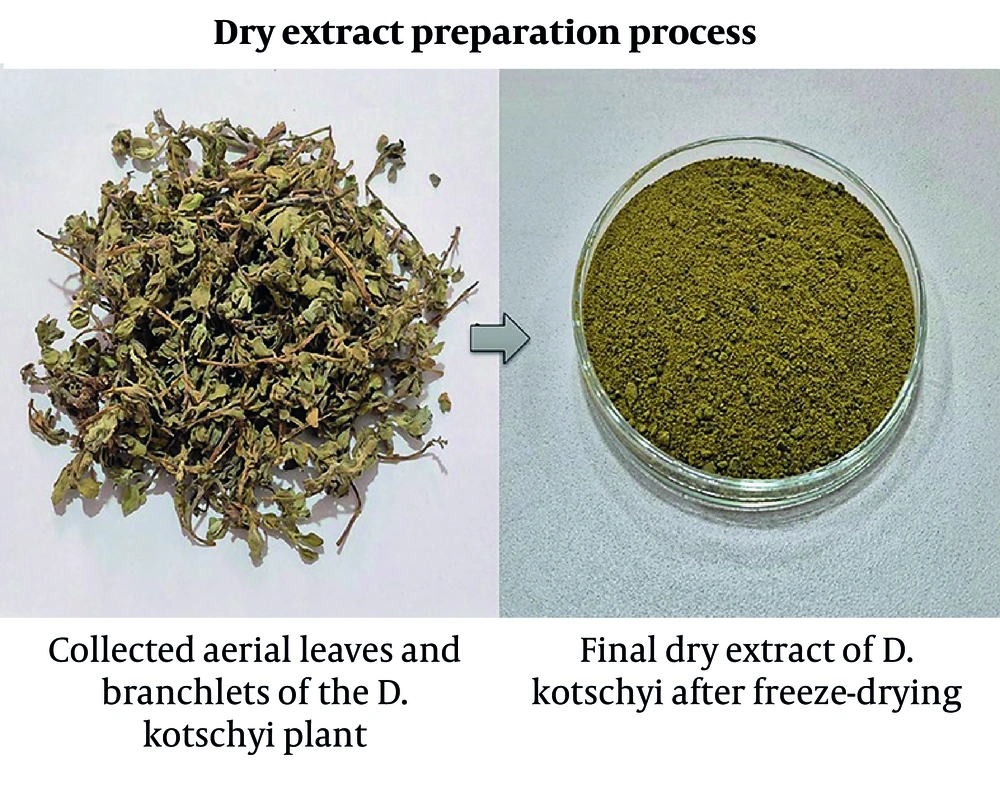
Figure 1.
Images of the D. kotschyi plant taken during the extraction process.
4.2. Detection and Determination of Phenolic Compounds
In the test used to identify phenolic compounds in the extract, a green color appeared in the solution, indicating the presence of phenolic compounds in the D. kotschyi extract. In addition, to standardize and accurately measure the syrup dosage, the phenolic compound content of the extract must be precisely determined. Therefore, the Folin-Ciocalteu reagent was used as described, and 13.8% of the powdered plant extract was found to consist of phenolic compounds. Standardization and dosing were therefore performed based on a thymol-equivalent phenol content of 0.5 mg/mL, as shown in Table 1.
Table 1.
Content of Phenolic Compounds in the Extract and Standardization of Syrup Dosing
| Sample | Amount of Phenolic Compounds (%) | Standardized Amount in Terms of 0.5 mg Phenol | D. kotschyi Extract in 100 mL Cough Syrup |
|---|---|---|---|
| D. kotschyi extract | 13.8% | 3.6 mg | 360 mg |
For example, 360 mg of plant extract is required to prepare 100 mL of D. kotschyi syrup containing the appropriate amount of phenolic compounds for effectiveness.
4.3. Syrup Formulation
Two syrup formulations were prepared according to the method described above. Sucrose has historically been a common ingredient in syrup formulations. It is a relatively inexpensive and readily available sweetener that effectively masks the bitter taste of plants, thereby improving consumer acceptance. In addition, at the amounts used, sucrose has thickening properties that increase syrup viscosity. This is particularly important because local effectiveness in the throat area is required for the intended indication. Sucrose also functions, to some extent, as a preservative by impeding microbial growth at a specific pharmacopoeial percentage (13, 14).
Despite these properties, sucrose has limitations. The most important limitation is glucose release and the resulting increase in blood sugar. This does not typically cause problems for healthy individuals; however, colds, sore throat, and cough are common across all age groups. Many people also use herbal cough syrups without a prescription. The prevalence of diabetes is increasing, and the age at onset has decreased. In addition to patients with diabetes, the main target group, other individuals may also wish to limit sugar intake for various reasons. Therefore, a sugar-free syrup sample was formulated and prepared using the aforementioned method with stevia as the sweetener (15, 16).
Stevia is a natural sweetener that has gained substantial popularity in the food and pharmaceutical industries worldwide because it is calorie-free and has strong sweetening properties. A notable benefit of stevia is its lack of effect on blood glucose levels, making it a suitable option for individuals with diabetes (17, 18).
Glycerol was used as a thickener in this formulation because sucrose was absent as a thickening agent. The objective was to increase syrup viscosity. Glycerol has a wide range of applications in the food and pharmaceutical industries. It is highly soluble in water and compatible with the aqueous solvent of the syrup. In addition, due to its dissolving properties, it facilitates the dissolution of the extract in the syrup. Therefore, this method is considered a suitable and safe approach for increasing syrup viscosity. In both formulations, the same percentage of preservative (sodium benzoate and citric acid) was used to prevent microbial growth (19-21).
4.4. Characterization
4.4.1. Stability
Syrup stability is a critical factor that directly influences efficacy, safety, and patient acceptance. The stability of the formulation depends on whether it is a solution or a suspension. Abnormal sedimentation in these formulations can reduce efficacy and create an unpleasant experience for the patient. Sedimentation is normal and permissible in suspensions; however, the essential requirement is that the suspension readily returns to its initial state and becomes uniformly redispersed after agitation.
Organoleptic attributes, including appearance, color, taste, and aroma, play a pivotal role in overall quality assessment (22). In this study, the formulated syrups were monitored periodically and evaluated over 1 month with respect to these characteristics. No substantial changes in syrup appearance were observed compared with the initial days; taste and aroma remained unchanged, and the color of the solutions remained stable and matched the original sample. During the 1-month observation period, no sedimentation or abnormal particle aggregation was detected.
4.4.2. pH, GS, and Viscosity
pH is a critical parameter for oral products, and monitoring it is essential to ensure that it remains within the normal physiological range. Specific gravity is defined as the ratio of the density of a substance to that of water. This measurement is routinely performed and documented for various oral products, including syrups.
Viscosity is a critical factor for products intended to act locally in the throat. Specifically, syrup viscosity must be adjusted to allow sufficient time for the active pharmaceutical ingredient to contact and exert its effect on the throat area without causing patient discomfort (23) (Table 2).
Table 2.
pH, GS, and Viscosity Calculated for the Formulations a
| Formulations | pH | GS | Viscosity (cP) |
|---|---|---|---|
| Sucrose-based syrup | 6.5 ± 0.1 | 1.04 ± 0.40 | 112 ± 4 |
| Stevia-based syrup | 6.4 ± 0.1 | 1.05 ± 0.33 | 108 ± 5 |
a Values are expressed as Mean ± SD.
4.4.3. Microbiological Analysis
Microbial quality is a critical quality attribute for oral pharmaceutical products, and standards vary substantially across pharmaceutical products based on the route of administration. For example, injectable or ophthalmic products must be sterile and free from microorganisms. Conversely, oral products, including tablets, capsules, and syrups, as well as topical and cosmetic-hygienic products, do not require sterility. Instead, the USP has established microbial limits for these products, along with specific acceptance criteria and standard operating procedures for quality control. In syrup formulations, the presence of liquid creates a potential risk of bacterial and fungal contamination. Contamination can occur during manufacturing or after the bottle has been opened. Therefore, a preservative is incorporated into the formulation to inhibit microbial proliferation. The results of the microbial analysis are presented in Table 3.
Table 3.
Microbial Test Results According to USP Standards for Two Syrup Formulations a
| Parameters | Acceptance Limit | Sucrose-Based Syrup | Stevia-Based Syrup |
|---|---|---|---|
| Total aerobic microbial count (TAMC) | ≤102 CFU/mL | 33 ± 4.5 CFU/mL | 28 ± 3.3 CFU/mL |
| Total combined yeasts and molds count (TYMC) | ≤101 CFU/mL | ≤101 CFU/mL | ≤101 CFU/mL |
| Escherichia coli | Absent in 1 mL | Not detected | Not detected |
a Values are expressed as Mean ± SD.
In accordance with USP acceptance criteria, the values recorded for both formulations were consistent with the established normal range. Moreover, because E. coli was absent in the syrup, the product was considered to meet microbial limit requirements and to be suitable for oral administration.
5. Discussion
The findings of this study confirm the preliminary capabilities and potential clinical efficacy of this formulation. However, the development and final validation of a therapeutically effective formulation require substantially more rigorous and extensive studies. These studies should include evaluation of active ingredient performance, assessment of long-term shelf-life stability, in vitro toxicity assessments to ensure safety in human cells, and, ultimately, preclinical and clinical evaluations. These evaluations will be conducted by colleagues in subsequent stages of this research (24, 25).
5.1. Conclusions
In this study, an herbal cough syrup with anti-inflammatory and throat-soothing properties was successfully formulated. Syrups are well tolerated by patients because of their ease of use, palatability, and efficacy. The dry plant extract was prepared with a satisfactory yield, and the resulting extract was standardized based on phenolic compound content. To ensure patient satisfaction and accommodate a broader patient population, the syrups were formulated in 2 versions: a standard sugar-containing formulation and a sugar-free formulation suitable for patients with diabetes. The 2 syrups exhibited desirable pharmaceutical properties, including pH, density, and viscosity, and showed excellent stability over 1 month. Moreover, because both syrups passed microbial testing, these formulations can be regarded as suitable pharmaceutical products for the treatment and relief of sore throat.