
1. Background
Diarrhea is a common clinical manifestation of a wide range of gastrointestinal and systemic disorders and remains a substantial global health problem (1). It is generally characterized by the frequent passage of loose or liquid stools and may result from disturbances in intestinal secretion, absorption, motility, or inflammatory processes (2, 3). Despite substantial improvements in sanitation, nutrition, and medical care, diarrheal diseases continue to cause considerable morbidity and mortality, particularly among young children and other vulnerable populations. Global estimates indicate that diarrheal diseases remain among the leading causes of death and disability worldwide, with a disproportionate burden in low- and middle-income countries (4, 5).
Pharmacological management of diarrhea is largely directed toward symptomatic control, with treatment selected according to the underlying cause and clinical severity (6). Opioid receptor agonists such as loperamide can reduce intestinal motility and secretion and are widely used as symptomatic antidiarrheal agents (7). However, their use is not appropriate in all clinical circumstances, particularly when diarrhea is associated with invasive infection, systemic illness, or other conditions in which suppression of intestinal motility may be undesirable (8). These considerations, together with the continuing global burden of diarrhea, have sustained interest in identifying pharmacologically active compounds and medicinal plants that may provide additional therapeutic leads. Natural products have historically contributed important antidiarrheal agents, including alkaloids and other phytochemicals capable of modulating gastrointestinal motility, secretion, and inflammatory pathways (9, 10, 11).
Sophora alopecuroides L. var. alopecuroides (family Leguminosae), hereafter referred to as SAA, is a medicinal plant widely distributed in Western and Central Asia, including Iran and China (12). Its seeds have a long history of use in traditional Persian and Chinese medicine for gastrointestinal disorders, including diarrhea (13). SAA seeds have also been used traditionally to manage symptoms associated with opium and heroin withdrawal, particularly gastrointestinal manifestations such as diarrhea and abdominal discomfort (14). The therapeutic dosage of SAA seeds in Persian medicine is 5 g/day, administered orally as a decoction (15). Experimental and clinical investigations have provided pharmacological support for some of these traditional applications. For example, a randomized, double-blind, placebo-controlled clinical trial reported that SAA seed extract reduced acute opioid withdrawal symptoms and was well tolerated (12). In preclinical studies, the alkaloid fraction and matrine have also been investigated in relation to opioid withdrawal and associated gastrointestinal manifestations (13, 16, 17).
The pharmacological properties of SAA have been closely associated with its diverse quinolizidine alkaloid profile. Matrine, sophoridine, sophocarpine, cytisine, oxymatrine, and related alkaloids have been identified in SAA, including its seeds (18, 19). These constituents have been associated with several biological activities, including anti-inflammatory, analgesic, and gastrointestinal effects (13, 20, 21). The seeds were selected for the present study because they are the part traditionally used for gastrointestinal disorders, including diarrhea, and contain a diverse profile of quinolizidine alkaloids that provides a pharmacologically relevant basis for investigating their gastrointestinal effects (19). Previous phytochemical and pharmacological studies of seed preparations have demonstrated biological activity, further supporting investigation of their potential antidiarrheal effects. The present study was designed to examine the activity of the seed preparation as a whole, its alkaloid-enriched fraction, and matrine as an individual major alkaloid (21).
Despite this background, an important evidence gap remains. Although the traditional use of SAA seeds for diarrhea is known and several studies have characterized their alkaloid constituents, the antidiarrheal activity of the whole seed extract and an alkaloid-enriched fraction has not been sufficiently characterized in a controlled experimental model of diarrhea. In particular, comparative evaluation across different preparation levels—from crude seed extract to an alkaloid-enriched fraction and an individual major alkaloid—within the same experimental framework remains limited. In addition, the relationship between the chemical composition of the alkaloid fraction and its antidiarrheal activity has not been adequately explored. Establishing such a relationship may help distinguish the activity of the whole preparation from that of individual constituents and improve the pharmacological interpretation and standardization of SAA-derived preparations.
2. Objectives
Accordingly, this study investigated the antidiarrheal effects of SAA seed extract, its alkaloid-enriched fraction, and matrine in a mouse model of castor oil-induced diarrhea. Loperamide was included as a pharmacological reference treatment to provide a benchmark for the observed antidiarrheal responses. The study evaluated diarrhea onset and fecal parameters across multiple doses of the SAA preparations. In addition, gas chromatography–mass spectrometry (MS, gas chromatography–mass spectrometry (GC)–MS) and gas chromatography with flame-ionization detection (GC-FID) profiling was performed to characterize the relative alkaloid composition of the alkaloid-enriched fraction.
Overall, the study was structured to first characterize the alkaloid profile of the SAA seed preparation by GC–MS and then systematically evaluate the antidiarrheal effects of its hydroalcoholic seed extract, alkaloid-enriched fraction, and matrine across multiple doses in a castor oil-induced diarrhea model, using loperamide as a pharmacological reference.
3. Methods
3.1. Plant Material and Authentication
Seeds of Sophora alopecuroides L. var. alopecuroides were collected during the fruiting stage from Raviz, Kerman Province, Iran (30°24′25″N, 55°29′34″E). Botanical identification was performed by Dr. Yousef Ajani, and a voucher specimen (No. 27235) was deposited at the Tehran University Central Herbarium. The plant material was cleaned, shade-dried under controlled environmental conditions, and powdered before extraction.
3.2. Preparation of Plant Extract
The seeds were cleaned, air-dried in the shade under controlled environmental conditions to prevent photodegradation of secondary metabolites, and pulverized into a fine powder. Extraction was performed using 90% (v/v) ethanol by percolation for 72 h at room temperature to ensure efficient recovery of both polar and semipolar phytoconstituents (22). The resulting extract was filtered and concentrated under reduced pressure using a rotary evaporator to obtain a crude hydroalcoholic extract, which was stored at −20 °C until use (23). The extraction yield was 6% (w/w), corresponding to 30 g of dried extract obtained from 500 g of powdered seeds.
3.3. Preparation of the Alkaloid Fraction and Chromatographic Analysis
The alkaloid-enriched fraction was characterized by GC–MS and GC-FID. Separation was performed on a DB-5 fused-silica capillary column (30 m × 0.25 mm internal diameter, 0.25 µm film thickness). Compounds were identified based on their retention times and Kovats retention index, calculated against a co-injected C8 - C28 n-alkane series under the same chromatographic conditions, and by comparing their electron-ionization mass-spectral fragmentation patterns with literature and Wiley Registry data (Table 1). GC–MS analysis was performed on an Agilent 6890 gas chromatograph coupled to an Agilent 5973N mass-selective detector (Agilent Technologies, Santa Clara, CA, USA) with helium carrier gas (linear velocity, 32.4 cm/s; flow, 0.8 mL/min). The injector and mass spectrometer interface temperatures were 290 °C, the injection volume was 1.0 µL, and the split ratio was 1:10. The oven program consisted of 50 °C for 5 min, followed by a ramp of 3 °C/min to 240 °C and then 15 °C/min to 300 °C, with a 3-min hold at 300 °C. The mass spectrometer was operated in electron-ionization mode (70 eV), scanning m/z 40 - 500 at 3.18 scans/s (0.50-s interval), with data acquired and processed using Agilent ChemStation software. Quantitative profiling was performed in parallel by GC-FID on a Younglin Acm 600 gas chromatograph (Younglin, Anyang, Republic of Korea) equipped with a flame-ionization detector and the same DB-5 column, using the same oven program (helium carrier gas, linear velocity, 30 cm/s; flow, 0.8 mL/min; injector and detector temperatures, 290 °C; split ratio, 1:50; H2 flow, 50 mL/min; air flow, 400 mL/min).
Table 1.
Alkaloid Composition of the Alkaloid-Enriched Fraction of S. alopecuroides Seeds by GC–MS/GC-FID (Relative Peak-Area Percentage of the Total Integrated Chromatogram and Approximate mg/g of Fraction) a
| No. | Compound | Rt (min) | KI (DB-5) | % of total peak area | Approx. mg/g fraction (area % × 10) |
|---|---|---|---|---|---|
| 1 | N-methylcytisine | 55.3 | 1965 | 12.5 | 125 |
| 2 | Cytisine | 56.1 | 1994 | 23.4 | 234 |
| 3 | Sophocarpine | 64.5 | 2235 | 7.8 | 78 |
| 4 | Sophoridine | 65.1 | 2246 | 15.2 | 152 |
| 5 | Matrine | 66.2 | 2266 | 25.9 | 259 |
| 6 | Sophoramine | 69.8 | 2451 | 1.2 | — |
a Percentages are relative GC-FID peak-area percentages of the total integrated chromatogram, not calibrated concentrations; approximate mg/g = area % × 10, assuming equal detector response. Sophoramine was detected but was not included among the five alkaloids used for the exposure estimates. Abbreviations: GC–MS, gas chromatography–mass spectrometry; GC-FID, gas chromatography with flame-ionization detection; Rt, retention time; KI, Kovats retention index.
Kovats retention index were calculated for each alkaloid from the retention times of a co-injected homologous series of normal alkanes (C8 - C28; Fluka, Buchs, Switzerland) analyzed under the same chromatographic conditions. Alkaloids were identified by matching both their retention indices and electron-ionization mass-spectral fragmentation patterns with the cited literature values and the Wiley Registry of Mass Spectral Data.
Relative quantification was performed by GC-FID peak-area normalization. For each identified alkaloid, the percentage was calculated as its integrated peak area relative to the total integrated peak area of the chromatogram, including all integrated peaks; thus, the percentages of the identified alkaloids sum to less than 100%. No analyte-specific response-factor correction or external- or internal-standard calibration curve was used. Accordingly, the reported percentages represent relative proportions within the chromatographic profile of the fraction rather than formally validated absolute concentrations. The corresponding mg/g values are approximate mass-basis estimates obtained by multiplying each reported area percentage by 10 (1% of total peak area ≈ 10 mg/g of fraction). This calculation assumes equal FID response factors across alkaloids and that area percentage equals mass percentage. These values are provided only to facilitate interpretation of the administered alkaloid-fraction doses and should not be interpreted as certified absolute concentrations. Therefore, formal analytical validation parameters, such as linearity, the limit of detection, and the limit of quantification, were not established for this area-normalization approach.
The alkaloid-enriched fraction subjected to GC–MS/GC-FID analysis was drawn from the same preparation batch used to formulate the doses administered in the in vivo antidiarrheal experiments. The alkaloid profile reported in this manuscript was generated for this experimental batch and was not replaced by previously published analytical data.
3.4. Chemicals
Loperamide hydrochloride (standard antidiarrheal agent) was purchased from Tehran Darou (Tehran, Iran). Matrine was obtained from Ningxia Zijinghua (Ningxia, China). All solvents and reagents were of analytical grade and were obtained from certified commercial suppliers.
3.5. Ethical Considerations
All experimental procedures were approved by the Ethics Committee of Maragheh University of Medical Sciences (Approval No. IR.MARAGHEHPHC.REC.1405.022) and conducted in strict accordance with national guidelines for the care and use of laboratory animals. Efforts were made to minimize animal suffering and reduce the number of animals used.
3.6. Animals and Housing Conditions
A total of 110 healthy male Swiss albino mice (4-week-old, 25 - 30 g) were obtained from the Animal Breeding Center of Tabriz University of Medical Sciences. The animals were housed under standard laboratory conditions (22 ± 2 °C; 50% - 60% humidity; a 12-h light/dark cycle) with free access to a standard pellet diet and water. They were acclimatized to laboratory conditions for 1 week before experimentation (24). Only male mice were used to reduce potential variability associated with sex-related physiological and hormonal factors and to maintain consistency with our previous experimental studies (25). However, the use of only male animals represents a limitation of the present study, and the findings may not be fully generalizable to female animals. Animals showing clinical signs of illness, marked physical abnormalities, or body weight outside the predefined range before randomization would have been excluded. After randomization, animals would have been excluded from the analysis only in the event of death, severe unexpected clinical deterioration requiring humane euthanasia, major protocol deviation, or confirmed failure of treatment administration that precluded reliable outcome assessment. No such exclusions occurred during the present study, and all 110 randomized animals completed the experimental protocol and were included in the final analysis. The animal experiments, including treatment administration and collection of all antidiarrheal outcome data, were conducted from May to June 2025.
Animal health and welfare were monitored throughout the experimental period, with particular attention to general appearance, locomotor activity, food and water intake, signs of dehydration, and diarrhea severity. Animals were monitored at regular intervals during the experimental procedure. Humane endpoints included severe or persistent distress, marked lethargy or inability to access food or water, severe dehydration, or any unexpected clinical condition indicating that continued participation in the experiment could compromise animal welfare. Appropriate access to water was maintained to minimize the risk of dehydration associated with the diarrhea model.
3.7. Randomization, Blinding, and Experimental Design
The methodology for the animal experiments was based on previous studies. Animals were randomly allocated to 11 experimental groups (n = 10 per group) using a computer-generated randomization sequence created with the RAND function in Microsoft Excel. To minimize allocation bias, animals were identified using coded numbers, and treatments were prepared and coded by an investigator who was not involved in outcome assessment. Treatments were administered according to the predefined allocation sequence. Outcome assessment was conducted by an investigator blinded to group allocation, and treatment codes were revealed after completion of outcome measurements. The order of treatment administration and outcome assessment was standardized across groups to minimize potential procedural variability. All animals were maintained under the same housing and environmental conditions throughout the experiment. At the end of the experimental procedures, all animals were humanely euthanized by an intraperitoneal overdose of sodium pentobarbital (200 mg/kg), in accordance with the approved institutional animal care protocol and internationally accepted guidelines for the euthanasia of laboratory animals. No unexpected adverse events, treatment-related morbidity, or mortality were observed during the study, and no animals met the predefined humane endpoint criteria. Reporting of this study follows the ARRIVE 2.0 guidelines for animal research (26). All 110 animals were included in the final analysis, and none were excluded, consistent with the absence of treatment-related morbidity, mortality, or humane-endpoint events reported above. Each animal was housed and assessed individually, and the experimental unit for all analyses was the individual animal. The investigator who performed the statistical analysis was blinded to treatment allocation.
No formal a priori power calculation was performed for this study. The sample size of 10 animals per group was selected based on group sizes commonly reported in mouse models of castor oil-induced diarrhea (27) and the authors’ previous experimental experience (15, 28).
The experimental groups were as follows:
SAA hydroalcoholic extract: 100, 200, and 300 mg/kg, orally
Alkaloid fraction: 5, 10, and 20 mg/kg, orally
Matrine: 5, 15, and 30 mg/kg, orally
Loperamide hydrochloride: 3 mg/kg, orally, as the positive control
Saline: 5 mL/kg, orally, as the negative control
3.8. Induction of Diarrhea and Treatment Protocol
The dose ranges used for the SAA seed extract and matrine were selected based on our previous pharmacological study in mice and further optimized through pilot experiments in the present experimental model. To facilitate interpretation across preparations, the approximate matrine content of the alkaloid-enriched fraction was estimated from its area-normalization-derived composition. The alkaloid-enriched fraction contained an estimated 259 mg of matrine per gram of fraction (25.9% on the approximate mass basis used here). Accordingly, alkaloid-fraction doses of 5, 10, and 20 mg/kg corresponded to approximate matrine exposures of 1.3, 2.6, and 5.2 mg/kg, respectively. The corresponding exposures to the five quantified alkaloids combined were approximately 4.2, 8.5, and 17.0 mg/kg. Because the yield of the alkaloid-enriched fraction from the crude hydroalcoholic extract and the alkaloid composition of the crude extract were not determined, the matrine or total-alkaloid exposure associated with the 100, 200, and 300 mg/kg crude-extract doses cannot be calculated from the present data. Therefore, comparisons among the crude extract, alkaloid fraction, and purified matrine are interpreted as comparisons among preparations rather than as exposure-matched comparisons. After 1 week of acclimatization and an overnight fasting period of 12 h, all treatments were administered orally. Thirty minutes after administration of the test substances or controls, diarrhea was induced by oral gavage of castor oil (0.3 mL per mouse). Animals were individually housed in metabolic cages to allow accurate fecal collection and prevent coprophagy.
3.9. Assessment of Antidiarrheal Activity
Animals were observed for 4 h following castor oil administration. The following parameters were recorded as indices of gastrointestinal motility and secretory activity:
Latency to the first diarrheal stool (onset time of diarrhea)
Number of wet feces
Wet fecal weight
Total fecal pellet number (wet and dry)
Fecal parameters were assessed over a 4-hour observation period following castor oil administration. The following endpoints were recorded separately for each animal: 1) wet fecal number, defined as the number of soft or liquid fecal pellets; 2) wet fecal weight, defined as the total mass (mg) of soft or liquid fecal pellets; and 3) total fecal pellet number, defined as the total count of all fecal pellets, including wet and dry pellets, produced during the observation period. These endpoints were analyzed and reported independently in the Results section and Figure 1. All measurements were performed by an observer blinded to treatment allocation to reduce measurement bias. Environmental conditions were kept constant throughout all experimental runs.
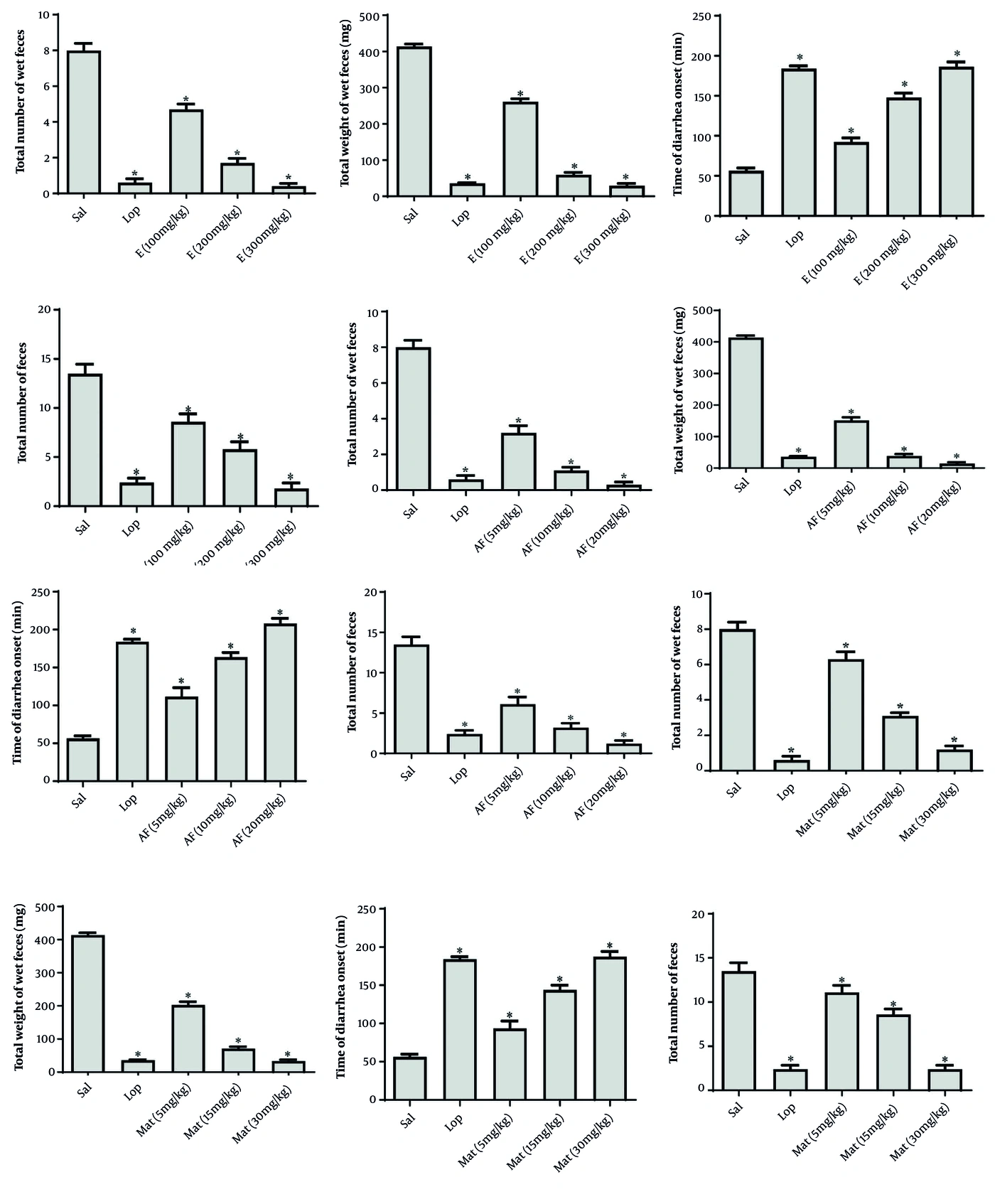
Figure 1.
Effects of saline (Sal, 5 mL/kg, orally), loperamide (Lop, 3 mg/kg, orally), Sophora alopecuroides var. alopecuroides seed extract (E), alkaloid fraction, and matrine (Mat) (all dissolved in 5 mL/kg saline and administered orally) 30 min before castor oil (0.3 mL, orally) on diarrheal parameters. There were 10 mice in each treatment group, and measurements were obtained from individually housed animals. Columns represent mean ± standard error of the mean (SEM). Panels 1, 5, and 9 show total fecal pellet number (wet and dry pellets); panels 2, 6, and 10 show latency to first diarrheal stool; panels 3, 7, and 11 show wet fecal number; and panels 4, 8, and 12 show wet fecal weight. Data were analyzed by one-way analysis of variance (ANOVA) followed by Tukey’s multiple-comparison test (a separate one-way ANOVA for each preparation and endpoint). The significance level was 0.05. Asterisks indicate statistically significant differences versus saline; exact Tukey-adjusted P values and 95% confidence intervals for the comparisons with saline and with loperamide are provided in Table S1 in the Supplementary File.
3.10. Statistical Analysis
Data were expressed as the mean ± standard error of the mean (SEM). Each group comprised 10 animals, and the individual animal (housed singly) was the experimental unit. No observations were missing, and all 110 animals were analyzed. Because the saline and loperamide groups served as common controls for all three preparations, each preparation was analyzed separately for each endpoint by one-way analysis of variance (ANOVA) with 5 groups (saline, loperamide, and three doses of the preparation; degrees of freedom: 4 and 45). Pairwise comparisons were made with Tukey’s honestly significant difference test, which was applied identically to every endpoint; the multiplicity adjustment was made within each ANOVA, not across preparations or endpoints (29). Tukey-adjusted P values and 95% confidence intervals (CIs) for the mean difference (treatment minus reference group) are reported in Table S1 in the Supplementary File for comparisons with saline (the primary comparison) and with loperamide (a descriptive reference comparison); comparisons among dose levels are not tabulated. An adjusted two-sided P < 0.05 was considered statistically significant. Standardized effect sizes were not calculated; the mean difference with its 95% confidence interval is reported as the effect-size measure.
4. Results
4.1. Phytochemical Profile of SAA Seed Alkaloids
GC–MS-based phytochemical profiling confirmed that the alkaloid-enriched fraction of SAA seeds is composed predominantly of quinolizidine alkaloids, with matrine as the major constituent (25.9% of total peak area; ≈259 mg/g of dry alkaloid-enriched fraction). Other structurally related alkaloids were also detected, including cytisine (23.4%; ≈234 mg/g), sophoridine (15.2%; ≈152 mg/g), N-methylcytisine (12.5%; ≈125 mg/g), and sophocarpine (7.8%; ≈78 mg/g). Together, these compounds confirmed a chemically coherent alkaloid signature in the alkaloid-enriched fraction. These five alkaloids collectively accounted for 84.8% of the total integrated peak area (≈848 mg/g). The mg/g values are estimates based on area normalization rather than externally calibrated absolute concentrations (see Section 3.3) (Table 1).
4.2. Effects on Castor Oil-Induced Diarrhea
As illustrated in Figure 1 (panels 1 - 12), oral administration of the SAA seed extract (E), alkaloid fraction, and isolated matrine (Mat) reduced diarrheal parameters relative to saline treatment. All reductions were statistically significant (Tukey-adjusted P < 0.05; Table S1 in the Supplementary File), except for total fecal pellet number after matrine 5 mg/kg. This value was numerically lower than that in the saline group (11.10 ± 0.80 vs 13.50 ± 0.96) but was not significantly different (adjusted P = 0.169). Saline-treated animals exhibited an earlier onset of diarrhea, higher wet fecal number, greater wet fecal weight, and higher total fecal pellet number.
Comparisons with loperamide varied by endpoint and dose. Some SAA-derived treatment groups did not differ significantly from loperamide, whereas other treatment-dose combinations showed statistically significant differences. Because the study was not designed as an equivalence or noninferiority trial, a nonsignificant difference from loperamide cannot be interpreted as evidence of equivalent efficacy, noninferiority, or comparable pharmacological potency. The primary evidence for antidiarrheal activity in this study is based on comparisons with saline.
Loperamide (Lop), used as a pharmacological reference, markedly inhibited all diarrheal indices and served as a positive-control benchmark for comparison.
The SAA-derived treatments significantly reduced several diarrheal parameters relative to saline, with the exact adjusted P values for each treatment-dose comparison reported in Table S1 in the Supplementary File.
4.3. Effect on Diarrhea Onset (Latency Period)
In Figure 1 (panels 2, 6, and 10), all treatment groups showed a clear delay in diarrhea onset relative to saline controls. Every comparison with saline was statistically significant (adjusted P < 0.002; Table S1 in the Supplementary File). This effect was consistent across the extract, alkaloid fraction, and matrine groups, suggesting a potential reduction in intestinal hypermotility and/or secretory activation.
For latency, the highest dose of each preparation (extract 300 mg/kg, alkaloid fraction 20 mg/kg, matrine 30 mg/kg) and alkaloid fraction 10 mg/kg did not differ significantly from loperamide. In contrast, the lower doses (extract 100 and 200 mg/kg, alkaloid fraction 5 mg/kg, matrine 5 and 15 mg/kg) had significantly shorter latencies than loperamide (adjusted P ≤ 0.00035). These comparisons are descriptive because no equivalence or noninferiority hypothesis was prespecified.
4.4. Effects on Total Fecal Pellet Number and Wet Fecal Number
As shown in Figure 1 (panels 1, 5, and 9), all doses of the extract and alkaloid fraction, as well as matrine at 15 and 30 mg/kg, significantly reduced total fecal pellet number relative to saline (adjusted P < 0.001). Matrine at 5 mg/kg produced only a numerical reduction, which was not statistically significant (adjusted P = 0.169). A similar reduction in wet fecal number was observed in Figure 1 (panels 3, 7, and 11). Fecal parameters were suppressed at every dose level for each endpoint, except for total fecal pellet number with matrine 5 mg/kg. A more apparent dose-related trend was observed at higher doses of the extract and matrine.
The alkaloid fraction reduced fecal parameters relative to saline. Comparisons with loperamide varied across doses and endpoints, with both significant and nonsignificant pairwise differences observed in the current statistical output.
4.5. Effect on Wet Fecal Weight
Figure 1 (panels 4, 8, and 12) further shows that all treatments significantly reduced wet fecal weight relative to saline controls (Tukey-adjusted P < 0.000001 for every dose of the extract, alkaloid fraction, and matrine; Table S1 in the Supplementary File). This reduction may indicate decreased intestinal fluid secretion and/or enhanced water reabsorption.
The response pattern was observed across the extract, alkaloid fraction, and matrine groups. Comparisons with loperamide included both significant and nonsignificant differences, depending on the treatment dose and endpoint; these comparisons should therefore be interpreted descriptively rather than as evidence of equivalence.
According to Table S1 in the Supplementary File, the highest dose of each preparation (extract 300 mg/kg, alkaloid fraction 20 mg/kg, matrine 30 mg/kg) showed no statistically significant difference from loperamide for any tabulated endpoint, whereas the lowest doses (extract 100 mg/kg, alkaloid fraction 5 mg/kg, matrine 5 mg/kg) differed significantly from loperamide for every tabulated endpoint.
Taken together, the findings indicate antidiarrheal activity relative to saline across the evaluated fecal and latency endpoints. Comparisons with loperamide varied by dose and endpoint and do not support a claim of equivalence.
5. Discussion
Castor oil–induced diarrhea remains a well-established experimental model for evaluating antidiarrheal agents, primarily reflecting enhanced intestinal secretion and accelerated motility mediated by ricinoleic acid (10, 30, 31). In this model, the present study provides experimental evidence that SAA seed extract and matrine reduce diarrheal parameters compared with saline.
In addition to the absence of opioid receptor involvement, several nonopioid pharmacological mechanisms may contribute to the observed antidiarrheal effects of SAA seed extract. Castor oil–induced diarrhea is primarily mediated by ricinoleic acid, which activates EP3 prostanoid receptors and TRPV1 channels on intestinal epithelial cells, promoting both hypersecretion and accelerated propulsion (32). Matrine and related quinolizidine alkaloids present in SAA have demonstrated affinity for muscarinic and nicotinic acetylcholine receptors and may modulate intestinal smooth muscle contractility through nonopioid mechanisms (19). Additionally, matrine and sophoridine have demonstrated inhibitory effects on proinflammatory mediators, including IL-6, TNF-α, and PGE2 in intestinal inflammation models (13), which could attenuate secretory diarrhea by reducing mucosal permeability and fluid secretion. Ion channel modulation, particularly inhibition of CFTR-mediated chloride secretion, represents another plausible pathway (33) that has not yet been directly tested for SAA alkaloids and merits mechanistic investigation in future studies. These possibilities remain speculative in the absence of direct mechanistic evidence from the current study and warrant investigation in dedicated receptor-binding and electrophysiological studies.
Loperamide was included as a pharmacological reference treatment because of its established antidiarrheal activity (34). The SAA seed extract, its alkaloid fraction, and the major isolated alkaloid matrine significantly attenuated diarrhea severity, as indicated by delayed diarrhea onset and reductions in fecal parameters compared with saline; the only nonsignificant comparison was total fecal pellet number with matrine at 5 mg/kg. Comparisons with loperamide varied by preparation, dose, and outcome measure. Some treatment-dose combinations did not differ significantly from loperamide, whereas others showed statistically significant differences. These pairwise comparisons were not designed to establish equivalence or noninferiority; therefore, a nonsignificant difference from loperamide should not be interpreted as evidence of equivalent efficacy, noninferiority, or comparable pharmacological potency (35). The direct evidence of antidiarrheal activity in this study derives from the significant differences observed compared with saline; the comparison with loperamide should be regarded as descriptive context rather than a formal test of equivalence.
The GC–MS/GC-FID profile provides phytochemical context for the activity observed with the SAA alkaloid-enriched fraction. Matrine was among the major identified alkaloids. When evaluated independently in the present study, it reduced diarrheal parameters under the experimental conditions used. These findings are consistent with the possibility that matrine contributes to the activity of the alkaloid-rich fraction. However, the fraction contains multiple quinolizidine alkaloids, and the present chemical analysis cannot establish a causal relationship between the abundance of any individual compound and the observed pharmacological effect. Cytisine, sophoridine, N-methylcytisine, and sophocarpine were not independently evaluated for antidiarrheal activity in the present study. Therefore, the activity of the alkaloid fraction should not be attributed to matrine alone.
5.1. Dose Selection and Exposure Comparability
Because the crude hydroalcoholic extract, the alkaloid-enriched fraction, and matrine were tested at different nominal dose ranges, their administered matrine exposures are not directly comparable. Based on the composition derived by area normalization, alkaloid-fraction doses of 5, 10, and 20 mg/kg correspond to approximate matrine exposures of 1.3, 2.6, and 5.2 mg/kg, respectively, and approximate exposures of 4.2, 8.5, and 17.0 mg/kg for the five quantified alkaloids combined. These exposures overlap only partially with the purified matrine doses of 5, 15, and 30 mg/kg. The corresponding matrine or total-alkaloid content of the crude hydroalcoholic extract cannot be estimated because the yield and chemical composition of the crude extract relative to the alkaloid-enriched fraction were not determined. Consequently, the present study does not provide exposure-matched comparisons among the crude extract, alkaloid fraction, and purified matrine (Table 1).
Regarding phytochemical reproducibility, the GC–MS alkaloid profile reported here was obtained from the specific batch of plant material used in the present pharmacological experiments. Although this single-batch characterization provides the necessary phytochemical context for interpreting the current results, it does not fully establish batch-to-batch consistency, a recognized limitation of botanical preparations. The alkaloid composition of S. alopecuroides seeds may vary with geographic origin, harvest season, and storage conditions (21). Future standardization efforts should include multibatch GC–MS validation and the establishment of tolerance ranges for the major alkaloids, particularly matrine and cytisine, to ensure reproducibility across independent pharmacological studies and support any potential transition to clinical application.
Previous experimental and clinical evidence provides additional context for the pharmacological relevance of SAA seeds. The alkaloid fraction, matrine, and crude extract have previously been investigated in models of opioid withdrawal and associated gastrointestinal manifestations (15). Randomized controlled clinical studies have also evaluated SAA seed preparations for opioid withdrawal symptoms (12, 28). These findings provide a rationale for continued investigation but do not establish the clinical efficacy of SAA preparations for independent diarrheal disorders.
An important consideration in interpreting the present findings is the reported adverse-effect and toxicological profile of matrine. Matrine has been associated with dose- and exposure-dependent adverse effects, and gastrointestinal adverse effects, including diarrhea, have been reported under certain conditions (13, 18, 19). These observations do not necessarily contradict the antidiarrheal activity observed in the present study, because pharmacological and adverse responses may depend on the administered dose, route, duration of exposure, species, and experimental context. Under the specific conditions of this acute castor oil-induced diarrhea model, a single oral administration of matrine at 5 - 30 mg/kg reduced diarrheal responses. However, the present study was not designed to characterize the safety profile, gastrointestinal toxicity, or therapeutic window of matrine. Therefore, the observed antidiarrheal effect should be interpreted within the specific experimental conditions of this study, and further dose-ranging and safety studies are required.
From a mechanistic perspective, diarrhea arises from dysregulated intestinal fluid transport, involving enhanced secretion and/or reduced absorption of water and electrolytes due to activation of enteric secretory pathways or inflammatory mediators (30, 31). Antidiarrheal agents typically act through modulation of intestinal motility, inhibition of secretion, or both. Opioid agonists such as loperamide exert their effects primarily through μ-opioid receptor–mediated inhibition of gastrointestinal motility and secretion. However, available evidence does not support classical opioid receptor–mediated activity for SAA constituents.
Although some studies have reported possible opioid receptor involvement in the analgesic effects of matrine, these findings remain inconsistent. Other investigations have demonstrated a lack of binding affinity of matrine to μ-, κ-, and δ-opioid receptors in vitro (15, 36, 37). Furthermore, the absence of naloxone reversal in SAA extract–induced analgesia and the lack of a Straub tail response suggest that SAA does not exhibit typical opioid-like pharmacodynamics (15, 36). Collectively, current evidence indicates that SAA is unlikely to act through canonical opioid pathways.
Given the pathophysiology of castor oil–induced diarrhea, a nonopioid mechanism is one plausible explanation for the observed antidiarrheal activity of SAA and its constituents; candidate pathways could include inhibition of intestinal hypersecretion, modulation of smooth muscle contractility, or suppression of inflammatory mediators such as prostaglandins (27, 32). We emphasize that these pathways are hypothetical: no receptor-binding, molecular, biochemical, or electrophysiological experiments were conducted in the present study, and the only experimentally demonstrated finding is the reduction in diarrheal parameters relative to saline. These candidate mechanisms therefore remain speculative and warrant direct mechanistic validation in future studies.
Although matrine was identified as a major alkaloid constituent and demonstrated antidiarrheal activity in the present model, the current findings do not establish matrine as the principal mediator of the activity of the crude extract or alkaloid fraction. Other alkaloids, including cytisine, sophoridine, N-methylcytisine, and sophocarpine, may contribute independently or in combination. Definitive attribution would require matrine-depleted and reconstituted fractions, exposure-matched comparisons, and direct mechanistic studies. Matrine therefore warrants further investigation as a candidate compound for antidiarrheal research, with its mechanism, safety profile, therapeutic window, and translational relevance requiring dedicated studies.
Despite its limitations, the present findings provide pharmacological evidence that SAA seed extract and matrine possess antidiarrheal activity in the castor oil-induced diarrhea model. The results support further investigation of SAA as a source of bioactive alkaloids while emphasizing the need for constituent-specific and mechanistic studies before attributing the activity of the whole-plant preparation to any single compound.
Future studies should focus on elucidating the molecular mechanisms underlying these effects, particularly in relation to intestinal ion transport, inflammatory signaling, and enteric nervous system modulation. Additional studies should use exposure-matched preparations, multibatch chemical characterization, and prespecified sample-size calculations. Clinical evaluation would require separate, well-designed trials addressing defined diarrheal indications and safety outcomes.
5.2. Conclusions
The SAA seed extract, its alkaloid-enriched fraction, and matrine reduced diarrheal parameters in the castor oil-induced mouse model relative to saline (all comparisons were significant except total fecal pellet number at the 5 mg/kg dose of matrine). Comparisons with loperamide varied according to treatment, dose, and endpoint; the present study was not designed to test equivalence or noninferiority, and therefore the loperamide comparisons do not establish equivalent efficacy or comparable pharmacological potency. The findings also do not establish matrine as the principal or sole mediator of the activity of the whole extract or alkaloid fraction. Other quinolizidine alkaloids may contribute to the observed activity. No molecular or receptor-level experiments were performed in the present study, so the proposed mechanisms remain hypothetical. Further constituent-specific, exposure-matched, mechanistic, safety, and translational studies are needed. As summarized in Figure 2, the SAA seed extract, its alkaloid-enriched fraction, and matrine exhibited antidiarrheal activity in the castor oil-induced mouse model, although the underlying mechanisms remain to be established.
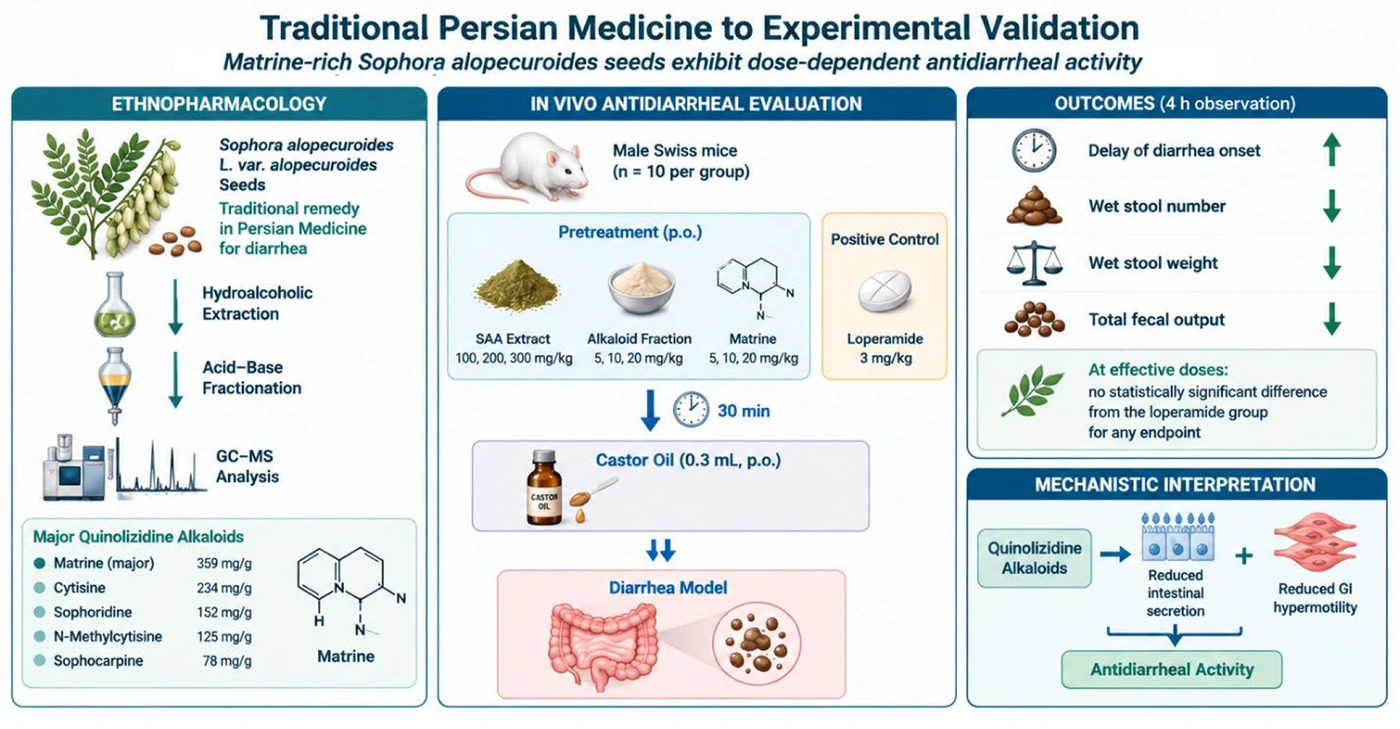
Figure 2.
Experimental evaluation of the antidiarrheal activity of Sophora alopecuroides L. var. alopecuroides seed extract, its alkaloid-enriched fraction, and matrine in male mice with castor oil-induced diarrhea. Oral pretreatment delayed diarrhea onset and reduced fecal parameters relative to saline, except total fecal pellet number at matrine 5 mg/kg. Proposed mechanisms remain hypothetical; equivalent efficacy to loperamide was not established.
5.3. Limitations
The present study was designed primarily to evaluate the antidiarrheal effects of SAA preparations and matrine in the castor oil-induced diarrhea model. Only male mice were studied, and the acute model does not establish efficacy in other forms of diarrhea or predict clinical effectiveness. The study did not directly investigate molecular or receptor-mediated mechanisms, establish the quantitative contribution of individual alkaloids to the whole preparations, or include exposure-matched comparisons across crude extract, alkaloid fraction, and purified matrine. In addition, the single-batch chemical characterization does not establish batch-to-batch consistency. These limitations should be considered when interpreting the findings.