
1. Background
Medicinal plants have served as an important foundation for the prevention, management, and treatment of various diseases for centuries (1-4). Although synthetic drugs currently dominate pharmaceutical markets, their potential adverse effects and toxicity cannot be overlooked (5, 6). Given the important role of medicinal plants in maintaining human health and well-being, they continue to attract considerable attention from the scientific community. Extensive research has therefore sought to validate the therapeutic properties recognized by traditional societies for centuries, with the ultimate goal of identifying bioactive compounds and integrating their therapeutic potential into modern pharmacotherapy.
Prosopis cineraria, a member of the family Fabaceae (Leguminosae), is a drought-tolerant tree widely distributed in arid and semiarid regions. In Iran, it is found primarily along the southern coast, particularly in the provinces of Sistan and Baluchistan, Hormozgan, Bushehr, Khuzestan, and southern Fars, although it is also occasionally found in agricultural areas. Locally known as Kahoor or Kahoorak, the plant is highly valued by local communities for its diverse nutritional, ecological, and medicinal properties. The genus Prosopis comprises approximately 45 species of spiny trees and shrubs distributed throughout tropical and subtropical regions. Four Prosopis species have been reported in Iran: Prosopis cineraria, Prosopis farcta, Prosopis juliflora, and Prosopis koelziana (7). Prosopis species have traditionally been used in various indigenous medical systems to manage pain, fever, influenza, asthma, rheumatism, spasms, stomachache, postpartum and neonatal conjunctivitis, diarrhea, diabetes, respiratory disorders, liver infections, and malaria, as well as otitis, pediculosis, skin inflammation, scabies, and kidney, pancreatic, and bladder stones (8-11).
The genus also has considerable socioeconomic importance in rural communities in countries such as India, Pakistan, Nigeria, Ghana, Brazil, and Peru. Numerous studies have documented the nutritional value and medicinal properties of Prosopis species, particularly their roots (12, 13). Different plant parts have long been used in traditional medicine to treat various ailments. For example, flowers mixed with sugar have traditionally been consumed during pregnancy to help prevent miscarriage (14), whereas bark ash has been applied topically for hair removal. Smoke from burning leaves has traditionally been used to treat certain eye disorders. A mixture of fresh leaf juice and lemon juice has been used to alleviate stomachache, whereas crushed pod extracts have been used to treat earache, toothache, and pain associated with bone fractures (15, 16). Topical application of aqueous leaf and bark extracts has also been reported to treat skin disorders, disinfect wounds, and promote wound healing (17, 18). Previous studies have demonstrated that different parts of P. cineraria, particularly the stem and roots, possess analgesic and anti-inflammatory properties (19-22). However, despite the plant's extensive traditional use and the reported pharmacological activities of other plant parts, the analgesic and anti-inflammatory effects of P. cineraria seeds have not been scientifically investigated. Seeds may exhibit a relatively stable and distinct phytochemical profile compared with other plant organs, and investigating their pharmacological properties may provide insights into their therapeutic potential. Therefore, the present study was designed to evaluate the analgesic and anti-inflammatory activities of P. cineraria seed extract using established experimental models of nociception and inflammation.
2. Objectives
Given the reported medicinal properties of Prosopis species, including vasodilatory, antispasmodic, and bronchodilatory effects (23, 24), antidepressant and neurological activities (11, 25), and analgesic and anti-inflammatory properties (19), this study aimed to evaluate the analgesic and anti-inflammatory effects of Prosopis cineraria seed extract (P. cineraria seed extract (PCSE)). Analgesic activity was assessed using the hot plate and acetic acid-induced writhing tests in male mice, whereas anti-inflammatory activity was evaluated using the carrageenan-induced paw edema and cotton pellet-induced granuloma models in male rats. The study investigated the potential of P. cineraria seeds as an accessible, cost-effective source of bioactive compounds with analgesic and anti-inflammatory activity.
3. Methods
3.1. Drugs, Chemicals, and Plant Material Preparation
Morphine sulfate, indomethacin, mefenamic acid, carrageenan, ethanol, and acetic acid were supplied by Merck (Germany) and Temad Pharmaceutical Co. (Iran).
P. cineraria seeds were collected in the fall of 2021 from Kahorestan, Hormozgan Province, Iran. The sample was identified by Kazemi-vash, and a voucher specimen was deposited in the Herbarium of the Department of Pharmacognosy, Faculty of Pharmacy and Pharmaceutical Sciences, Islamic Azad University (IAU), under registration number 527-AUPF.
The seeds were washed with distilled water and dried in a shaded, well-ventilated area. The dried material was coarsely powdered using a mechanical grinder and extracted by maceration with 80% (v/v) ethanol. Briefly, 100 g of plant powder was soaked in 500 mL of 80% ethanol in a closed glass container and stirred occasionally at room temperature for 72 h. The mixture was then filtered through Whatman No. 1 filter paper. Maceration was performed in triplicate using fresh solvent to ensure maximum extraction. The combined filtrates were concentrated under reduced pressure using a rotary evaporator at 40 °C. The extraction yield was 8.27% (w/w). The dried extract was stored at 4 °C until further pharmacological evaluation. During this period, the containers were regularly monitored for signs of fungal and bacterial contamination. The specific extract batch used in the completed animal experiments is no longer available; therefore, chemical characterization or chromatographic fingerprinting of that exact batch could not be performed retrospectively.
3.2. Experimental Animals
This was a randomized, unblinded experimental study. Healthy adult animals weighing 180 - 220 g for rats and 20 - 25 g for mice were eligible for inclusion. Animals with an illness or body weights outside the specified ranges were excluded. The study involved 60 male Wistar rats for evaluating anti-inflammatory effects using the carrageenan and cotton pellet tests and 60 male NMRI mice for assessing analgesic activity using the hot plate and acetic acid-induced writhing tests. No formal a priori sample-size or power calculation was performed. The individual animal was the statistical unit for the analyses.
All animals were maintained under controlled conditions, with a 12:12 light-dark cycle and a temperature of 22 ± 2 °C. They were provided with standard rat food and access to water. For each rat assay, animals were divided into five groups of six. Three groups received ethanolic seed extract at 100, 200, or 300 mg/kg body weight. One group received a standard drug, and the final group served as the control.
The experiments were conducted in accordance with the Guide for the Care and Use of Laboratory Animals (National Institutes of Health Publication No. 80 - 23, revised 1996) and were approved by the Research and Ethics Committee of Islamic Azad University of Pharmaceutical Sciences (ethical approval number: IR.IAU.PS.REC.1401.284). Table 1 summarizes the study design.
Table 1.
Summary of the Study Design a
| Experimental Designs and Test Models (Animals) | Groups |
|---|---|
| Analgesic activity experiment (Mice) | |
| Hot plate test | Control (vehicle, 10 mL/kg, i.p.) |
| Standard (morphine 5 mg/kg, i.p.) | |
| Test (100 mg/kg, i.p.) | |
| Test (200 mg/kg, i.p.) | |
| Test (300 mg/kg, i.p.) | |
| Writhing test | Control (vehicle, 10 mL/kg, i.p.) |
| Standard (morphine 5 mg/kg, i.p.) | |
| Test (100 mg/kg, i.p.) | |
| Test (200 mg/kg, i.p.) | |
| Test (300 mg/kg, i.p.) | |
| Anti-inflammatory activity experiment (Rat) | |
| Carrageenan-induced paw edema test | Control (vehicle, 10 mL/kg, i.p.) |
| Standard (mefenamic acid 30 mg/kg, i.p.) | |
| Test (100 mg/kg, i.p.) | |
| Test (200 mg/kg, i.p.) | |
| Test (300 mg/kg, i.p.) | |
| Cotton pellet-induced granuloma test | Control (vehicle, 10 mL/kg, i.p.) |
| Standard (indomethacin 5 mg/kg, i.p.) | |
| Test (100 mg/kg, i.p.) | |
| Test (200 mg/kg, i.p.) | |
| Test (300 mg/kg, i.p.) |
a Abbreviation: i.p., intraperitoneal.
3.3. Analgesic Activity
Two standard methods, the hot plate and acetic acid-induced writhing tests, were used to assess analgesic activity in male NMRI mice (6, 26, 27).
3.3.1. Hot Plate Test
The hot plate was electrically heated. Thirty male albino mice were allocated to five groups of six. Mice were placed on the plate, maintained at 52 ± 2 °C, to determine the pretreatment baseline at time zero. The latency to paw licking or the specified change in walking behavior was recorded as the pain threshold. Saline, morphine (5 mg/kg, intraperitoneally [i.p.]), or extract (100, 200, or 300 mg/kg, i.p.) was then administered to the respective groups. Response latencies were measured at 15, 30, 60, and 120 min after injection and compared with baseline. Morphine served as the positive control.
3.3.2. Acetic Acid-Induced Writhing Test
Thirty male mice were divided into five groups of six. Extract (100, 200, or 300 mg/kg), vehicle (saline, 10 mL/kg), or morphine (5 mg/kg) was injected intraperitoneally 30 min before acetic acid administration (1%, 10 mL/kg). Intraperitoneal administration of acetic acid induces tonic pain manifested as writhing. Morphine served as the positive control. Animals were placed in an observation box, and writhes were counted by direct observation during the first 30 min after acetic acid injection. The mean number of writhes in each treatment group was compared with that in the control group.
3.4. Anti-Inflammatory Activity
Anti-inflammatory activity was evaluated using the carrageenan-induced paw edema and cotton pellet-induced granuloma models.
3.4.1. Carrageenan-Induced Paw Edema
The acute anti-inflammatory effect of Prosopis cineraria seed extract (PCSE) was assessed in male rats using carrageenan-induced paw edema (27-29). Thirty male rats were divided into five groups of six: 1) saline control (10 mL/kg, i.p.); 2) mefenamic acid reference group (30 mg/kg, i.p.); and 3), 4), and 5) PCSE treatment groups receiving 100, 200, or 300 mg/kg, i.p., respectively. Treatments were administered 30 min before carrageenan (0.1 mL, 2%) was injected into the plantar surface of the right hind paw. Paw volume was measured using a plethysmometer (Borj-Sanat Co., Iran; model PM 4500) before and at 0.5, 1, 2, 3, and 4 h after carrageenan administration. Anti-inflammatory activity was assessed as the percentage inhibition of edema compared with the control group (30, 31).
3.4.2. Cotton Pellet-Induced Granuloma
The chronic anti-inflammatory activity of PCSE was evaluated using the cotton pellet-induced granuloma model, following the approach proposed by Porter and Winter (32, 33). Thirty male rats were anesthetized with ketamine and xylazine (100/10 mg/kg) (34). After the rats' backs were shaved and disinfected with 70% ethanol, a longitudinal incision was made. Subcutaneous tunnels were created, and a sterile cotton ball (15 ± 1 mg) was placed on each side of the shoulder area. Treatments comprised extract (100, 200, or 300 mg/kg, i.p.), vehicle (saline, 10 mL/kg), or indomethacin (5 mg/kg, i.p.), administered daily for 7 consecutive days. After treatment, the cotton pellets and surrounding granulomatous tissue were carefully excised, cleared of extraneous tissue, and immediately weighed to determine wet weight. The pellets were then dried in an oven at 60 °C until a constant weight was achieved, and the final dry weight was recorded. The initial weight of each pellet had been recorded before implantation.
Transudate weight was calculated as the difference between the wet and dry weights of the implanted pellet:
Transudate weight (mg) = Wet weight − Dry weight
The weight of newly formed granulomatous tissue was calculated by subtracting the initial cotton pellet weight from its final constant dry weight:
Granuloma weight (mg) = Dry weight − Initial cotton pellet weight
The percentage inhibition of transudate formation was calculated using the following formula:
% Inhibition of transudate = [(TWControl – TWTreated) / TW Control] × 100
Similarly, the percentage inhibition of granuloma formation was calculated as follows:
% Inhibition of granuloma = [(GWControl − GWTreated) / GW Control] × 100
Here, TWControl and GWControl represent the mean transudate and granuloma weights, respectively, in the control group, whereas TWTreated and GWTreated represent the corresponding values in the treatment group. Wet weight primarily reflects inflammatory fluid accumulation, whereas the increase in dry weight above the initial pellet weight represents newly formed granulomatous tissue and thus reflects the proliferative component of chronic inflammation.
3.5. Data Analysis
Data were expressed as the mean ± standard error of the mean (SEM). GraphPad Prism version 8.0.2 was used for data analysis. Normality was assessed using the Kolmogorov-Smirnov test. Groups were compared using repeated-measures analysis of variance (ANOVA) and one-way ANOVA, followed by Tukey's post hoc test. P < 0.05 was considered statistically significant. The individual animal was the experimental unit for statistical analysis. No formal retrospective power calculation was performed.
4. Results
4.1. Hot Plate Test
ANOVA and Tukey's post hoc test indicated no significant differences in baseline responses to the thermal stimulus among the groups (Figure 1A). At 15 min, PCSE at 100 and 200 mg/kg showed significant analgesic activity compared with the control group (P < 0.05; Figure 1B), whereas the response latency at 300 mg/kg did not differ significantly from the control (P > 0.05). At 30 min, all three extract doses showed significant analgesic activity compared with the control (P < 0.05; Figure 1C). Morphine showed a significant analgesic effect (P < 0.05), including at 1 and 2 h (Figure 1D and 1E), and its effect at 30 min was significant at P < 0.0001. At 1 and 2 h, none of the PCSE treatment groups showed an analgesic effect compared with the control or morphine groups (Figure 1D and 1E).
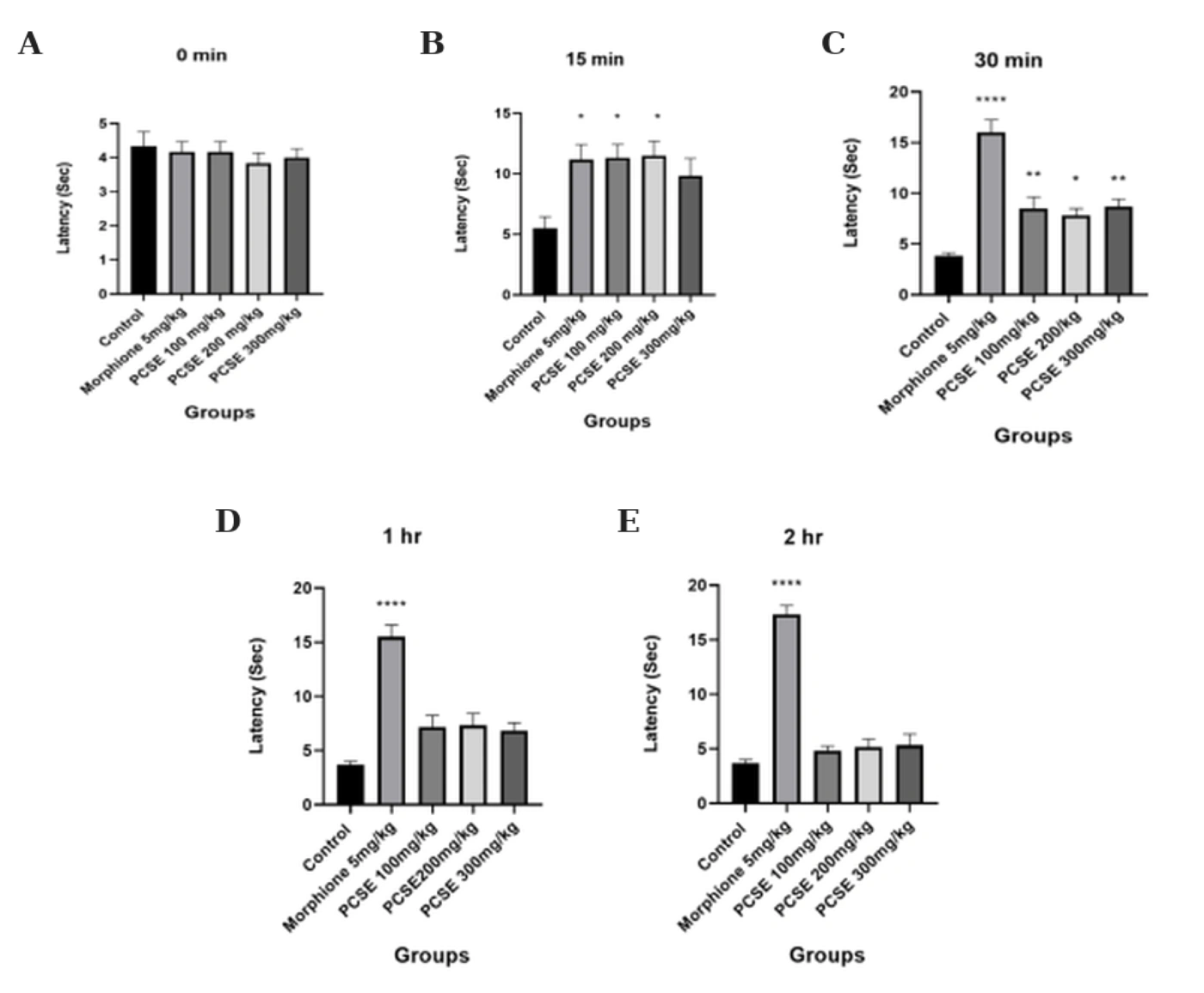
Figure 1.
Anti-nociception activity of Prosopis cineraria seed extract in male mice using the hot plate test; Each value expresses the mean ± SEM of 6 mice. *P < 0.05, **P < 0.01, and ****P < 0.0001 compared to the control.
4.2. Writhing Test
The mean number of writhes was significantly lower in the morphine and PCSE groups than in the control group (Figure 2). The morphine group differed significantly from the PCSE 100 mg/kg group (P < 0.0001), but not from the PCSE 200 or 300 mg/kg groups. The analgesic effect of PCSE at 100 mg/kg was significantly lower than that at 200 and 300 mg/kg (P < 0.0001 and P < 0.05, respectively). PCSE at 100, 200, and 300 mg/kg and morphine at 5 mg/kg significantly reduced acetic acid-induced stretches or writhes by 46.23%, 64.93%, 76.35%, and 75.33%, respectively (P < 0.05; Table 2).
Table 2.
Effect of Prosopis Cineraria Seed Extract (PCSE) On Acetic Acid-Induced Writhing in Mice: Mean Writhes and Inhibition (%) a
| Groups | Mean ± SEM (inhibition, %) |
|---|---|
| Normal saline | 64.17 ± 3.07 |
| Morphine | 15.83 ± 1.30 (75.33) |
| PCSE 100 mg/kg | 34.50 ± 2.70 (46.23) |
| PCSE 200 mg/kg | 22.50 ± 2.86 (64.93) |
| PCSE 300 mg/kg | 15.17 ± 1.50 (76.35) |
a Abbreviation: SEM, standard error of the mean; PCSE, prosopis cineraria seed extract.
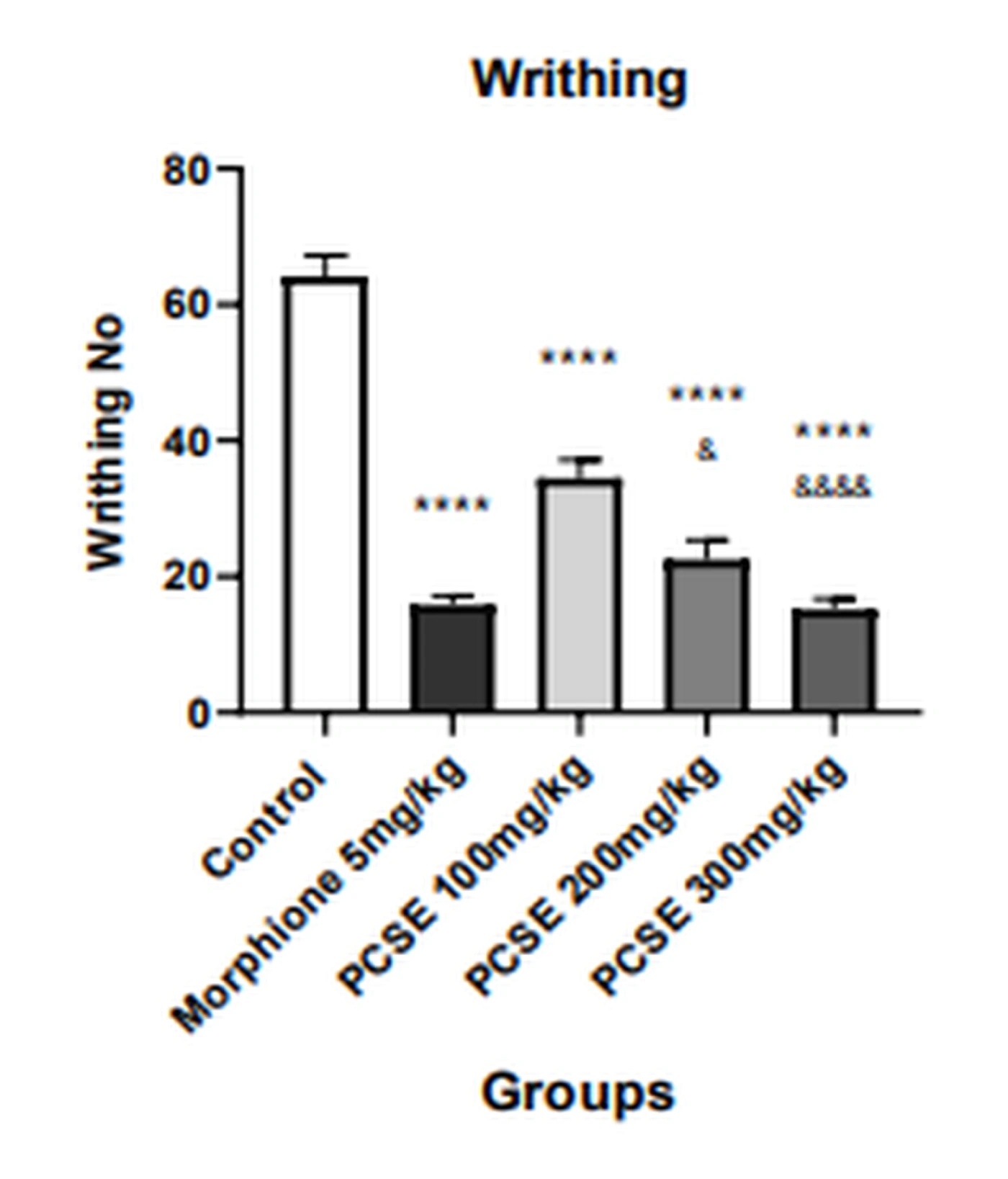
Figure 2.
Examining the analgesic effect of P. cineraria seed extract in male mice through the Writhing test (n = 6, data represent Mean ± SEM, ****P < 0.0001 compared with the control group, &P < 0.05; &&&& P < 0.0001 compared with 100 mg/kg of extract)
4.3. Carrageenan Test
Figure 3 shows the effect of PCSE injection on carrageenan-induced paw edema in rats. PCSE at 200 and 300 mg/kg, administered i.p., showed anti-inflammatory activity at 30 min, and this effect persisted throughout the test (Figure 3). However, PCSE at 100 mg/kg showed no anti-inflammatory activity at 30 min. Paw edema inhibition was compared across doses and time points (Table 3). At 2 h, the peak of edema formation, mefenamic acid (30 mg/kg) and PCSE at 100, 200, and 300 mg/kg significantly inhibited paw edema (P < 0.05), with inhibition of 51.54%, 40.74%, 46.61%, and 49.07%, respectively (Table 3). The PCSE inhibition percentages in Table 3 do not imply formal equivalence to the reference drug. Inflammation was significantly lower in the PCSE 200 and 300 mg/kg groups and the mefenamic acid group than in the control group. At 2 h, inhibition with mefenamic acid and PCSE at 100, 200, and 300 mg/kg was 51.54%, 40.74%, 46.61%, and 49.07%, respectively (Table 3).
Table 3.
Paw Edema Inhibition (%) After Intraperitoneal Prosopis Cineraria Seed Extract (PCSE) Administration in Rats with Carrageenan-Induced Inflammation a
| Groups | 30 min | 1 h | 2 h | 3 h | 4 h |
|---|---|---|---|---|---|
| Mefenamic acid (30 mg/kg) | 50.81 | 59.02 | 51.54 | 32.77 | 44.15 |
| PCSE (100 mg/kg) | 15.86 | 46.76 | 40.74 | 33.90 | 32.77 |
| PCSE (200 mg/kg) | 37.28 | 48.36 | 46.61 | 36.13 | 30.48 |
| PCSE (300 mg/kg) | 44.43 | 43.49 | 49.07 | 39.21 | 34.19 |
a Values are expressed as percentage. Abbreviation: PCSE, Prosopis cineraria seed extract.
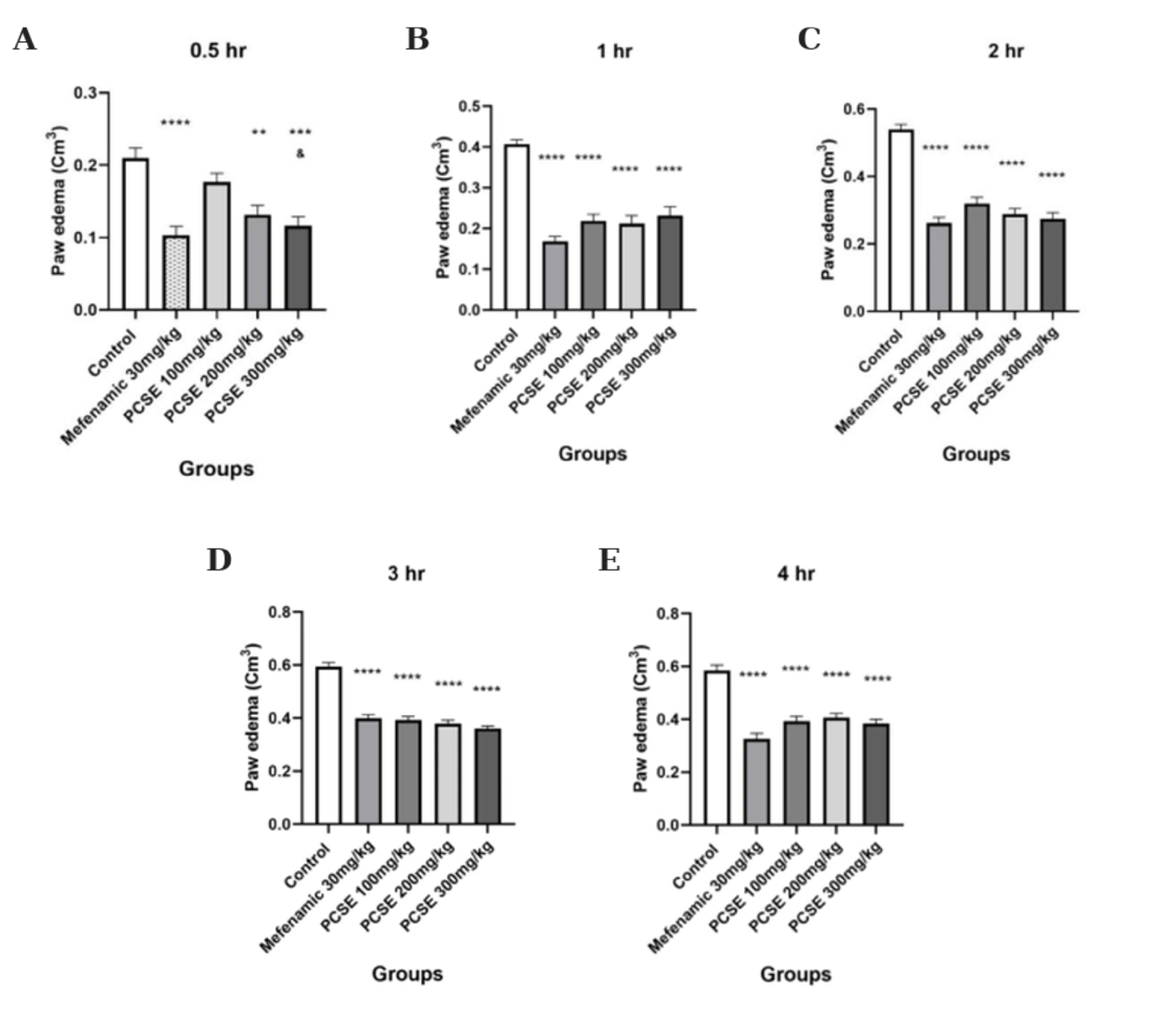
Figure 3.
Anti-inflammatory activity of P. cineraria extract (PCSE) using the carrageenan test in male rats. The control (saline; 10 mL/kg), mefenamic acid (30 mg/kg; i.p.), and PCSE (100, 200, and 300 mg/kg, i.p.) were administered 30 min before the carrageenan test. Afterward, the paw edema was measured at 0.5, 1, 2, 3, and 4 h after the carrageenan administration. The data expresses the mean ± SEM of 6 rats in each group (**P < 0.01, ***P < 0.001, ****P < 0.0001) compared to the control group.
4.4. Cotton Pellet Test
ANOVA and Tukey's post hoc test showed no significant difference in the amount of granuloma between the extract-treated and control groups (P > 0.05). The amount of granuloma was markedly lower in animals receiving indomethacin than in the control group. The amount of transudate also did not differ significantly between the PCSE-treated and control groups (P > 0.05). Indomethacin significantly decreased transudate volume compared with the control group (P < 0.05). Granuloma inhibition with PCSE at 100, 200, and 300 mg/kg was 20%, 25%, and 5%, respectively, compared with 79% with indomethacin. As shown in Table 4, transudate inhibition with PCSE at 100, 200, and 300 mg/kg was 15%, 20%, and 0.5%, respectively, compared with 57% with indomethacin.
Table 4.
Effect of Prosopis Cineraria Seed Extract on the Cotton Pellet-Induced Granuloma Pouch in Rats a
| Groups | Transudate Mean ± SEM (mg; Inhibition%) | Granuloma Mean ± SEM (mg; Inhibition%) |
|---|---|---|
| Control | 0.544 ± 0.043 | 0.077 ± 0.008 |
| indomethacin (5 mg/kg) | 0.234 ± 0.011 (56.97) | 0.0162 ± 0.002 (79.13) |
| PCSE (100 mg/kg) | 0.462 ± 0.016 (15.12) | 0.062 ± 0.003 (20.22) |
| PCSE (200 mg/kg) | 0.438 ± 0.024 (19.77) | 0.058 ± 0.004 (25.16) |
| PCSE (300 mg/kg) | 0.541 ± 0.029 (0.51) | 0.074 ± 0.004 (4.52) |
a Abbreviation: SEM, standard error of the mean; PCSE, prosopis cineraria seed extract.
5. Discussion
Inflammation, particularly when chronic and accompanied by pain, can substantially impair quality of life. Persistent inflammation may also delay tissue repair and prolong disease. Although pharmacological therapies have long been used to manage pain and inflammation, they may cause adverse effects, particularly with prolonged treatment. Complementary and alternative medicine has therefore attracted considerable interest in the search for effective and relatively safe therapeutic agents. Prosopis cineraria belongs to the Fabaceae family and is widely distributed along the southern coast of Iran (7). The plant has been described as a valuable source of bioactive compounds (35). Previous studies have reported analgesic and anti-inflammatory activities in different parts of P. cineraria, suggesting its potential as an inexpensive and readily available source of therapeutic agents for pain and inflammation (36, 37). However, to the best of our knowledge, limited information is available about the anti-inflammatory and anti-nociceptive effects of P. cineraria seed extracts. Therefore, this study investigated these effects using established experimental models of pain and inflammation.
PCSE was evaluated at 100, 200, and 300 mg/kg in male NMRI mice using two nociception models (the hot plate and acetic acid-induced writhing tests) and in male Wistar rats using two inflammation models (carrageenan-induced paw edema and cotton pellet-induced granuloma). Morphine (5 mg/kg), indomethacin (5 mg/kg), and mefenamic acid (30 mg/kg) were used as reference drugs in the respective models, based on previously reported protocols. All treatment groups were compared with their corresponding controls. In the hot plate test, the extract produced transient anti-nociceptive effects at 15 and 30 min after administration, but these effects were no longer evident at 1 or 2 h. In contrast, morphine (5 mg/kg) produced a sustained anti-nociceptive effect throughout the 2-h observation period. At the doses investigated, PCSE may therefore exert a relatively short-lasting effect against acute thermal nociception without providing sustained analgesia. In the writhing test, all three extract doses significantly reduced writhing responses. These different responses may reflect the distinct nociceptive pathways and mechanisms assessed by the two models.
The hot plate and acetic acid-induced writhing tests are widely used preclinical models to evaluate analgesic or anti-nociceptive activity, but they differ substantially in the types and mechanisms of nociception assessed. The hot plate test primarily evaluates acute thermal nociception and involves supraspinal processing of nociceptive stimuli (38). The writhing test is particularly sensitive to peripherally mediated visceral nociception and chemically induced inflammatory pain. Intraperitoneal acetic acid causes tissue injury and irritation, promoting the release of inflammatory mediators, including prostaglandins, which increase vascular permeability and sensitize peripheral nociceptors. These events lead to the characteristic abdominal constrictions and stretching behavior termed writhing (39). The model is sensitive to both opioid and nonopioid analgesics; compounds that reduce writhing episodes are therefore considered to have anti-nociceptive activity (40). The extract's marked activity in the writhing test, together with its relatively limited effect in the hot plate test, may suggest that its anti-nociceptive action has a predominantly peripheral component. One possible explanation is modulation of inflammatory mediators involved in peripheral nociceptor sensitization, such as prostaglandins and leukotrienes. However, this interpretation remains hypothetical because these mediators and molecular pathways were not directly assessed. Further mechanistic studies are needed to determine whether the observed effect involves prostaglandin synthesis, leukotriene pathways, or other peripheral nociceptive mechanisms.
Consistent with the present findings, previous studies have reported anti-nociceptive activity in P. cineraria stem bark, roots, and leaves. Manikandar et al. reported that an ethanolic stem bark extract produced a significant analgesic effect in rats in the Eddy hot plate model at 300 mg/kg. A petroleum ether extract also showed significant antipyretic activity at the same dose in a Brewer's yeast-induced hyperpyrexia model (20). Kumar et al. (21) investigated an ethanolic root extract at oral doses of 200 and 300 mg/kg using tail immersion and hot plate tests. The extract showed significant analgesic activity at 200 mg/kg, with this dose appearing more effective than the higher dose in both models (21). Joseph et al. reported that an aqueous leaf extract produced significant analgesic activity at 200 mg/kg in Swiss albino mice in the acetic acid-induced writhing test. The extract also showed significant antipyretic activity at the same dose in a Brewer's yeast-induced hyperpyrexia model.
Differences between these findings and the present results may partly reflect the plant material investigated. Earlier studies primarily examined roots, leaves, and stem bark, whereas this study focused on seeds. The concentration and composition of bioactive constituents may vary considerably among plant organs and consequently affect pharmacological activity. Differences in extraction solvents and procedures, experimental species, doses, and nociceptive models may also contribute to discrepancies among studies. As noted in the Background, anti-convulsant, antioxidant, antimalarial, antimicrobial, and anticancer effects have been reported for P. cineraria, in addition to its analgesic and antipyretic properties. These findings support further investigation of its bioactive constituents and mechanisms of action.
In the carrageenan-induced paw edema test, PCSE showed significant anti-inflammatory activity at the investigated doses and time points, except that 100 mg/kg was not effective at 30 min. These findings indicate that the extract can attenuate acute inflammatory edema induced by carrageenan. In contrast, the cotton pellet model, which assesses the proliferative component of chronic inflammation, showed no significant differences in transudate or granuloma weight between the extract-treated and control groups. Under the experimental conditions used, PCSE therefore did not significantly inhibit the chronic inflammatory response assessed by this model. Indomethacin (5 mg/kg), however, produced a significant anti-inflammatory effect, supporting the model’s responsiveness to a standard anti-inflammatory agent.
The distinct findings in these models may reflect the different phases and mechanisms of inflammation they represent. Carrageenan-induced paw edema is an established model of acute inflammation characterized by edema formation and the sequential release of mediators, including histamine, serotonin, bradykinin, and prostaglandins (41). The later phase is particularly associated with increased prostaglandin production, which contributes to edema and nociceptor sensitization. This model is therefore widely used to screen compounds with acute anti-inflammatory activity, particularly those affecting prostaglandin-mediated pathways. Cotton pellet implantation, by contrast, induces a foreign-body inflammatory response that develops over several days and produces vascularized granulomatous tissue. It thus assesses the proliferative component of chronic inflammation and can be used to evaluate agents that inhibit granuloma formation (42).
The lack of a significant effect in the cotton pellet model, despite marked activity in the carrageenan assay, suggests that PCSE may have greater activity during the acute phase than during the proliferative phase of chronic inflammation. Together with the writhing test results, these findings suggest that PCSE may preferentially affect acute inflammatory and peripheral nociceptive processes. Its activity may involve the modulation of inflammatory mediators or pathways associated with prostaglandin production. However, the experimental design does not support definitive conclusions about a specific molecular target, such as cyclooxygenase inhibition or prostaglandin receptor modulation. Direct assessment of cyclooxygenase activity, prostaglandin levels, cytokines, and other inflammatory biomarkers would help clarify the mechanisms involved.
The present findings are consistent with earlier reports of anti-inflammatory activity in P. cineraria. Yadav et al. reported significant anti-inflammatory activity of a phenol-rich P. cineraria ointment (22). Sharma et al. also reported significant activity against an LPS-induced inflammatory response (43). Although these findings support the plant’s anti-inflammatory potential, differences in plant part, extraction method, formulation, experimental model, and administration route should be considered when comparing studies. Pharmacological activities have also been reported for other Prosopis species. Extracts of P. juliflora leaves and seeds have shown anti-inflammatory, antifungal, and antibacterial effects in vitro (12).
Previous phytochemical investigations of Prosopis species and related plant materials have reported steroids such as stigmasterol, β-sitosterol, and campesterol; alkaloids such as prosophylline and spicigerine; and flavonoid derivatives, including prosogerins A-E. Flavonoid derivatives and phenolic compounds reported in Prosopis materials include prosogerins C, D, and E (44, 45), as well as gallic acid, luteolin, patuletin, patulitrin, and rutin (46, 47). P. cineraria seed lipids have also been reported to contain substantial amounts of unsaturated fatty acids, particularly oleic and linoleic acids (48). These literature-derived findings are indirect evidence and should not be interpreted as confirming the constituents of the extract used in this study, because the original batch is no longer available for chemical characterization. Establishing a direct relationship between individual phytochemicals and the observed antinociceptive or anti-inflammatory effects requires further pharmacological and phytochemical investigation.
5.1. Study Limitations
Several limitations should be considered when interpreting these findings. The specific extract batch used in the animal experiments is no longer available, preventing retrospective chemical characterization or chromatographic fingerprinting. The study did not include direct biochemical or mechanistic investigations, a comprehensive toxicological evaluation, or observer blinding. The number of animals was relatively limited, and no formal a priori power calculation was performed. Finally, findings from these animal models should not be directly extrapolated to human therapeutic applications. The reported pharmacological effects should therefore be regarded as preliminary evidence requiring confirmation through chemical characterization, mechanistic studies, and further safety evaluation.
5.2. Conclusions
PCSE significantly reduced acetic acid-induced writhing and carrageenan-induced paw edema, indicating visceral anti-nociceptive and acute anti-inflammatory activities in the specific animal models investigated. However, it did not significantly inhibit the response in the cotton pellet-induced granuloma model, suggesting greater activity during the acute phase than during the proliferative phase of inflammation. The relatively short duration of activity in the hot plate test and the pronounced effect in the writhing model may indicate a predominantly peripheral component of anti-nociceptive activity, although the mechanism was not directly investigated. Further studies are needed to characterize the extract chemically, identify its bioactive constituents, and determine the relevant pharmacological mechanisms and safety profile. The potential therapeutic relevance of these findings remains preliminary and requires confirmation in further preclinical studies.