1. Background
The increasing prevalence of Type 2 diabetes is driven by factors such as population aging, urbanization, physical inactivity, unhealthy dietary patterns, and rising obesity rates, making it a major challenge for public health systems worldwide (1-3). Diabetes is an increasingly important global health concern. Type 2 diabetes affected an estimated 462 million people globally in 2017, accounting for approximately 6.28% of the total world population. Projections suggest that by 2030, the global burden of this condition will reach 7,079 cases per 100,000 population, highlighting a continued upward trend in prevalence across regions worldwide (3, 4). Clinically, diabetes is categorized into several types, including Type 1, Type 2, gestational diabetes, and other specific forms arising from distinct etiologies such as monogenic disorders, pancreatic diseases, or drug-induced conditions (3). Type 2 diabetes is the most common variant, comprising around 90% of all diagnosed cases (3, 5, 6). Its pathogenesis involves a combination of genetic predisposition, obesity, and psychological stress. Notably, individuals with diabetes frequently report elevated stress levels, and research confirms a substantial association between stress and disease development (7, 8). Environmental and behavioral factors, particularly physical inactivity and excessive consumption of foods that contribute to obesity, are also critically involved in the onset of Type 2 diabetes (3, 5). In addition to its high global prevalence and incidence, the serious long-term complications of diabetes warrant focused attention from healthcare systems. The progression of chronic complications, subsequent reductions in life expectancy, and increased mortality impose a considerable economic burden on individuals, families, and societies, while diminishing the quality of life for patients and their relatives (3). The chronic course of diabetes and common problems with treatment adherence often hinder the achievement of optimal therapeutic outcomes. Consequently, effective management requires the lifelong practice of self-care behaviors by the patient (9, 10).
To understand variation in adherence to self-care practices among individuals, some research has examined psychological frameworks. According to the Theory of Planned Behavior, the intention to perform a behavior is shaped by one’s attitude toward the behavior, perceived control over its execution, and prevailing social expectations; this intention subsequently guides actual behavior (11). In line with this theory, a favorable attitude toward diabetes self-care is associated with a higher likelihood of engaging in such practices. Specifically, beliefs regarding medication efficacy are linked to better treatment adherence. Therefore, improving patients’ knowledge and perceptions of their condition is a fundamental step in promoting disease management and health-promoting actions (12). Existing studies indicate that insufficient knowledge, along with negative attitudes and practices, is prevalent among patients with diabetes and often results in poor adherence to therapeutic protocols. Therefore, because attitude is a key determinant of motivation to adopt behaviors that prevent complications in Type 2 diabetes, educational interventions aimed at reshaping attitudes and self-care practices are essential for strengthening preventive strategies in this population (9, 10). Within e-health approaches, mass media platforms such as television can serve as powerful tools for patient education. Galavi et al. reported that users regarded this medium as the most valuable source of information and expressed higher satisfaction with content delivered through it. Thus, health policymakers can strategically leverage television for educational outreach (13). Additionally, integrating artificial intelligence into nurse training can improve service quality while optimizing the use of economic and human resources (14).
2. Objectives
Although the attitudinal dimension is critical to self-care behaviors and structured education plays a decisive role in diabetes management and the prevention of complications, national-level investigations in this field remain limited, with most relevant research conducted internationally. This gap highlights the need for a more comprehensive understanding of self-care mechanisms and educational approaches for patients with diabetes. Accordingly, the present study aimed to evaluate the efficacy of an integrated educational program, grounded in lived experience, in improving self-care practices and modifying diabetes-related attitudes among individuals diagnosed with Type 2 diabetes.
3. Methods
3.1. Research Design
This study employed a non-randomized, quasi-experimental pretest-posttest design with an equivalent control group. The target population comprised patients diagnosed with Type 2 diabetes who were referred to healthcare centers in Sanandaj or were registered members of the Sanandaj Diabetes Association during 2024 - 2025.
Using purposive sampling, 30 eligible participants were recruited. Group allocation was conducted using a non-randomized, convenience-based procedure: participants who met the inclusion criteria and were available during the initial recruitment phase were assigned to the experimental group (n = 15), whereas those recruited subsequently were assigned to the control group (n = 15). No randomization procedures were used. This non-randomized design was chosen due to practical constraints, including limited recruitment.
The inclusion criteria were as follows: a confirmed diagnosis of Type 2 diabetes by a specialist physician; age of 30 years or older; having at least a middle school diploma; a minimum diabetes duration of one year; no current use of neuropsychiatric medications; absence of significant visual or auditory deficits; and voluntary consent to participate in the study.
The exclusion criteria were as follows: voluntary withdrawal from the study; hospitalization during the intervention period; initiation of neuropsychiatric drug therapy; or missing more than two scheduled sessions.
3.2. Integrated Educational Program
Participants in the experimental group received the integrated educational program (lived experience-based integrative protocol), delivered over 10 sessions of approximately 60 minutes each, conducted twice weekly. The educational content was developed and validated by the research team in consultation with diabetes specialists and professors of psychology. A summary of the 10-session protocol is presented in Table 1.
Table 1.
Content and Objectives of the 10-Session Integrated Lived Experience-Based Training Protocol
| Session | Content and Objectives |
|---|---|
| Session 1 | Introduction of participants and facilitator, establishment of group rules, overview of diabetes and its consequences, and introduction to the concept of self-care. Participants shared personal experiences regarding diabetes diagnosis and daily disease management. |
| Session 2 | Education regarding genetic and physiological factors associated with diabetes, common complications, and recognition and management of hypoglycemia. Participants discussed their own experiences of symptoms and complications. |
| Session 3 | Promotion of physical activity adapted to individual health conditions and education on selecting healthy foods within financial constraints. Participants exchanged practical strategies they had successfully used in their daily lives. |
| Session 4 | Discussion of the relationship between stress and diabetes management. Participants identified personal stressors and shared effective coping experiences. |
| Session 5 | Identification of psychological barriers to self-care and maladaptive beliefs regarding diabetes. Group discussions focused on challenging ineffective beliefs through reflection on lived experiences. |
| Session 6 | Examination of the role of family and social support in diabetes self-management. Participants shared experiences of receiving or lacking support and explored strategies for improving communication and support-seeking. |
| Session 7 | Education regarding high-risk behaviors (smoking, substance use, and alcohol consumption) and their impact on diabetes outcomes. Participants reflected on lifestyle choices and barriers to behavior change. |
| Session 8 | Medication management and treatment adherence, identification of available local resources, and training in the use of public healthcare services. Participants shared practical experiences related to medication use and healthcare access. |
| Session 9 | Problem-solving skills training focused on common self-care challenges. Real-life examples provided by participants were used to practice structured problem-solving techniques. |
| Session 10 | Review of key concepts, consolidation of learned skills, discussion of future self-care plans, and commitment to maintaining healthy behaviors. Participants reflected on their progress and lessons learned throughout the program. |
A lived experience-based approach was integrated throughout the program by encouraging participants to share personal experiences related to diabetes management, discuss real-life challenges, exchange practical coping strategies, and collectively reflect on successful and unsuccessful self-care behaviors. These discussions were incorporated into each session alongside the educational content.
All sessions were delivered by the principal investigator (a PhD candidate in Health Psychology with a Master's degree in Clinical Psychology and clinical experience in a hospital setting) to ensure consistent implementation. Attendance was recorded at each session, and all participants in the intervention group completed all 10 sessions without any absences (100% attendance rate). Intervention fidelity was ensured through a predefined, standardized session protocol. Fidelity was monitored using a session checklist completed by the facilitator after each session, verifying that all core components were delivered as planned. No protocol deviations occurred.
Participants in the control group maintained their usual daily activities for the duration of the study and did not receive any additional training.
For data collection, a demographic information form (including gender, education level, age, and disease duration) was used, along with the Diabetes Self-Care Questionnaire (15) and the Diabetes Attitude Scale (IR-DAS-3).
3.3. Diabetes Self-Care Questionnaire
This 15-item self-report instrument was designed to evaluate patients' self-care activities over the preceding seven days. It covers multiple dimensions of diabetes management, including general and diabetes-specific diet (5 items), physical exercise (2 items), blood glucose monitoring (2 items), medication adherence for insulin or oral hypoglycemic agents (1 item), foot care (4 items), and smoking status (1 item) (15, 16).
With the exception of the smoking item, which is scored dichotomously (0 or 1), each behavior is rated on a scale from 0 to 7. A total adherence score is calculated by summing all item scores, yielding a possible range of 0 to 99. The validity and reliability of the Persian-translated version of this questionnaire were previously confirmed, and the internal consistency of the questionnaire, assessed using Cronbach's alpha, was reported as 0.90 (16, 17).
3.4. Attitudes Toward Diabetes Questionnaire
To assess patients' perspectives on their illness, the culturally adapted Persian version of the third Diabetes Attitude Scale (IR-DAS-3) was used. This instrument was originally developed by Anderson and colleagues and consists of 33 items (18). Its psychometric suitability for the Iranian population has been confirmed previously, demonstrating acceptable internal consistency (α = 0.85 for the overall scale and α = 0.68 for the subscales). Furthermore, its concurrent validity is supported by significant associations between the obtained scores and HbA1c levels in individuals with diabetes.
Responses to each item were recorded on a five-point Likert scale, in which 1 indicated "completely disagree" and 5 indicated "completely agree." After the appropriate reversal of negatively worded items, higher cumulative scores indicated a more favorable and adaptive outlook toward diabetes self-management.
For this study, only the total score was used. Each participant's total score was calculated by summing responses across all 33 items. Subsequently, mean total scores were computed for each group and served as the dependent variable in the ANCOVA.
3.5. Data Analysis
Data were analyzed using the Statistical Package for the Social Sciences (SPSS) version 23.0 (SPSS Inc., Chicago, IL, USA). The chi-square test and independent-samples t-test were used to assess the comparability of demographic characteristics between the two study groups. To compare post-intervention outcomes between groups, an analysis of covariance (ANCOVA) was performed with baseline scores as the covariate, group as the fixed factor, and post-intervention scores as the dependent variable. Before conducting ANCOVA, its key assumptions were examined and found to be satisfied: normality of residuals (Shapiro-Wilk, P > 0.05 for all groups), homogeneity of variances (Levene's test, P > 0.05), and homogeneity of regression slopes (group × covariate interaction, P > 0.05). In addition, paired-samples t-tests were conducted to evaluate within-group changes from baseline to the end of the study. Mean differences with 95% confidence intervals and partial eta squared (η2) effect sizes were reported.
4. Results
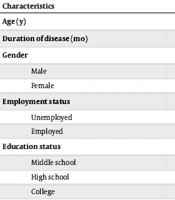
To assess baseline equivalence, demographic characteristics were compared between the two groups before the study. As shown in Table 2, there were no significant differences in age, sex, disease duration, employment, education, or marital status (P > 0.05).
Table 2.
Comparison of Background Characteristics Between the Two Groups a
| Characteristics | Control group (n = 15) | Experimental group (n = 15) | P-Value |
|---|---|---|---|
| Age (y) | 46.40 ± 5.42 | 46.93 ± 4.38 | 0.769 b |
| Duration of disease (mo) | 7.13 ± 3.33 | 6.07 ± 3.61 | 0.408 b |
| Gender | 1.00 c | ||
| Male | 8 (53.3) | 8 (53.3) | |
| Female | 7 (46.7) | 7 (46.7) | |
| Employment status | 0.690 c | ||
| Unemployed | 4 (26.7) | 5 (33.3) | |
| Employed | 11 (73.3) | 10 (66.7) | |
| Education status | 0.904 c | ||
| Middle school | 5 (33.3) | 4 (26.7) | |
| High school | 5 (33.3) | 6 (40.0) | |
| College | 5 (33.3) | 5 (33.3) | |
| Marital status | 0.439 c | ||
| Married | 11 (73.3) | 9 (60.0) | |
| Single | 4 (26.7) | 6 (40.0) |
a Values are expressed as mean ± SD or No. (%).
b P-value based on independent t-test.
c P-value based on chi-square test.
Comparisons between the two groups showed significant differences in self-care and attitude toward diabetes scores (P < 0.05, based on the ANCOVA test) (Table 3). The experimental group showed a significant increase in self-care scores compared with the control group (P-value between groups = 0.001; partial η2 = 0.950). Likewise, after the study, the mean attitude toward diabetes score was significantly higher in the experimental group than in the control group, controlling for the baseline score (P-value between groups = 0.001; partial η2 = 0.990).
Table 3.
Comparison of Outcome Measures Between the Two Groups a
| Variables | Control Group (n = 15) | Experimental Group (n = 15) | Between-groups Statistics b |
|---|---|---|---|
| Self-Care | P = 0.001; F = 516.19; df = 1; partial η2 = 0.950 | ||
| Pre-test | 55.67 ± 7.93 | 56.00 ± 6.77 | |
| Post-test | 57.87 ± 7.06 | 70.33 ± 7.92 | |
| MD | 2.20 (1.67 to 2.72) | 14.33 (13.33 to 15.33) | |
| Within-group P-value c | 0.001 | 0.001 | |
| Attitude toward Diabetes | P = 0.001; F = 2764.81; df = 1; partial η2 = 0.990 | ||
| Pre-test | 99.07 ± 13.67 | 100.60 ± 13.08 | |
| Post-test | 101.80 ± 12.20 | 134.00 ± 13.02 | |
| MD | 2.73 (2.40 to 3.06) | 33.40 (32.18 to 34.62) | |
| Within-group P-value c | 0.001 | 0.001 |
a Values are expressed as mean ± SD or (95% CI). Abbreviations: MD, mean difference; df, degrees of freedom.
b P-value based on analysis of covariance
c P-value based on paired t-test.
Additionally, self-care and attitude toward diabetes scores increased significantly from baseline to post-treatment within both groups (P < 0.05, paired Student t-test). Relative to baseline, these scores increased more in the experimental group (mean difference (MD) with 95% confidence interval (CI) for self-care = 14.33 (13.33 to 15.33); MD with 95% CI for attitude toward diabetes = 33.40 (32.18 to 34.62)).
5. Discussion
This study was conducted to evaluate the impact of an educational intervention based on an integrated educational program on illness-related attitudes and self-care practices among patients with Type 2 diabetes. The results showed that the integrated educational program significantly improved both self-care behaviors and diabetes-related attitudes in patients with Type 2 diabetes. The beneficial effects of self-care education observed in this study are consistent with prior research across various chronic conditions (19-21).
A substantial body of previous research provides empirical support for the role of self-care education in improving self-management behaviors and reducing diabetes-related complications. Among these studies, the work by Funnell et al. (22) is a cornerstone contribution in this field. It proposes that self-care education provides individuals with Type 2 diabetes with essential knowledge, skills, and the capacity to implement meaningful behavioral changes. Their findings suggest that this approach promotes the adoption of new behaviors that support sustainable lifestyle modification (22). The results of the present study are consistent with those reported by Alhaiti et al., who implemented a structured educational program emphasizing dietary adherence, physical activity, and weight management (23).
The findings indicated a marked increase in dietary adherence in the intervention group compared with the control group in the weeks following the educational sessions, along with improved quality of life and reduced stress levels. Consistent with this, recent studies continue to highlight the benefits of structured self-care education for individuals with Type 2 diabetes. For example, a systematic review and meta-analysis by Cunningham et al. (24), including cluster randomized trials, randomized controlled trials, and quasi-experimental designs, evaluated the effects of diabetes self-care education on glycemic control and quality of life among African Americans compared with standard hospital care. The analysis documented a statistically significant improvement in quality of life among participants in the intervention groups compared with controls. In an empirical study, Ernawati, Wihastuti, and Utami (25) assessed the efficacy of diabetes self-care education for patients with Type 2 diabetes. Their results confirmed the positive effects of such education, demonstrating that it was significantly effective in promoting lifestyle modification and strengthening self-care behaviors in this population.
Moreover, the outcomes of the current study suggest that education and increased awareness contributed to improved patient attitudes and self-management practices. These findings are consistent with earlier work by Ferrari, who identified an association between knowledge and attitudes in patients with diabetes; specifically, greater knowledge was associated with more favorable attitudes. That study also reported a weak but positive correlation between knowledge and actual performance (26).
Similarly, research by Gagliardino et al. (27) showed that educational interventions can improve patient attitudes, which in turn contribute to better quality of life for individuals living with diabetes.
In a study by Ozcelik et al. (28), a direct association was identified between patients’ level of knowledge and their attitudes toward foot care; however, no direct link was found between knowledge and actual practice. The authors noted that because only a limited proportion of patients receive instruction in healthcare settings, many individuals with diabetes, despite having adequate knowledge, do not develop a positive attitude toward foot care, underscoring the need for further training to foster more favorable attitudes in this area. Similarly, Girotto et al. (12) reported a significant positive relationship between a constructive attitude toward diabetes and the regularity of blood glucose self-monitoring.
Limited education provided by healthcare professionals regarding diabetes management, dietary regimens, and beneficial self-care activities may contribute to insufficient disease awareness and poor self-care behaviors among patients with diabetes (10). Therefore, appropriate education is fundamental to enhancing knowledge, attitudes, and performance (10, 29), and improved attitudes can increase the quality of life of patients with diabetes (27). Accordingly, changing attitudes is an important factor in increasing self-care among patients with diabetes. Given the critical role of self-care behaviors in preventing and controlling diabetes-related complications, this finding is highly significant and may reflect successful patient empowerment to adopt effective self-care practices (30). In other words, for a patient with diabetes to care for themselves effectively, they must receive the necessary education about their disease and strengthen their knowledge and skills related to their condition (30).
To explain these findings, patient education may be considered a key facilitating factor for empowerment in individuals with diabetes by promoting positive attitudes and self-care. Patients with diabetes need adequate knowledge about their disease to perform correct self-care behaviors and must also receive appropriate training to carry out these behaviors properly. The limitations of this study include the small sample size and the restriction of the study population to patients with Type 2 diabetes in the city of Sanandaj.
In addition, group allocation was non-randomized, and the quasi-experimental design limited our ability to control for multiple external factors affecting outcomes, which is an inherent limitation of quasi-experimental designs.
5.1. Conclusions
The integrated educational program was effective in significantly enhancing self-care behaviors and improving attitudes toward diabetes in patients with Type 2 diabetes. These findings suggest that incorporating such experiential educational programs into standard diabetes care may be a valuable strategy for patient empowerment and improved health outcomes.