
1. Background
Efficient health systems require accurate, comprehensive, and up-to-date data for evidence-based decision-making. Health registries are among the most essential tools for achieving this goal, as they enable the systematic, standardized, and continuous collection of patient and health service data. In addition to supporting scientific research, these registries play a key role in monitoring service quality, informing national planning, and enabling rapid responses to emerging health challenges (1, 2). Despite recent advances, health data recording systems in the country still face serious challenges. Limited financial resources and dependence on short-term support are considered major obstacles to the sustainability of these systems. At the same time, fragmentation and the lack of unified standards have left data insufficiently comparable and aggregated for national and international analyses (3, 4). Furthermore, regional differences in demographic characteristics, epidemiological patterns, and health care access may not be adequately reflected in nationally aggregated health data, which limits the identification of local health needs and the development of targeted interventions (5). Moreover, many registries lack effective mechanisms for data exchange and interoperability with other academic and national information systems, which limits data integration and reduces research efficiency. International experience indicates that developing and strengthening registries not only improves data quality and research efficiency (6) but also provides a basis for increasing transparency, accountability, and efficiency in the health system (7, 8). Improving the health data registry sector should therefore be considered a policy and research priority at both the national and regional levels.
1.1. Importance of the Topic
Iran has undertaken a national initiative to develop disease and health outcome registries, with approximately 80 registry proposals approved for implementation (3). However, evidence from Iran indicates that these systems face organizational, technical, and operational challenges, including inadequate stakeholder coordination, a lack of standardization, data quality problems, and insufficient resources (1). Such challenges may contribute to data fragmentation, duplication of activities, and inefficient resource use, potentially limiting the availability of reliable, integrated information for health research, disease monitoring, and evidence-informed policymaking. Therefore, strengthening the coordination, standardization, and sustainable management of health registries is essential.
2. Objectives
This policy brief aims to review current challenges, explain the importance of the issue, present policy options, and offer implementation suggestions, thereby providing a roadmap for improving health registries in the research area.
3. Methods
This policy brief examines key challenges in the health data registration system and proposes policy measures to address them, including data standardization, development of interoperable technological infrastructure, strengthening data security and confidentiality, improving data quality monitoring, and facilitating access to and dissemination of registry data.
4. Results
4.1. The Need for Compilation
The main challenges facing health data registries in Iran can be summarized in several areas:
A. Lack of unified standards for data recording and coding: Health data are recorded and coded using different systems and formats across registries, without a unified national framework for standardization and oversight. This inconsistency limits data comparability, integration, and analysis, thereby restricting the broader use of these data for research and policymaking.
B. Absence of registries for some diseases and conditions: Some diseases and conditions, such as metabolic syndrome, lack a dedicated registry.
C. Limited dissemination of registry-based information: Some disease registries do not regularly disseminate aggregated statistical findings, epidemiological trends, or analytical reports derived from their collected data. The lack of systematic reporting and accessible information limits the use of registry data for research, health system monitoring, and evidence-informed policymaking.
D. Poor data quality: Entry errors, incomplete or duplicate data, and inadequate quality control have reduced the reliability of the data.
E. Limited access to registry data for research: The absence of transparent, standardized, and efficient procedures for granting authorized researchers access to registry data, subject to ethical and legal requirements, limits the research use of these data and reduces opportunities for evidence generation.
F. Limited sustainable financial resources: Many registries are established with ad hoc or project-based budgets, and their continued operation faces serious challenges.
G. Lack of a sustainable data management and protection mechanism: This shortcoming arises partly because legal and ethical considerations in the field of data protection have not yet been comprehensively and systematically formulated.
H. Neglect of local and regional issues: National plans often overlook epidemiological, cultural, and social differences across regions of the country, resulting in unequal access to the data needed for local policymaking.
4.2. Policy Options
To improve the health data recording system, the following policy options can be considered (Table 1):
Table 1.
Solutions, Advantages, and Existing Challenges for Enhancing the Health Data Registration System
| Policy Option | Advantages | Challenges |
|---|---|---|
| Data standardization | Enhances data quality, analysis, and comparability | Requires training and a change in the culture of data entry |
| Creation of linked technology infrastructure | Prevents duplication of effort and integrates data | Requires initial investment and continuous maintenance |
| Ensuring security and privacy | Increases the trust of patients and researchers | Involves legal and technical complexity in implementation |
| Establishing a national portal and regional hubs | Addresses local issues and facilitates regional research and policymaking | Requires access management and coordination among centers |
| Launching a data quality monitoring system | Identifies errors and enables continuous data improvement | Requires specialized human resources and sustainable financial resources |
- Applying relevant standards according to data type: ICD for disease classification, SNOMED CT for clinical terminology, LOINC for laboratory data, and ATC for medication classification, within a unified national health data dictionary.
- Developing an interoperable IT infrastructure for secure data exchange: Data exchange should be supported by standardized formats and secure APIs, with clearly defined institutional responsibilities for data stewardship, access management, and system maintenance.
- Ensuring data security and privacy: Reviewing and strengthening the existing Iranian legal and regulatory framework for health data protection, privacy, confidentiality, and data sharing, drawing on relevant international principles where appropriate.
- Establishing a national health registry portal and dissemination mechanism: Providing authorized researchers with transparent access to registry data on the basis of approved research proposals and in accordance with relevant ethical and legal requirements, and disseminating aggregated statistical reports, epidemiological findings, and policy briefs to researchers, health professionals, and policymakers through periodic publication, preferably on an annual basis.
- Establishing a data quality monitoring system: Developing protocols for regular, periodic data monitoring and evaluation, and defining relevant data quality indicators.
- Selecting an appropriate organizational model for the national registry system: Comparing the advantages and limitations of strengthening existing decentralized registries, establishing a centralized national system, and developing a national system with regional hubs. The last of these is proposed as the preferred option because it combines national coordination and standardization with regional implementation capacity (Figure 1).
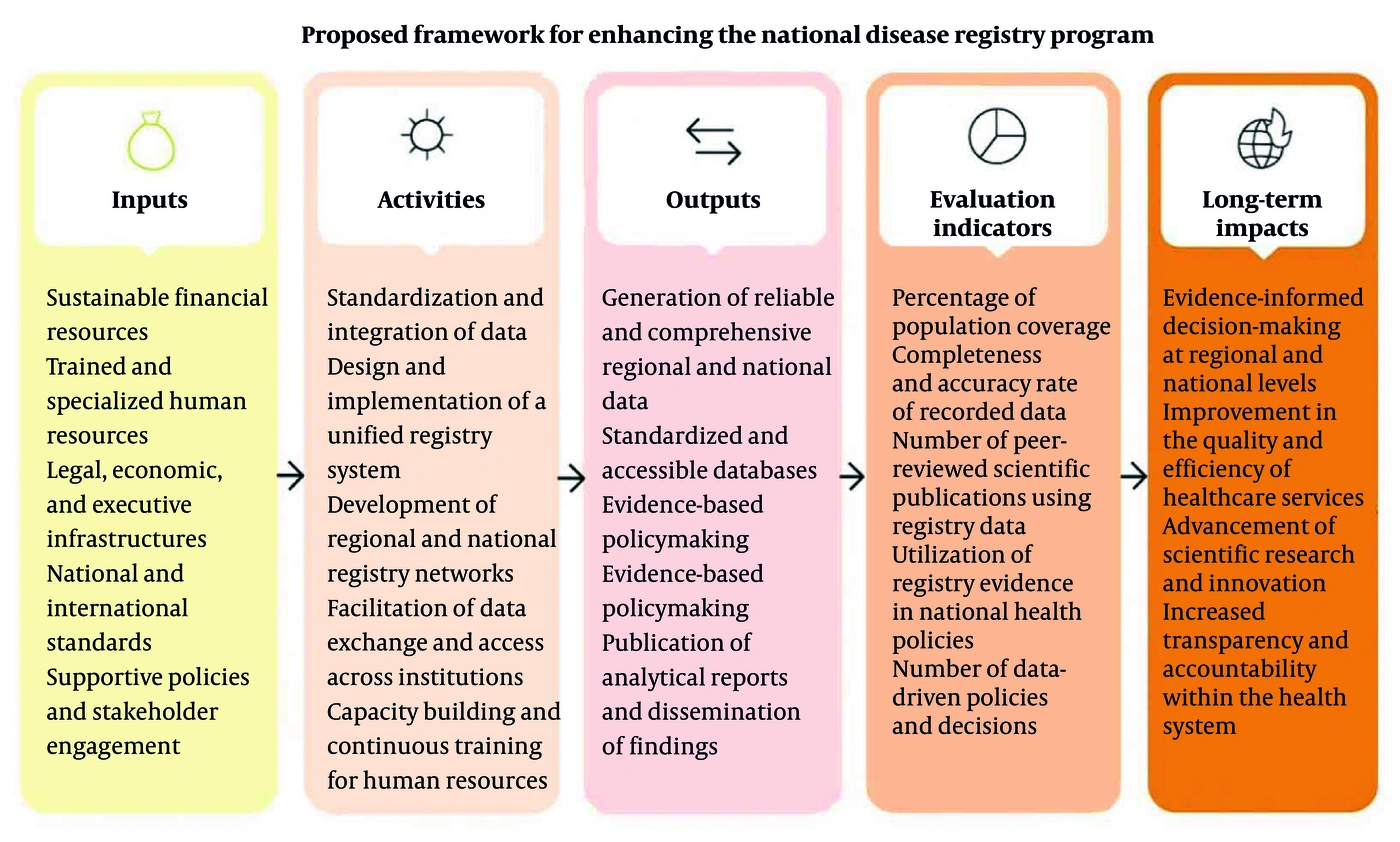
Figure 1.
Proposed Framework for Enhancing the National Disease Registry Program.
4.3. Policy Proposal
Based on the analysis of policy options, the following solution is proposed:
- Establishing a three-level governance structure comprising a national coordinating authority (the Ministry of Health), responsible for policy, standard setting, coordination, and oversight; regional registry hubs, responsible for technical support, inter-university coordination, and regional data management; and university-level registry committees, responsible for local implementation, data quality, and coordination with data providers. Health insurers and other relevant organizations would contribute data through standardized and secure exchange mechanisms. A national coordinating committee involving relevant stakeholders would facilitate inter-institutional coordination and accountability.
- Establishing a sustainable financing mechanism through dedicated national and university research budgets, competitive research grants, and other authorized funding sources. Annual budgets should be allocated according to registry priorities, operational needs, and performance indicators, with regular financial monitoring and reporting.
4.4. Implementation Steps
Implementation is proposed in four phases (Figure 2):
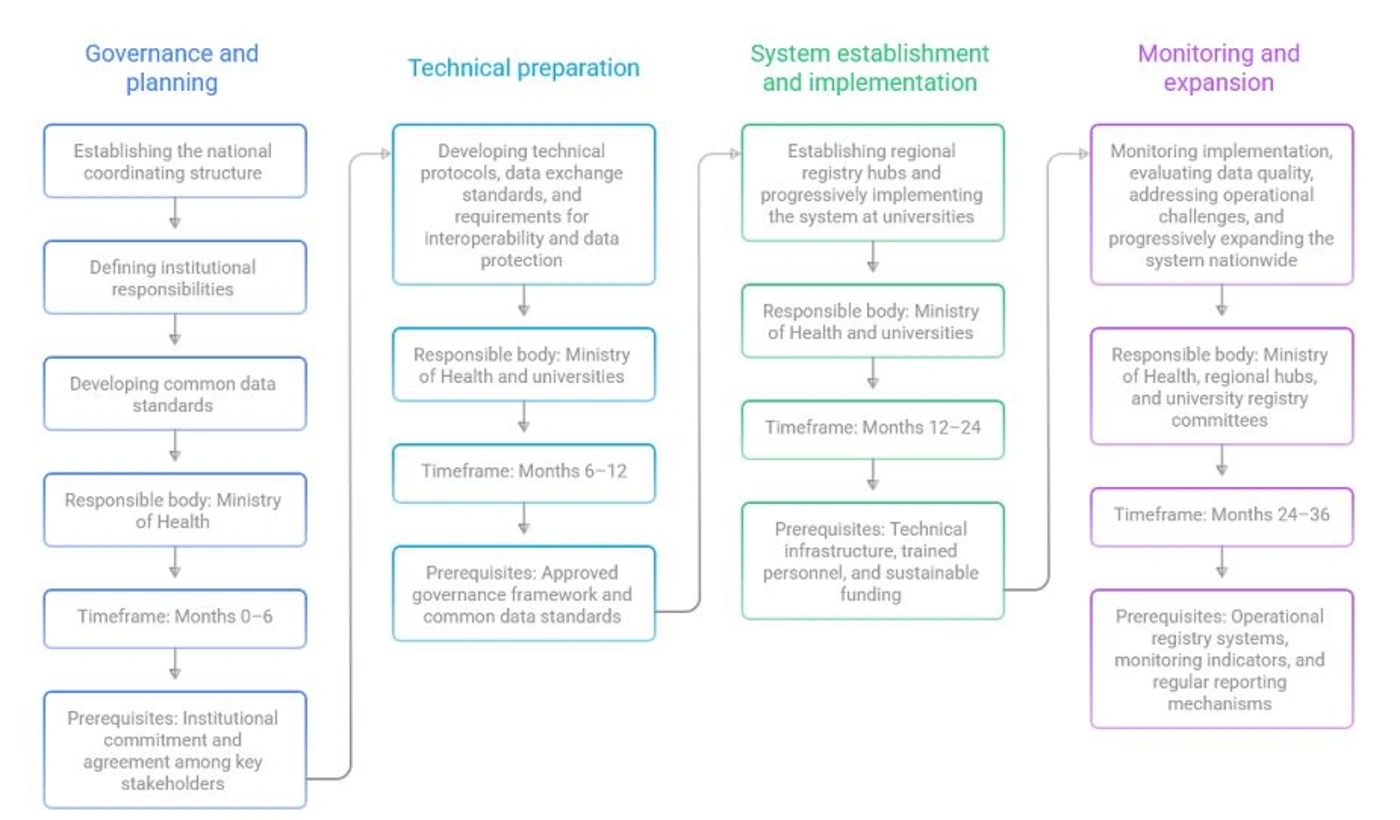
Figure 2.
Implementation Roadmap of the Proposed National Disease Registry System.
- Short term (0 – 6 months): Establishment of the national coordinating structure and definition of governance responsibilities and common standards, led by the Ministry of Health.
- Short to medium term (6 – 12 months): Development of technical protocols and data exchange requirements through collaboration between the Ministry of Health and universities.
- Medium term (12 – 24 months): Establishment of regional registry hubs and progressive implementation of the system at universities, under the supervision of the Ministry of Health.
- Long term (24 – 36 months): Monitoring of implementation, evaluation of data quality, and progressive nationwide expansion of the system, coordinated by the Ministry of Health and university registry committees.
4.5. Evaluation Indicators
The performance of the proposed system can be assessed using the following indicators:
- Data quality and system performance: Population coverage, data completeness, accuracy, and timeliness of registry data.
- Research and policy utilization: Number of research publications and policy reports, and documented use of registry data in health planning and decision-making.
- Health system and equity outcomes: Evidence of improved identification of regional health needs, reduced regional disparities in registry coverage, and increased use of registry data to guide targeted health interventions.
5. Conclusions
Establishing a national health registry system with regional hubs is proposed as a means of strengthening coordination, standardization, and data integration across existing registries. This model has the potential to support more efficient use of resources, enhance research capacity, and improve the availability of regional health information for evidence-informed policymaking and more equitable health planning. However, these potential benefits require further assessment through implementation and evaluation.