
1. Introduction
Diabetes mellitus is one of the most prevalent metabolic disorders worldwide, and its global incidence is increasing rapidly (1). According to the latest estimates from the International Diabetes Federation, approximately 589 million adults aged 20 – 79 years are living with diabetes, and this number is projected to exceed 853 million by 2050. More than 90% of these cases are attributable to type 2 diabetes mellitus (T2DM) (2). Owing to its chronic course and associated systemic complications, T2DM imposes a substantial socioeconomic and therapeutic burden on healthcare systems worldwide, making clarification of its underlying pathophysiological mechanisms a major priority in biomedical research (3). Experimental modeling of diabetes in laboratory animals, particularly mice, has become an invaluable approach for investigating disease mechanisms and evaluating novel therapeutic interventions (4). Among murine strains, male C57BL/6 mice are widely recognized as a robust model for T2DM research because of their marked susceptibility to high-fat diet-induced metabolic disturbances, which often reproduce key human-like features such as dyslipidemia and hepatic steatosis (5).
The combination of an enriched diet and low-dose streptozotocin (STZ) injection, commonly referred to as the combined model, is a widely used and effective strategy for mimicking the disease (6). Streptozotocin exerts dose-dependent cytotoxic effects on pancreatic β-cells; whereas high doses cause extensive β-cell destruction and produce a type 1 diabetes-like phenotype, lower doses administered in the setting of diet-induced insulin resistance can reproduce key metabolic features of T2DM (6).
Conventionally, HFD-based induction protocols have relied on saturated animal fats such as lard, beef tallow, or full-fat dairy products (7). Although effective, these fat sources may be associated with undesirable effects, including excessive hypercholesterolemia, systemic inflammation, non-alcoholic steatohepatitis, and pronounced inflammation-related insulin resistance, as well as metabolic disturbances that do not always closely reflect the clinical pathophysiology of human T2DM (5, 7). To optimize the induction protocol, the present study used a high-fat diet (HFD) enriched with extra virgin olive oil (EVOO), a plant-based fat source, in combination with low-dose STZ. Although EVOO is rich in monounsaturated fatty acids, the increase in dietary caloric density may still promote diet-induced obesity and ectopic lipid accumulation, both of which are major contributors to insulin resistance and impaired glucose homeostasis in this experimental setting (8, 9).
2. Objectives
Given the need for a stable laboratory model with fewer inflammatory side effects than those associated with saturated animal fats, the present study was designed to evaluate the efficacy of a new T2DM induction protocol in male C57BL/6 mice, using an EVOO-based high-fat diet combined with low-dose STZ.
3. Methods
This study was performed following approval by the Institutional Ethics Committee of the Islamic Azad University, Qaemshahr Branch (Ethical Code: IR.IAU.SARI.REC.1404.333). Nine male C57BL/6 mice (6 – 7 weeks old) were used. This study adhered to the ARRIVE (Animal Research: Reporting of in vivo Experiments) guidelines. Given the exploratory, preliminary pilot nature of this single-cohort study, a sample size of nine male C57BL/6 mice (n = 9) was chosen to minimize animal use in accordance with the 3Rs principle, without a formal a priori power calculation. Animals were randomly assigned to their housing cages upon arrival. To ensure physiological stability and facilitate acclimatization to the new environment, the animals were housed at the animal facility of Golestan University of Medical Sciences for a three-week adaptation period. During this phase, environmental conditions were strictly regulated: temperature was maintained at 22 ± 2∘C, relative humidity at 53 – 57%, and a 12-hour light/dark cycle was implemented. Health status, behavioral patterns, and biochemical markers were monitored weekly to confirm that all animals remained in a normal metabolic state.
Throughout the three-week adaptation period, the mice were provided with a standard low-fat diet (8 g/day) consisting of 17% crude protein, 4% crude fat, 12% ash, 1.30% calcium, 0.65% phosphorus, and 765.05% soluble carbohydrates/fiber. Purified drinking water was provided ad libitum throughout the experimental period. Body weight and fasting blood glucose levels were recorded at the end of each week (Figure 1). Following the acclimatization period and verification of normoglycemia (defined as normal fasting blood glucose levels of approximately 90 – 100 mg/dL) (10), the diabetes induction protocol was initiated.
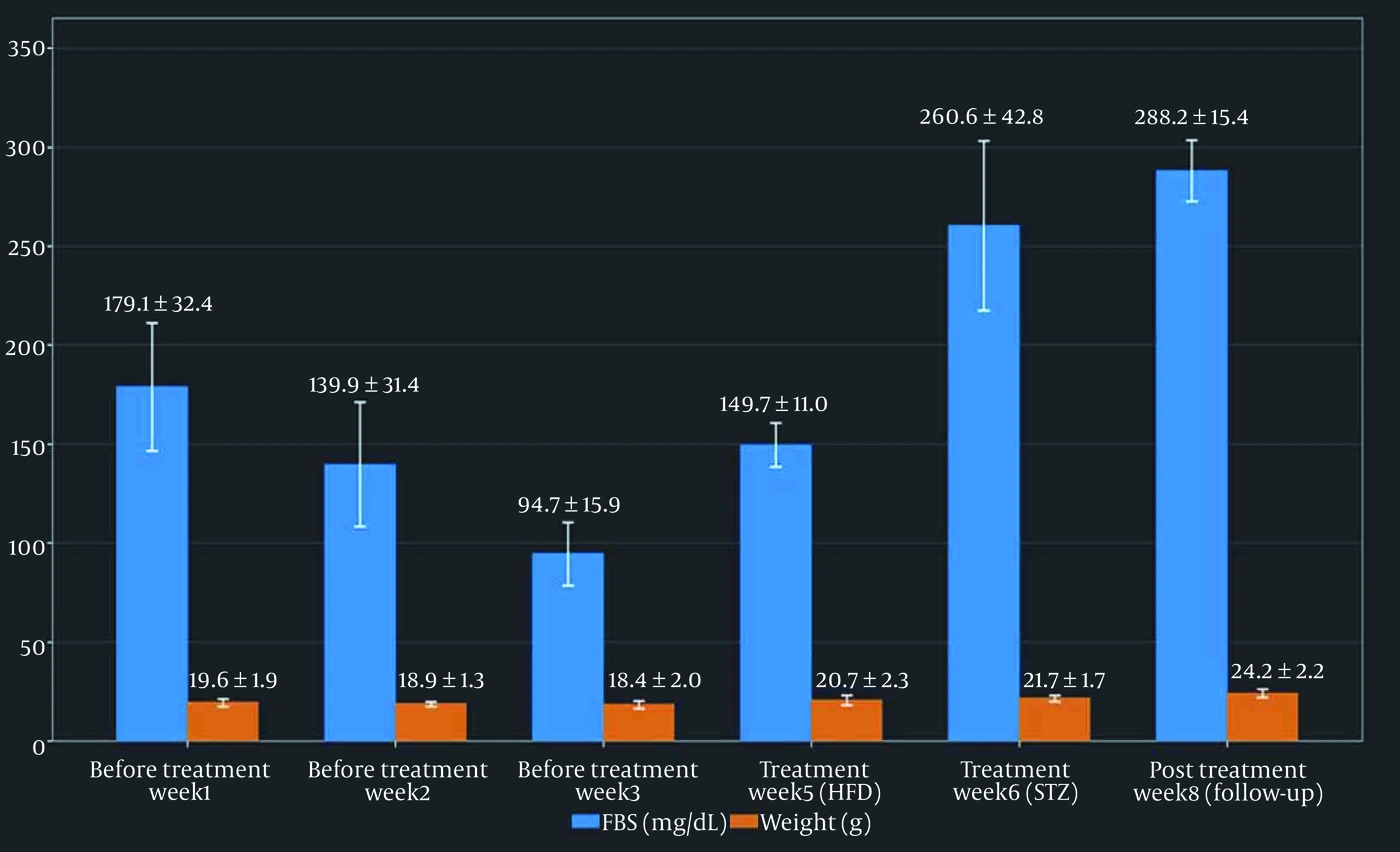
Figure 1.
Average blood glucose levels and body weight of mice over 8 weeks and during three phases. Data points represent individual animal trajectories alongside group means (expressed as mean ± SD, n = 9).
It should be noted that this investigation was designed as a preliminary, single-cohort pilot study to evaluate the feasibility of the induction protocol; therefore, concurrent control groups (such as standard diet-fed or vehicle-treated groups) were not included.
3.1. Preparation of the High-Fat Diet
To induce the T2DM model, an HFD with approximately 10% fat content was formulated. The diet was prepared by gradually incorporating 35 g of EVOO, extracted by cold pressing (below 30 °C), into 500 g of powdered standard rodent chow. The mixture was thoroughly kneaded to achieve a homogeneous consistency. Given that the standard chow contained ~4% crude fat (~20 g of fat per 500 g) and that 35 g of EVOO was added, the final formulation provided ~55 g of total fat in 535 g of total mixture (~10.28% crude fat by weight, yielding ~22 – 24% of energy from fat; Figure 2). To prevent lipid oxidation, the prepared diet was stored at 4 °C. Each mouse was provided with 8 g of the EVOO-enriched diet daily for two weeks. The daily provision of 8 g per animal represented the amount of food offered; because of the single-cohort housing setup, individual food consumption was not precisely quantified.
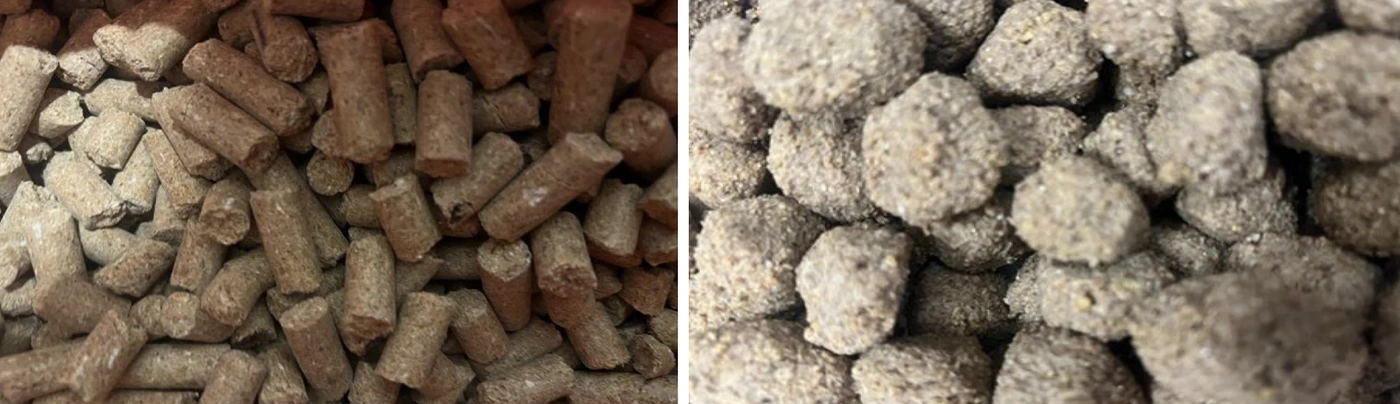
Figure 2.
Diets used for the mice in this study: (Left) standard diet containing 4% fat; (Right) high-fat diet (10.3% fat) prepared by supplementation with extra virgin olive oil.
3.2. Diabetes Induction and Parameter Monitoring
Upon completion of the HFD period, diabetes was induced by a single intraperitoneal injection of STZ at a dose of 25 mg/kg body weight. Streptozotocin (STZ; Sigma-Aldrich) was freshly prepared by dissolving it in cold 0.1 M citrate buffer (pH 4.5) immediately before use. The solution was kept on ice and administered as a single intraperitoneal injection at a dose of 25 mg/kg body weight within 15 minutes of preparation to prevent degradation. Following the injection, the animals were returned to the standard low-fat diet (Figure 2 Left). Fasting blood glucose levels were measured in tail vein blood after a 5-hour fast using a CareSens N glucometer at the following time points: the end of the acclimatization period (week 3), the end of the HFD period (week 5), week 6 (one week post-STZ), and week 8 (final follow-up) of the experimental timeline. Mice with a fasting blood glucose level of at least 200 mg/dL were considered diabetic (11).
3.3. Sample Size Rationale and Animal Safeguards
A preliminary pilot sample of nine male C57BL/6 mice (n = 9) was used. No animals were excluded during the study, and no unexpected mortality, severe adverse events, or humane endpoint violations occurred throughout the experimental period. Throughout the study, the researchers sought to avoid any potential bias to ensure objective and reliable results. Furthermore, although formal double-blind allocation or investigator blinding was not feasible owing to the single-group exploratory design, data collection and biochemical measurements were performed in a standardized, uniform manner to minimize potential observation bias.
3.4. Statistical Analysis
All quantitative data are expressed as mean ± standard deviation (SD). The normality of data distribution was assessed using the Shapiro–Wilk test. Longitudinal physiological parameters (fasting blood glucose and body weight) were analyzed using repeated-measures ANOVA, followed by the Bonferroni post hoc test for pairwise comparisons across time points. Statistical analyses were performed using IBM SPSS Statistics version 26, and statistical significance was set at P < 0.05. No data points were missing during the experimental period.
4. Results
During the study period, metabolic and physiological parameters, including fasting blood glucose and body weight, were monitored in male C57BL/6 mice (Figure 1). During the 3-week acclimatization period, initial fasting blood glucose was elevated at the end of week 1 (179.1 ± 32.4 mg/dL; body weight: 19.6 ± 1.9 g), likely owing to transportation and handling stress, but progressively stabilized to physiological normoglycemia by the end of week 3 (94.7 ± 15.9 mg/dL; body weight: 18.4 ± 2.0 g) (Figure 1).
Following two weeks of feeding with a high-fat diet containing EVOO, the average fasting blood glucose level increased to 149.7 mg/dL. In the sixth week, after STZ injection, the average blood glucose level rose to 260.6 mg/dL. This increase persisted into the eighth week, with the average blood glucose level rising further to 288.2 mg/dL.
The average body weight also increased during the HFD period and after STZ injection, reaching 20.7 g and 21.7 g in the fifth and sixth weeks, respectively. By the end of the follow-up period (week 8), the average body weight had increased to 24.2 g. Fasting blood glucose increased significantly across the experimental timeline (repeated-measures ANOVA, P < 0.001). Post hoc pairwise comparisons confirmed that blood glucose levels after STZ injection (260.6 ± 42.8 mg/dL) and at week 8 (288.2 ± 15.4 mg/dL) were significantly higher than the post-adaptation baseline (94.7 ± 15.9 mg/dL; P < 0.001). Similarly, body weight showed a statistically significant progressive increase over the study period (P < 0.001).
5. Discussion and Conclusion
Initial measurements showed that blood glucose levels during the first weeks after the animals were transferred to the animal facility were higher than expected. This transient elevation was most likely attributable to two factors. First, transport and handling stress may have contributed, since laboratory procedures and environmental change can trigger stress responses, and activation of the hypothalamic-pituitary-adrenal axis, together with increased secretion of corticosterone and catecholamines, can induce hyperglycemia (12-15). Second, as a working hypothesis, the mice may previously have been maintained on a diet rich in carbohydrates and simple sugars with a high glycemic load, such as starch-rich feed, simple sugars, or even fruits. Such nutritional conditions may lead to marked fluctuations in blood glucose and even to transient elevations in basal glucose levels. Previous studies have shown that dietary composition and inadequate acclimatization can influence fasting glucose measurements in laboratory mice, and that these values may stabilize after an appropriate adaptation period (10, 16).
Our findings showed that, with a diet containing 4% fat and extension of the acclimatization period from 2 weeks to 3 weeks, blood glucose levels returned to the normal range. This suggests that the initial elevation in glucose was likely related to stress and environmental change and was corrected through dietary modification and stabilization of housing conditions. After the acclimatization phase and stabilization of metabolic status, the animals were placed on an EVOO-enriched diet (~10% total crude fat). This change was accompanied by an increase in fasting blood glucose levels, suggesting that EVOO supplementation may serve as an effective dietary approach to initiate prediabetic glycemic perturbation in mice.
With regard to the induction strategy, a low-dose streptozotocin approach combined with moderate dietary fat enrichment was selected instead of high toxic doses of STZ. This protocol was intended to induce partial β-cell damage rather than extensive destruction, avoiding the acute toxicity and sudden mortality associated with classical high-dose STZ models while preserving baseline metabolic function. Classical two-hit models typically combine high-fat diet-induced insulin resistance with low-dose STZ-mediated β-cell dysfunction (11). In the present protocol, the EVOO-supplemented diet was utilized as a sub-acute dietary priming regimen rather than a severe, long-term obesogenic high-fat diet (45 – 60% kcal fat). Following the two-week dietary intervention, fasting blood glucose rose significantly to 149.7 mg/dL, indicating acute metabolic and glycemic perturbation prior to STZ administration (25 mg/kg). While standard HFD protocols require prolonged feeding (8 – 16 weeks) to establish frank peripheral insulin resistance, our moderate-fat diet (~22 – 24% energy from fat) was intended to prime the animals for enhanced susceptibility to low-dose STZ without the excessive systemic toxicity or mortality associated with saturated animal fats. Nonetheless, because circulating insulin, HOMA-IR, and dynamic insulin sensitivity tests (ITT/OGTT) were not directly measured in this pilot phase, we cannot unequivocally conclude that classic insulin resistance was fully established, and the observed state is more accurately described as an early prediabetic glycemic dysregulation. Although this approach was designed to capture phenotypic features of a type 2 diabetes-like state, low-dose STZ (25 mg/kg) primarily serves to impair glucose tolerance and reduce glycemic control without acute toxicity (9, 11). Consequently, rather than claiming a complete recapitulation of human T2DM pathophysiology, this protocol should strictly be characterized as producing a viable, stable HFD/STZ-induced hyperglycemic or T2DM-like phenotype suitable for initial screening studies.
Body weight was monitored regularly throughout the study. Overall, these findings indicate that the present induction protocol successfully established a hyperglycemic phenotype within the studied cohort. It may therefore serve as a useful preliminary platform for future studies investigating pharmacological or herbal interventions for glucose regulation. Because this model combined moderate fat enrichment with low-dose streptozotocin, marked weight loss was not expected. The results showed a slight increase in body weight over the 8-week study period, particularly during the final weeks, which may be attributed to aging and attainment of sexual maturity. At 15 weeks of age, the body weight observed in our male C57BL/6 mice was broadly consistent with reported ranges for age-matched animals (17). Furthermore, consistent with our findings regarding the utility of high-fat dietary models in preclinical evaluations, recent studies further underscore the importance of optimizing dietary intervention models for investigating metabolic and obesity-related disorders (18).
In conclusion, our observations suggest that an EVOO-enriched diet combined with low-dose streptozotocin provides a reproducible preliminary protocol for inducing a type 2 diabetes-like phenotype in mice, serving as a practical and accessible platform for future pharmacological and microbiome investigations.
5.1. Limitations of the Study and Concluding Remarks
Several limitations of this study should be acknowledged. First, because of the single-cohort pilot design without a concurrent standard-diet control group, the effects of handling stress and diet composition could not be completely isolated from those of the induction process. Second, this preliminary study primarily evaluated fasting blood glucose and body weight trajectories to verify the diabetic state; direct assessments of plasma insulin levels, insulin/glucose tolerance tests, and pancreatic histopathology were not included in this pilot phase, although relevant tissue specimens were harvested and preserved for comprehensive downstream analyses in subsequent investigations. Therefore, the current model should be conservatively characterized as an EVOO/STZ-induced hyperglycemic, T2DM-like phenotype rather than a definitively characterized metabolic syndrome.