Journal of Kermanshah University of Medical Sciences
Peer-reviewed Medical Quarterly
e-ISSN 2588-2570
p-ISSN 2588-2562
Image Credit:J Kermanshah Univ Med Sci
Outline
Premenstrual syndrome among single and married women in the city of Eyvan-e-Gharb
Authors
1Dept. of Psychology, Faculty of Humanity, Science and Research Branch, Islamic Azad University, Tehran, Iran
2Dept. of Counseling and Guidance, Faculty of Educational Sciences, Allameh Tabataba'i University, Tehran, Iran
*Corresponding Author: Corresponding author: Sara Jamali, Dept. of Psychology, Faculty of Humanity, Science and Research Branch, Islamic Azad University, Tehran, Iran, Tel: +98 9183419970 Email: sjamali66@yahoo.com
Published online:Jan 29, 2015
Article type:Research Article
Received:Aug 11, 2014
Accepted:Dec 30, 2014
How to Cite:Jamali S, Karimi F. Premenstrual syndrome among single and married women in the city of Eyvan-e-Gharb. J Kermanshah Univ Med Sci. 2015;18(10):e74008. doi: https://doi.org/10.22110/jkums.v18i10.1887
Abstract
Background: The premenstrual syndrome is a common problem in women. Because of contradictory findings about the prevalence and role of age and marital status, this syndrome was compared between single and married women.
Methods: This analytical-descriptive research was carried out upon 230 single and married women in the city of Eyvan-e-Gharb. The premenstrual syndrome questionnaire (Cronbach's alpha reliability=0.88) was used to collect the data. Data were analyzed by one-way ANOVA and Scheffe’s post hoc tests (P<0.05)
Results: There was a significant difference between the two age groups of single girls (15-28 and 21-28 years old) and the married women (31-38 years old) in terms of the intensity of symptoms. Also, a significant difference was reported between the 15-18 year-old age group and 21-28 year-old girls and 31-38 year-old women. Further, there was a significant difference between the 21-28 year-old girls and 31-38 year-old women. Prevalence and type of physical and psychological symptoms of premenstrual syndrome were different in each group. The 21-28 year-old girls, with the mean of 26.87, were reported to have the highest level of premenstrual syndrome symptoms. The 31-38 year-old women, with the mean of 26.8, were ranked second, and the 15-18 year-old girls, with the mean of 20.54, indicated the minimum level of prevalence.
Conclusion: The findings of the current study showed that premenstrual syndrome is a common problem among the girls and women of different age groups, but is lower in 15-18 years age group. It occurs as both physical psychological symptoms in females and disturbs their compatibility.
Highlights
References
- 1.The references of this article is available on PDF.
Copyright
© 2015, Journal of Kermanshah University of Medical Sciences. This open-access article is available under the Creative Commons Attribution-NonCommercial 4.0 (CC BY-NC 4.0) International License (https://creativecommons.org/licenses/by-nc/4.0/), which allows for the copying and redistribution of the material only for noncommercial purposes, provided that the original work is properly cited.
Similar Articles
5
Sep
2011
Prevalence of premenstrual symptoms and premenstrual dysphoric disorder among adolescents students of Zahedan
Noor mohammad Bakhshani,
Zahra Hasanzadeh,
Mahvash Raghibi
Bakhshani NM, Hasanzadeh Z, Raghibi M. Prevalence of premenstrual symptoms and premenstrual dysphoric disorder among adolescents students of Zahedan. Zahedan J Res Med Sci. 2012;13(8):e93773. doi:
30
Dec
2014
Premenstrual Syndrome and Comorbid Depression Among Medical Students in the Internship Stage: A Descriptive Study
Seyed Saeed Sadr,
Seyed Mehdi Samimi Ardestani,
Katayoon Razjouyan,
Mahboobeh Daneshvar,
Ghazal Zahed
Sadr SS, Samimi Ardestani SM, Razjouyan K, Daneshvar M, Zahed G. Premenstrual Syndrome and Comorbid Depression Among Medical Students in the Internship Stage: A Descriptive Study. Iran J Psychiatry Behav Sci. 2014;8(4):. doi:
30
Nov
2019
Prevalence of Premenstrual Syndrome, Premenstrual Dysphoric Disorder and Associated Factors Among Female High School Students
Forough Bustani,
sara ziagham,
Azam Jahangirimehr,
Azam Honarmandpour
Bustani F, ziagham S, Jahangirimehr A, Honarmandpour A. Prevalence of Premenstrual Syndrome, Premenstrual Dysphoric Disorder and Associated Factors Among Female High School Students. J Inflamm Dis. 2024;23(4):e156173. doi:
11
Nov
2025
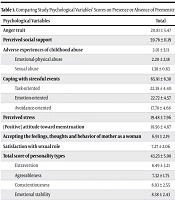
Predicting Premenstrual Syndrome Among University Students: Considering Anger, Social Support, Childhood Adversity, and Stress Related Factors, Menstrual Attitudes, and Sex Role Satisfaction
Mahsa Barari,
Zohreh Shahhosseini,
Abolfazl Hosseinnataj,
Fatemeh Khaleghi,
Hamideh Azimi Lolaty
Barari M, Shahhosseini Z, Hosseinnataj A, Khaleghi F, Azimi Lolaty H. Predicting Premenstrual Syndrome Among University Students: Considering Anger, Social Support, Childhood Adversity, and Stress Related Factors, Menstrual Attitudes, and Sex Role Satisfaction. J Nurs Midwifery Sci. 2026;13(1):e165764. doi: https://doi.org/10.5812/jnms-165764
8
Feb
2021
Comparison of Blood Pressure in Women with and without Premenstrual Syndrome
Hadiseh Shabdini,
Akram Peyman
Shabdini H, Peyman A. Comparison of Blood Pressure in Women with and without Premenstrual Syndrome. Shiraz E-Med J. 2021;22(10):e111338. doi: https://doi.org/10.5812/semj.111338
Cited by
- Scopus by DOI: 0
Last Update: 1 week ago
- Scopus by Title: 0
Last Update: 1 week ago
- Scopus by Title (Ref): 0
Last Update: 1 week ago
- CrossRef: 0
Last Update: 6 days ago
- OpenAlex: 0
Last Update: 2 days ago
- OpenCitations: 0
Last Update: 4 days ago
Comments
Number of Comments:0