
Fulltext
Full-text is available in PDF format.
Journal of Motor Control and Learning
An International Journal of Movement Science
Authors
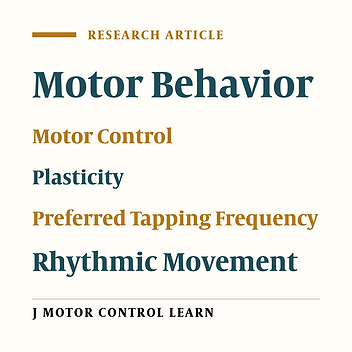
Objective: To test the following hypothesis. Initial submaximal tapping at preset relatively low and high target tapping rates causes a subsequent freely chosen tapping rate to be relatively low and high, respectively, as compared with a reference freely chosen tapping rate.
Methods: Participants performed three 3-min bouts of submaximal index finger tapping on separate days. In one bout (C, considered reference), the rate was freely chosen, throughout. In another bout (A), initial tapping was performed at a relatively low target rate and followed by freely chosen tapping. In yet another bout (B), initial tapping was performed at a relatively high target rate, followed by freely chosen tapping.
Results: At the end of bout A, the rate was 14.6±23.7% lower than the reference value during bout C (p = 0.023). At the end of bout B, the rate was similar to the rate during bout C (p = 0.804).
Conclusions: Initial tapping at a preset relatively low target rate caused a subsequent freely chosen rate to be lower than a reference freely chosen rate. The observation was denoted a phenomenon of motor behavioral history dependence. Initial tapping at a preset relatively high target rate did not elicit history dependence.
© 2022, Journal of Motor Control and Learning. This open-access article is available under the Creative Commons Attribution-NonCommercial 4.0 (CC BY-NC 4.0) International License (https://creativecommons.org/licenses/by-nc/4.0/), which allows for the copying and redistribution of the material only for noncommercial purposes, provided that the original work is properly cited.
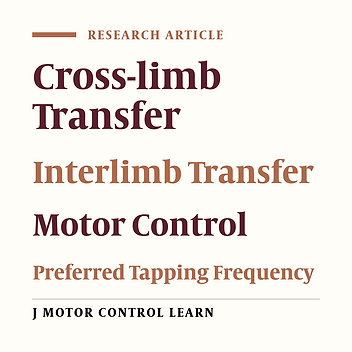
Hansen E. Twenty Seconds of Finger Tapping: A Borderland for Contralateral Transfer of Repeated Bout Rate Enhancement. J Motor Control Learn. 2022;4(2):e144307. doi: https://doi.org/10.52547/ijmcl.4.2.9
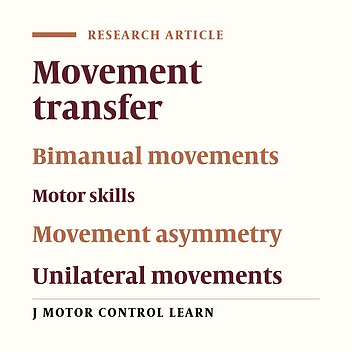
Maharjan P, Hyllegard R, Narvaez M, Radlo SJ. Transfer of Motor Skills: A Comparative Study of College-Level Musicians and Athletes. J Motor Control Learn. 2022;4(3):e144312. doi: https://doi.org/10.52547/ijmcl.4.3.5
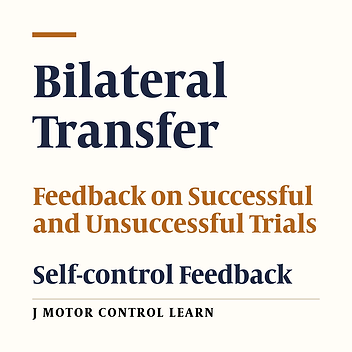
C. Martinez S, Clark D, Coons J. The Effect of Motivational and Informational Role of Feedback on Bilateral Transfer of Force Control Task. J Motor Control Learn. 2021;3(1):e146565. doi: https://doi.org/10.52547/ijmcl.3.1.4
rahman gholhaki M, Molanorouzi K, Ghasemi A. The Effect of Motivational and Informational Role of Feedback on Bilateral Transfer of Force Control Task. J Motor Control Learn. 2021;3(3):e146558. doi: https://doi.org/10.52547/ijmcl.3.3.33
R. Arshi A. The Effect of Motivational and Informational Role of Feedback on Bilateral Transfer of Force Control Task. J Motor Control Learn. 2020;2(4):e146524. doi: https://doi.org/10.29252/ijmcl.2.4.1
Last Update: 1 month ago
Last Update: 1 month ago
Last Update: 1 month ago
Last Update: 6 days ago
Last Update: 8 hours ago
Last Update: 4 days ago