
Fulltext
Full-text is available in PDF format.
Journal of Motor Control and Learning
An International Journal of Movement Science
Authors
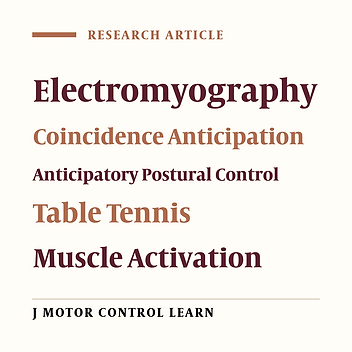
Background: Skilled athletes’ optimal performance might be due to their postural ability to counteract perturbation. However, how expertise influences the coordination of anticipatory postural adjustment (APA) and main movement under temporal pressure needs more investigation. This study aimed to investigate how available time (temporal pressure) for the central nervous system to prepare postural and motor commands, differentiates skilled and novice postural capacity during performing Table Tennis Forehand stroke.
Methods: 10 skilled (20.3±1.15 years old) and 10 novices (19.9±0.99 years old) Table Tennis players while maintaining Forehand stroke position on two force plates stand in front of a screen that presents a Coincident Anticipation Timing stimulus. Participants completed a block of 20 trials consisting of random-order presentation of fast and slow stimuli and surface muscle activity of postural muscles was recorded using an Electromyography device, simultaneously.
Results: The results of two-way MANOVA showed that more/less temporal pressure for the central nervous system led to later/earlier onset time of APA with lower/higher magnitude, respectively. Skilled players’ postural strategy was the higher magnitude of APA in dorsal muscles (Erector Spainae, Biceps Femoris, and Gasterocnemous), more backward peak excursion, and lower velocity of the center of pressure.
Conclusion: Although such findings may be beneficial factors for coaches in programming athletes’ training, however, the similarity in anticipatory postural adjustments’ onset time of novice and skilled players, do not let a certain conclusion about the effects of expertise on feed-forward control of posture.
© 2022, Journal of Motor Control and Learning. This open-access article is available under the Creative Commons Attribution-NonCommercial 4.0 (CC BY-NC 4.0) International License (https://creativecommons.org/licenses/by-nc/4.0/), which allows for the copying and redistribution of the material only for noncommercial purposes, provided that the original work is properly cited.
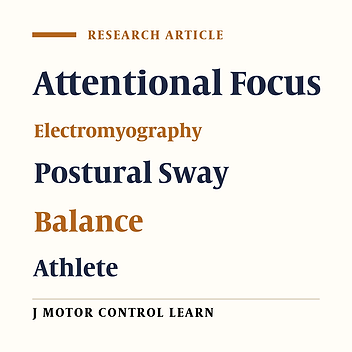
Ashraf Jamshidi A, Pashabadi A. The Neurophysiological Effect of Attentional Focus as a Function of Expertise in Postural Task. J Motor Control Learn. 2021;3(4):e144310. doi: https://doi.org/10.52547/ijmcl.3.4.36
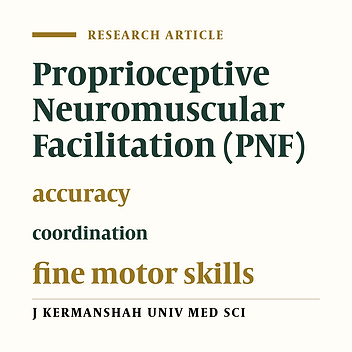
Shahabi Kaseb MR, Mehranian A, Rezaei K. The Effect of Proprioceptive Neuromuscular Facilitation on Learning Fine Motor Skills: A Preliminary Study. J Kermanshah Univ Med Sci. 2016;20(2):e69701. doi: https://doi.org/10.22110/jkums.v20i2.2922
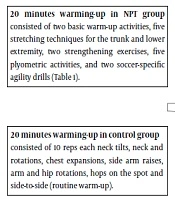
Rezaeipour M, Apanasenko GL. Steady-State Postural Response to Neuromuscular and Proprioceptive Training Program in Active Middle-Aged Women. Middle East J Rehabil Health Stud. 2019;7(1):e93864. doi: https://doi.org/10.5812/mejrh.93864
Ahmadabadi F, Avandi SM, Aminian-far A. Correlation between sway parameters of center of pressure in static and dynamic balance indices with eyes closed after four weeks static warm up in skilled gymnast athletes. koomesh. 2017;19(1):e151114. doi:
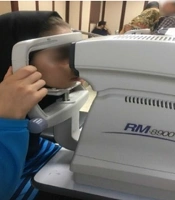
Assar S, Rahavi Ezabadi R, Shojaei Baghini A, Maleksabet N. The Relationship Between Reaction Time, Eye-Hand Coordination with Visual Field in Elite Table Tennis Players. Asian J Sports Med. 2022;13(2):e115787. doi: https://doi.org/10.5812/asjsm-115787
Last Update: 1 month ago
Last Update: 1 month ago
Last Update: 1 month ago
Last Update: 6 days ago
Last Update: 10 hours ago
Last Update: 4 days ago