Journal of Motor Control and Learning
An International Journal of Movement Science
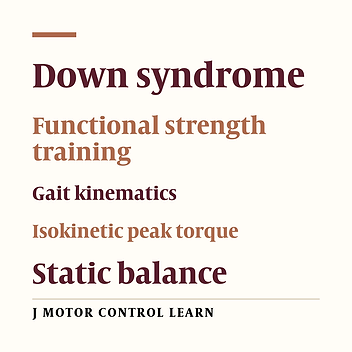
Effect of Functional Strength Training on Gait Kinematics, Muscle Strength and Static Balance of Young Adults with Down Syndrome
Authors
Abstract
Background: Atypical gait pattern is one of the most important motor impairments in individuals with Down syndrome.
Objective: This study aimed to evaluate the effect of functional strength training on gait kinematics, isokinetic peak torque, and static balance of adults with Down syndrome.
Methods: Thirteen men with Down syndrome from the Iran Down Syndrome Association participated in this study. The kinematics variable, isokinetic peak torque, and static balance were assessed by motion analysis, isokinetic dynamometer, and Standing Stork Test respectively before and after completing the training study. All subjects were allocated to experimental (Mage = 28.75±6.1; n = 7) and control (Mage = 30±8.5; n = 6) groups according to their desire to participate, or not, in the training program. The exercise protocol consisted of 6-week functional strength training (treadmill walking and step up/down training) for the experimental group. One-Way ANCOVA Independent test was employed for data analysis.
Results: The results revealed that the functional strength training improved step length, walking velocity, ankle and knee ROMs (range of motion in the sagittal plane), isokinetic peak torque of lower extremities, and static balance. However, no significant difference occurred in step width and hip ROMs.
Conclusion: These findings reinforce previous research showing that task-oriented training with respect to the principle of specificity of training promotes movement patterns in individuals with Down syndrome.
Highlights
Copyright
© 2020, Journal of Motor Control and Learning. This open-access article is available under the Creative Commons Attribution-NonCommercial 4.0 (CC BY-NC 4.0) International License (https://creativecommons.org/licenses/by-nc/4.0/), which allows for the copying and redistribution of the material only for noncommercial purposes, provided that the original work is properly cited.
Similar Articles
The Effect of a Physical Exercise Package on the Motor Proficiency of Students with Down Syndrome
Kashi A, Dawes H, Mansoubi M, Sarlak Z. The Effect of a Physical Exercise Package on the Motor Proficiency of Students with Down Syndrome. Inn J Pediatr. 2023;33(1):e120408. doi: https://doi.org/10.5812/ijp-120408
A comparative study on the effects of aerobic walking and strength training programs on balance in patients with knee osteoarthritis
Delkhoush CT, Fatemi E, Ghorbani R. A comparative study on the effects of aerobic walking and strength training programs on balance in patients with knee osteoarthritis. koomesh. 2022;24(1):e154096. doi:
The Effect of Two Methods of Motor Program and Computer Games on the Fine Motor Skills in Children with Down Syndrome Disorder
Hashemi A, Arab Ameri E. The Effect of Two Methods of Motor Program and Computer Games on the Fine Motor Skills in Children with Down Syndrome Disorder. J Motor Control Learn. 2019;1(1):e146434. doi: https://doi.org/10.29252/ijmcl.1.1.53
Comparing the Effects of NASM-Based Exercises and Common Interventions on Functional Balance in Children with Spastic Diplegic Cerebral Palsy
Kargarfard E, Moghadas Tabrizi Y, Zandi S, Minoonejad H, Amini M. Comparing the Effects of NASM-Based Exercises and Common Interventions on Functional Balance in Children with Spastic Diplegic Cerebral Palsy. J Motor Control Learn. 2024;6(4):e148151. doi: https://doi.org/10.5812/jmcl-148151
The Effect of Isometric Exercise on Pain Severity and Muscle Strength of Patients with Lower Limb Fractures: A Randomized Clinical Trial Study
Khosrojerdi H, Tajabadi A, Amadani M, Akrami R, Tadayonfar M. The Effect of Isometric Exercise on Pain Severity and Muscle Strength of Patients with Lower Limb Fractures: A Randomized Clinical Trial Study. Med Surg Nurs J. 2018;7(1):e68104. doi: https://doi.org/10.5812/msnj.68104
- Scopus by DOI: 0
Last Update: 1 month ago
- Scopus by Title: 0
Last Update: 1 month ago
- Scopus by Title (Ref): 0
Last Update: 1 month ago
- CrossRef: 0
Last Update: 6 days ago
- OpenAlex: 8
Last Update: 10 hours ago
- OpenCitations: 2
Last Update: 4 days ago