
1. Background
Today, societies are seeking to increase the standard of living and quality of life and life without limitation. Disability is a major public health strategy in advanced countries. Fractures are one of the problems people have been facing for ages and today they have been increased more than ever due to the industrial structure of the societies and the increase of vehicles (1). The fracture of the lower limb comprises one-third of the total fractures and can lead to death and disability (2). Men in the age of 30 - 36 and women in the age of 50 - 60 have the highest frequency of fractures (3). Orthopedic surgeries can cause severe pain (4). Effective management of postoperative pain is now part of the surgical process, which not only makes the patient comfortable but also reduces mortality (5).
Inadequate postoperative pain relief can lead to long recovery, prolonged hospitalization, increased hospital costs, and reduced patient satisfaction, and if it is not treated, problems such as increased postoperative bleeding, increased oxygen consumption, and increased infarction will occur (6). About 80% of patients experience moderate to severe pain after surgery (7). Approximately, 53 million surgical procedures are performed annually in the United States, with 30% of the patients suffering from mild pain, 30% moderate pain, and 40% severe pain after the operation (8). For centuries, physicians have been using narcotic drugs to reduce acute pain, but their side effects, such as respiratory suppression, nausea and vomiting, constipation, seizure, and possibly addiction, reduce their effective usage (9).
It is unclear why little progress has been made in the treatment of postoperative pain, but its causes may be several factors, including inadequacy of assessment and the effect of pain, lack of specific post-surgical pain written instructions, deficiencies in programs for pain management training for healthcare workers, low utilization of inefficient techniques, and weak adherence to existing strategies (10).
Today, the use of multi-model pain relief is recommended for the effective control of postoperative pain (11). One of the effective methods for reducing postoperative pain in fractures is the use of isometric movements. By using physical, mechanical, special techniques, and medical exercises associated with the knowledge of muscle anatomy, joints, and nerves, one can reduce muscle and joint pains, muscle spasm, inflammation and swelling and accelerate the process of tissue repair, patient independence, as soon as possible, and prevention of recurrence (12). The motion of the patient’s limb after a fracture in a constant condition causes the joints of that limb to move, thereby causing dryness and limitation of movement, that is, after the fracture and discharging of the patient from the hospital, it is possible even by performing physiotherapy exercises, joint movements cannot return to the initial state (13). Motionlessness causes muscle weakness and atrophy. After fracture fusion, the patient must perform long-term medical exercises so that his/her muscle strength reaches the pre-fracture level. The least problem is the length of treatment. After fracture surgery, the patient can move the joints, causing the muscles of the organ to move through the therapy (14).
Studies have shown that only six months after a proximal femoral fracture, only half of the subjects got their previous performance (15). Motor constraints are very common and are mostly due to muscle weakness, with a break in the strength as 20% less than the strength of a healthy foot in the period of 3 - 36 months after the fracture (16). Another study suggests that people with hip fractures who had isometric exercises and some types of physiotherapies physically improved faster and experienced a higher quality of life (17). Post-fracture pain can delay the recovery process and cause an interruption in supportive care and walk. A study found that nerve stimulation through the skin significantly reduced pain and improved patient function (18).
Considering the use of multidimensional analgesics for their effective pain control, and also the need for rapid return of the patient to the pre-fracture condition in order to prevent more damage and more lifespan, the aim of this study was to investigate the effect of isometric movements on pain relief and reversing muscle strength in patients undergoing a fracture surgery in lower extremities.
2. Methods
This study is a parallel two-group pretest-posttest single-blind clinical trial registered with code IRCT2015070216221N3. The research population consisted of patients aged 15 - 49 who suffered from lower limb fractures admitted to Shahid Beheshti hospital in Sabzevar in 2016-2017. The inclusion criteria were all patients with lower limb trauma aged 15 - 49 years old. The exclusion criteria included a history of surgery, addiction, diabetes, cardiovascular and other chronic diseases. This study was approved by the ethics committee of research and technology of Sabzevar University of Medical Sciences (IR code medsab.rec.1394.38). The ethical considerations included the following: getting informed consent from patients, explaining the goal of the study and its advantages and disadvantages to them, and ensuring the confidentiality of information. The data-gathering tools were a questionnaire and two scales for the measurement of pain and muscle strength. Demographic data of the research units were recorded in the questionnaire. To measure the pain, the numeric pain rating scale (NPRS), which is a unidimensional measure of pain intensity in adults, was used. The respondent selects a number (0 - 10) that reflects the intensity of his/her pain with the score ‘0’ representing no pain to the score ‘10’ representing pain as bad as possible or worst pain imaginable (19). Construct validity showed NPRS is highly correlated with the VAS, with correlations ranging from 0.86 to 0.95, along with a good reliability (Intra-rater reliability = 0.74, test-retest r = 0.70, and Cronbach’s alpha = 0.88) (20). The muscle strength was evaluated by a physiotherapist using a standard scale of manual muscle. The muscle strength is rated on a five-point scale as normal, good, moderate, weak, and poor.
The patients were selected by convenience sampling and divided into two intervention and control groups by random allocation using four-way perverted blocks. To obtain the sample size, based on previous studies (21) and 95% confidence interval, 54 people were calculated for each group. With the probability of 12% attrition rate, this number increased to 60 in each group. Therefore, finally, 60 patients were entered in the intervention group and 60 patients in the control group.
Data collection was cried out with interviews with patients and physicians, as well as extraction from medical records. The patients were asked questions about the history of the disease and the underlying diseases. Four hours after the surgery, as a pretest, the severity of pain was assessed by a person and muscle strength by a skilled physiotherapist while both assessors were blinded to patient allocation. Then, the first session of physical therapy was performed by the physiotherapist as isometric motion in half an hour for the affected organ in the intervention group. The next sessions consisted of four times of isometric exercise per day for five consecutive days while each time it took 30 minutes. The severity of pain and muscle strength of the affected organ was assessed at the end of the last session as a posttest. There was no intervention in the control group and only the severity of muscle pain and muscle strength was evaluated four hours after the surgery and similar to the intervention group on the fifth day of operation. Data were analyzed by STATA version 11 software with t-test, exact Fisher, Wilcoxon, Mann-Whitney, and covariance. The significance level was considered 0.05. To describe the quantitative variables, we used the mean and standard deviation. In this study, physical therapy was managed by a skilled physiotherapist in the intervention group and another person as assessor evaluated the severity of pain and muscle strength in all patient of the two groups who were blind to the allocation of patients in the two groups. Data analyzer was also blinded.
3. Results
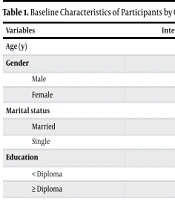
According to the findings, the most patients in the intervention group were in the age of 49 - 40 years old and about 83% were male. In the control group, the highest frequency belonged to the age of 30 - 39 years and 85% of the participants were male. There were no significant differences between the two groups based on demographic characteristics (Therefore, Therefore, the research groups were homogeneous.
Table 1.
Baseline Demographic Characteristics of Patients with Lower Limb Fractures in the Intervention and Control Groupsa
| Variable | Intervention Group | Control Group | P-Value |
|---|---|---|---|
| Age | 36.8 ± 3.5 | 31.4 ± 2 | 0.054 |
| Gender | 0.803 | ||
| Male | 50 (83.3) | 51 (85) | |
| Female | 10 (16.67) | 9 (15) | |
| Marital status | 0.709 | ||
| Single | 25 (41.65) | 23 (38.33) | |
| Married | 35 (58.33) | 37 (61.67) | |
| Job | 0.102 | ||
| Vacancies | 17 (28.33) | 15 (25) | |
| Government | 3 (5) | 12 (20) | |
| Unemployed | 8 (13.33) | 7 (11.67) | |
| Student | 32 (53.33) | 26 (43.33) |
a All values represented as No. (%) or Mean ± SD
Table 2.
Comparison of Mean ± SD of Pain Severity before and after the Intervention in the Two Groups
| Group | Before, Mean ± SD | After, Mean ± SD | Test | P-Value |
|---|---|---|---|---|
| Intervention | 6.86 ± 1.18 | 2.86 ± 1.39 | Wilcoxon | < 0.001 |
| Control | 6.3 ± 0.96 | 5.1 ± 1.00 | Wilcoxon | < 0.001 |
| P-value (test) | 0.004 (Mann U Whitney) | < 0.001 (Mann U Whitney) | Covariance | < 0.001 |
Table 3.
Comparison of Muscle Strength in Research Units after Isometric Movementsa
| Group | Muscle Strength | P-value | ||||
|---|---|---|---|---|---|---|
| Normal | Good | Moderate | Weak | Poor | < 0.001 (Fischer’s exact test) | |
| Intervention | 27.00 (45) | 32.00 (53.33) | 1.00 (1.67) | 0.00 (0) | 0.00 (0) | |
| Control | 3.00 (5) | 6.00 (10) | 39.00 (65) | 12.00 (20) | 0.00 (0) | |
a All values represented as No. (%)
The two groups had a significant difference in pain score before and after the intervention (P < 0.001), and the difference between the mean of the two groups was meaningful while the covariance test confirmed this meaningfulness (P < 0.001).
After the intervention, in the experimental group, muscle strength was about 53% at a "good" level, but in the control group, it was 10% and 65% of the patients reported the muscle strength at a "moderate" level. There was a statistically significant difference between the two groups in muscle strength after the intervention (P < 0.001). Therefore, isometric movements improved muscle strength in the affected limb.
4. Discussion
The most important physiotherapy goals of patients with orthopedic problems are pain relief, reduced edema and joint swelling, increased joint range, flexibility of the tissue, muscle weakness prevention and muscle atrophy in the early stages, and strengthening the muscles, improving balance, enhancing coordination and creating programs for motor control in later stages (22).
According to the results of this study, the physiotherapy and isometric movements of the lower limb fractures at the first postoperative time reduced the pain and increased reverse muscle strength. Isometric movements caused constant contractions in the muscles without movement and change in the articular angles. Muscle contraction on the one side of the body causes analgesia on the other side of the body expresses the central response to pain relief (23).
The results of this study are consistent with the results of some studies. For example, Rhyu et al. (21) after isometric movements for 6 weeks and three times a week concluded that performing physiotherapy and isometric movements reduced back pain and increased the function. In a research study conducted in Isfahan in 2008, it was concluded that isometric movements were effective in reducing lumbar and pelvic pain in pregnant women (24). Asgari Ashtiani et al. carried out a research, concluding that isometric exercises were effective in reducing chronic neck pain (25). In the year 2013, Qhasemi in Tehran, during a research, investigated the effect of current physiotherapy training on pain, disability, and muscular endurance in women with chronic low back pain, which showed a positive effect on pain and disability reduction and muscle endurance (26). Ojoawo et al. (2016) also argued that isometric contraction of the muscle leads to increased strength and productive power of patients with knee osteoarthritis (27). Goebel et al. (28) in the study of patients after anterior knee ligament repair surgery performed physiotherapy and isometric contractions for 30 minutes and 5 days a week. They concluded that this procedure would enhance the strength of the quadriceps muscle that was weakened by the anterior cruciate ligament repair.
However, some similar studies did not achieve significant effective results. In the study of 9 low back pain patients (29) and also another study in 97 low back pain patients (30), no significant differences were observed between the two groups (Physiotherapy and control). This insignificance can be due to fewer sessions and less time duration of physiotherapy compared to the current study. In addition, the sample sizes were less in these studies than in our study.
According to the results of the current study and other similar studies, rehabilitation interventions, including isometric exercises, can reduce pain, and improve the functional status of patients. Therefore, rehabilitation is the most important part of the treatment of fractures, which begins immediately after treatment. Therefore, it seems that the initiation of rehabilitation programs in patients with fractures immediately after initial treatment interventions should be emphasized.
In this study, isometric exercise was effective in pain relief and reverse muscle strength of patients with lower limb fracture. Physiotherapy and isometric movements in patients with lower limb fracture can be recommended by orthopedic physicians. Further research on other patients with different fractures and considering other rehabilitation interventions are suggested.