
1. Background
Decreased interest and motivation among adolescent girls toward physical activity and motor skill acquisition in school settings is a complex phenomenon influenced by psychosocial, cultural, and pedagogical factors. Research indicates that upon entering adolescence, girls experience a significant decline in physical activity participation, often due to anxiety about peer judgment, body image concerns, or curricular misalignment with gender-specific interests and developmental needs. In addition, educational environments that emphasize competition and individual performance have been found to undermine girls’ intrinsic motivation and hinder their engagement in motor skill learning (1). This issue is further exacerbated by the lack of visible female role models in physical education and by entrenched traditional attitudes among instructors, which may reinforce this motivational decline (2). Therefore, implementing gender-responsive curricula, fostering non-competitive and psychologically safe learning environments, and enhancing movement-related self-efficacy are essential strategies to rekindle adolescent girls’ motivation and sustain their engagement in physical activity and motor skill development.
In recent years, numerous studies have sought to enhance the teaching and learning of motor skills. Among the most recent and influential contributions is the OPTIMAL theory of motor learning, which identifies three key variables for optimal motor skill acquisition: enhanced expectations, autonomy, and an external focus of attention. The first two factors are motivational, whereas the third is attentional. Enhanced expectations trigger dopamine responses that anticipate positive experiences; learner autonomy fosters heightened expectations; and an external focus promotes efficient performance by facilitating connections across brain networks involved in skilled movements (3). Both enhanced expectations and an external focus facilitate cognitive and motor systems, preventing lapses into self-focused states (3). Expectations transfer individuals’ experiential histories into new contexts and involve cognitive or predictive beliefs about forthcoming events. Successful experiences generate positive expectations that support learning progress. Positive feedback is one method of enhancing expectations for future success and improving performance during practice by optimizing attentional, motivational, and motor preparation processes (3).
Humans tend to seek positive information about themselves, such as positive feedback regarding performance, sports, or physical abilities (4). Individuals’ implicit knowledge regarding motivation, performance, and learning indicates a preference for positive over negative states. It also suggests that increasing the frequency of positive feedback leads to improved motor performance during practice and, consequently, better learning (4). While OPTIMAL theory posits that increased positive expectations via positive feedback generally enhance performance and learning, reinforcement learning theories propose that the experience of reward contingent on successful performance drives learning (5). This implies that learners prefer to receive feedback following good and correct repetitions, and that providing feedback after relatively successful trials can enhance motor learning.
The second motivational factor in OPTIMAL theory is learner autonomy, which involves allowing learners to use aids (6), arrange the use of tools (7), determine the amount of practice, or decide the spacing of practice repetitions (8). This autonomy increases performers’ willingness to complete more repetitions, promotes more effective learning than other factors, enhances engagement, and leads to more adaptable learning behaviors. Research has shown that even random or irrelevant task-related choices can enhance learning benefits (4). For instance, Carter and Ste-Marie found that making task-relevant choices improves retention and transfer of motor skills compared with making irrelevant choices (9). These findings are consistent with Lewthwaite et al., who suggested that even incidental choices during motor learning can positively affect skill acquisition, primarily through enhanced learner autonomy (10). Allowing individuals to exert control over their environment not only fulfills a basic psychological need (11) but may also be a biological necessity (12). Even when an individual’s effects are minimal, motivation increases because of their control and influence over these effects. Therefore, conditions that provide opportunities for choice may be highly motivating.
According to another study, motivational factors, particularly those supporting intrinsic motivation and the satisfaction of basic psychological needs, play a critical role in performance and learning across domains beyond physical movement. Motivation is a multifaceted construct that encompasses the energy, direction, and intensity of behavior. Behavior is shaped by a wide range of factors, including social and environmental contexts, as well as individuals’ cognitive appraisals and emotional responses. Motivation to engage in a task develops when anticipated future outcomes foster positive expectations and individuals perceive themselves as autonomous agents capable of attaining those outcomes. Motivational processes may function either implicitly or explicitly (13).
Research indicates that when learners engage in tasks they find enjoyable or relevant, their performance improves significantly, particularly when combined with positive feedback that enhances self-efficacy (14). For example, in studies in which participants received encouraging feedback alongside engaging tasks, they not only demonstrated superior skill mastery but also reported higher levels of interest and motivation to continue practicing (14). This suggests that the interaction between task enjoyment and motivational feedback creates a more conducive learning environment, ultimately leading to better long-term retention of motor skills. Therefore, understanding how to effectively integrate task choice with motivational feedback is crucial for designing training programs that maximize skill acquisition outcomes.
2. Objectives
In this study, we focused on the motivational factors of OPTIMAL theory, specifically enhanced expectancies and autonomy. The present study aimed to investigate the combined effects of positive feedback, which is expected to enhance learners’ expectancies of success, and task choice, which promotes autonomy, on motivation and motor skill acquisition. Specifically, we examined whether providing learners with task choice in conjunction with positive feedback for successful attempts would produce greater improvements in motivation and skill acquisition than conditions without task choice.
3. Methods
3.1. Study Design and Outcomes
This study employed a randomized controlled pretest-posttest design with six parallel groups and was conducted over a two-month period. Participants completed pre-test and post-test assessments. The primary outcome was motor skill acquisition, operationalized as the change in golf putting performance from pre-test to post-test. The secondary outcome was motivation, assessed using the Sanchez-Oliva questionnaire.
3.2. Participants and Sampling
Ninety female students (mean age, 14 ± 2 years) attending middle schools in one of the cities of Tehran province were enrolled in this study. Participants were randomly assigned to six groups of 15 using a computer-generated random number table. All participants were right-handed.
Participants were selected using random sampling. The inclusion criteria were right-handedness, no previous experience in golf, and complete physical health. Accordingly, left-handed volunteers, those with golf experience, and those with injuries were excluded. The remaining 90 female students (mean age, 14 ± 2 years) were randomly divided into 6 groups of 15.
3.3. Apparatus and Task
Participants performed golf putting toward a dartboard-like target positioned 3 meters away. Points were awarded based on ball placement within concentric circles (Figure 1).
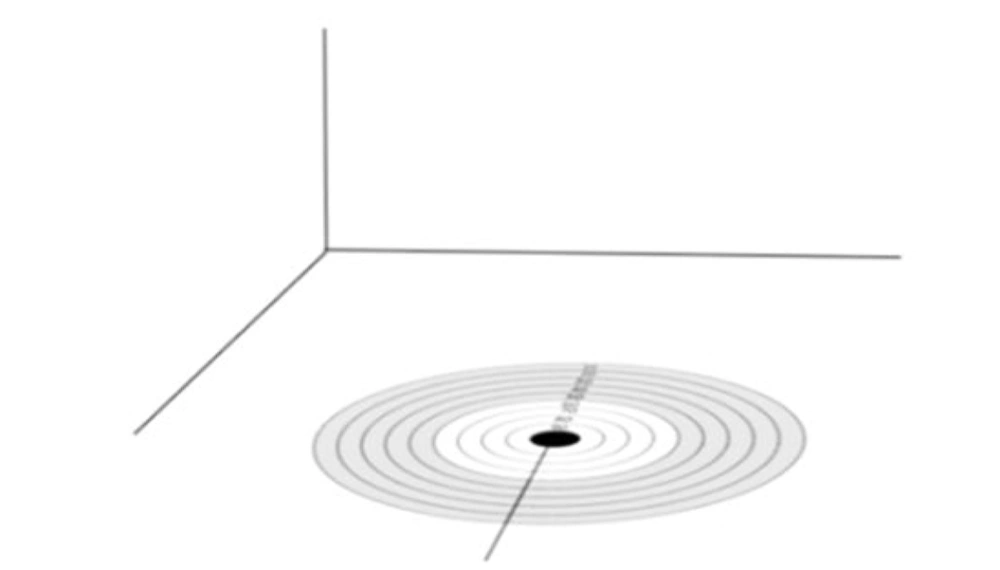
Figure 1.
Ball Putting test (the target consists of ten concentric circles; the diameter of the largest circle is 100 cm, and the diameters of the subsequent circles are 90 cm, 80 cm, and so on.)
Motivation Questionnaire: This questionnaire, developed by Sanchez and Oliva in 2012, consists of 20 items assessing different types of motivation: intrinsic motivation (4 items; e.g., "Because physical education is fun"), identified regulation (4 items; e.g., "Since this subject gives me knowledge and skills, it is necessary to feel good about myself"), extrinsic regulation (4 items; e.g., "To show my interest in the subject to the teacher and classmates"), and amotivation (4 items; e.g., "I really feel like I am wasting my time with this subject"). Participants indicated their level of agreement on a five-point Likert scale ranging from "strongly disagree" (1) to "strongly agree" (5). The questionnaire's Cronbach alpha coefficient was 0.7.
3.4. Procedure
Participants hit a ball from a distance of 3 meters toward a target placed on an artificial turf field. The target consisted of concentric circles: the central circle measured 10 cm in diameter, and the subsequent nine circles measured 20 cm, 30 cm, 40 cm, and up to 100 cm in diameter. If the ball landed in the center of the target, 10 points were awarded; the next circles corresponded to 9, 8, and so on, respectively. If the ball landed between two scoring zones, the higher score was awarded. If the ball landed completely outside the target, it received zero points. The target was projected onto the artificial turf field from above using a projector.
Initially, the examiner taught the correct technique for hitting the ball, including how to strike the ball with the racket and the appropriate body angle. At the beginning of the study, before the pre-test for baseline evaluation, all participants completed a motivation questionnaire (15). Subsequently, during the pre-test, all participants performed 10 putts at the target, after which they were randomly divided into six groups. The scores from the 10 putts were recorded for each participant.
1) Group with Positive Feedback for Successful Attempts (CPFSAG): In this group, participants could choose from different balls and golf clubs of various sizes. After successful attempts, they received positive feedback, such as "Well done! You got closer to the target than in your previous putts, or you scored higher."
2) Group with Positive Feedback for Unsuccessful Attempts (CPFUAG): In this condition, participants did not receive feedback for successful attempts but were given positive feedback for unsuccessful attempts. For example, "You made fewer errors compared to your previous unsuccessful attempt" or "Great job executing the correct technique."
3) Group Without Feedback (CNFG): Participants in this group did not receive any feedback on their attempts; they only selected their own equipment.
4) Group Without Choice, Positive Feedback for Successful Attempts (NCPFSAG): In this scenario, participants were required to use the provided equipment and received feedback similar to that given to Group 1.
5) Group Without Choice, Positive Feedback for Unsuccessful Attempts (NCPFUAG): In this group, participants used the provided equipment and received positive feedback even for unsuccessful attempts.
6) Group Without Choice, No Feedback (NCNFG): Members of this group did not receive any feedback and had no option to select their equipment.
During the acquisition phase, participants in each group performed 50 putts at the target and received feedback according to their assigned condition. Different-colored balls and rackets of varying lengths were provided, allowing participants in the choice groups to select their preferred equipment. Participants in the non-choice groups were provided with one ball and one racket at the start. In addition, because participants were to receive feedback after their putts, the concentric circles projected as targets were made invisible during practice to ensure that participants remained unaware of their putting results and were influenced solely by the feedback. However, these circles reappeared during evaluation (16). Participants were allowed to view the target before each of the three tests (17). At the end of the acquisition phase, all participants completed the motivation questionnaire again after receiving positive feedback to assess the impact of the training and feedback. Feedback was provided after every 5 trials (i.e., 10 feedback instances during the 50-trial acquisition phase) to avoid feedback dependency.
In the post-test phase, all participants performed 10 putts without receiving any feedback, and the examiner recorded their putting scores. Finally, participants' scores from both the pre-test and acquisition phases, along with their questionnaire responses, were compared. Motor skill acquisition was defined as the improvement in golf-putting accuracy from pre-test to post-test, measured by the total points scored across 10 trials.
An attempt was classified as successful if the ball landed within the top 3 scoring zones (8 - 10 points, i.e., ≤ 40 cm from the center); attempts landing outside this range were classified as unsuccessful. All feedback was delivered by the same trained examiner following a standardized protocol. Examiner blinding to group assignment was not feasible due to the nature of the intervention, but outcome assessors for the post-test were blinded to group allocation.
3.5. Data Analysis
Statistical analyses were performed using IBM SPSS Statistics (version 27.0; IBM Corp., Armonk, NY, USA). Before inferential analyses, the assumptions of normality and homogeneity of variances were assessed using the Shapiro-Wilk and Levene tests, respectively. As these assumptions were satisfied, a 6 (group) x 2 (time) mixed ANOVA was conducted to examine differences in the dependent variables across groups and measurement occasions. When significant main or interaction effects were observed (P < 0.05), Bonferroni-adjusted post hoc comparisons were performed to identify specific pairwise differences while controlling for the family-wise error rate.
4. Results
4.1. Motivation
The results for motivation are presented in Table 1. Significant main effects of time and group, as well as a significant time x group interaction, were observed, indicating that changes in motivation from pre-test to post-test differed among the experimental groups. Therefore, Bonferroni-adjusted post hoc comparisons were conducted, and the results are reported in Table 2.
Table 1.
Results of the Mixed ANOVA for the Motivation Variable
| Source | Sum of Squares | Df | Mean Square | F | P-Value | η2 |
|---|---|---|---|---|---|---|
| Time | 372.672 | 1 | 372.672 | 40.971 | 0.000 | 0.33 |
| Time x group | 1626.761 | 5 | 325.352 | 35.769 | 0.000 | 0.50 |
| Group | 764.067 | 5 | 152.813 | 16.80 | < 0.001 | 0.68 |
| Error | 764.07 | 84 | 9.096 | - | - | - |
Table 2.
Results of the Bonferroni Post Hoc Test Assessing Within-Group Effects on Motivation a
| Group | Mean Difference (Pre-test - Post-test) | P-Value |
|---|---|---|
| CPFSAG | 9.13 | 0.001 |
| CPFUAG | 7.80 | 0.001 |
| CNFG | 1.20 | 0.837 |
| NCPFSAG | 7.47 | 0.001 |
| NCPFUAG | -8.07 | 0.001 |
| NCNFG | -0.27 | 0.999 |
a Significance level: P ≤ 0.05. Abbreviations: CPFSAG, Choice + positive feedback + successful attempt; CPFUAG, choice + positive feedback + unsuccessful attempt; CNFG, choice + no feedback; NCPFSAG, no choice + positive feedback + successful attempt; NCPFUAG, no choice + positive feedback + unsuccessful attempt; NCNFG, no choice + no feedback.
The post hoc analyses showed that motivation increased significantly from pre-test to post-test in the CPFSAG and CPFUAG groups, as well as in the NCPFSAG group. In contrast, motivation decreased significantly from pre-test to post-test in the NCPFUAG group. No significant changes were observed in the CNFG and NCNFG groups.
4.2. Putting Performance
The results for putting performance are presented in Table 3. Significant main effects of time and group, together with a significant time x group interaction, were found (Table 3).
Table 3.
Results of the Mixed ANOVA for Putting Task Performance
| Source | Sum of Squares | Df | Mean Square | F | P-Value | η2 |
|---|---|---|---|---|---|---|
| Time | 897.800 | 1 | 897.800 | 122.427 | 0.000 | 0.60 |
| Time x group | 1551.200 | 5 | 310.240 | 42.305 | 0.000 | 0.34 |
| Group | 616.000 | 5 | 123.200 | 16.80 | < 0.001 | 0.09 |
| Error | 1551 | 84 | 18.46 |
Accordingly, Bonferroni-adjusted post hoc comparisons were performed, and the results are summarized in Table 4. The results revealed that putting performance during successful attempts improved significantly from pre-test to post-test in the CPFSAG, CNFG, NCPFSAG, and NCNFG groups. In contrast, performance during unsuccessful attempts declined significantly from pre-test to post-test in the CPFUAG and NCPFUAG groups (Table 4).
Table 4.
Results of the Bonferroni Post Hoc Test Assessing Within-Group Effects on Motor Task Learning a
| Groups | Mean Difference (Pre-test - Post-test) | P-Value |
|---|---|---|
| CPFSAG | 13.87 | 0.001 |
| CPFUAG | -2.93 | 0.001 |
| CNFG | 7.20 | 0.001 |
| NCPFSAG | 6.07 | 0.001 |
| NCPFUAG | -2.80 | 0.017 |
| NCNFG | 5.40 | 0.001 |
a Significance level: P ≤ 0.05. CPFSAG, Choice + positive feedback + successful attempt; CPFUAG, choice + positive feedback + unsuccessful attempt; CNFG, choice + no feedback; NCPFSAG, no choice + positive feedback + successful attempt; NCPFUAG, no choice + positive feedback + unsuccessful attempt; NCNFG, no choice + no feedback.
5. Discussion
The findings of this study emphasize the vital roles of autonomy and positive reinforcement in motor skill acquisition. The results indicate that learners who have opportunities to make choices during practice, coupled with receiving positive feedback after successful attempts, experience greater motivation and demonstrate improved performance. Conversely, providing feedback after unsuccessful attempts appears to diminish both motivation and skill development. These insights align with OPTIMAL theory and underscore the importance of enhancing expectancies and fostering autonomy to optimize learning outcomes (18).
The positive effects of autonomy on motivation in educational psychology are well documented. When language learners are allowed to choose their tasks, they are more likely to develop a sense of ownership over their learning process, which can increase intrinsic motivation (19). In our study, the group that received positive feedback after successful attempts not only reported higher motivation but also demonstrated superior performance in executing golf strokes. This finding is consistent with previous research suggesting that positive reinforcement enhances skill acquisition by fostering a supportive learning environment. Additionally, studies have shown that when learner autonomy is supported, individuals experience a sense of integrity that helps them understand their actions, thoughts, and feelings, thereby increasing motivation. In contrast, when autonomy is undermined, individuals may experience pressure and threatening situations, such as feelings of rejection, which can reduce motivation (20).
By contrast, feedback provided after unsuccessful attempts appears to reduce both motivation and skill development. This observation aligns with existing literature indicating that negative feedback can elicit frustration and reduce self-efficacy, ultimately hindering performance. The detrimental effects of negative feedback on motivation and learning outcomes underscore the importance of carefully evaluating the types of feedback used in educational and training environments (21).
Our results underscore the critical role of positive feedback in motor skill acquisition. These findings align with those of McKay and Wulf, who concluded that increasing individuals' overall expectations regarding performance can positively affect their motor abilities. Providing positive feedback after successful attempts during execution leads to enhanced observed performance through self-regulatory processes such as emotional regulation, goal setting, increased effort, and focused attention (22).
Zhou and colleagues found that providing feedback with choice options led to better learning outcomes and reduced the time required to complete tasks during retention and transfer tests compared with a control group (23). This suggests that autonomy enhances emotional neural responses and improves participants' overall sense of agency or capability, which has been shown to strengthen competence, self-efficacy, and motor learning (24). Additionally, self-controlled practice conditions generally align more closely with learners' needs and preferences than externally imposed conditions, resulting in more efficient processing of task-related information (25). This finding is particularly relevant in youth sports and physical education, where fostering a positive learning environment is crucial for skill development and long-term engagement in physical activities. The increased motivation and skill acquisition observed in the choice + positive feedback group indicate that such strategies can be effectively implemented in coaching practices to optimize training outcomes.
Future research should explore the implications of these findings across a broader range of motor tasks and more diverse learner populations. Understanding how different types of feedback interact with levels of autonomy across contexts will be essential for developing more effective educational strategies in motor learning.
Additionally, investigating the long-term effects of autonomy and positive feedback on skill retention and transfer could provide valuable insights for sports professionals and educators.
5.1. Study Limitations
This study has some limitations. First, the sample was limited to adolescent females, and results may differ for males or other age groups. Second, only a single motor task, golf putting, was examined. Third, long-term skill retention was not assessed. Future research should address these issues.
5.2. Conclusions
In conclusion, this study reinforces the importance of autonomy and positive reinforcement in acquiring motor skills and aligns with the principles of OPTIMAL theory. Coaches and educators who prioritize learner autonomy and focus on providing positive feedback after successful attempts can enhance motivation and performance in motor learning contexts. Task choice and positive comparative feedback following successful attempts enhanced both motivation and motor skill acquisition, whereas positive comparative feedback following unsuccessful attempts was associated with reduced motivation and poorer performance. These findings support the view that enhanced expectancies and autonomy facilitate motor learning by strengthening motivation and self-regulation. However, the results do not suggest that feedback after failure is inherently ineffective. Rather, the effectiveness of feedback appears to depend on its valence, timing, and the autonomy afforded to learners. Future research should examine how these factors interact across different motor tasks and learner populations.