Fulltext
The body of the article can be found in the PDF file.
Journal of Medical Education for Future Demands
Former Title: Journal of Medical Education | The Official Journal of School of Medical Education and Learning Technologies
Image Credit:J Med Edu
Authors
Background and purpose: Training in basic clinical and procedural skills is considered an important part of the core medical undergraduate curriculum. There are some reasons to assume that junior doctors are not adequately trained in these skills. Due to the lack of enough information on skills competence of our students, this study was designed in 3 medical schools in southern Iran to evaluate whether students expectations of current training programs are fulfilled.Method: The subjects of this study were 7th year medical students at Shiraz, Jahrom and Fassa Medical Schools in southern Iran. Through a questionnaire the students were asked to rate the necessity of each procedure (importance rating) and the quality of preparation based on a Likert’s scale (from 1as not at all important or prepared to 5 as very important or well prepared) and also the frequency of doing such procedures during their education.Results: In spite of the fact that the students found such procedures as chest tube insertion, IV cannulation , splinting, joint aspiration, cardiopulmonary cerebral resuscitation, pleural and peritoneal fluid aspiration, pelvic examination, pap smear, phlebotomy, urinary catheterization and supra pubic aspiration very important, they told that they had not been well prepared to do them.Procedural skills that at least 50% of the respondents performed less than 2 times were: chest tube insertion, IV cannulation, splinting, joint aspiration, pleural and peritoneal fluid aspiration, pelvic examination, pap smear, cardio pulmonary cerebral resuscitation and supra pubic aspiration.Conclusion: Training in procedural skills needs to be given more attention and improved in the medical curriculum.
© 2009, Author(s). This open-access article is available under the Creative Commons Attribution 4.0 (CC BY 4.0) International License (https://creativecommons.org/licenses/by/4.0/), which allows for unrestricted use, distribution, and reproduction in any medium, provided that the original work is properly cited.
Hagiabadi MR, Kazemi T. What are the Sources of Learning Medical Skills for Medical Students and Interns of Birjand University of Medical Sciences and Health Services?. J Med Edu. 2008;12(1 & 2):e105370. doi: https://doi.org/10.22037/jme.v12i1,2.18491
Mirzazadeh A, Afshari A. Procedural Skills Training In The Internal Medicine Residency In Iran: A National Survey Of Recent Graduates Of Residency Programs. J Med Edu. 2005;7(1):e105168. doi: https://doi.org/10.22037/jme.v7i1.843
Daffalla-Awadalla Gismalla M, Kaliya-Perumal A, Babeker Habour A, Mohammed MEI. Does perception of clinical competency correlate with perception of training efficiency?. J Med Edu. 2017;16(4):e105595. doi: https://doi.org/10.22037/jme.v16i4.18698
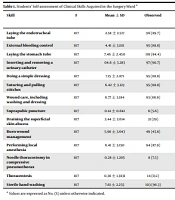
Safabakhsh L, Atashpanjeh A, Moulaei N, Ayubi E, Chahabdar Z. Medical Students' Clinical Skills Compared to Educational Standards at Universities of Medical Sciences: A Self-assessment Study. Zahedan J Res Med Sci. 2022;24(4):e127526. doi: https://doi.org/10.5812/zjrms-127526
Jalili Z, Noohi E, Nakhaee N. The Sources and their Rate of use by Interns for Learning Clinical Skill. J Med Edu. 2006;8(2):e105245. doi:
Last Update: 1 week ago
Last Update: 1 week ago
Last Update: 1 week ago
Last Update: 6 days ago
Last Update: 10 hours ago
Last Update: 5 days ago