
1. Introduction
In today’s world, professional ethics has become an important aspect that should be considered (1). In all organizations, employees are considered valuable assets, and it is expensive to train and prepare them for high-quality performance (2). Human force forms the basis of the healthcare system, and nurses play an essential role in providing care to patients and individuals’ health promotion (3). The managers’ incompetence in handling ethical challenges, the nursing workforce shortage, and the power imbalance between the health staff have created inappropriate ethical conditions (4). On the other hand, the coronavirus disease 2019 (COVID-19) crisis led to a nursing workforce shortage and, subsequently, a decrease in the quality of service provision. Therefore, keeping the motivation of nurses is a serious challenge (5). In general, the work environment is considered a serious challenge for nurses, which can even lead to humiliating behaviors against them (6). A study showed that policymakers need to consider fundamental modifications to increase the motivation of nurses. However, it requires dialogue between managers and nurses (7).
In dynamic organizations, there must be leaders who, in addition to being up-to-date, can consider the needs of employees and reduce their stress (8). Leadership can be considered a process in which a person influences others to achieve their determined goals (9). In nursing leadership, there are several components, such as knowledge, creativity, management, and leadership skills, organizing how to provide nursing care, interdepartmental coordination, and creating a positive atmosphere in the work environment (10). On the other hand, ethical issues are closely related to the nursing profession, and the number of studies in this field is increasing day by day (11).
Leadership style also plays an important role in shaping employees’ experiences. Additionally, the evidence has indicated the positive effect of nursing leadership on improving the work environment, positive outcomes for the patient, and reducing medical errors (12). Leadership has been considered a hot topic for years. For instance, some concepts, such as authentic leadership, transformational leadership, situational leadership, ethical leadership, and servant leadership, were developed (13). The theory of ethical leadership was first developed by Brown, who stated that ethical leadership consists of normatively appropriate behaviors enforced by two-way communication (14). In other words, ethical leadership is designed to manage the behavior of employees and to institutionalize ethical standards in their behavior (15).
Nursing managers are recognized as ethical leaders and play an important role in strengthening ethical behaviors in the nursing profession (16). The approaches adopted by nursing managers have a direct relationship with several components, such as mental health and the quality of work of nurses (17). The awareness of leadership styles in hospitals, which are considered the most important treatment centers in health and treatment networks, can help officials in better management of hospital affairs. Additionally, policymakers would be able to recognize the potential obstacles (18). There is no comprehensive practical guide for nursing managers in this field (19). Furthermore, a systematic review has not been conducted on Iranian nurse managers in this regard. This is the first study to determine the association of ethical leadership with nursing. The present study aimed to determine the association of various factors with ethical leadership in nursing in Iran. Additionally, the assessment of the relationship between ethical leadership and the improvement of clinical services by nurses was another purpose of the current study.
2. Methods
2.1. Data Sources
A systematic review was conducted based on the PRISMA statement (20). The protocol was registered on PROSPERO (CRD42022372753). The PECO (Population, Exposure, Comparison, Outcome) model was utilized to identify the factors related to the research question and the problem (21).
(P) Nurses working in the hospital, (E) use of ethical leadership by nursing managers and coordinators, (C) services or interventions unrelated to ethical leadership, and (O) results or outcomes from previous studies and in the field of the nursing profession in the clinical setting
To answer the research question, databases were searched using the following pattern:
(1) Ethical (Text Word) ethic (MeSH term) OR ethics (MeSH term) OR ethical issues (MeSH term) OR ethical issue (MeSH term) OR situational ethics (MeSH term) OR moral policies.
(2) Leadership (Text Word) OR administration (MeSH term) OR influentials (MeSH term)
(3) Nurse manager (Text Word) OR nurse administrators (MeSH term) OR nurse Executives (MeSH term).
(4) Nursing (Text Word) OR nurse (MeSH term) OR nursing personnel (MeSH term) OR nursing student (MeSH term).
(5) Iran (Text word) OR Islamic Republic of Iran (MeSH term).
(6) 1 and 2 and 3 and 4 and 5.
The search in PubMed, ProQuest, Scopus, SID, and Magiran was restricted to “title/abstract” and “humans”. To minimize the missing relevant data, the Google Scholar search engine was searched, and the snowball method was considered for the included studies, as the resources in the included studies were reviewed in order to reduce the number of missed data. Two authors independently assessed the present articles. First of all, the titles were reviewed. If they were appropriate, the abstract before reading the full text was assessed. If there was any disagreement between the authors, a third author resolved it.
2.2. Study Selection
The observational and qualitative studies were considered eligible and were published in English or Persian up to October 2022. In addition, the primary studies conducted in hospital settings and deemed nurse-focused investigated the correlation between ethical leadership and various aspects of the nursing profession in Iran. The exclusion criteria included studies that only examine ethical leadership and do not refer to nurses. Grey literature that was not published as articles, such as posters related to seminars, statements, class presentations, and organizational projects, did not meet the eligibility criteria.
2.3. Data Extraction
A predetermined data collection form was designed, which consisted of the first author, publication year, reference, study type, participants, mean age, mean experience, assessment tools, and main findings/key points.
2.4. Quality Assessment
For the quality assessment of observational studies, the Strengthening the Reporting of Observational Studies in Epidemiology (STROBE) was used. STROBE consists of a checklist with 22 items (22). The total scores lower than 17 were indicative of low methodological quality. Additionally, Kmet standard criteria were selected for the assessment of qualitative studies, with a maximum score of 20 (23). The total scores lower than 16 could prove the impaired methodological quality.
3. Results
A total of 16 studies were included in the study (Figure 1). The total sample size was 2844. There were 14 descriptive and 3 qualitative studies. The results indicated the association of ethical leadership with moral courage, self-efficacy, turnover, general health, errors, organizational citizenship, moral distress, job satisfaction, stress, risk management, and psychological empowerment in nursing. It was proved that ethical leadership can have a direct impact on nurses’ performance (Tables 1 and 2).
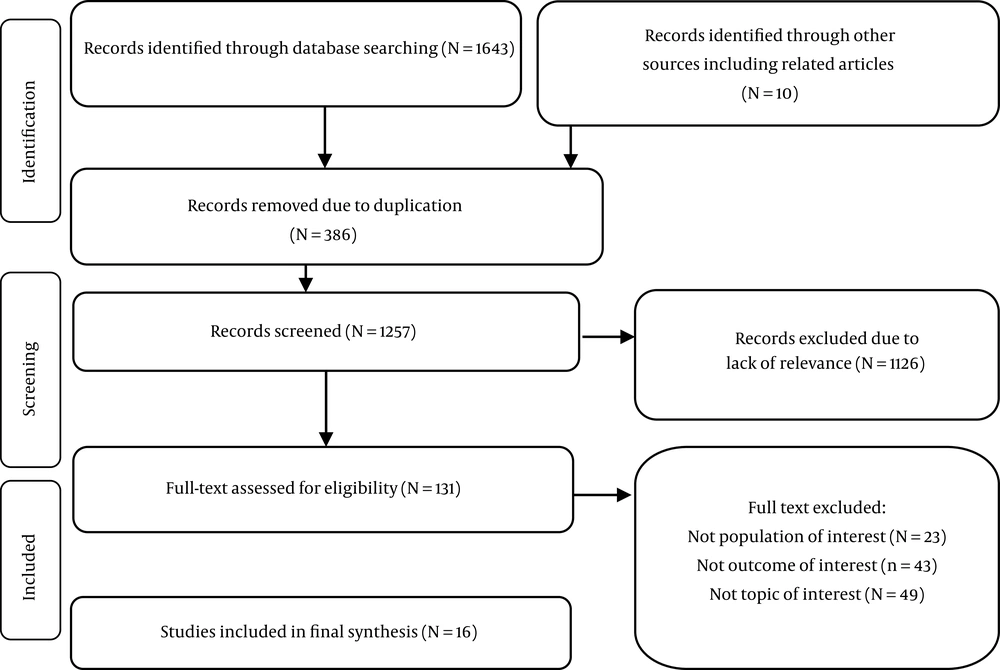
Figure 1.
PRISMA Flowchart of Selected Studies
Table 1.
Included Qualitative Studies on Ethical Leadership in Nursing
| Author, Year, Reference | Sample Size/Gender | Data Collection | Sampling | Length of Interview | QAS | Main Findings/Key Points |
|---|---|---|---|---|---|---|
| Esmaelzadeh et al. (2017) (24) | N = 20, F: 19, M: 1 | Semi-structured interviews | Purposive | 30 - 100 min | 19 | Presence of 5 categories in the area of ethical sensitivity: sensitivity to care, sensitivity to errors, sensitivity in communications, sensitivity in decision-making, and sensitivity to ethical practice |
| Barkhordari-Sharifabad et al. (2017) (25) | N = 14, F: 6, M: 8 | Semi-structured interviews | Purposive | 35 - 90 min | 18 | “Leader as a mentor” and “Professional insight” known as two main categories. Recognition of moral role models of ethical leaders. Identifying organizational atmosphere as another role for ethical nursing leaders. Recognition of professional insight is another characteristic of an ethical nursing leader. Effective role of ethical nursing leaders in the empowerment of personnel |
| Esmaelzadeh et al. (2017) (26) | N = 17 | Semi-structured interviews | Purposive | 30 - 100 min | 18 | Importance of some personal characteristics for ethical leaders. Leadership capability is another property of ethical leaders in nursing management. Recognition of another property known as ethical capability. Moralism, altruism, ethical sensitivity, and ethical courage subcategories for ethical capability |
Abbreviations: QAS, quality assessment score; F, female; M, male.
Table 2.
Included Observational Studies on Ethical Leadership in Nursing
| Authors, Year, Reference | Sample Size/Gender | Mean Age (Y) | Mean Experience (Y) | Assessment Tool | QAS | Main Findings/Key Points |
|---|---|---|---|---|---|---|
| Pakizekho and Barkhordari-Sharifabad (2022) (27) | N = 180, F: 106, M: 74 | 33.93 ± 7.61 | 10.21 ± 9.6 | Ethical Leadership, Conscientiousness, and Moral Courage questionnaires | 20 | A positive and significant relationship between conscientiousness and moral courage with ethical leadership.A significant relationship between conscientiousness and moral courage |
| Sabzehband et al. (2022) (28) | N = 230, F: 166, M: 64 | ≥ 25 | ≥ 1 | Ethical leadership in nursing and the general self-efficacy scale of Scherer | 20 | No significant relationship between ethical leadership and self-efficacy.Higher self-efficacy among intensive care unit (ICU) nurses compared to nurses working in burn units |
| Moghadam and Ranji Jafroudi (2022) (29) | N = 245, F: 196, M: 49 | 31-50 | 1 - 30 | Turnover intent, ethical leadership, and mediation of intrinsic motivation questionnaires | 19 | A significant association between ethical leadership and individual and organizational citizenship and turnover intention.Effective role of intrinsic motivation in affecting the above items |
| Zarezadeh et al. (2021) (30) | N = 205, F: 153, M: 52 | 35.12 ± 5.68 | ≥ 10 | Ethical leadership of Brown, Schwarzer, and Jerusalem self-efficacy and Goldberg’s general health | 19 | A positive association between ethical leadership and self-efficacy among nurses.Lack of positive association between ethical leadership and general health disorder.The higher the experience of nurses, the higher their score for ethical leadership.The positive association between the age of nurses and the score of ethical leadership |
| Barkhordari-Sharifabad and Mirjalili (2020) (31) | N = 171, F: 102, M: 69 | 31.70 ± 6.46 | 9.19 ± 5.82 | Ethical leadership in nursing, nursing errors, and error reporting questionnaires | 19 | Positive correlation between the level of nursing managers’ ethical leadership with errors.The highest level of power-sharing among the ethical leadership components .Moderate level of ethical leadership among nursing managers |
| Aloustani et al. (2020) (32) | N = 250 NR | 32.26 ± 7.1 | 7.7 ± 6.9 | Ethical Leadership Questionnaire, Hospital.Ethical Climate Survey and Organizational Citizenship Behavior Scale | 20 | A significant association between ethical leadership, organizational citizenship behavior, and ethical climate.A positive relationship between ethical climate and nurses’ organizational citizenship behavior.Predictive role of ethical leadership and an ethical climate for organizational citizenship behavior |
| Hashemi et al. (2020) (33) | N = 130, F: 101, M: 29 | 34.64 ± 8.58 | 10.21 ± 8.34 | Ethical Leadership in Nursing, Moral Distress, and Turnover Intention Questionnaires | 19 | The appropriate level of ethical leadership. Significant negative correlation between ethical leadership with turnover intention and moral distress.Significant positive correlation between turnover intention and moral distress. Lack of significant correlation between ethical leadership and moral distress in relation to work experience. Significant correlation between ethical leadership and moral distress in relation to employment status and gender |
| Islam et al. (2018) (6) | N = 564, F: 471, M: 93 | 25 - 34 | < 5 | Work overload scale of Furda, Ethical leadership of Brown | 20 | A positive and significant relationship between ethical leadership and organizational identification and employee voice behavior. A negative and significant relationship between workload and ethical leadership |
| Ahanchian et al. (2018) (34) | N = 166 NR | NR | NR | Job satisfaction, ethical leadership, and subjective well-being questionnaires | 18 | A significant association between ethical leadership and job and life satisfaction. Association between the satisfaction of nurses and their subjective well-being |
| Talebi et al. (2015) (35) | N = 168 NR | NR | NR | Ethical Leadership, Risk Management, and Security-Insecurity Inventory | 20 | A positive and significant relationship between ethical leadership with psychology safety and risk management (t = 2.65 and t = 4.25, respectively). The mediating role of psychological safety in risk management and ethical leadership |
| Fathi et al. (2014) (36) | N = 156, F: 98, M: 58 | 34 | 10 | Ethical leadership, clinical governance, and psychology empowerment questionnaires | 19 | A significant association between ethical leadership, clinical governance, and psychological empowerment |
| Dalavi and Ganji-Arjenaki (2014) (37) | N = 180, F: 53, M: 127 | ≥ 30 | 10-20 | Ethical leadership,.job stress, and turnover intention questionnaires | 21 | A negative and significant relationship between ethical leadership and turnover intention.A negative and significant association between ethical leadership and job stress |
| Moosavijed et al. (2014) (38) | N = 148 NR | NR | NR | Ethical Leadership .and Psychological Empowerment Questionnaire | 20 | A significant relationship between ethical leadership and empowerment components.Predictive role of pattern and pragmatism in psychological empowerment |
Abbreviations: QAS, quality assessment score; F, female; M, male; NR, not reported.
The findings indicated that ethical leadership is effective in the psychological empowerment of nurses. Ethical leadership is a multi-dimensional structure, and through adherence to ethical values in practice, they are presented as a superior standard (P = 0.000) (38). However, ethical leadership affects nurses’ life satisfaction both directly and through the mediating variable of job satisfaction. The ethical approach to leadership has attracted the attention of most healthcare organizations (P = 0.000) (34). Ethical leaders can increase organizational citizenship behaviors and reduce turnover by guiding their followers. Because ethical leaders display some traits, such as altruism, honesty, and integrity, and are likely to foster an ethical climate and commitment, their followers are likely to feel more psychologically safe (P < 0.01) (29). When leaders genuinely and patiently listen to followers, they can reduce the rate of turnover (39). Even the important role of religious beliefs has been addressed. For instance, it is stated in Islam that individuals who conduct their affairs with the cooperation and consultation of others will take advantage of God’s grace (40). The mediating role of clinical governance in ethical leadership and cognitive empowerment has been proven. It is not far from the expectation that leaders who are bound by ethical principles will create and promote the feeling of empowerment in subordinates (P < 0.01) (36).
4. Discussion
The results of the present study showed that ethical leadership has a positive relationship with several factors, namely moral courage, individual and organizational citizenship and the intention to leave the job, the influential role of internal motivation, self-efficacy in nurses, clinical governance, and psychological empowerment. In addition, it showed that as the experience of nurses increases, their moral leadership score increases; therefore, the age of nurses has a positive relationship with the moral leadership score, and there is a positive relationship between the level of moral leadership of nursing managers and errors. - The results were indicative of a high level of ethical leadership among nurse managers (30, 32, 33). Additionally, the studies conducted in other countries, such as Turkey and Finland, reported an appropriate level of nursing ethical leadership (41, 42). A study conducted in Finland proved that nursing managers consider ethical leadership in their routine tasks (42). However, one of the included studies showed a moderate level of ethical leadership among nurse managers (31).
The evidence points to a negative association between turnover rate and ethical leadership (37). Moreover, one study addressed the relationship between ethical climate and ethical leadership (32). Other studies have also shown that an ethical climate is effective in the intention to leave and turnover. Likewise, some factors, such as interpersonal relations, stress, emotional burnout, confidence in the supervisor, and job satisfaction, are in direct association with ethical climate (43). Notably, ethical climate should be addressed as a tool to establish ethical values by nurse managers. In this way, more support, unification, and formation of professional values are observed (44). Some studies claimed that gender and age are two principal factors that might alter the score of the ethical climate among nurses (45).
Seemingly, numerous studies claim that ethical problems in nurse managers pertain to nursing staff. For instance, ignoring orders and a lack of honesty can cause many ethical issues. To solve this problem, nurse managers should be in direct relation with nurses and even patients. In this way, many problems are automatically eradicated (46, 47). The problems related to patients usually originate from requesting their rights and autonomy as nurses assume they can decide what is the best choice for their patients (48). Elsewhere, a significant correlation between nurses’ conscientiousness and ethical leadership was shown (27). This finding is in line with the finding of another study, which claimed ethical leaders can affect the credibility and conscientiousness of employees (24, 49).
Another finding showed that ethical leadership directly affects organizational citizenship (29). Likewise, another study conducted in China showed that ethical leadership encourages employees to maintain mutual relationships and prioritize ethical values. Ethical leaders motivate employees toward compliance with the principles of organizational citizenship (50). Furthermore, it is claimed that organizational commitment is in direct relationship with organizational citizenship (51). This finding is in line with the findings of other studies (52). However, a study conducted in China proved that there is no significant association between ethical leadership and organizational citizenship (53). It is proven that organizational support can be effective in improving the level of organizational commitment. For instance, job promotions or support from managers are two ways to elevate the level of organizational commitment (54).
One of the findings showed that there is a direct relationship between ethical leadership and psychological safety (35). Other studies have also shown leaders can affect the psychological safety of individuals. Respect, support, and sympathy from ethical leaders are effective factors in the improvement of psychological safety (55). In addition, the findings of this systematic review proved there is a significant association between ethical leadership and job satisfaction among nurses (34). Moreover, other studies have shown that there is a positive association between job satisfaction and ethical leadership, as unpleasant issues are normally decreased after considering ethical values (56). According to Bandura’s theory, improving job satisfaction can lead to higher efficacy in any organization. It is the employees who play a key role in shaping the provided services (14).
One of the findings was related to having five kinds of sensitivity for ethical nurse managers (24). It is argued that cognition can lead to sensitivity regarding ethical factors. It is believed that the awareness of ethical factors does not matter; however, an increased level of cognition is a way to analyze and infer them (57). Another imperative component pertains to commitment, as it can play the role of a motivator toward compliance with ethical principles. Therefore, it might increase ethical sensitivity (58). Furthermore, demographic factors are highlighted in shaping the sense of commitment. When an individual is committed, he/she tries to act based on some determined attitude (58).
4.1. Strengths and Limitations
The main strength of this study covering the relationship between ethical leadership and nursing is that a sensitive study with few limitations was conducted. Manual searching and snowball methods were used to diminish the number of missing data.
Some limitations need to be addressed. First of all, four databases were searched, and the language was limited to English and Persian. Although some studies had methodological flaws, the heterogeneity of the included studies was considered in terms of participants, exposure, and desired outcome. Furthermore, the full text of some eligible studies was not available. Moreover, the study was not a meta-analysis, and it is difficult to judge the quality of the findings. Despite the restrictions, this systematic review presented valuable information on the importance of ethical leadership in nursing.
The results of the study showed that ethical leadership has a positive relationship with moral courage, individual and organizational citizenship and the intention to leave the job, the influential role of internal motivation, self-efficacy in nurses, clinical governance, and psychological empowerment. This review aimed to elucidate the importance of ethical leadership in the nursing profession. The findings were indicative of the undeniable role of ethical leadership in various fields. By showing a combination of honesty, trustworthiness, purity, democratic decision-making, supportive participation, compassion, kindness, justice, compliance with ethical cultures, and reducing job stressors, nursing managers can increase the organizational commitment of nurses and reduce turnover intention. It is recommended to employ managers who possess this style of leadership.