
1. Background
Conflict is a natural and inevitable event in individual and organizational relationships (1). According to Dubrin, people's different needs, desires, goals, beliefs, or values cause conflict in competitive environments, shown by emotions such as anger, helplessness, discouragement, worry, anxiety, and fear. Reasonable conflict is natural and desirable in any relationship and can be valuable if managed constructively (2). However, when people compete for personal and vengeful purposes, it becomes harmful and detrimental, creating conditions where organizations lose many efficient workforces (3). Nowadays, most multispecialty teams provide medical services in difficult and stressful situations; therefore, healthcare workers face many internal and external conflicts every day (4). The pre-hospital emergency operational staff is not an exception (5). For instance, pre-hospital emergency staff in the USA had many conflicts due to issues concerning informed consent, patient refusal, minors, and assigned duties (6). In Turkey, 91% of nurses experienced conflict and believed that working conditions, inadequate communication, and imbalance of authority were the most important reasons (7, 8). In Iran, research indicates that most nurses have experienced a moderate level of job conflict (1). Since the conflict between health sector employees negatively affects the patients, its management should be a priority among physicians, nurses, and other healthcare providers (9). Good conflict management does not protect us from changes. It does not mean that we will consistently achieve our desires with this skill. However, it enables us to get acquainted with new developments, find suitable solutions to deal with threats, and use opportunities (10).
Conflict management, referring to an individual's behavioral patterns to resolve conflict (11), means identifying and handling conflict logically and reasonably (12). Considering his ideas and other researchers' perspectives, Rahim introduced five styles for conflict management in 1983: (1) dominating style: The dominating side tries to focus on its desires and pays less attention to the other side's interests and desires, (2) integrating style: One side has a deep concern for self and others and tries to satisfy the other party's maximum desires, (3) avoiding style: It occurs when a person withdraws to avoid conflict, (4) obliging style: One party tries to continue the relationship by ignoring its wishes to satisfy the other party to achieve desires, and (5) compromising style: It occurs when both parties give up achieving something valuable for making a mutually acceptable decision (13).
The pre-hospital emergency is one of the organizations that creates a conflicting setting for the employees due to multiple communications (with the patient, companion, and colleagues), the time limit in performing the duties, the critical condition of the patient, companions' expectations, and the fear of incompetence in saving the dying patient's life. These conflicts and tensions certainly affect their work quality, threaten the health of society, and negatively affect the lives of the residents covered by the relevant emergency bases (14). Furthermore, persistent conflict in the pre-hospital emergency center destroys the work environment and hurts the person mentally and physically (14, 15). Therefore, it is necessary to identify the factors affecting the conflict.
Factors influencing conflict management styles include personality traits, values, ethics, perception, laws and regulations, organizational culture, organizational structure, technology, and organization size (16). According to the literature, resilience is one of the most significant personality constructs related to conflict management (2, 17). It is the ability to endure problems and cope with and overcome life's challenges. Research illustrates that resilient people do not engage in self-destructive behaviors, are emotionally calm, and can deal with adverse situations (18). Resilience is an individual's active and constructive participation to improve positive emotional and cognitive consequences (19). It is a protective factor against mental health problems, playing a beneficial role in reducing burnout and perceived workload in emergency staff (20). Resilience, along with logical factors such as intelligence, thinking, and reasoning, has been effective in many people's success and can enhance people's efficiency in conflict management (2). Nurses in all areas work with people and communities whose daily lives have very unpleasant environments; therefore, according to Isaksson Ro et al., resilience is a way to continue life to the extent necessary for success in nursing (21). Some experts have applied this concept to healthcare professionals and believe resilience is about maintaining personal and professional health to cope with stress and adversity at work (20).
2. Objectives
Despite the importance of resilience and conflict management in medical team members and the consequences of not adequately managing conflict in the healthcare system and patients, a few studies have investigated the relationship between resilience and conflict management styles in pre-hospital emergency operational staff. Therefore, this study aimed to determine the relationship between resilience and conflict management styles from the pre-hospital emergency operational staff perspective in Golestan Province in 2022. The findings can be implemented in various fields of pre-hospital emergency, including education, management, service, and research.
3. Methods
This descriptive correlational study was conducted in 2022. The study population included 200 pre-hospital emergency medicine operational staff in Golestan Province (Gorgan, Gonbad-e Kavus, Maraveh Tappeh, Aqqala, and Gomishan). The stratified sampling method with proportional allocation was applied. The sample selection in each city was based on a simple random sampling method using the Excel program. To select the participants, we first divided the cities of Golestan Province into four geographical regions: North, south, east, and west. Then, we chose the cities with the largest number of operational staff in the pre-hospital emergency in each region; that is, Gonbad-e Kavus from the north, Gorgan from the south, Maraveh Tappeh from the east, and Aqqala and Gomishan from the west. To estimate the correlation coefficient, we conducted a pilot study with 30 operational staff and obtained a correlation coefficient of 0.28. The calculations showed that the minimum sample size was 130 people, considering the significance level of 5% and the test power of 90%. According to the acceptable number of participants needed in Questionnaire-Based studies, we collected a sample of 200 people. Given that 314 operational employees were working in these cities (110 in Gonbad-e Kavus, 53 in Maraveh Tappeh, 28 in Gomishan, 42 in Aqqala, and 81 in Gorgan), we selected 35% from Gonbad-e Kavus, 17% from Maraveh Tappeh, 9% from Gomishan, 13% from Aqqala, and 26% from Gorgan.
The inclusion criteria included the willingness to participate in the study, having an associate's, bachelor's, or higher degree in emergency medicine, nursing, operating room technician, and anesthesiology, and at least six months of work experience (1) in a pre-hospital emergency medicine department. On the other hand, the exclusion criteria encompassed having an incomplete questionnaire (even one question) and a history of attending conflict management and resilience workshops.
The data collection instruments included a demographic characteristic form, the Connor-Davidson Resilience Scale (CD-RISC), and the Rahim Organizational Conflict Inventory-II (ROCI-II). The demographic characteristic form consisted of 11 questions to obtain information related to age, gender, education, marital status, employment status, work experience, work shift, job interest, and ethnicity. The CD-RISC is a 25-item questionnaire, rated on a 5-point Likert scale (0 not true at all, 1 = rarely true, 2 = sometimes true, 3 = often true, and 4 = true all the time). The total score ranges from 0 to 100, and a higher score indicates higher resilience of the respondent. The cut point is 50; in other words, a score higher than 50 shows resilient people. Items 10, 11, 12, 16, 17, 23, 24, and 25 measure the perception of personal competence; items 6, 7, 14, 15, 18, 19, and 20 measure the trust in one's instincts to tolerate negative affect, items 1, 2, 4, 5 and 8 measure acceptance of change and secure relationships, items 13, 21, and 22 measure control, and items 3 and 9 tap the spiritual influences (22, 23). Sharif Nia et al. found that the CD-RISC is a reliable and valid scale to measure resilience as a complex construct in Iran (24).
The ROCI-II is a 28-item questionnaire that assesses conflict management in 5 styles: Dominating, obliging, compromising, integrating, and avoiding. The dominating style has five items, including 8, 9, 18, 21, and 25; the obliging style has six items, including items 2, 10, 11, 13, 19, and 24; the compromising style is evaluated by four items, including items 7, 14, 15, and 20, the integration style is measured with seven items, including items 1, 4, 5, 12, 22, 23, and 28, and avoiding style is evaluated with six items, including items 3, 6, 16, 17, 26, and 27. The scoring is based on a 5-point Likert scale (strongly disagree = 1, disagree = 2, no opinion = 3, agree = 4, and strongly agree = 5). Each item is rated from 1 to 5. The total score of each subscale is obtained according to the number of items in that subscale. The total score ranges from 28 to 140. More conflict management styles are used if the score is closer to 140 (13, 25, 26). Ahanchian et al. evaluated and confirmed the validity and reliability of the Persian version of ROCI-II. They employed the internal consistency coefficient to measure its reliability and obtained Cronbach's alpha of 0.78 (25). The present study confirmed the overall reliability of CD-RISC and ROCI-II with Cronbach's alpha of 0.899 and 0.860, respectively.
The data were analyzed using descriptive and inferential statistics in SPSS software version 22. The data were described as the percentage, frequency, mean, median, and standard deviation in the descriptive part. On the other hand, Pearson correlation analysis, independent t-test, analysis of variance, and multiple regressions were used to test the hypotheses at a P < 0.05.
3.1. Ethical Consideration
After the Research Ethics Committee of Mazandaran University of Medical Sciences approved the project with code IR.MAZUMS.REC.1401-356, we obtained permission from the Vice-Chancellor for Research and Technology of Golestan University of Medical Sciences to conduct the study. After explaining the study's objectives and assuring them about the confidentiality of the information, we obtained written informed consent from the operational staff. Then, we distributed the questionnaires at the beginning of the work shift in Emergency Bases 115 and asked them to complete them carefully.
4. Results
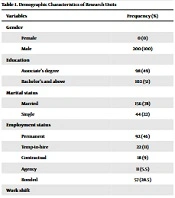
All the participants completed the questionnaires meticulously. All (100%) were men, and 51% held a bachelor's degree or higher. Most were married (78%), permanent employees (46%), highly interested in the job (47%), and Turkmen (75.5%), and 98% worked in a rotating shift. Table 1 summarizes the demographic characteristics of the participants.
Table 1.
Demographic Characteristics of Research Units
| Variables | Frequency (%) |
|---|---|
| Gender | |
| Female | 0 (0) |
| Male | 200 (100) |
| Education | |
| Associate's degree | 98 (49) |
| Bachelor's and above | 102 (51) |
| Marital status | |
| Married | 156 (78) |
| Single | 44 (22) |
| Employment status | |
| Permanent | 92 (46) |
| Temp-to-hire | 22 (11) |
| Contractual | 18 (9) |
| Agency | 11 (5.5) |
| Bonded | 57 (28.5) |
| Work shift | |
| Morning | 4 (2) |
| Rotating | 196 (98) |
| Job interest | |
| Low | 5 (2.5) |
| Medium | 44 (22) |
| High | 94 (47) |
| Very high | 57 (28.5) |
| Ethnicity | |
| Turkmen | 151 (75.5) |
| Persian | 31 (15.5) |
| Sistani | 11 (5.5) |
| Other | 7 (3.5) |
According to Table 2, there is no significant relationship between the demographic variables and conflict management. However, the linear regression analysis of factors affecting the score of conflict management styles shows a significant relationship between resilience and conflict management styles (P = 0.02). In other words, as resilience increases by one unit, the score of conflict management styles rises by 0.17. In addition, the coefficient of determination (R2) for the regression model in Table 3 is 48.5%. The correlation coefficient between resilience and conflict management styles is 0.18 and significant (P = 0.011). The resilience score increases with the score of conflict management styles. Moreover, resilience is directly related to compromising (P = 0.012) and integrating styles (P = 0.001). Table 4 shows the relationship between resilience dimensions and conflict management styles. Resilience has a significant and direct relationship with the compromising style (P = 0.012) and the integrating style (P = 0.001) of conflict management (Table 4).
Table 2.
Relationship Between Conflict Management Styles and Demographic Characteristics
| Variables | Mean ± SD | Statistics | P-Value |
|---|---|---|---|
| Education | t = 1.80 | 0.074 | |
| Associate's degree | 88.01 ± 11.60 | ||
| Bachelor's or higher | 91.06 ± 12.35 | ||
| Marital status | t = 0.23 | 0.820 | |
| Married | 89.46 ± 12.42 | ||
| Single | 89.93 ± 10.77 | ||
| Employment status | F = 0.79 | 0.534 | |
| Permanent | 90.40 ± 12.28 | ||
| Temp-to-hire | 88.23 ± 13.27 | ||
| Contractual | 87.83 ± 18.00 | ||
| Agency | 94.09 ± 10.84 | ||
| Bonded | 88.40 ± 8.82 | ||
| Work shift | t = 0.26 | 0.794 | |
| Morning | 88.00 ± 15.34 | ||
| Rotating | 89.60 ± 12.03 | ||
| Interest in the job | F = 1.54 | 0.206 | |
| Low | 95.80 ± 11.52 | ||
| Medium | 86.68 ± 12.28 | ||
| High | 89.78 ± 12.23 | ||
| Very high | 90.89 ± 11.44 | ||
| Ethnicity | F = 0.82 | 0.483 | |
| Turkmen | 89.19 ± 11.71 | ||
| Persian | 92.52 ± 12.15 | ||
| Sistani | 87.36 ± 12.47 | ||
| Other | 88.14 ± 18.22 | ||
| Age | - | r = 0.04 | 0.613 |
| Work experience | - | r = 0.02 | 0.795 |
| Overtime | - | r = 0.05 | 0.465 |
Table 3.
Regression Analysis of Factors Affecting the Scores of Conflict Management Styles
| Variables | Beta | SE | 95% CI | Standardized Beta | t | P-Value |
|---|---|---|---|---|---|---|
| Education | ||||||
| Associate's degree | Reference | |||||
| Bachelor's or above | 2.71 | 1.75 | -0.72, 6.14 | 0.11 | 1.55 | 0.122 |
| Marital status | ||||||
| Married | Reference | |||||
| Single | -1.09 | 2.41 | -5.81, 3.63 | -0.04 | 0.45 | 0.651 |
| Employment status | ||||||
| Permanent | Reference | |||||
| Temp-to-hire | -3.23 | 2.85 | -8.82, 2.36 | -0.08 | 1.13 | 0.258 |
| Contractual | -0.51 | 3.06 | -6.51, 5.49 | -0.01 | 0.17 | 0.867 |
| Agency | 3.25 | 3.85 | -4.30, 10.80 | 0.06 | 0.84 | 0.399 |
| Bonded | -2.59 | 2.32 | -7.14, 1.96 | -0.10 | 1.11 | 0.265 |
| Work shift | ||||||
| Morning | Reference | |||||
| Rotating | -3.07 | 6.20 | -15.22, 9.08 | -0.04 | 0.49 | 0.621 |
| Job interest | ||||||
| Low | Reference | |||||
| Medium | -10.89 | 5.59 | -21.85, 0.07 | -0.37 | 1.59 | 0.051 |
| High | -9.29 | 5.46 | -19.99, 1.41 | -0.39 | 1.70 | 0.089 |
| Very high | -7.38 | 5.60 | -18.36, 3.60 | -0.28 | 1.32 | 0.187 |
| Ethnicity | ||||||
| Turkmen | Reference | |||||
| Persian | 3.14 | 2.52 | -1.80, 8.08 | 0.09 | 1.25 | 0.212 |
| Sistani | -0.93 | 3.69 | -8.16, 6.30 | -0.02 | 0.25 | 0.800 |
| Other | -1.76 | 4.59 | -10.76, 7.24 | -0.03 | 0.38 | 0.702 |
| Age | -0.21 | 0.14 | -0.48, 0.06 | -0.14 | -0.48 | 0.149 |
| Overtime | 0.02 | 0.02 | -0.02, 0.06 | 0.06 | -0.02 | 0.408 |
| Resilience | 0.17 | 0.07 | 0.03, 0.31 | 0.16 | 0.03 | 0.021 |
Table 4.
Relationship Between Resilience and Conflict Management Styles
| Variables | Conflict Management Style | Dominating Style | Obliging Style | Compromising Style | Integrating Style | Avoiding Style |
|---|---|---|---|---|---|---|
| Resilience | ||||||
| Correlation | 0.180 | 0.112 | 0.101 | 0.178 | 0.276 | 0.030 |
| P-value | 0.011 | 0.114 | 0.154 | 0.012 | 0.001 | 0.677 |
| Perception of personal competence | ||||||
| Correlation | 0.114 | 0.094 | 0.023 | 0.105 | 0.276 | -0.039 |
| P-value | 0.109 | 0.186 | 0.748 | 0.139 | 0.001 | 0.579 |
| Trust in one's instincts | ||||||
| Correlation | 0.250 | 0.198 | 0.198 | 0.208 | 0.194 | 0.113 |
| P-value | 0.001 | 0.005 | 0.005 | 0.003 | 0.006 | 0.111 |
| Acceptance of change and secure relationships | ||||||
| Correlation | 0.136 | 0.048 | 0.079 | 0.192 | 0.251 | -0.012 |
| P-value | 0.054 | 0.499 | 0.269 | 0.006 | 0.001 | 0.870 |
| Control | ||||||
| Correlation | 0.065 | -0.002 | 0.038 | 0.063 | 0.206 | -0.030 |
| P-value | 0.360 | 0.973 | 0.590 | 0.378 | 0.003 | 0.675 |
| Spiritual influences | ||||||
| Correlation | 0.130 | 0.029 | 0.045 | 0.147 | 0.153 | 0.124 |
| P-value | 0.068 | 0.679 | 0.525 | 0.038 | 0.031 | 0.079 |
5. Discussion
This study aimed to determine the relationship between resilience and conflict management styles from the perspective of the pre-hospital emergency operational staff at the Golestan Province Medical Emergency and Accident Management Center in 2022. The findings revealed no significant relationships between demographic characteristics and conflict management styles; in addition, it was found that those interested in their jobs obtained higher resilience scores.
The study findings showed no demographic characteristics significantly associated with conflict management styles. In contrast, the results of the studies, including Ardalan et al., Azizzadeh et al., and Ghasemyani et al. demonstrated a statistically significant relationship between the nurses' age, gender, employment status, work experience, and workplace and conflict management styles (1, 4, 27). This discrepancy in the result can be due to different study departments and the working conditions of the nurses in these departments; further research is required in this regard.
In addition, the study findings showed that job interest was significantly associated with the resilience score (P < 0.01); the resilience score was higher in the employees who were more interested in their jobs. However, other demographic characteristics had no statistically significant relationship with the resilience score. On the other hand, Graminejad et al. showed an association between resilience and some demographic variables such as age, work shift, and employment (23). Furthermore, Lee et al. found a statistical relationship between work experience and resilience score (28). In a 2021 study, Keragholi et al. aimed to determine the relationship between resilience and mental health of the pre-hospital emergency operational staff. They reported a significant relationship between employment status and the resilience score (29). Sotoodeh et al., conducting a study to determine the relationship between the resilience score of nurses working in the intensive care unit and their personal and professional characteristics, revealed that quantitative variables such as age, work experience, and the amount of overtime per month did not have a statistically significant relationship with resilience. However, they found a significant association between marital status and resilience (30). The possible causes of these discrepancies may be due to individual, cultural, and social differences, management structure, arrangement of forces, workload, work environment, and participants. However, no study was found on the relationship between resilience and job interest, indicating the need for the present study.
The study results revealed a statistically significant and direct relationship between resilience and compromising and integrating styles. Nonetheless, there was no significant relationship between resilience and dominating, obliging, and avoiding styles. According to Vivar, uncontrolled conflict in nurses leads to stress, fear, worry, and professional relationship breakdown, resulting in conflict and reduced productivity due to errors, illness, and injury that will increase the costs for the individual and the organization (31). Many studies have demonstrated job conflicts and physical and mental breakdowns in nurses, leading to job quitting, employee disputes, extreme turnover, health disorders and inability to perform duties, vulnerability in professional communication, reduced quality of care, and job dissatisfaction (1, 32). Mohammadi and Mahdian confirmed a positive relationship between the compromising style and resilience in educational managers (2). Moreover, Ashraf et al. studied religious self-regulation, autonomy, resilience, and conflict management strategies in international Muslim students in Pakistan. Similar to the present study, they found a moderate to strong relationship between resilience and conflict management styles (33). It is because resilience is people's confidence in their abilities to overcome stress, coping capabilities, self-esteem, emotional stability, and personal characteristics that increase social support. Some researchers have applied this concept to healthcare professionals and stated that resilience is the person's ability to maintain personal and professional well-being to deal with stress and difficulty at work (20).
One of the conflict management styles is the compromising style. The authors believe that the compromising style can be mainly used for temporarily solving issues and problems. Knowing that issues and difficulties must be solved carefully and the origin of the problem should be found, the managers try to resolve the problem temporarily and superficially in the department or organizational unit. These managers attempt to continue the organization's affairs in an unprofessional way. Applying this style is a temporary solution to the conflict and prevents the thorough diagnosis and discovery of issues. Therefore, this style cannot be appropriate in healthcare environments. This style is analogous to administering painkillers for acute diseases to temporarily reduce the pain, relieving the pain for a few hours and calming the patient down. However, the pain will return to the patient after a few hours. Therefore, the authors suggest using this conflict management style when necessary.
The study findings revealed that the integrating style has a significant and direct relationship with resilience. The most appropriate conflict management style is the integrative style, a win-win strategy for the conflicting parties. Personnel working in conflicting situations use this style so that both themselves and the other party achieve their wishes. Moreover, research demonstrates that successful managers mostly use the integrating style in conflict management (34). Tosun and Dilmaç conducted a study in 2015 to find the predictive relationships between married people's values, resilience, and conflict management styles. They found that their values and resilience were the most important variables affecting conflict management styles. That is, the conflict management styles of couples differed based on their resilience levels (35), which is in line with the results of the present study.
One of the styles of conflict management is the dominating style. According to the study findings, the dominating style was not significantly associated with the resilience of pre-hospital emergency operational staff. However, Mohammadi and Mahdian found an inverse relationship between resilience and dominating style (2). In a 2022 study, Alnajjar and Abou Hashish demonstrated that nursing students' most favored conflict management style was the integrating style, and the least favored one was the dominating style (36). In the dominating style, one party focuses only on its desires and pays less attention to the other party's interests and wishes (37). Insisting on one's desires and ignoring the other party's interests is a win-lose strategy. The employees who try to pretend to be entitled in social interaction and merely achieve their desires use this style (38). The authors believe that the dominating style is inefficient in the long run because of the work pressure and job stress in the pre-hospital emergency operational staff and managers, the low work independence of subordinates and colleagues, and their lack of freedom to implement the assigned responsibilities and duties.
The result showed that the obliging style has no significant relationship with resilience. In this style, one side tries to continue the relationship by ignoring its desires, so the other side reaches its wishes (39). The authors believe that applying this style negatively affects the pre-hospital emergency departments in the medium- and long-term periods. Hence, the managers and operational staff can hardly control these departments because applying the obliging style to solve the problems gradually creates a situation where the subordinates use unfriendly and authoritative behavior, knowing that the manager and other staff will get along with them. Hence, they will not do their duties and violate the organizational rules and guidelines.
In contrast to this study, Mohammadi and Mahdian (2) showed that the avoiding style is associated with resilience. Avoiding style presents itself with withdrawal; the person tries to avoid conflict. This person does not dare to achieve his desires or cooperate with the second party to achieve his goal (40). This style is sometimes efficient and helpful and sometimes causes a negative effect; therefore, using this conflict management style is like a double-edged sword. This style is only desirable in some conflicting situations to justify the present result regarding the avoiding style. Still, it can be used as a desirable method when the conflict is trivial or if the emotions and feelings of the involved parties are not damaged much. However, it cannot be used continuously because others may judge the person unfavorably.
5.1. Conclusions
The findings illustrated a direct relationship between resilience and conflict management styles. As the resilience score increased, the conflict management styles score rose, too. Resilience was directly associated with the compromising and integrating styles of conflict management. In addition, job interest was associated with resilience. In other words, the resilience score of employees more interested in their jobs was higher. Consequently, managers must pay more attention and implement measures to increase the efficiency of pre-hospital emergency operational staff and reduce the harm caused by conflicts. Since increased resilience significantly improves conflict management, pre-hospital emergency managers and officials can hold training courses for operational staff using instructors familiar with pre-hospital working environments who know resilience concepts. Undoubtedly, raising the awareness and skills of operational staff regarding resilience and conflict management methods will directly reduce conflicts and indirectly increase the quality of services and clinical care. This, in turn, will increase the employee's satisfaction with their jobs and the client's satisfaction with the services provided.
Similar to any other study, this study had some limitations. One of the limitations of the study, which was uncontrollable, was the psychological differences among people. Moreover, other limitations were diversity in their intelligence, interest, scientific and professional ability, as well as factors related to economic, social, and cultural characteristics and failure to register database management experiences.