Fulltext
Full-text is available in PDF format.
Journal of Nursing and Midwifery Sciences
The Official Journal of Mazandaran University of Medical Sciences
Authors
Background and Purpose: Cardiovascular diseases are the most common causes of death worldwide and stress is the reason behind
many negative emotions. Surgery is one of the most stressful situations. Coping styles and life expectancy affect people's mental and
physical efficacy. The present study aims to determine the effectiveness of training life expectancy and effective coping styles to deal
with negative emotions on cardiac surgery patients' mental health at Sari-based Fateme Zahra Hospital in 2013.
Methods: In this quasi-experimental study, 30 candidates for coronary artery bypass surgery referring to this center was selected
using the available sampling method. They were then randomly included into two 15-member groups as experimental and control
group. Stress management, anger management, and hopefulness training courses were held individually for 7 sessions. Before
and after the intervention, the patients of both groups answered the questionnaires including the Coping Manners Questionnaire
(by Lazarus & Folkman), Snyder’s Hope Scale, and the General Health Questionnaire-12 (GHQ-12).
Results: Data analysis implied that there is a significant difference between the average general health in the experimental and control
groups after training. Investigating the subscales of coping strategies in the experimental and control groups after training showed that
there is a significant difference between direct coping, planned problem solving, and positive reappraisal in the two groups.
Conclusions: In patients with coronary heart disease, high stress, and negative emotions (anger, anxiety, depression) also as the
candidates of coronary artery bypass surgery, training raised life expectancy level and the practical methods for coping with life
can be great help to their mental health condition.
2022 Journal of Nursing and Midwifery Sciences. This work is licensed under a Creative Commons Attribution-NonCommercial 3.0 Unported License which allows users to read, copy, distribute and make derivative works for non-commercial purposes from the material, as long as the author of the original work is cited properly. https://jnms.mazums.ac.ir/ https://wiki.creativecommons.org/wiki/License_Versions
Mohammadi Pashaki M, Mahmoodi Molaee A, Mirzaian B, Heydarifard J, Jafari H. The effect of training coping styles to deal with negative emotions on mental health of patients undergoing open heart surgery. J Nurs Midwifery Sci. 2016;3(4):e141213. doi: https://doi.org/10.18869/acadpub.jnms.3.4.13
Soltanishal R, Aghamohammadian Sharbaf H, Karshki H. The role of type D personality and emotional intelligence with mediating of perceived stress and coping styles in the quality of life of coronary heart disease patients. J Kermanshah Univ Med Sci. 2013;17(7):e74464. doi:
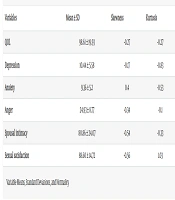
Mahdipour Z, Kianimoghadam AS, Hasani M, Masjedi Arani A. Prediction of Quality of Life Based on Anger, Depression, Anxiety, Spousal Intimacy, and Sexual Satisfaction in Iranian Patients Undergoing Coronary Artery Bypass Surgery. Int Cardiovasc Res J. 2025;19(1):e160976. doi: https://doi.org/10.5812/icrj-160976
Farrashbandi H, Jamshidi M, Kianpoor M, Khosropanah S, Haghshenas H, et al. Mental Health and Depression after Coronary Artery Bypass Graft. Zahedan J Res Med Sci. 2014;16(10(suppl)):. doi:
Last Update: 1 week ago
Last Update: 1 week ago
Last Update: 1 week ago
Last Update: just now
Last Update: 2 days ago
Last Update: 4 days ago