
1. Background
Cardiovascular disease (CVD), which affects the heart and blood vessels, is becoming more prevalent each year and is a major public health concern, serving as one of the primary causes of death, disability, and reduced quality of life (QOL) globally (1). In 2019, the global prevalence of CVD reached nearly 500 million people (1). According to conducted studies, the prevalence of CVDs in Iran has increased by 20 to 45 percent in recent years (2). About 17.9 million deaths are attributed to CVDs, which are the leading cause of death worldwide (3). These diseases also have a substantial financial impact, causing 7.28 trillion dollars in economic losses (3, 4). Coronary artery bypass graft (CABG) is a widely used treatment for coronary disease, and recent advancements have significantly improved postoperative and long-term outcomes, including enhanced cardiac activity and QOL for heart disease patients (5, 6). One important outcome of treatments like CABG is QOL (7). The QOL signifies the overall well-being of individuals, which includes aspects such as health, emotional well-being, and social connections (8). In Iran, approximately 30 - 40 thousand people have undergone cardiac surgery, with CABG accounting for 50 - 60% of the total (9). The CABG is a stressful procedure that can improve life expectancy but may lead to mood disorders, physical dysfunction, and hinder participation in rehabilitation, negatively impacting QOL (10). Depression and heart disease are highly comorbid, affecting 14% to 47% of patients, many of whom experience depressive symptoms before and after CABG surgery (11). Depression is a prevalent psychiatric disorder characterized by persistent sadness, disinterest in activities, and a variety of emotional, behavioral, and cognitive symptoms (12). Patients undergoing CABG often experience anxiety and panic due to various stresses like environmental changes, pain, waiting, and fear of death (13). Anxiety is an emotional response to perceived threats, involving worry, tension, and physiological changes like increased heart rate and blood pressure (14). This surgery may also lead to anger and suppressed rage (15). Anger is an emotional response to obstacles or provocation, often shown in social interactions (16). The CABG surgery may also impact spousal intimacy (17). Improved intimacy and spousal support aid in treatment, recovery, and reduce the risk of complications, mortality, and readmission (18). The CABG can also affect sexual satisfaction, which in turn impacts the overall QOL (19). Prior studies have explored the role of psychological factors, demographic variables, and clinical characteristics in predicting recovery following CABG, but several critical gaps remain. Most studies have been conducted in various cultural or social contexts, and their results cannot be generalized to Iranian populations. Additionally, a comprehensive and interactive investigation of these factors has not been conducted in Iran, highlighting an important research gap. Previous studies have reported contradictory results regarding QOL after CABG. Some studies report significant improvements (6, 20), while others emphasize patients' difficulties in daily activities post-surgery, indicating the need for further interventions (9, 21). These discrepancies emphasize the necessity of additional research to achieve consistent and reliable findings. The relationships between these variables and QOL remain underexplored in a systematic manner.
2. Objectives
This study aims to explore the predictive role of depression, anxiety, marital intimacy, and sexual satisfaction on the QOL of CABG patients, aiming to resolve contradictions in previous findings and provide clearer insights into their psychological and functional recovery.
3. Methods
3.1. Study Methods and Participants
The study employed a cross-sectional correlation method to assess the effects of anger, depression, anxiety, spousal intimacy, and sexual satisfaction on QOL in post-CABG patients. A collaboration letter for participant recruitment from Ayatollah Taleghani Hospital was obtained from the university's research vice presidency after project approval and ethics code issuance by Shahid Beheshti University of Medical Sciences. The inclusion criteria were patients aged 20 to 65 years, diagnosed with CAD, who underwent CABG within the last 12 months and are currently married. Exclusion criteria included significant comorbidities (e.g., diabetes, cancer) and incomplete or patterned questionnaire responses. Participants with chronic physical illnesses were excluded to prevent independent effects of chronic pain, fatigue, treatment side effects, and physical limitations, which could directly impact psychological states and the quality of spousal relationships. This approach enhanced sample homogeneity and improved the internal validity of the study.
The minimum sample size for regression analysis in this investigation was 91, estimated with a median effect size (f2) = 0.15, P = 0.05, power (1 - β) = 0.80 (calculation made using G*Power version 3.1), and five significant predictors that were suggested in previous research. The final analysis included 130 responses. The questionnaire, consisting of 113 questions, assessed sociodemographic variables such as gender, age, education, alcohol consumption, marital status, and smoking behavior. Data were collected from October 01, 2023, to November 01, 2024, at Hospital Center Taleghani, with approval from the Ethics Committee of Shahid Beheshti University. Participants were recruited based on inclusion criteria and completed a face-to-face structured questionnaire. They were informed about the study’s purpose, data confidentiality, and their voluntary participation was confirmed through written consent. Participants were briefed on study procedures, potential benefits, and risks. The researcher ensured participants understood their rights, including the option to withdraw at any time without consequences.
3.2. Measures
3.2.1. Quality of Life Scale
The Quality of Life Scale (SF-36) is a 36-item questionnaire that measures QOL, with scores ranging from 26 to 130, where higher scores indicate better health (22). It has shown high reliability, with Cronbach’s alpha values ≥ 0.70 for all eight subscales (23). The Persian version has been rigorously validated in both clinical and non-clinical populations in Iran, with Cronbach's alpha coefficients ranging from 0.70 to 0.85 for each domain. Asghari Moghaddam and Faqihi confirmed its reliability and validity for assessing QoL in Iranian populations (24).
3.2.2. Aggression Questionnaire
Bass and Perry developed the Aggression Questionnaire (AGQ) in 1992, a 30-item self-report tool. It includes 14 items on anger, 8 on aggression, and 8 on hostility. In this study, only the 14 anger-related items were used. Participants select from four options: "Never", "rarely", "sometimes", and "always", scored 0 to 3. The anger score ranges from 0 to 42, with scores above the average indicating high anger (25). Soltani and Hosseini reported a Cronbach's alpha of 0.83, showing good reliability for this scale (26).
3.2.3. Depression, Anxiety, and Stress Scale
The Depression Anxiety Stress Scale-21 (DASS-21) Questionnaire, developed by Lovibond and Lovibond, measures depression and anxiety through three subscales. Each subscale has a score range of 0 to 21, with higher scores indicating greater severity. Scores are reported separately, and the overall score is not calculated (27). Validity in Iran has been confirmed through factor analysis, criterion validity, and forward-backward translation. Reliability coefficients are 0.73 for anxiety and 0.81 for depression, making it a valuable tool for both clinical and research purposes (28).
3.2.4. Walker-Thompson Intimacy Scale
The 17-item Walker-Thompson Intimacy Questionnaire, developed by Walker and Thompson in 1983, measures intimacy and affection among married couples. Its Cronbach's alpha ranges from 0.91 to 0.97 (29). Validity was assessed through face and content validity. Researchers concluded it effectively measures marital intimacy. In comparison to Bagarozzi's Intimacy Scale, Babaei et al. reported a concurrent validity of 0.61 and an overall reliability of 0.9 in Iran (30).
3.2.5. Larson's Sexual Satisfaction Questionnaire
A reliable method for assessing participants' sexual experiences was Larson's Sexual Satisfaction Questionnaire (LSSQ). It includes 25 items on a 5-point Likert scale from 1 = never to 5 = always, with scores ranging from 1 to 125. High sexual satisfaction has been associated with a high score (31). This questionnaire's Cronbach's α was 0.93, and its validity and reliability were assessed to be 0.90 and 0.98 in Iran, respectively (32).
3.3. Data Analysis
The data were analyzed using IBM SPSS Statistics version 24.0. Descriptive statistics were used to summarize the demographic characteristics, including age, gender, education level, alcohol consumption, smoking habits, and disease-related factors. To check the normality of the data, skewness and kurtosis were used. We assessed the relationships between independent variables and QOL using independent t-tests, ANOVA, and Pearson or Spearman correlation tests, depending on the distribution of the data. A multiple linear regression analysis was performed to explore how independent variables, such as anger, depression, spousal intimacy, functional anxiety, and marital sexual satisfaction, affected QOL while adjusting for potential confounders like age and gender. The results were presented with R2 values, regression coefficients, and P-values, with a significance level set at P < 0.05.
4. Results
A total of 130 post-CABG patients (60% male, 40% female) with a mean age of 51.9 ± 7.9 years participated in the study. All participants were married. Regarding education, 19.2% had a middle school degree, 18.5% held a high school diploma, and 62.3% had a college or university degree. Among them, 38.5% were smokers, 31.5% reported alcohol use, and 74.6% had a family history of heart disease. Sociodemographic and clinical characteristics are detailed in Table 1.
Table 1.
Sociodemographic and Clinical Characteristics of the Participants (N = 130) a
| Variables | Values |
|---|---|
| Age | |
| 20 - 30 | 0 |
| 30 - 40 | 10 (7.7) |
| 40 - 50 | 48 (36.9) |
| ≥ 50 | 70 (53.8) |
| Gender | |
| Men | 78 (60) |
| Women | 52 (40) |
| Education level | |
| ≤ Middle school | 25 (19.2) |
| High school | 24 (18.5) |
| ≥ College | 81 (62.3) |
| Marital status | |
| Single | 0 |
| Married | 130 (100) |
| Smoking | |
| Current smoker | 50 (38.5) |
| Non-smoker | 80 (61.5) |
| Drinking | |
| Current drinker | 41 (31.5) |
| Non-drinker | 89 (68.5) |
| Family history | |
| Yes | 97 (74.6) |
| No | 33 (25.4) |
a Values are expressed as No (%).
Independence of residuals was confirmed with the Durbin-Watson value of 1.83, indicating independent observations. Multicollinearity was not an issue, with VIF values below 10 and Tolerance above 0.1. Residual analysis and skewness/kurtosis values were within acceptable ranges, supporting the normality of the data for further analysis.
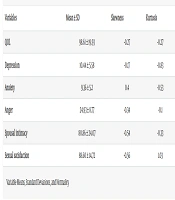
The participants’ mean QOL scores was 98.61 ± 19.93 points. The mean depression and anxiety scores were 10.44 ± 5.58 and 9.36 ± 5.2 points, respectively. The mean anger score was 24.93 ± 8.77 points. The mean spousal intimacy and sexual satisfaction scores were 80.86 ± 24.07 and 88.60 ± 14.72 points, respectively (Table 2).
Table 2.
Variable Means, Standard Deviations, and Normality
| Variables | Mean ± SD | Skewness | Kurtosis |
|---|---|---|---|
| QOL | 98.61 ± 19.93 | -0.27 | -0.27 |
| Depression | 10.44 ± 5.58 | -0.17 | -0.83 |
| Anxiety | 9.36 ± 5.2 | 0.4 | -0.53 |
| Anger | 24.93 ± 8.77 | -0.34 | -0.1 |
| Spousal intimacy | 80.86 ± 24.07 | -0.54 | -0.33 |
| Sexual satisfaction | 88.60 ± 14.72 | -0.56 | 1.03 |
Abbreviation: QOL, quality of life.
Table 3 presents the descriptive statistics of the study variables and the correlations between them. As demonstrated, all variables were statistically correlated with each other. The QOL score was negatively correlated with depression, anxiety, and anger, and positively associated with spousal intimacy and sexual satisfaction.
Table 3.
Pearson Correlation Coefficient of the Research Variables (Significant at P < 0.01)
| Variables | 1 | 2 | 3 | 4 | 5 | 6 |
|---|---|---|---|---|---|---|
| QOL | 1 | -0.637 | -0.669 | -0.371 | 0.459 | 0.59 |
| Depression | 1 | 0.571 | 0.544 | -0.466 | -0.493 | |
| Anxiety | 1 | 0.347 | -0.415 | -0.479 | ||
| Anger | 1 | -0.466 | -0.318 | |||
| Spousal intimacy | 1 | 0.631 | ||||
| Sexual satisfaction | 1 |
Abbreviation: QOL, quality of life.
Multiple regression analysis was conducted to identify the factors influencing the participants' QOL scores. Before testing the regression model, the underlying assumptions for carrying out multiple regression analyses were examined and verified. This ensured the validity and reliability of the regression results.
Table 4.
Multiple Regression of Quality of Life
| Variables | B (Unstandardized Coefficients) | Std. Error | β (Standardized Coefficients) | t | P-Value | 95% CI for B (Unstandardized Coefficients) |
|---|---|---|---|---|---|---|
| Depression | -1.082 | 0.293 | -0.303 | -3.69 | 0 | (-1.662, -0.501) |
| Anxiety | -1.435 | 0.278 | -0.375 | -5.166 | 0 | (-1.985, -0.885) |
| Anger | -0.012 | 0.16 | -0.005 | -0.077 | 0.938 | (-0.329, 0.304) |
| Spousal intimacy | -0.039 | 0.067 | -0.047 | -0.576 | 0.566 | (-0.171, 0.094) |
| Sexual satisfaction | 0.391 | 0.106 | 0.289 | 3.699 | 0 | (0.182, 0.600) |
The results, as shown in Table 4, indicated that anger (B = -0.012, P = 0.938) did not have a significant impact on QOL. In contrast, depression (B = -1.082, P = 0.0001) and anxiety (B = -1.435, P = 0.0001) had significant negative effects on QOL. Spousal intimacy (B = -0.039, P = 0.566) did not exhibit a significant effect, while sexual satisfaction (B = 0.391, P = 0.0001) showed a significant positive effect.
The standardized coefficients (β) reflect the relative impact of the variables. Here, anxiety (β = -0.375) had the most significant negative effect, while sexual satisfaction (β = 0.289) had the most significant positive effect on QOL. The confidence intervals (CI) for anger (CI: -0.329 to 0.304) and spousal intimacy (CI: -0.171 to 0.094) include zero, indicating that these variables do not have a significant effect on QOL. Conversely, depression (CI: -1.662 to -0.501), anxiety (CI: -1.985 to -0.885), and sexual satisfaction (CI: 0.182 to 0.600) exhibit significant effects as their confidence intervals do not include zero.
Table 5.
Model Summary for Predicting Quality of Life
| R | R2 | Adj R2 | △R2 | F | P |
|---|---|---|---|---|---|
| 0.771 | 0.595 | 0.578 | 0.08 | 36.368 | 0 |
As shown in Table 5, the model's R was 0.771, indicating a strong correlation between the predictors and the dependent variable. R2 is 0.595, showing that 59.5% of the variance in the dependent variable is explained by the model. Adjusted R2 is 0.578, indicating that 57.8% of the variability is explained after accounting for the predictors. △R2 is 0.08. The F statistic is 36.368, and the P-value is 0.000, showing the model's overall statistical significance (P < 0.05).
5. Discussion
This study examines the factors affecting the QOL in Iranian patients after CABG. Although the surgery may impact QOL, other factors also play a role in its outcome (33). Among the research variables, anxiety, depression, and sexual satisfaction had the most explanatory power in predicting the QOL of patients undergoing CABG. Higher depression levels were associated with lower QOL (P < 0.001), consistent with previous research (34, 35). Even with successful surgery, depression negatively impacts QOL (36). Limited social support, reduced activity, and job loss due to prolonged recovery can increase a sense of loss of control, raising depression risk (37-39). The post-surgical period disrupts daily routines, making future planning difficult and further increasing depression likelihood (40). Additionally, depression activates the hypothalamus-pituitary-adrenal axis, boosting pro-inflammatory cytokines (41). In this study, a significant relationship was found between QOL and anxiety (P < 0.001).
Although anxiety may decrease post-surgery, it often does not return to subclinical levels. Factors such as a pessimistic outlook, catastrophizing, and a lack of control exacerbate anxiety (42). Physiological changes like hypothalamus-pituitary-adrenal (HPA) axis activation and increased cortisol (43), along with financial problems, treatment costs, and the inability to return to work, further intensify anxiety (44). Insufficient information from healthcare providers, fear of health status without medical supervision, difficulty adapting to life after discharge, and changes in social roles also contribute to heightened anxiety (42, 45).
In this study, sexual satisfaction showed a positive and significant relationship (P < 0.001) with QOL. Some previous studies are consistent with the results of this research (46, 47), while others obtained results contrary to our study (48). The CVD contributes to impaired sexual satisfaction, and CABG can significantly address these issues (49). The CABG, by reducing angina, improves social, physical, and sexual activities, ultimately leading to sexual satisfaction (46).
In this study, contrary to the findings of Rapelli et al., no significant relationship (P = 0.566) was found between marital intimacy and QOL in CABG patients (17). This discrepancy may arise from cultural differences in expressing intimacy; in collectivist Iranian culture, spousal support is often implicit, involving family duties or nonverbal emotional support, while explicit verbal support is more common in Western cultures (50). Instruments like the Walker-Thompson Scale, developed in Western contexts, may not fully capture these implicit forms of intimacy in Iran. Additionally, CABG patients, due to fatigue and physical limitations after surgery, may prioritize physical recovery or social support over emotional intimacy (51). Therefore, the nonsignificant relationship could be due to tool limitations or differing patient priorities. Future studies should use culturally adapted instruments or mixed-method approaches.
Additionally, in this study, anger had no significant impact (P = 0.938). As a transient emotion, it may not have yielded significant results due to the study's cross-sectional design. Overall, this study reaffirms the negative effects of depression and anxiety while highlighting the positive role of sexual satisfaction in improving QOL in cardiac patients. The discrepancies in the influence of anger and spousal intimacy call for further research to understand the complex psychological and social factors affecting the QOL in this population.
The current findings are particularly significant given their practical implications. Depression and anxiety are critical targets for postoperative care, and psychological interventions should be integrated into rehabilitation programs to address these issues. Evidence-based therapies such as cognitive-behavioral therapy (CBT) and mindfulness-based stress reduction (MBSR) have shown efficacy in reducing psychological distress and improving QOL in cardiac patients (52, 53). Moreover, couple-based sexual counseling, encompassing educational and interactive sessions with both the patient and their spouse, can enhance sexual satisfaction by improving communication skills (46).
This study’s strengths include an adequate sample size, enhancing statistical power, and a diverse sample of male and female patients from various age and education levels, allowing for generalizability. Using valid, standardized tools and multiple regression analysis ensures accurate, precise results by examining the simultaneous effects of multiple variables. However, the study has some limitations.
5.1. Cross-Sectional Design Limitations
The cross-sectional design of this study does not allow for causal inference or determination of temporal directionality between variables. This approach was chosen due to time and resource limitations; however, the findings are restricted to correlational relationships. Future longitudinal studies are recommended to more accurately examine causal and temporal associations.
5.2. Exclusion of Patients with Chronic Comorbidities
Excluding patients with chronic comorbidities limits the generalizability of the findings and narrows the sample to a subgroup of CABG patients without such conditions. Consequently, the results may not fully represent the broader CABG population. Future studies could enhance generalizability by including these patients or statistically controlling for relevant variables, providing a more comprehensive understanding of the psychological and relational factors involved.
5.3. Limited Scope of the Anger Subscale
The use of the 14-item Anger subscale from the AGQ may not capture other dimensions of aggression, such as hostility or physical aggression. This selection was based on the primary focus on the emotional experience of anger, but it may not fully reflect the role of aggression in the QOL of CABG patients. Therefore, employing the full AGQ or additional subscales is recommended for a more comprehensive assessment of various aggression dimensions.
5.4. Focus on Sexual Satisfaction
This study focused on sexual satisfaction as a cognitive construct and therefore used the LSSQ, which does not assess sexual functioning. Consequently, the results may have overlooked the role of sexual functioning. Future studies should employ more comprehensive tools like the International Index of Erectile Function (IIEF) and the Female Sexual Function Index (FSFI) to better examine sexual functioning as a mediator in the relationship with QOL.
5.5. Multicollinearity and Factor Analysis
The VIF and Tolerance indices confirmed that multicollinearity was not an issue. However, the lack of factor analysis, despite the validated structure of DASS-21 in Iran, and the choice to analyze depression and anxiety separately may have limited insights into their overlap. Future studies with larger samples could examine their structure via factor analysis and consider using a composite ‘psychological distress’ Index to reflect shared variance while maintaining clinical distinctions.
5.6. Reliance on Self-reported Data
Reliance on self-reported data may introduce response bias. Future studies should consider adding physiological measures, such as cortisol, to improve assessment accuracy. This approach would provide a more objective measure of psychological states and enhance the robustness of the findings by correlating self-reported data with physiological indicators.