
1. Background
Adolescents constitute one-sixth of the world’s population, with an estimated 16 million females aged 15 to 19 years and 2.5 million females aged 15 or younger giving birth each year in developed countries (1). Although the teenage pregnancy rate in Iran is currently lower than the global average (approximately 7%), it is anticipated to rise by 2025 due to changes in population policy programs (2, 3). Teenage pregnancy poses numerous physical and psychological challenges for both mothers and newborns. Pregnant teenagers are at a higher risk of encountering health problems, including anemia, nutritional deficiencies, inadequate weight gain, miscarriage, preterm birth, preeclampsia, hemorrhage, birth trauma, cesarean section, or interventions during delivery, in addition to anxiety and depression (4-6). Nevertheless, some studies have indicated that teenagers exhibit positive attitudes toward pregnancy and childbirth during adolescence, including improved connections with parents and family members, happiness, the fulfillment of gender-related roles, responsibility, maturity, autonomy, and a sense of purpose in life (4-7).
The transition to motherhood presents a significant challenge, with teenage mothers experiencing an even greater burden of responsibility during this phase (8-10). Adolescents who become mothers often grapple with various stressors, such as limited financial resources, role confusion, social isolation, and depressive symptoms, which can exacerbate their difficulties during this transition (11).
Childcare is one of the most demanding responsibilities for mothers (12). The transition to adulthood, independence, parenting, nurturing a child, addressing the emotional and physical needs of the neonate, and caring for children represent the primary challenges faced by adolescent mothers (13). Factors such as a lack of knowledge and experience in infant care and receiving conflicting information from various sources hinder their ability to assume the maternal role (13, 14). Infancy is widely recognized as the most crucial stage in a child’s life that involves both the appropriate knowledge and careful care, and it is influenced significantly by proper care. Adequate infant care contributes to a healthier society, reduces healthcare costs across all age groups, including children and adults, and contributes to the preservation of social capital (15).
2. Objectives
In Iran, various qualitative studies (2, 9, 10) have been conducted, emphasizing that, given the country’s population policies and the rising percentage of childbirth among young mothers, there is a pressing need for comprehensive planning to offer parenting and newborn care services to teenagers while also establishing robust social support systems. Due to the scarcity of quantitative studies aimed at assessing the current situation and informing planning efforts, this study was designed to compare the challenges associated with the transition to motherhood and the quality of infant care between adolescent mothers and young mothers in Karaj, Iran.
3. Methods
3.1. Design
This cross-sectional study was conducted in 2020 and involved 160 adolescent and young mothers who were referred to selected comprehensive health service centers in Karaj, Iran, and met the inclusion criteria.
3.2. Ethics
The Ethics Committee of Alborz University of Medical Sciences, Alborz, Iran, approved this study (IR.ABZUMS.REC.1398.237). All participants read and signed written consent letters. The study ensured the confidentiality of participants’ information, and individuals were free to withdraw from the study at any stage.
3.3. Participants
The study included primiparous mothers whose neonates were at least 6 months old. Teenage mothers were defined as those 19 years of age or younger. The inclusion criteria were Iranian nationality, marriage, absence of self-reported physical or mental illnesses, no history of alcohol, tobacco, or psychotropic substance use, and no complications during pregnancy, childbirth, postpartum, or infancy. Incomplete questionnaire submissions were considered the exclusion criteria.
3.4. Sample Size Estimation
Based on the Infant Feeding Surveillance System (IFSS, 2015) (16) and using the formula for comparing two ratios related to a qualitative trait in 2 independent communities, with α = 0.05, β = 0.2, P1 = 21, P2 = 54, and accounting for a 10% potential dropout rate, a sample size of 40 subjects per group was initially calculated. Considering samples from both urban and suburban areas, the total sample size was increased to 80 individuals per group.
3.5. Sampling Method
The participants were selected using a multistage random sampling approach. Initially, 13 urban centers and 6 suburban centers were randomly chosen through a lottery system from the list of comprehensive health service centers in Karaj based on their numbers. Subsequently, the sample size for each group was determined according to the population of mothers covered by each center. Sampling was conducted in each center using a convenient method until the required sample size was reached.
3.6. Measures
Data collection involved three instruments: a demographics and obstetrics questionnaire, a difficulty of transition to motherhood questionnaire, and an infant care checklist.
3.6.1. Demographics and Obstetrics Questionnaire
The researcher-designed questionnaire included information on age, maternal and spouse’s educational levels, maternal occupation, household income, ethnicity, marriage duration, preference for type of delivery, place of residence, type of home, breast problems, childbirth interventions, cause of cesarean section, type of delivery, gravidity, number of abortions, history of infertility, pregnancy complications, frequency of prenatal care, gestational age at delivery, infant birth weight, preference for type of delivery, receiving support at home, and support received for infant care.
3.6.2. Difficulty of Transition to Motherhood
The modified transition difficulty to parenthood questionnaire assesses the level of difficulty experienced by new mothers and consists of 38 items across four dimensions: responsibility and commitment (13 items), pleasure and satisfaction (12 items), fondness and stability (7 items), and self-commitment (6 items). Responses are measured on a 5-point Likert scale (very much, relatively much, medium, little, and not at all). Scores ranging from 10 to 50 indicate low levels of difficulty in becoming a parent, scores of 110 to 179 indicate medium levels and scores of 180 to 250 indicate high levels (17). The reliability of this tool has been reported in the study by Moller et al., with a Cronbach’s alpha of 0.81 and subscale values ranging from 0.65 to 0.82 (18). The Persian version of the scale’s content validity was also approved by Seraj et al. in 2014. They reported the scale’s reliability with a Cronbach’s alpha of 0.86 and subscale values ranging from 0.68 to 0.79 (19). In the present study, the reliability was confirmed with a Cronbach’s alpha of 0.922.
3.6.3. Infant Care Checklist
The Infant Care Checklist is based on the Country Guide (Iran) for Integrated Healthy Child Care (20) and Integrated Child Sick Care (21). It includes 46 questions categorized into 4 areas: routine child care (10 questions), child sick care (15 questions), child health (5 questions), and mother’s health (16 questions). Each question is scored as “yes” (1) or “no” (0). The total score ranges from 0 to 46, with higher scores indicating better care of the child by the mother. The validity of the Infant Care Checklist was based on the content of the National Guide to Integrated Care of Healthy Children and Integrated Child Care, which has been confirmed by experts in neonatology and pediatrics in the Ministry of Health of Iran. To assess reliability, the internal consistency of the scale was evaluated using Cronbach’s alpha. In this study, the Cronbach’s alpha was calculated to be 0.922.
Eligible mothers in the selected health centers were asked to personally complete the mentioned questionnaires in a quiet environment provided for them at those centers. If they had any questions related to the questions, the researcher was available to provide assistance.
3.7. Statistical Analysis
Finally, the data were imported into SPSS software (version 24; IBM, Chicago, IL, USA). Descriptive statistics, including frequency, percentage, mean, and standard deviation (SD), were reported. The analysis of data was performed using the chi-square and Mann-Whitney U test, with a significance level set at 95%.
4. Results
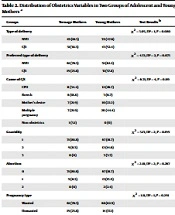
A total of 160 primiparous mothers participated in the study, with 80 adolescent mothers and 80 young mothers. The results indicated that the minimum and maximum ages of adolescent mothers were 15 and 19 years, respectively; however, the young mothers had minimum and maximum ages ranging from 21 to 37 years. Additionally, the minimum and maximum ages of the spouses of adolescent mothers were 19 and 36 years, respectively; nevertheless, the minimum and maximum ages of the spouses of young mothers ranged from 24 to 48 years. A comparison of demographic and obstetric variables between the two groups is provided in Tables 1. and 2.
Table 1.
Distribution of Sociodemographic Variables in Two Groups of Adolescent and Young Mothers a
| Variables | Teenage Mothers | Young Mothers | Test Results |
|---|---|---|---|
| Mother’s age, y | 18.25 ± 1.01 | 29.35 ± 4.15 | Z = -11.12; P < 0.0001 b |
| Spouse’s age, y | 27.26 ± 3.33 | 32.92 ± 4.59 | Z = -7.58; P < 0.0001 b |
| Marriage duration, y | 2.60 ± 1.04 | 4.43 ± 2.23 | Z = -5.76; P < 0.0001 b |
| Mother’s education | χ2 = 78.88; DF = 3; P < 0.0001 c | ||
| Elementary | 38 (47.5) | 13 (15.9) | |
| High school diploma | 40 (50) | 32 (39) | |
| Associate degree/bachelor’s | 2 (2.5) | 31 (37.8) | |
| Above bachelor’s | 0 (0) | 6 (7.3) | |
| Husband’s education | χ2 = 48.73; DF = 3; P < 0.0001 c | ||
| Elementary | 38 (47.5) | 13 (15.9) | |
| High school diploma | 40 (50) | 32 (39) | |
| Associate degree/bachelor’s | 2 (2.5) | 31 (37.8) | |
| Above bachelor’s | 0 (0) | 6 (7.3) | |
| Husband’s occupation | χ2 = 45.16; DF = 4; P < 0.0001 c | ||
| Unemployed | 37 (46.3) | 35 (42.7) | |
| Employed | 5 (6.3) | 23 (28) | |
| Worker | 38 (47.5) | 24 (29.3) | |
| Mother’s occupation | χ2 = 65.2; DF = 1; P = 0.103 c | ||
| Housewife | 4 (5) | 10 (12.2) | |
| Employed | 76 (95) | 72 (87.8) | |
| Income level | X 2= 18.66; DF = 3; P < 0.0001 c | ||
| Low | 41 (51.3) | 17 (20.7) | |
| Medium | 35 (43.8) | 51 (62.6) | |
| Good | 4 (5) | 13 (15.9) | |
| Excellent | 0 (0) | 1 (1.2) | |
| House type | χ2 = 7.11; DF = 2; P = 0.029 c | ||
| Rental | 50 (62.5) | 38 (46.3) | |
| Private | 21 (26.3) | 38 (46.3) | |
| With parent | 9 (11.3) | 6 (7.3) | |
| Ethnicity | χ2 = 6.153; DF = 4; P = 0.169 c | ||
| Lor | 2 (2.5) | 1 (1.2) | |
| Kord | 7 (8.8) | 11 (13.4) | |
| Tork | 50 (62.5) | 60 (73.2) | |
| Fars | 15 (18.8) | 8 (9.8) | |
| Gilak | 6 (7.5) | 2 (2.4) |
a Values are expressed as mean ± SD or No. (%).
b Mann-Whitney U test
c Chi-square test
Table 2.
Distribution of Obstetrics Variables in Two Groups of Adolescent and Young Mothers a
| Groups | Teenage Mothers | Young Mothers | Test Results b |
|---|---|---|---|
| Type of delivery | χ2 = 3.05; DF = 1; P = 0.080 | ||
| NVD | 49 (61.3) | 39 (47.6) | |
| C/S | 31 (38.3) | 43 (52.4) | |
| Preferred type of delivery | χ2 = 4.33; DF = 2; P = 0.073 | ||
| NVD | 61 (76.3) | 51 (62.2) | |
| C/S | 19 (23.8) | 31 (37.8) | |
| Cause of C/S | χ2 = 6.71; DF = 4; P = 0.119 | ||
| CPD | 11 (34.4) | 12 (26.7) | |
| Breech | 6 (18.8) | 3 (6.7) | |
| Mother’s desire | 7 (21.9) | 10 (22.2) | |
| Multiple pregnancy | 7 (21.9) | 20 (44.4) | |
| Non-obstetrics | 1 (3.1) | 0 (0) | |
| Gravidity | χ2 = 3.13; DF = 2; P = 0.199 | ||
| 1 | 71 (88.8) | 67 (81.7) | |
| 2 | 9 (11.3) | 12 (14.6) | |
| 3 | 0 (0) | 3 (3.7) | |
| Abortion | χ2 = 2.81; DF = 2; P = 0.267 | ||
| 0 | 71 (88.8) | 67 (81.7) | |
| 1 | 9 (11.3) | 13 (15.9) | |
| 2 | 0 (0) | 2 (2.4) | |
| Pregnancy type | χ2 = 1.11; DF = 1; P = 0.291 | ||
| Wanted | 61 (76.3) | 68 (82.9) | |
| Unwanted | 19 (23.8) | 14 (17.1) | |
| Pregnancy complications | χ2 = 3.26; DF = 1; P = 0.071 | ||
| Yes | 13 (16.3) | 23 (28) | |
| No | 67 (83.8) | 59 (72) | |
| Delivery intervention | χ2 = 1.98; DF = 1; P = 0.159 | ||
| Yes | 43 (53.8) | 35 (42.7) | |
| No | 37 (46.3) | 47 (57.3) | |
| Childbirth complications | χ2 = 5.08; DF = 1; P = 0.024 | ||
| Yes | 35 (43.8) | 22 (26.8) | |
| No | 45 (56.3) | 60 (73.2) | |
| Pregnancy duration (week) | χ2 = 0.335; DF = 2; P = 0.84 | ||
| < 37 | 11 (13.8) | 6 (7.3) | |
| 37 - 40 | 64 (80v | 67 (81.7) | |
| >40 | 5 (6.3) | 9 (11) | |
| Breastfeeding beginning | χ2 = 4.19; DF = 3; P = 0.259 | ||
| First hour | 47 (58.8) | 37 (45.1) | |
| 1 - 4 hours | 27 (33.8) | 35 (42.7) | |
| 4 - 12 hours | 4 (5) | 4 (4.9) | |
| > 12 hours | 2 (2.5) | 6 (7.3) | |
| Neonate care support | χ2 = 0.965; DF = 1; P = 0.002 | ||
| Yes | 29 (36.2) | 30 (36.6) | |
| No | 51 (63.8) | 52 (63.4) | |
| Housing support | χ2 = 0.299; DF = 1; P = 0.585 | ||
| Yes | 26 (32.5) | 30 (36.4) | |
| No | 54 (67.5) | 52 (63.4) | |
| Attending readiness delivery class | χ2 = 0.582; DF = 1; P = 0.445 | ||
| Yes | 6 (7.5) | 9 (11) | |
| No | 74 (92.5) | 73 (89) | |
| Breast complications | χ2 = 5.582; DF = 1; P = 0.018 | ||
| Yes | 41 (51.3) | 27 (32.9) | |
| No | 39 (48.8) | 55 (67.1) |
Abbreviations: NVD, normal vaginal delivery; C/S, cesarean section; CPD, cephalopelvic disproportion.
a Values are expressed as No. (%).
b Chi-square test
The Kolmogorov-Smirnov test revealed that only total care in the teenage mothers’ group and total transition to motherhood in the young mothers’ group followed a normal distribution. Mann-Whitney U test results, as shown in Table 3, indicated that there were no statistically significant differences between both groups regarding the mean levels of difficulty in transition to motherhood, responsibility and commitment, pleasure and satisfaction, fondness and stability, and self-commitment (P ≥ 0.05).
Table 3.
Comparison of Transition Difficulty to Motherhood and Its Dimensions in Two Groups of Adolescent and Young Mothers
| Groups | Teenage Mothers | Young Mothers | Test Results a | ||||||
|---|---|---|---|---|---|---|---|---|---|
| Minimum | Maximum | Mean ± SD | Mean Rank | Minimum | Maximum | Mean ± SD | Mean Rank | ||
| Difficulty of transition to motherhood | 41 | 129 | 72.47 ± 16.53 | 79.89 | 48 | 110 | 72.97 ± 13.97 | 83.07 | Z = 0.432; P = 0.655 |
| Responsibility and commitment | 16 | 51 | 27.88 ± 7.23 | 76.61 | 17 | 49 | 28.63 ± 6.31 | 84.39 | Z = -1.06; P = 0.288 |
| Pleasure and satisfaction | 12 | 40 | 21.33 ± 5.75 | 84.31 | 14 | 33 | 20.39 ± 4.07 | 78.67 | Z = -0.75; P = 0.45 |
| Fondness and stability | 7 | 23 | 12.81 ± 3.75 | 80.43 | 7 | 21 | 12.87 ± 3.83 | 81.56 | Z = -0.154; P = 0.877 |
| Self- commitment | 6 | 18 | 10.43 ± 3.15 | 78.47 | 6 | 20 | 10.92 ± 3.56 | 83.50 | Z = 0.68; P = 0.49 |
a Mann-Whitney U test
Mann-Whitney U test results, presented in Table 4, revealed statistically significant differences between both groups in terms of the mean ranks of total infant care, child disease care, routine child care, and maternal health (P < 0.05).
Table 4.
Comparison of Infant Care and Its Dimensions in Two Groups of Adolescent and Young Mothers
| Groups | Teenage Mothers | Young Mothers | Test Results a | ||||||
|---|---|---|---|---|---|---|---|---|---|
| Minimum | Maximum | Mean ± SD | Mean Rank | Minimum | Maximum | Mean ± SD | Mean Rank | ||
| Total infant care | 24 | 39 | 33.07 ± 2.77 | 55.98 | 28 | 39 | 34.57 ± 2.65 | 75.93 | Z = -3.03; P = 0.002 |
| Child sick care | 7 | 12 | 10.63 ± 1.30 | 73.96 | 7 | 12 | 11.03 ± 1.20 | 88.85 | Z = - 2.12; P = 0.034 |
| Child health | 2 | 4 | 3.57 ± 0.59 | 81.50 | 2 | 4 | 3.56 ± 0.63 | 81.50 | P = 1 |
| Routine child care | 3 | 8 | 5.38 ± 1.23 | 63.33 | 3 | 8 | 5.83 ± 1.28 | 77.08 | Z = -2.06; P = 0.039 |
| Mother’s health | 10 | 16 | 13.37 ± 1.60 | 63.98 | 10 | 16 | 14.29 ± 1.29 | 90.54 | Z = -3.78; P < 0.0001 |
a Mann-Whitney U test
5. Discussion
This study aimed to compare adolescent and young primiparous mothers in terms of infant care and the difficulty of transitioning to motherhood. In the current study, there were statistically significant differences between both groups regarding sociodemographic factors affecting health, such as educational level and household income level. Adolescent mothers also experienced more childbirth complications and breast problems, which aligns with previous studies’ findings. The aforementioned studies have shown that a majority of adolescent mothers do not have favorable socioeconomic statuses, including income, educational levels, and social support. Teenage mothers are at risk of negative health outcomes, not only due to their age but also due to factors such as poverty and other disparities in the social determinants of health (10, 22-24).
No significant difference was observed between the two groups in terms of the type of delivery, which is consistent with some studies. In these studies, the primary reason for natural births among adolescent mothers was limited access to medical facilities and hospitals. However, in the present study, the existing national guidelines aimed at controlling cesarean section rates were responsible for the prevalence of natural births among them. Furthermore, some studies have suggested higher cesarean section rates among adolescent mothers due to the potential complications during childbirth (25-28).
In the current study, there was no statistically significant difference between both groups in terms of the difficulty of transitioning to motherhood, which is not in line with the findings of existing quantitative studies (23, 24). The cultural differences and the support received from relatives in Iran might have contributed to the different results in the present study in comparison to studies conducted in other countries. Since no significant difference was noticed between the two groups regarding the receipt of support from others in caring for the neonate and household chores, we considered the factor of receiving support to be significant in accepting the role of the mother.
In Iran, most adolescent pregnancies result from legal marriages, and therefore, adolescent mothers often have the support of their families, including their spouses and mothers. Several studies have suggested that social support is essential for teenagers' successful adaptation to the maternal role (29, 30). Social support involves receiving love, care, assistance, and guidance from others. Teenage mothers are often not mentally and emotionally prepared to take on maternal roles and require both support and guidance to learn parenting skills. They need social support for tasks related to caring for and nurturing the newborn, adapting to the newborn’s sleep patterns, and coping with the emotional and physical changes that occur following childbirth. Additionally, social support in areas such as food, clothing, housing, transportation, and other financial matters is necessary for some teenage mothers, particularly in specific circumstances (29).
Social support can play a crucial role in helping teenage mothers raise their children and adjust to the maternal role. It can reduce stress and promote the overall health of teenage mothers (29, 30). Although there were no similar quantitative studies found, qualitative studies have shown consistent results. In Iran, several strategies have been identified that teenage mothers use to succeed in their maternal roles. Optimizing the process of gaining maternal experience and fostering acceptance of motherhood have been identified as key strategies and facilitators of success among adolescent mothers (31). One of the most important strategies employed by Iranian teenage mothers is leveraging their maximum individual abilities, often referred to as resilience, which has been reported in numerous studies. This process enables individuals to overcome challenges, and factors such as self-efficacy, environmental mastery, internal control, and positive relationships with others can contribute to resilience (31-33).
In the current study, a statistically significant difference was observed between both groups in terms of infant care. This difference might be attributed to the lack of sufficient skills among adolescent mothers, who often have lower educational levels and might not utilize informational resources, such as books and the Internet, to the same extent as older mothers. This lack of knowledge and skills in infant care aligns with findings from previous studies (25).
As anticipated, this study revealed that teenage mothers, in addition to their age, differed from the group of young mothers in terms of influential social variables, such as educational level, income, spouse’s occupation, childbirth complications, and breast problems. It is important to note that these factors might have a more significant impact on the experience of assuming the maternal role during adolescence than the mother’s age alone. These varying social factors underscore the need for increased attention to teenage mothers at the community level.
In the present study, the participants completed the questionnaire using a self-reporting method. However, it is worth acknowledging that some respondents might not have provided completely honest answers, which can be considered a limitation of this study. Therefore, it is recommended that further research be conducted in different regions of Iran using various study designs, such as case-control studies.
5.1. Conclusions
Based on the findings of this study, it is evident that teenage mothers require support programs from healthcare providers, especially midwives, and doctors, to empower them to care for their children effectively.