1. Background
Having a healthy family and mental health has a significant influence on the whole community’s mental health. It can affect the dynamism of the family. Now, if a child is born with mental, physical, or behavioral disabilities or even a combination of them, the psychological pressures of having such a child will be multiplied regarding that family (1).
One of the disorders in children that can put huge stress on the family environment, especially mothers, is autism. This disorder is the most well-known widespread developmental disorder, characterized by its obvious and persistent defects and deviations from social communication, limited patterns, and clichés in the interests and behaviors. Despite its low prevalence in the community (about 4 to 5 per 10,000), it still occupies a significant population in specialized pediatric psychiatric clinics (2). Parents of children with autism encounter many problems due to their child’s developmental problems (3). The mother is usually the one who suffers the most severe emotional trauma (4).
In order to explain the need to assess mental health, stress, and coping strategies in autism, we can say that many pieces of evidence have shown that parents of children with a range of autism disorders suffer more problems than parents with normal children and even parents of children with developmental disorders (5). Families with normal and healthy children or even children with other disabilities such as Down syndrome feel less stressed than families of children with autism (6). The results of Pisula and Porebowicz-Dorsmann’s (7) study showed that parents of children with autism have lower mental and physical quality and social relationships since mothers have more problems than fathers due to their assigned roles in the family and marital life. Comparing these mothers with fathers showed that the mothers experienced more stress and anxiety (8).
A systematic review of ten studies showed that autism could severely affect family dynamism (9). One study found that these children’s siblings also suffer from depression and anxiety (10). Also, mothers’ stress with their affected children increases anxiety, emotional instability deteriorating their life quality (11). To avoid these problems, a high number of researches on the phenomenon of exceptional children have been devoted to the effects of such children on the family, especially mothers (2). One of the most common of these stresses is the grief response. Awareness that their child was born with a problem and that the problem will continue causes a process of grief very similar to the grief that a family feels in time of losing a child (12).
Various researchers have identified and introduced various sources of stress. Stressors can be either external or internal (13). Studies have revealed that stress is associated with many mental and physical illnesses, but what can bring hope here are "ways to deal with stress" that can affect the consequences of stress. People use coping strategies to cope with the problem and to avoid the negative consequences of stressful situations (14). The goal is to create a productive and meaningful life for oneself by effectively controlling the pains and tensions forcibly imposed on one’s life (15). The greater a person’s ability to cope, the less likely they are to become traumatized (16). In other words, each person’s vulnerability to stress is affected by one’s coping skills (17).
The prevalence of autism in Iran does not have any accurate statistics, but if in our country, like in the United States, accurate diagnostic tools and qualified specialists are used to diagnose autism spectrum disorder, the statistics can be worrying (especially in large industrial cities).
2. Objectives
Given the aforementioned importance of family and also improving the health of families with autistic children, this study aimed to answer the question of whether there was a relationship between mental health, stress, and coping strategies in mothers of autistic/non- autistic children. Also, was there a significant difference in Ahvaz city? Actually, the novelty of this study is to check the relationship among Mental Health, Stress, and Coping Methods in Mothers of Children with/without Autism in Ahvaz City.
3. Methods
The present study was a descriptive-analytical study, which compares the mental health, stress, and coping styles of mothers of children with autism with mothers of normal children in Ahvaz.
3.1. Population and Sampling
The statistical population of this study included all mothers of children with autism and also those with normal children in Ahvaz. From the statistical population of the study, 120 (60 mothers with children with autism and 60 mothers with normal children) were selected as a sample through the convenience sampling method and based on Morgan table. Regarding level of education, in the group of mothers of children with autism, the highest frequency was bachelor’s degree, including 35 mothers (58.33%), and the lowest frequency was master’s degree, including two mothers (3.34%). In the group of mothers with normal children, the highest frequency was bachelor’s degree, including 26 mothers (43.33%), and the lowest frequency was master’s degree or higher, including one mother (1.67%). Furthermore, the mean age of the mothers of autistic children was 32.47 years, with the standard deviation of 4.54, and the mean age of mothers of normal children was 32.60 years, with the standard deviation of 4.52.
Inclusion criteria were mothers whose children’s autism had been previously diagnosed by a psychiatrist, no history of hospitalization in psychiatric hospitals and use of certain medications, and consent to participate in the study. The exclusion criteria were not completing the questionnaire, lack of favorable cooperation in the interview session, and absence of more than one session. The inclusion criteria for mothers of normal children were the same, including no autism diagnosis for their children, based on a psychiatrist’s diagnosis, and no severe and chronic physical and mental problems.
Descriptive, inferential statistics (MANOVA and ANOVA) were all used to analyze the data. Stress, mental health, problem-oriented coping style, excitement-oriented coping style, avoidance coping style, and SPSS 21 were all used to control the variables.
3.2. Instruments
3.2.1. Mental Health Questionnaire
Goldberg and Hiller’ (18) Mental Health Questionnaire was used to assess mental health. This questionnaire is largely used to identify mental and non-psychotic disorders in various conditions and has four components: physical symptoms, anxiety and insomnia, social dysfunction, and depression. Each component consists of seven items. The responses are rated on a four-point Likert scale ranging from (0) to (3) high. Taghavi (19) calculated its reliability coefficients using three methods of test-retest, split half, and Cronbach's alpha, which were 0.70, 0.73, and 0.90, respectively. In the present study, the Cronbach's alpha coefficient was 0.83 for the mothers of children with autism; it was 0.86 for mothers with normal children, and it was 0.87 for all subjects.
3.2.2. Stress Questionnaire
Everly and Girdano’s (20) stress questionnaire was used to measure the stress. This questionnaire has 14 items and measures four components of haste (6 items), competitiveness (4 items), greed (2 items), and doing a job without proper planning (2 items). Responses are rated on a four-point Likert scale ranging from 0 (never applies to me) to 3 (always applies to me). Everly and Girdano (20) reported the reliability coefficient of 0.91 for this questionnaire.
3.2.3. Scale for Coping with Stressful Situations
Endler and Parker's (21) Scale for Coping with Stressful Situations was used to measure the coping strategies. This scale comprises 48 articles, three problem-oriented strategies, oriented excitement strategies, avoidance. The answers are based on a five-point Likert, i.e., one (for almost not) and up to five (for too many). Qureishirad (22) calculated the reliability coefficients of the scale for coping with stressful situations using Cronbach's alpha method for its problem-oriented, excitement-oriented, and avoidance subscales which were 0.86, 0.81, and 0.79, respectively. Cronbach's alpha was used to measure the reliability of this scale in this study. In mothers with autistic children, the coefficients of problem-oriented, excitement-oriented, and avoidance scales were 0.75, 0.73, and 0.76, respectively. In mothers with normal children, coefficients for problem-oriented, excitement-oriented, and avoidance subscales were 0.73, 0.73, and 0.82, respectively. The reliability coefficient equaled 0.93, 0.75, and 0.82 for all the subjects regarding the same subscales.
3.3. Ethical Consideration
This article is part of the master’s thesis and is approved by the Ethics Committee of the Islamic Azad University, Ahvaz branch (code: 1608). We considered anonymity and confidentiality of the participants in this study.
3.4. Statistical Analysis
The data were analyzed by descriptive, inferential (MANOVA and ANOVA) statistics by SPSS software version 21.
4. Results
Table 1 shows the descriptive statistics, including the mean and the standard deviation of the research variables.
Table 1.
Descriptive Statistics of Research Variables a
| Variable | Mothers of Autistic Children | Mothers of Normal Children |
|---|---|---|
| Mental health | 41.82 ± 10.92 | 49.28 ± 9.95 |
| Stress | 24.32 ± 3.08 | 20 ± 3.85 |
| Problem-oriented coping strategy | 34.07 ± 4.35 | 50.63 ± 5.40 |
| Excitement-oriented coping strategy | 47.13 ± 5.37 | 43.93 ± 5.39 |
| Avoidance coping strategy | 43.73 ± 7.12 | 37.88 ± 7.88 |
aValues are expressed as mean ± SD.
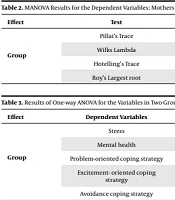
As seen in Table 1, for the variables of stress, excitement-oriented coping strategy, and avoidance coping strategy, the mean of the mothers of autistic children was higher, while for the variables of mental health and problem-oriented coping strategy, the mean of the mothers of normal children was higher. To evaluate the differences between the two groups in terms of research dependent variables, the multivariate analysis of variance (MANOVA) was performed. Table 2 shows its results.
Table 2.
MANOVA Results for the Dependent Variables: Mothers with Autistic Children and Mothers with Normal Children
| Effect | Test | Value | F | Hypothesis df | Error df | P |
|---|---|---|---|---|---|---|
| Group | Pillai's Trace | 0.816 | 100.88 | 5 | 114 | 0.001 |
| Wilks Lambda | 0.184 | 100.88 | 5 | 114 | 0.001 | |
| Hotelling's Trace | 4.42 | 100.88 | 5 | 114 | 0.001 | |
| Roy's Largest root | 4.42 | 100.88 | 5 | 114 | 0.001 |
As the results in Table 2 show, there is a significant difference between mothers of autistic children and mothers of normal children in terms of at least one of the dependent variables, i.e., stress, mental health, problem-oriented coping style, emotional coping style, and avoidance coping style (F = 100.88, P < 0.001). For a more detailed examination, the one-way ANOVA was performed on dependent variables.
Table 3 shows the results of one-way analysis of variance to compare the dependent variables i.e., stress, mental health, problem-oriented coping style, excitement-oriented coping style, and avoidance coping style in mothers of autistic children and mothers of normal children.
Table 3.
Results of One-way ANOVA for the Variables in Two Groups: Mothers of Autistic Children and Mothers of Normal Children
| Effect | Dependent Variables | Sum of Squares | df | Mean Squares | F | P |
|---|---|---|---|---|---|---|
| Group | Stress | 559 | 1 | 559 | 38.24 | 0.001 |
| Mental health | 1672.53 | 1 | 1672.53 | 15.32 | 0.001 | |
| Problem-oriented coping strategy | 8233.63 | 1 | 8233.63 | 342.14 | 0.001 | |
| Excitement- oriented coping strategy | 310.4 | 1 | 310.4 | 10.71 | 0.001 | |
| Avoidance coping strategy | 1026.67 | 1 | 1026.67 | 18.21 | 0.001 |
As the results in Table 3 reveal, the analysis of one-way variances regarding the stress variable is significant (F = 38.24, P < 0.001). According to Table 1, the stress level is different between these two groups. One-way ANOVA in mental health variables is significant (F = 15.32, P < 0.001). According to Table 1, the mental health of mothers with autistic children and mothers with normal children is significantly different. One-way ANOVA is significant in the problem-oriented coping style variable (F = 342.14, P < 0.001). According to Table 1, there is a significant difference between mothers with autistic children and those with normal children regarding the coping style.
One-way ANOVA in the excitement-oriented coping style variable is significant (F = 10.71, P < 0.001). The results of Table 1 show the significant differences between mothers who have children and mothers with normal children. It is how hypothesis four is confirmed. One-way ANOVA was significant in terms of the avoidance coping style variable (F = 18.21, p < 0.001). According to Table 1, there are significant differences between the mothers with autistic children and mothers with normal children regarding the avoidance coping style.
5. Discussion
In order to explain the similarities and differences in results, it can be said that mental health findings showed a significant difference between the two groups, i.e., the mothers of autistic children and mothers of normal children. It is shown that mothers of autistic children enjoy lower mental health than the mothers of normal children. The process of giving birth to a child is enjoyable for the parents, but as soon as the parents become aware that their child is disabled, all wishes and hopes turn into despair, and then problems begin.
A mother’s encounter with her disabled child disrupts and destroys her normal, and she has to put up with the different types of stress such as the child’s stereotypes, language problems, and lack of self-care skills. This is why there is a higher rate of mental disorders in mothers of autistic children compared with the mothers of normal children. Overall, these conditions can lead to isolation and lack of interest in establishing a relationship with the environment, as well as low self-esteem and worthlessness in the mother, which, in turn, can result in depression (23). However, Malekpour (24) also showed that depression was one of the most common reactions of parents of mentally retarded children.
Stress-related findings showed a significant difference between the two groups of mothers. It means that mothers of autistic children experience far more stress than mothers of normal children. These findings are in line with the findings in the study by Malekpour (24). It can be said that mothers of autistic children face higher levels of recurrent stress and more severe psychotic symptoms compared to parents of normal children or even those who have other mental/physical conditions (25). One of the main sources of stress for parents of children with autism is the child’s characteristics such as verbal problems, cognitive instabilities, behavioral problems, inadaptability, and severity of these disabilities (26). Mothers of autistic children consistently report high levels of psychological distress, including parental stress, symptoms of depression, and social isolation (27).
Findings related to task-oriented, excitement-oriented, and avoidance-oriented coping strategies between the mothers of autistic children and mothers of normal children showed a significant difference purporting to the fact that mothers of autistic children employ fewer task-oriented coping strategies compared to mothers with normal children (28). Mothers of autistic children follow more emotion-oriented and avoidance coping strategies than the other group. According to Gupta (29), parents of autistic children are less likely to be seen in family and friends’ gatherings because of their children’s obvious disabilities, so they enjoy less support from their friends and families.
Every study has limitations, and some of the most important limitations of the present study are as follows: Since the instruments used in this study were self-assessment questionnaires, their limitations should be considered. Since the present study was performed on mothers of autistic children and mothers of normal children in Ahvaz, so caution should be exercised in generalizing the results to other cases. The present study is a cross-sectional study, and therefore, it is difficult to generalize to cause-effect studies.
We can use the findings of this study in clinical situations to help mothers with autistic children to reduce their stress, so they can control their lives better with less stress and this way, the quality of their lives will be higher.
5.1. Conclusions
The results of this study are in line with other similar studies. Besides, as the results showed, mothers of normal children were significantly different from mothers of autistic children in using avoidance-oriented coping styles. Avoidance style describes behavioral efforts to escape or evade a problem. Excitement-oriented coping styles are less useful methods that do not work well in reducing stress and sometimes backfire.
The task-oriented strategy requires information about the tense situation and its possible consequences. Mothers of normal children who use this strategy try to prioritize their activities according to their importance and focus on time management to complete the activities. The excitement-oriented strategy also requires new ways to control the emotions and try to be hopeful in case of facing stressful situations. Mothers of autistic children, who use this strategy while controlling their emotions, may show anger or frustration outbursts. Also, avoidance strategies require denying or minimizing stressful situations. The task-oriented strategy is the most effective when mothers of autistic children can logically classify the existing stressful situations, but if such mothers are unable to anticipate stressful situations and adopt solutions; an excitement-oriented strategy proves to be more effective, as reported by (29).
It is suggested that longitudinal research should be conducted in the future to find the possible causal-effect relationship of the variables under the study. The comparison between the findings of this study with other findings leads to a better understanding of the phenomena under the study. Training courses should be held for mothers to improve mental health and reduce anxiety, stress management, and stress reduction. Parents should get acquainted with a variety of coping strategies and their negative and positive consequences so that they can use these strategies more properly.