
1. Background
Adolescent pregnancy remains an important public health issue in many countries, including Taiwan. Although overall fertility rates have declined in recent decades, adolescent childbearing continues to persist and remains a concern for governments, healthcare systems, and social services (1). Infants born to adolescent mothers are also more likely to experience adverse birth outcomes, including preterm birth and low birth weight (2). These complications may contribute to increased healthcare utilization and may place additional burdens on families and healthcare systems. Pregnant adolescents are therefore considered a high-risk group, with higher risks of abortion, miscarriage, low birth weight, and premature birth (3-6). Due to limited parenting experience and insufficient infant care knowledge, adolescent mothers may also face challenges in providing adequate infant care, potentially leading to increased risks of infant illness and accidents (7, 8).
Previous studies have primarily focused on pregnancy outcomes among adolescent mothers, while relatively fewer studies have examined the health and healthcare utilization of infants born to adolescent mothers after birth. Differences in early infant medical utilization—including outpatient visits, emergency care, and hospitalization during the first months of life—may be related not only to biological vulnerability associated with maternal age but also to maternal behaviors and infant care practices. Recent studies have suggested that adolescent mothers may face greater challenges during the transition to motherhood compared with young adult mothers, including lower parenting confidence, limited social support, and reduced access to healthcare resources (9). These factors may influence infant health outcomes as well as healthcare-seeking behaviors. Recent studies have also reported lower vaccination coverage and delayed immunization timeliness among children born to adolescent mothers (10, 11). Recent reviews have also highlighted the importance of providing specialized antenatal and postnatal care models to improve health outcomes among adolescent mothers and their children (12, 13). Nevertheless, although adolescent fertility has been widely recognized as an important demographic and public health issue, relatively few population-based studies have specifically examined healthcare utilization patterns among infants born to adolescent mothers (10, 14-16).
2. Objectives
A comprehensive investigation of the health of adolescent mothers and their children was performed with data collected by the Taiwan Birth Cohort Study (TBCS). The purpose of the study is to investigate the medical utilization difference between infants born to adolescent mothers and adult mothers. We hope that the results from this study can be used in formulating constructive suggestions for the government and society to create an environment that ensures the safety of each childbirth and the health of each child.
3. Methods
3.1. Research Design and Study Population
This study employed a cross-sectional analytical design using data derived from the TBCS, a nationally representative, population-based birth cohort in Taiwan (17). The present analysis was based on infants followed from birth to 6 months of age as part of the cohort framework.
The TBCS enrolled a nationally representative sample of newborns through a multistage stratified random sampling process. Infants included in this analysis were born during the study recruitment period and had complete birth and follow-up information at 6 months of age.
3.2. Data Collection and Follow-up
Data were collected through standardized, structured questionnaire interviews conducted by trained field interviewers during home visits. Birth-related information, including gestational age, birth weight, and mode of delivery, was obtained from official birth certificates.
Follow-up data on infant healthcare utilization and immunization status were collected at 6 months of age through face-to-face interviews with the primary caregivers, primarily the mothers, as part of the routine follow-up procedures of the TBCS.
The study protocol was approved by the institutional review board, and written informed consent was obtained from all participants prior to data collection.
3.3. Data Analysis
The completed questionnaires were entered into the computer database for consolidation. The consolidated data were analyzed with SPSS PC 18.0, and the performed statistical analysis is detailed as follows: (1) Single variable descriptive and dual variable statistical analysis: In this study, descriptive analysis of categorical and continuous variables was performed to compare number, percentage, and mean ± standard deviation; t test and χ² test were performed for dual variable analysis, and the deviations were assessed with Z verifications; (2) The variables of medical utilization (outpatient, emergency, and inpatient services) that were determined to be significant by the single variable analysis were further analyzed by logistic regression or multilevel logistic regression to determine their correlations.
4. Results
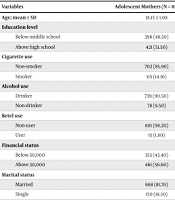
The cases recorded during the first phase investigation consisted of 818 and 16,996 adolescent (between the ages of 12 to 19) and adult (between the ages of 20 to 34) mothers, respectively. The basic demographic information and health behaviors comparison between the two groups are listed in Table 1. The comparison showed the following findings: compared to adult mothers, infants born to adolescent mothers have significantly lower weight (3136.28 g ± 518.09 and 3035.83 g ± 498.07, respectively). The rate of premature births is also higher in adolescent mothers than adult mothers.
Table 1.
Socio-demographic and Health Behaviors of Mothers a
| Variables | Adolescent Mothers (N = 818); No. (%) | Adult Mothers (N = 16996); No. (%) | P-Value b |
|---|---|---|---|
| Age; mean ± SD | 18.15 ± 1.08 | 27.35 ± 3.74 | < 0.001 |
| Education level | < 0.001 | ||
| Below middle school | 396 (48.50) | 2272 (13.40) | |
| Above high school | 421 (51.50) | 14697 (86.60) | |
| Cigarette use | < 0.001 | ||
| Non-smoker | 702 (85.90) | 15896 (93.60) | |
| Smoker | 115 (14.10) | 1093 (6.40) | |
| Alcohol use | 0.656 | ||
| Drinker | 739 (90.50) | 15445 (90.90) | |
| Non-drinker | 78 (9.50) | 1544 (9.10) | |
| Betel use | 0.001 | ||
| Non-user | 801 (98.20) | 16858 (99.30) | |
| User | 15 (1.80) | 126 (0.70) | |
| Financial status [New Taiwan Dollars (NTD)] | < 0.001 | ||
| Below 30,000 | 353 (43.40) | 1781 (10.50) | |
| Above 30,000 | 461 (56.60) | 15166 (89.50) | |
| Marital status | < 0.001 | ||
| Married | 668 (81.70) | 16484 (97.00) | |
| Single | 150 (18.30) | 512 (3.00) | |
| Nationality | < 0.001 | ||
| Taiwan | 526 (64.30) | 14755 (86.80) | |
| Foreign | 292 (35.70) | 2241 (13.20) | |
| Delivery | < 0.001 | ||
| Regular | 671 (82.00) | 11560 (68.00) | |
| Cesarean section | 147 (18.00) | 5436 (32.00) | |
| Parity | < 0.001 | ||
| Multiple | 113 (13.80) | 8297 (48.80) | |
| First born | 705 (86.20) | 8699 (51.20) | |
| Prenatal examination | < 0.001 | ||
| More than 10 times | 622 (76.00) | 14448 (85.00) | |
| Less than 10 times | 193 (24.00) | 2548 (15.00) | |
| Weight increase (kg) | < 0.001 | ||
| More than 12 | 504 (61.60) | 11848 (69.70) | |
| Less than 12 | 314 (38.40) | 5142 (30.30) | |
| Birthing complications | 0.014 | ||
| No | 720 (88.00) | 14424 (84.90) | |
| Yes | 98 (12.00) | 2571 (15.10) |
a Excluded artificial insemination, multiple births, and congenital anomalies.
b Verified with χ2 test and t-test.
The comparison of outpatient, emergency, and inpatient service usage of 6-month-old infants between the two groups is listed in Table 2. The medical utilization rate for infants born to adolescent mothers was 2.1, 17.1, and 11.9% for outpatient, emergency, and inpatient services, respectively. The medical utilization rate for infants born to adult mothers was 1.2, 15.4, and 12.3% for outpatient, emergency, and inpatient services, respectively. Infants born to adolescent mothers have a higher rate of outpatient service visits (2.1%) than those born to adult mothers (1.2%). There were no statistical differences between the groups for emergency and inpatient services. Furthermore, there was no statistical difference for inpatient frequencies between the two groups (adolescent group: 1.11 ± 0.35 times versus adult group: 1.16 ± 0.57 times).
Table 2.
Utilizations of Outpatient, In-Patient, Emergency and Immunizations a
| Variables | Adolescent Mothers (N = 818) | Adult Mothers (N = 16996) | P-Value b | All Mothers |
|---|---|---|---|---|
| Outpatient | 17 (2.10) | 198 (1.20) | 0.019 | 229 (1.20) |
| Emergency | 140 (17.10) | 2611 (15.40) | 0.175 | 2965 (15.20) |
| Inpatient | 97 (11.90) | 2092 (12.30) | 0.701 | 2360 (12.10) |
| Number of inpatients; mean ± SD | 1.11 ± 0.35 | 1.16 ± 0.57 | 0.395 | 1.16 ± 0.55 |
| Vaccination | ||||
| Hepatitis B immunoglobulin | 21 (2.60) | 1051 (6.20) | < 0.001 | |
| Bacillus Calmette–Guérin | 809 (99.50) | 16912 (99.60) | 0.625 | |
| Hepatitis B | 810 (99.60) | 16953 (99.90) | 0.103 | |
| Polio(oral or injectable) | 799 (98.30) | 16862 (99.30) | 0.001 | |
| Diphtheria tetanus pertussis vaccine | 797 (98.00) | 16838 (99.20) | 0.001 | |
| Haemophilus type B vaccine (premium) | 238 (29.30) | 9031 (53.20) | < 0.001 |
a Values are expressed as No. (%) unless otherwise indicated.
b Verified with χ2 test; P-values less than 0.05 are considered significant.
The comparison between the two groups revealed that infants born to adolescent mothers had a lower rate of receiving hepatitis B immune globulin vaccine, diphtheria tetanus pertussis vaccine, polio vaccine (oral), and B-type haemophilus vaccine than those born to adult mothers (shown in Table 2).
The comparison of outpatient service visit rate predicting factors between the two groups revealed that education level is a significant factor in the adolescent group (OR = 3.12, 95% CI 1.01, 9.66). The higher the adolescent mother’s education level, the higher rate of outpatient service visits was observed for their children.
The comparison of emergency service rate predicting factors between the two groups revealed that infants born to foreign adolescent mothers had a significantly lower rate of emergency service visits (OR = 0.6, 95% CI 0.4, 0.9). Furthermore, those infants whose daytime caretaker were their parents are associated with a higher rate of emergency service visits (OR = 1.69, 95% CI 1.08, 2.63).
The comparison of inpatient service rate predicting factors between the two groups revealed that infants born to adolescent mothers who were of foreign nationality, whose education level, maternal parity, the infant’s primary daytime caregiver, breastfeeding, and vaccinations were not significant factors for predicting the inpatient rate of infants.
All the related factors that are related to the outpatient service utilization rate of 6-month-old infants were analyzed with the logistic regression model and the data are shown in Table 3, Model I. These factors include maternal influences such as age, education level, nationality, cigarette or betel use during pregnancy, number of prenatal examinations, financial status, marital status; infancy factors such as gender, premature birth, birth weight, and maternal parity; and upbringing factors such as day/nighttime primary caregivers, and vaccination. Aside from the aforementioned maternal and infancy factors, the effect of parenting education factors was also investigated. These factors include daytime and nighttime primary caregiver and complete vaccination. The data are shown as Model III. The mother’s age is significantly related to the outpatient service utilization rate of 6-month-old infants, where the older the mother, the higher the rate of outpatient service utilization (OR = 0.96, P = 0.03). Other affecting factors include alcohol usage during pregnancy (OR = 1.72, P = 0.005), first-borns (OR = 1.7, P < 0.001), less than 10 prenatal examinations (OR = 1.52, P = 0.015), and foreign mothers (OR = 0.43, P = 0.001). Those infants whose primary nighttime caretaker were their parents also had a higher rate of outpatient service utilization (OR = 1.70, P = 0.016) (Table 3).
Table 3.
Logistic Regression Analysis for Utilization of Outpatient Services
| Variables | Model I | Model II | Model III | |||
|---|---|---|---|---|---|---|
| OR (95% CI) | P-Value | OR (95% CI) | P-Value | OR (95% CI) | P-Value | |
| Age | 0.95 (0.90, 0.99) | 0.009 | 0.96 (0.93, 1.00) | 0.030 | ||
| Education level (above high school vs. below middle school) | 1.26 (0.77, 2.06) | 0.354 | ||||
| Cigarette use (yes vs. no) | 1.02 (0.62, 1.69) | 0.943 | ||||
| Alcohol use (yes vs. no) | 1.69 (1.14, 2.50) | 0.009 | 1.72 (1.17, 2.52) | 0.005 | ||
| Number of prenatal examinations (less than 10 vs. more than 10) | 1.43 (1.02, 2.01) | 0.038 | 1.52 (1.08, 2.13) | 0.015 | ||
| Financial status (more than 30,000 vs. less than 30,000) | 0.79 (0.53, 1.20) | 0.272 | ||||
| Marital status (single vs. married) | 1.40 (0.79, 2.49) | 0.249 | ||||
| Nationality (Foreign vs. Taiwanese) | 0.57 (0.33, 1.00) | 0.050 | 0.43 (0.26, 0.72) | 0.001 | ||
| Infant gender (female vs. male) | 0.96 (0.73, 1.26) | 0.775 | ||||
| Low birth weight (yes vs. no) | 1.08 (0.49, 2.38) | 0.856 | ||||
| Pregnancy terms (preterm vs. non-preterm) | 1.29 (0.68, 2.44) | 0.436 | ||||
| Parity (first born vs. multiple) | 1.76 (1.32, 2.33) | < 0.001 | 1.70 (1.27, 2.28) | < 0.001 | ||
| Complete vaccination (no vs. yes) | 1.04 (0.51, 2.13) | 0.907 | ||||
| Daytime care giver (parents vs. others) | 1.13 (0.83, 1.52) | 0.442 | ||||
| Nighttime care giver (parents vs. others) | 1.70 (1.10, 2.61) | 0.016 | ||||
| -2Log Likelihood | 2267.65 | 2309.09 | 2266.68 | |||
All the related factors that are related to the emergency service utilization rate of 6-month-old infants were analyzed with the logistic regression model and the data are shown in Table 4, Model I. Despite the differences among different mother demographic characteristics, after adjusting for all the related factors, there is no significant difference that was determined between adolescent and adult mothers.
Table 4.
Logistic Regression Analysis for Utilization of Emergency Services
| Variables | Model I | Model II | Model III | |||
|---|---|---|---|---|---|---|
| OR (95% CI) | P-Value | OR (95% CI) | P-Value | OR (95% CI) | P-Value | |
| Age | 0.98 (0.97, 0.99) | 0.001 | 0.98 (0.97, 0.99) | < 0.001 | ||
| Education level (above high school vs. below middle school) | 0.88 (0.76, 1.01) | 0.064 | ||||
| Cigarette use (yes vs. no) | 1.24 (1.06, 1.45) | 0.009 | 1.30 (1.12, 1.51) | 0.001 | ||
| Alcohol use (yes vs. no) | 0.92 (0.79, 1.06) | 0.255 | ||||
| Number of prenatal examinations (less than 10 vs. more than 10) | 1.19 (1.07, 1.33) | 0.002 | 1.16 (1.04, 1.30) | 0.009 | ||
| Financial status (more than 30,000 vs. less than 30,000) | 0.90 (0.79, 1.02) | 0.101 | ||||
| Marital status (single vs. married) | 1.11 (0.90, 1.37) | 0.321 | ||||
| Nationality (Foreign vs. Taiwanese) | 0.76 (0.66, 0.88) | < 0.001 | 0.82 (0.72, 0.93) | 0.003 | ||
| Infant gender (female vs. male) | 0.80 (0.74, 0.87) | < 0.001 | 0.80 (0.74, 0.87) | < 0.001 | ||
| Low birth weight (yes vs. no) | 0.98 (0.76, 1.25) | 0.851 | ||||
| Pregnancy terms (preterm vs. non-preterm) | 1.28 (1.06, 1.56) | 0.011 | 1.21 (1.05, 1.38) | 0.006 | ||
| Parity (first born vs. multiple) | 1.10 (1.01, 1.19) | 0.028 | 1.07 (0.98, 1.17) | 0.113 | ||
| Complete vaccination (no vs. yes) | 0.88 (0.70, 1.11) | 0.288 | ||||
| Daytime care giver (parents vs. others) | 1.01 (0.92, 1.11) | 0.844 | ||||
| Nighttime care giver (parents vs. others) | 1.18 (1.05, 1.33) | 0.005 | ||||
| -2Log Likelihood | 1519.22 | 1528.61 | 1521.46 | |||
All the related factors that are related to the inpatient service utilization rate of 6-month-old infants were analyzed with the logistic regression model and the data are shown in Table 5, Model I. Despite the differences among different mother demographic characteristics, after adjusting for all the related factors, there is no significant difference that was determined between adolescent and adult mothers.
Table 5.
Logistic Regression Analysis for Utilization of In-Patient Services
| Variables | Model I | Model II | Model III | |||
|---|---|---|---|---|---|---|
| OR (95% CI.) | P-Value | OR (95% CI.) | P-Value | OR (95% CI.) | P-Value | |
| Age | 0.99 (0.98, 1.00) | 0.210 | ||||
| Education level (above high school vs. below middle school) | 0.82 (0.71, 0.96) | 0.011 | 0.87 (0.77, 0.98) | 0.026 | ||
| Cigarette use (yes vs. no) | 1.20 (1.01, 1.43) | 0.043 | 1.22 (1.03, 1.45) | 0.019 | ||
| Alcohol use (yes vs. no) | 1.04 (0.89, 1.22) | 0.608 | ||||
| Number of prenatal examinations (less than 10 vs. more than 10) | 1.10 (0.97, 1.24) | 0.123 | ||||
| Financial status (more than 30,000 vs. less than 30,000) | 0.89 (0.78, 1.03) | 0.123 | ||||
| Marital status (single vs. married) | 0.85 (0.66, 1.09) | 0.205 | ||||
| Nationality (Foreign vs. Taiwanese) | 0.88 (0.75, 1.04) | 0.135 | ||||
| Infant gender (female vs. male) | 0.74 (0.67, 0.81) | < 0.001 | 0.74 (0.67, 0.81) | < 0.001 | ||
| Low birth weight (yes vs. no) | 0.94 (0.73, 1.21) | 0.642 | ||||
| Pregnancy terms (preterm vs. non-preterm) | 1.60 (1.31, 1.95) | < 0.001 | 1.54 (1.34, 1.76) | < 0.001 | ||
| Parity (first born vs. multiple) | 0.82 (0.75, 0.90) | < 0.001 | 0.83 (0.76, 0.91) | < 0.001 | ||
| Complete vaccination (no vs. yes) | 1.10 (0.86, 1.40) | 0.459 | ||||
| Daytime care giver (parents vs. others) | 1.05 (0.95, 1.17) | 0.310 | ||||
| Nighttime care giver (parents vs. others) | 1.19 (1.04, 1.36) | 0.011 | ||||
| -2Log Likelihood | 1317.96 | 1317.32 | 1310.51 | |||
5. Discussion
This longitudinal investigation for the comparison of adolescent and adult mothers in Taiwan has revealed similar results to other studies. Infants born to adolescent mothers, compared to adult mothers, are often of lower birth weight and have higher chances of premature birth (18). In the present study, the rate of premature birth among infants born to adolescent mothers was 12.7%, and the proportion of underweight infants was 8.3%. These findings are consistent with previous international studies indicating that adolescent pregnancy is associated with increased risks of premature birth and low birth weight, as reported in recent epidemiological studies and systematic reviews (1, 2). Similar trends have been reported in various countries and regions, suggesting that younger maternal age remains an important risk factor for adverse neonatal outcomes. Despite differences in healthcare systems and sociocultural contexts, the patterns observed in Taiwan appear broadly comparable to those reported internationally (1). These results suggest that regardless of the impact of social and cultural factors, the severity of the Taiwan adolescent fertility results is comparable to Western countries (14, 19).
In this study, the rate of outpatient service utilization of 6-month-old infants born to adolescent mothers is higher than those born to adult mothers, which is consistent with recent studies reporting disparities in infant healthcare utilization among children of adolescent mothers (10, 20). However, no significant differences were observed in emergency service utilization or inpatient admission rates between infants born to adolescent mothers and those born to adult mothers. One possible explanation is the relatively young age of the infants included in this study (6 months). At this developmental stage, infants have limited mobility and are less exposed to environmental injury risks compared with older children. Therefore, the risk of accidents or trauma that might require emergency services or hospitalization remains relatively low. This may explain why no significant differences were observed in emergency or inpatient service utilization between the two groups. Literature research revealed that there are very few Taiwanese studies that have focused on infant accidents, and research depicting the patterns of children’s healthcare utilization. Future investigations may be useful to investigate the difference in medical utilization rate of children of different ages.
Investigation into the predicting factors of outpatient service utilization rate revealed that in the adolescent mothers’ group, the higher the mother’s education level, the higher the rate of the infants’ outpatient service utilization. In the adult mothers’ group, mothers of other nationalities, when compared to mothers of Taiwan nationality, have a lower rate of infant outpatient service utilization (OR = 0.58, 95% CI 0.35, 0.96). Furthermore, first born (OR = 1.76, 95% CI 1.31, 2.35), single mothers (OR = 2.49, 95% CI 1.44, 4.32), and parents being the infant’s primary nighttime caregivers (OR = 1.69, 95% CI 1.11, 2.57) are associated with a higher rate of outpatient service utilization.
A previous study (14) indicated that significant factors predicting healthcare utilization among infants born to both adolescent and adult mothers included maternal characteristics (age, education level, nationality, cigarette or betel nut use during pregnancy, number of prenatal examinations, financial status, and marital status), infant characteristics (sex, preterm birth, birth weight, and parity), and caregiving factors (daytime and nighttime primary caregivers and vaccination status). Another previous study has also reported lower immunization coverage, delayed vaccination, and vaccination disparities among children born to adolescent mothers, highlighting disparities in preventive healthcare utilization in this population (10, 11, 21). After adjusting for maternal, infant, and caregiving factors, multilevel logistic regression analysis demonstrated that older maternal age was associated with lower outpatient service utilization rates.
Previous studies have suggested that social support plays an important role in helping adolescent mothers adapt to their parenting roles. Adequate family and professional support may improve maternal confidence, increase infant care knowledge, and reduce parenting stress. These factors may influence maternal decision-making and healthcare-seeking behaviors for infants. Recent studies have also emphasized that targeted antenatal education and support programs may improve parenting skills and maternal–infant relationships among adolescent mothers, although the extent to which such interventions affect infant healthcare utilization remains unclear (13, 22).
One limitation of this study is that the data were collected between 2005 and 2006. However, the primary objective was not to describe short-term temporal trends but to examine structural differences in healthcare utilization between infants born to adolescent and adult mothers within a nationally representative birth cohort. The TBCS provides important baseline evidence for understanding caregiving- and behavior-related mechanisms associated with adolescent motherhood, which remain relevant to current healthcare planning and policy development despite changes in healthcare systems over time (23). Although this study was conducted using data from Taiwan, the TBCS is a nationally representative birth cohort. Therefore, the observed patterns of healthcare utilization among infants born to adolescent mothers may be generalizable to populations in settings with similar healthcare systems and sociodemographic contexts.