
1. Background
Teaching pharmacology in anesthesia nursing education presents unique challenges, including the need for rapid intraoperative decision-making, the management of complex drug interactions, and the prevention of medication errors in high-stakes operating room environments (1). The operating room requires robust pharmacological knowledge not only to optimize therapeutic outcomes but also to minimize adverse effects and enhance patient safety (2, 3).
Clinical internships provide invaluable opportunities for students to apply theoretical knowledge in authentic clinical settings (4, 5). However, studies consistently show that nursing and anesthesia students often feel inadequately prepared in pharmacological principles, primarily because of superficial teaching methods and ineffective integration of the basic sciences with clinical education (6, 7). In Iranian anesthesia nursing education, a substantial gap exists between the foundational pharmacology course and the clinical internship, with no structured mechanism to reinforce pharmacological principles during clinical practice.
This theory–practice gap results in the decay of pharmacological knowledge and impaired clinical decision-making, ultimately threatening patient safety in high-stakes operating room environments. Strategic integration of the basic and clinical sciences within medical curricula has been shown to optimize learning and knowledge transfer (8). Although the Kern model has been applied in nursing education, to the best of our knowledge, no study has specifically used this model to design and test a structured pharmacology integration module for anesthesia nursing interns during their clinical internship. Moreover, the combination of concept mapping, a flipped classroom, scenario-based learning, and gamification within a single integrated module has not previously been tested in anesthesia nursing education.
Addressing this gap is important for several reasons. Theoretically, it tests cognitive integration theory in anesthesia nursing education. Practically, strengthening pharmacological knowledge during clinical training is a critical step toward reducing medication errors and promoting safer patient care. Demonstrating the effectiveness of this model may provide evidence for curriculum policymakers to consider similar structured programs in anesthesia nursing internships. Cognitive integration theory emphasizes that actively linking basic science knowledge with clinical practice enhances retention and application.
2. Objectives
This study aimed to design, implement, and evaluate a comprehensive anesthesia pharmacology educational program using the Kern six-step model for integration into clinical internships.
3. Methods
3.1. Study Design and Setting
Using Kern's six-step model, this mixed-methods study was conducted in 2024 at the School of Allied Medical Sciences and the teaching hospitals of Ahvaz Jundishapur University of Medical Sciences in Ahvaz, Iran (Table 1).
Table 1.
Overview of the Study Workflow Based on the Kern Model
| Phases and Kern Steps | Key Actions | Output |
|---|---|---|
| Step 1: Problem Identification and General Needs Assessment | Collected preliminary feedback from faculty and students; analyzed students' grades in the pharmacology course; reviewed existing literature on the theory-practice gap. | A clearly defined educational problem: insufficient integration of pharmacology into clinical internships, leading to a theory-practice gap and knowledge decay. |
| Step 2: Targeted Needs Assessment | Conducted two focus group discussions with faculty and students; performed qualitative thematic analysis of the transcripts. | Key themes informing the intervention: theory-practice chasm, fragile knowledge, demand for active learning, and unsupported clinical instructors. |
| Step 3: Goals and Objectives | Defined the overall aim and specific, measurable learning objectives based on the needs assessment. | A set of specific learning objectives for students, focusing on explaining drug actions, justifying clinical choices, and identifying contraindications. |
| Step 4: Educational Strategies | Selected pedagogical methods that directly addressed the identified needs and objectives. | An educational strategy plan incorporating flipped classroom, concept mapping, scenario-based learning, and gamification. |
| Step 5: Implementation | Developed the educational content; recruited and randomized participants; delivered the 4-week structured training module to the intervention group. | A fully developed and implemented Anesthesia Pharmacology Training Module. The control group received standard apprenticeship-based training. |
| Step 6: Evaluation and Feedback | Administered pre-test and post-test knowledge questionnaires; distributed a satisfaction survey to the intervention group; analyzed quantitative data. | Evaluation data on the intervention's effectiveness (Kirkpatrick Level 2: Learning) and acceptability (Kirkpatrick Level 1: Reaction). |
3.2. Participants and Sampling
3.2.1. Participants in the Targeted Needs Assessment Phase
The targeted needs assessment involved 3 faculty members from the Department of Anesthesiology, 3 Master of Science students in Anesthesia Education, and 6 anesthesia nursing students in their fifth and seventh semesters.
Students with direct, recent internship experience (fifth and seventh semesters) were purposively sampled to capture authentic learner perspectives. Faculty members were selected through convenience sampling based on availability and willingness to participate because their expertise as educators was the primary criterion. This combination of sampling methods may introduce bias because faculty members who volunteered might hold perspectives that differ from those of nonparticipants.
3.2.2. Participants in the Implementation Phase
The sample size was calculated using G*Power software (version 3.1.9.7). Based on a pilot study and similar educational interventions (2), an anticipated effect size (Cohen d) of 0.80 was used. To achieve 80% statistical power (1 - β) at a significance level of α = 0.05 for an independent t-test comparing 2 means, a total sample size of 52 participants (26 per group) was required. To account for an anticipated attrition rate of approximately 15%, the final sample size was increased to 60 participants (30 per group).
The study population included all fifth- and seventh-semester anesthesia nursing students at Ahvaz Jundishapur University of Medical Sciences, Ahvaz, Iran. Sixty participants who met the inclusion criteria were selected using convenience sampling because of logistical constraints and the specific population available during the study period. This sampling approach is acknowledged as a study limitation.
3.2.3. Randomization and Allocation Concealment
To ensure balanced allocation, stratified block randomization was used. Randomization was stratified by academic semester (fifth and seventh) and prior grade point average (GPA; categorized as high or low based on the median). Within each stratum, a computer-generated random sequence, created in Microsoft Excel by a researcher who was not involved in recruitment or assessment, was used to assign participants to the intervention (n = 30) or control (n = 30) group at a 1:1 ratio with varying block sizes, such as 4 and 6. Block sizes were randomly varied to reduce predictability, and the allocation sequence was concealed until assignment (Figure 1). This approach was intended to balance key prognostic factors between groups while concealing the upcoming assignment sequence.
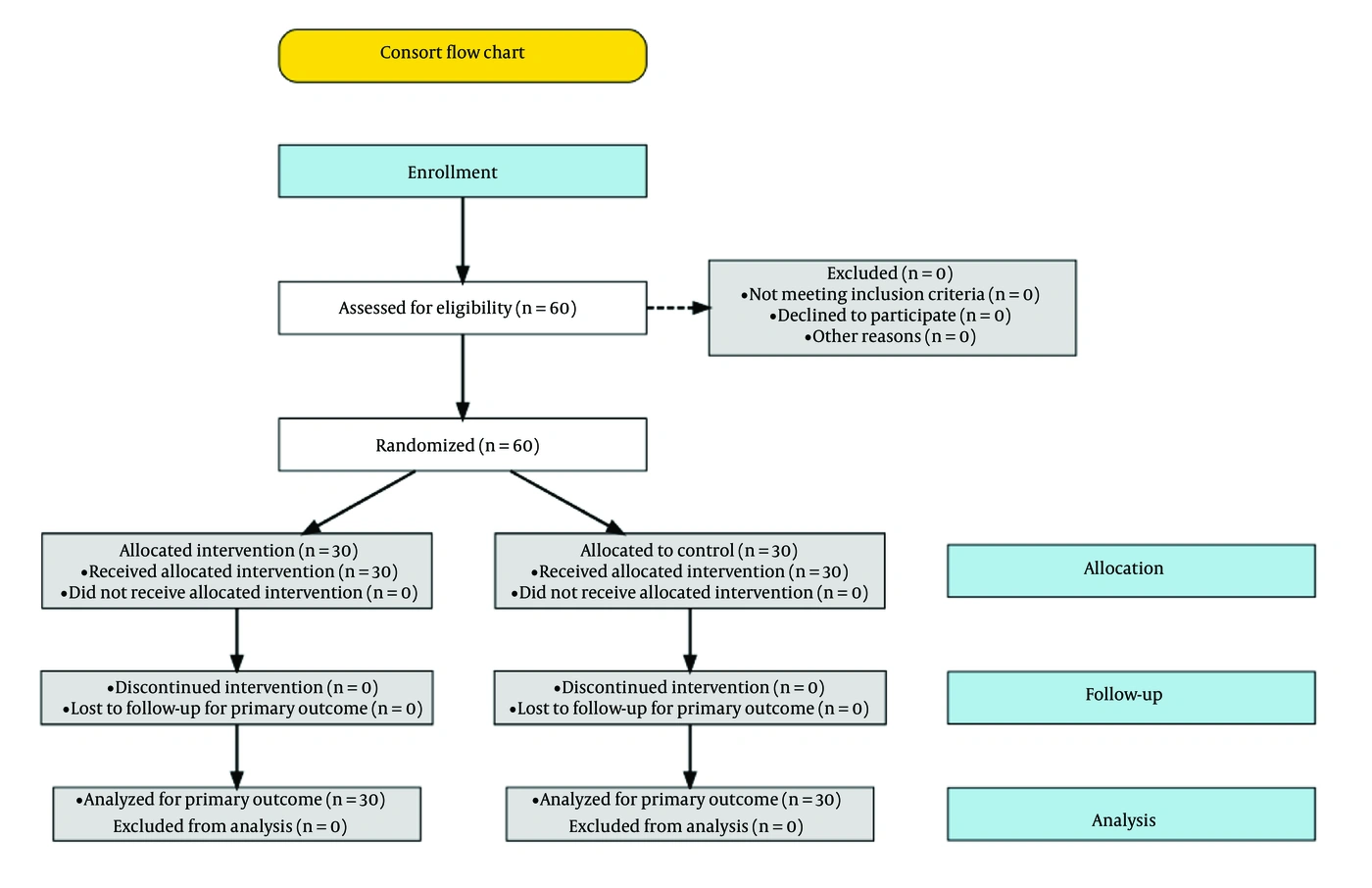
Figure 1.
CONSORT flow diagram of participant recruitment, allocation, follow-up, and analysis
Sequentially numbered, opaque, sealed envelopes were prepared and held by an independent research assistant who was not involved in participant recruitment or outcome assessment. The research assistant performed group assignment after enrollment was completed. Envelopes were opened only after each participant's name and baseline data had been recorded.
3.2.4. Control Condition
The control group received standard clinical internship training following a traditional apprenticeship model. Learning occurred opportunistically according to daily surgical cases, with informal pharmacology teaching provided by supervising clinicians during routine activities. Instruction was unstructured and varied considerably depending on the clinical supervisor and surgical schedule, with no dedicated pharmacology sessions or standardized content. This approach emphasized practical skill acquisition with implicit, rather than structured, integration of pharmacological principles. Standard training continued throughout the semester, whereas the intervention group received an additional 4-week structured pharmacology module alongside standard training.
3.2.5. Eligibility Criteria
Inclusion criteria were 1) undergraduate anesthesia nursing students in the fifth or seventh semester, 2) current participation in a clinical internship, and 3) provision of informed consent. Exclusion criteria were 1) incomplete pre-test data, 2) absence from more than 2 intervention sessions, and 3) voluntary withdrawal.
3.2.6. Blinding
Participants and the principal investigator could not be blinded because of the nature of the educational intervention. However, assessors administering the knowledge tests were blinded to group allocation, and the statistician analyzed the data using anonymized group labels (eg, Group A and Group B) to minimize bias.
3.3. Data Collection and Instruments
3.3.1. Pharmacology Knowledge Questionnaire
A 30-item multiple-choice test was developed to assess anesthesia pharmacology knowledge. Items were generated by an expert team and aligned with the learning objectives. The test covered key topics, including inhalational and intravenous anesthetics, opioids, local anesthetics, and neuromuscular blocking agents. Content and face validity were established through review by a panel of 5 experts (content validity index = 0.82; content validity ratio = 0.86). Pilot testing with 15 students demonstrated acceptable reliability (Cronbach α = 0.70). Item analysis showed acceptable difficulty (0.32 - 0.78) and discrimination (0.25 - 0.62) indices, with a standard error of measurement of 2.14, further supporting the questionnaire's reliability and validity.
The questionnaire was developed for the present study and demonstrated acceptable validity and reliability in the study sample. Although designed for this specific context, its content covers core topics common to anesthesia curricula and may be adaptable to other settings after revalidation. The same knowledge questionnaire was used for pre- and post-testing, with the item order randomized at post-test administration to reduce recall bias.
3.3.2. Course Satisfaction Questionnaire
A 13-item, 5-point Likert-scale questionnaire (1 = strongly disagree to 5 = strongly agree) was used to measure student satisfaction, with total scores ranging from 13 to 65. Internal consistency was good (Cronbach α = 0.814). The satisfaction questionnaire was developed by the research team based on a review of the literature on student satisfaction with educational interventions in health professions education.
3.3.3. Outcomes
The primary outcome was the change in pharmacology knowledge scores from pre-test to post-test. The secondary outcome was student satisfaction with the educational program, measured using the 13-item satisfaction questionnaire.
3.3.4. Evaluation Framework
The study used the Kirkpatrick Model for evaluation, assessing Level 1 (Reaction) through student satisfaction scores and Level 2 (Learning) through improvement in pharmacology knowledge test scores.
3.4. Research Stages
3.4.1. Stage 1: Problem Identification and General Needs Assessment
This phase identified a substantial educational gap in integrating pharmacological knowledge with clinical training. Key findings were as follows: students and faculty reported substantial knowledge decay during clinical internships; current educational approaches lacked structured integration of theoretical and practical components; traditional teaching methods were inadequate for delivering complex pharmacological concepts; and this theory-practice gap may contribute to medication errors and compromised patient safety.
Supporting evidence included reports that 30% - 40% of medication errors in operating rooms stem from pharmacological knowledge deficits (9), low student grades in specialized pharmacology courses (average, 13.79 for fifth-semester students and 13.22 for seventh-semester students), and student dissatisfaction with the quality of pharmacology education.
3.4.2. Stage 2: Targeted Needs Assessment
Two focus group discussions with faculty and students were conducted for an in-depth needs assessment. Sessions were recorded, transcribed verbatim, and analyzed using Braun and Clarke's thematic analysis approach (10). Data analysis was performed independently by 2 researchers to enhance credibility. Focus group discussions were conducted separately for faculty members and students. Thematic analysis was performed independently for each group, and the emerging themes were then compared and integrated to form the final set of themes.
To further enhance trustworthiness, direct quotations from participants were used to support the identified themes. The research team reviewed the findings, and disagreements were resolved through discussion. Preliminary findings were also shared with a subset of participants for informal validation to ensure that the themes accurately reflected their perspectives.
3.4.3. Stage 3: Goals and Objectives
Based on the needs assessment findings, the objectives were to enhance students' pharmacological knowledge, implement effective and efficient teaching methods, and integrate specialized pharmacology into clinical internships.
3.4.4. Stage 4: Educational Methods and Strategies
Drawing on relevant literature, recommendations from the research team, and insights from the general and targeted needs assessments, the intervention used collaborative learning, immediate feedback, and integration, implemented through 4 techniques: concept mapping, flipped classroom, scenario-based learning, and gamification.
3.4.5. Stage 5: Implementation and Execution
Following the pre-test, the intervention was delivered to the intervention group over 4 weeks and integrated into the regular clinical internship schedule. The control group continued the standard training program. The intervention consisted of 3 core components.
3.4.5.1. Flipped Classroom and Concept Mapping
The researcher developed comprehensive PowerPoint presentations covering 4 key pharmacological topics: 1) intravenous anesthetics, 2) inhalational anesthetics, 3) opioids and reversal agents, and 4) neuromuscular blocking agents and reversal. Content was based on the latest editions of standard anesthesia textbooks, including Miller's Anesthesia and Pharmacology and Physiology in Anesthetic Practice. One topic was covered each week. Presentations were shared with students through a virtual group, such as WhatsApp or Telegram, 1 week before the scheduled session.
3.4.5.2. Scenario-Based Learning
Four clinical scenarios were developed, each directly aligned with the weekly topic. For example, the opioid scenario involved an older patient with renal impairment who was scheduled for laparoscopic cholecystectomy, with details of comorbidities and home medications.
A 1-hour session was held each week after the concept-map presentations. The scenario was distributed, and students in their groups were given 15 minutes to discuss and answer guided questions such as: "Which drugs would you choose for induction and maintenance? Why?" "Which drugs are contraindicated? Provide the pharmacological rationale." and "What are your monitoring priorities based on the pharmacodynamics of your chosen drugs?" Each group then presented its anesthetic plan, followed by a comparative discussion moderated by the researcher that focused on the evidence-based pharmacological reasoning behind each choice.
3.4.5.3. Gamification Using Kahoot
A 20-question multiple-choice quiz was created using the Kahoot! application and covered all 4 topics cumulatively. Each question had 4 options and a 20-second time limit.
In the final week, a gamified review session was conducted. Because of the application's limit, students in the hospital classroom were organized into 10 teams of 3. One member of each team logged in to the Kahoot! session. The quiz was conducted live, with teams discussing and selecting answers collaboratively. Immediately after each question, the correct answer and a live scoreboard were displayed. After the quiz, the researcher reviewed the questions with the lowest accuracy rates, as identified in the Kahoot! report, to reinforce challenging concepts. The 3 highest-scoring teams received small educational gifts, such as medical pens and pocket notebooks, as recognition.
The intervention group participated for approximately 2 - 2.5 hours per week for 4 consecutive weeks, in addition to self-study for the flipped-classroom component. All sessions were facilitated by the principal investigator, ensuring instructor consistency across the program. No additional pharmacology refresher courses were provided during this period. Accordingly, the interval between the pre-test and post-test was approximately 5 - 6 weeks for all participants, accounting for the 4-week intervention and adjacent testing weeks.
3.4.6. Stage 6: Evaluation and Feedback
The final stage of the Kern model involved evaluating the intervention using a researcher-developed post-test administered to both the control and intervention groups by the blinded assessor. Students in the intervention group also completed the course satisfaction questionnaire.
3.5. Statistical Analysis
Data were analyzed using SPSS version 26 (IBM Corp, Armonk, NY, USA). Normality of quantitative variables was assessed using the Shapiro-Wilk test. The chi-square test was used to examine relationships between qualitative variables. Paired t tests were used to compare quantitative variables within each group. To determine intervention effectiveness while considering the outcome type and potential confounding variables, score differences between groups were examined using an independent t-test.
In addition, analysis of covariance (ANCOVA) was used to compare post-test knowledge scores between the intervention and control groups, with pre-test scores entered as a covariate. The intervention group had significantly higher post-test scores than the control group (F(1, 57) = 120, P < 0.001). The significance level for all analyses was set at P < 0.05.
3.6. Ethical Considerations
This study received ethical approval under reference number IR.AJUMS.REC.1403.088 from the Research Vice-Chancellor of Ahvaz Jundishapur University of Medical Sciences, Iran. The study was registered under clinical trial code IRCT20210222050463N1. The objectives, stages, and conditions of the study were fully explained to participants, and written informed consent was obtained from all participating students. Data confidentiality and student anonymity were maintained throughout the study.
4. Results
4.1. Comparison of Demographic and Baseline Variables
No significant differences were observed between the groups in age, gender, academic semester, or GPA (all P > 0.05), indicating successful randomization (Table 2). No student was excluded due to absence from more than 2 sessions. Three students each had 1 absence and completed make-up sessions before the following week; therefore, no data were missing.
Table 2.
Comparison of the Intervention and Control Groups in Demographic and Baseline Variables a
| Variables | Intervention Group | Control Group | Statistical Significance b |
|---|---|---|---|
| Age | 24.30 ± 5.83 | 23.16 ± 3.79 | 0.642 |
| Gender | 0.260 | ||
| Female | 23 (76.7) | 19 (63.3) | |
| Male | 7 (23.3) | 11 (36.7) | |
| Total | 30 (100.0) | 30 (100.0) | |
| Academic semester | 1.000 | ||
| Fifth | 15 (50.0) | 15 (50.0) | |
| Seventh | 15 (50.0) | 15 (50.0) | |
| Total | 30 (100.0) | 30 (100.0) | |
| Grade point average | 17.23 ± 1.68 | 17.02 ± 1.78 | 0.642 |
a Values are expressed as mean ± SD or No. (%).
b Independent t test for age and GPA; chi-square test for gender and academic semester.
4.2. Qualitative Findings from the Targeted Needs Assessment
Thematic analysis of the focus group discussions yielded 4 key themes: the theory-practice chasm, fragile knowledge and the need for reinforcement, dissatisfaction with passive learning, and the unsupported clinical instructor (Table 3). These themes directly informed the selection of the educational strategies used in Stage 4, including the flipped classroom, concept mapping, scenario-based learning, and gamification. The focus group questions are presented in Table 4.
Table 3.
Themes and Illustrative Quotes from Focus Group Discussions on Pharmacology Education
| Themes | Description | Illustrative Quote |
|---|---|---|
| Theme 1: The Theory-Practice Chasm | A significant disconnect between theoretical knowledge learned in the classroom and its application in clinical practice. | "We study the thick pharmacology book for the exam. But in the OR, when the anesthesiologist asks 'why this drug for this patient?', my mind goes blank. The book knowledge doesn't translate." (Student) |
| Theme 2: Fragile Knowledge and Need for Reinforcement | Detailed pharmacological knowledge decays after finals because of a lack of structured reinforcement during the clinical internship. | "The specific pharmacology course was in a previous semester. The deep drug knowledge fades because we don't actively use it in the same way." (Student) |
| Theme 3: Dissatisfaction with Passive Learning | Criticism of traditional lectures and a strong demand for interactive, contextual, and engaging learning methods. | "Lectures are one-way and passive. We need something that makes us think and participate, like real patient cases or simulations." (Student) |
| Theme 4: The Unsupported Clinical Instructor | Faculty members see their role as a bridge between theory and practice but lack a structured framework or sufficient time to integrate teaching into the clinical workflow. | "Between managing the anesthesia and the patient, there is little time for structured teaching. We need a ready-to-use framework." (Faculty) |
Table 4.
Focus Group Discussion Questions for Professors and Students
| Number | Questions | Target Group |
|---|---|---|
| 1 | Do you think that specific pharmacology concepts are necessary for a deeper understanding to solve clinical problems? | Professors |
| 2 | What is the current state of students' specific pharmacology knowledge at the beginning of their clinical internship? | Professors |
| 3 | What expectations do you have regarding the specific pharmacology knowledge of fifth- and seventh-semester students entering clinical internships? | Professors |
| 4 | In your opinion, what is the root of the problem? | Professors |
| 5 | How can this issue be addressed? | Professors |
| 6 | What methods do you suggest for teaching and integrating specific pharmacology into clinical internships? | Professors |
| 7 | How much of the specific pharmacology concepts do you retain and remember when starting your clinical internship? | Students |
| 8 | Do you think that specific pharmacology concepts are necessary for a deeper understanding and solving clinical problems? | Students |
| 9 | If yes, how and when do you suggest this integration of basic and clinical knowledge should take place? | Students |
4.3. Knowledge Outcomes
The intervention had a very large effect on knowledge scores (Cohen d = 1.80; 95% CI, 1.25 - 2.35). Knowledge scores in both groups increased significantly after the intervention (P < 0.001). In the intervention group, the mean score increased from 11.56 ± 4.35 at pre-test to 22.16 ± 5.85 at post-test. In the control group, the mean score increased from 11.43 ± 5.96 at pre-test to 13.90 ± 5.31 at post-test. Although both groups improved significantly, the gain was markedly greater in the intervention group (10.60 ± 7.54 vs 2.47 ± 2.34; P < 0.001) (Table 5).
Table 5.
Intra-Group and Inter-Group Comparison of Knowledge Scores in the Control and Intervention Groups a
| Group | Intervention | Control | Statistical Significance Between Groups c |
|---|---|---|---|
| Knowledge score before intervention | 11.56 ± 4.35 | 11.43 ± 5.96 | 0.923 |
| Knowledge score after intervention | 22.16 ± 5.85 | 13.90 ± 5.31 | |
| Statistical significance within group b | < 0.001 | < 0.001 | |
| Difference in knowledge score | 10.60 ± 7.54 | 2.47 ± 2.34 | < 0.001 |
a Values are expressed as mean ± SD.
b Paired t test.
c Independent t test.
ANCOVA was conducted to compare post-test knowledge scores between the groups, with pre-test scores as the covariate. After adjustment for baseline differences, the intervention group had significantly higher post-test scores than the control group (F(1, 57) = 120.45, P < 0.001, partial η2 = 0.679). The adjusted mean post-test score was 22.08 (95% CI, 20.32 - 23.84) for the intervention group and 13.98 (95% CI, 12.22 - 15.74) for the control group. The covariate (pre-test score) was also significantly associated with post-test scores (F(1, 57) = 8.32, P = 0.006). The assumptions of homogeneity of regression slopes (group × covariate interaction, F(1, 56) = 0.94, P = 0.336) and normality of residuals (Shapiro-Wilk test, P = 0.182) were met.
4.4. Student Satisfaction with the Training Program
The intervention group reported high overall satisfaction (mean total score, 54.80/65). The highest satisfaction ratings were for up-to-date content (4.43/5), clear objectives (4.33/5), and overall session quality (4.30/5) (Table 6).
Table 6.
Average Satisfaction Scores for the Anesthesia Pharmacology Training Program in the Intervention Group
| Number | Question | Mean ± SD |
|---|---|---|
| 1 | The duration of the Anesthesiology Pharmacology training course integrated into clinical practice was sufficient. | 4.20 ± 0.92 |
| 2 | The Anesthesiology Pharmacology training program has improved my ability to care for patients. | 4.13 ± 0.81 |
| 3 | The teaching strategies used in this course improve the quality of education. | 4.17 ± 0.64 |
| 4 | The Anesthesiology Pharmacology training program has increased my awareness and interest in clinical procedures. | 4.23 ± 0.72 |
| 5 | The Anesthesiology Pharmacology training program is a useful method for connecting theoretical knowledge with practical actions. | 4.20 ± 0.71 |
| 6 | The Anesthesiology Pharmacology training program has strengthened my critical thinking and decision-making abilities. | 4.03 ± 0.80 |
| 7 | The Anesthesiology Pharmacology training program has helped me better understand the importance of medication for the patient. | 4.27 ± 0.78 |
| 8 | The Anesthesiology Pharmacology training program increases self-confidence. | 4.23 ± 0.89 |
| 9 | The Anesthesiology Pharmacology training program has improved my clinical competence. | 4.00 ± 1.08 |
| 10 | This educational method is applicable as part of the Anesthesia Technician Bachelor's program curriculum. | 4.27 ± 0.86 |
| 11 | The content of the Anesthesiology Pharmacology training program was up to date and relevant to the latest anesthesia references. | 4.43 ± 0.56 |
| 12 | The course objectives were clearly stated and aligned with my needs. | 4.33 ± 0.75 |
| 13 | I have overall satisfaction with the Anesthesiology Pharmacology training program sessions. | 4.30 ± 0.65 |
| - | Total score of questions | 54.80 ± 8.13 |
5. Discussion
Our findings indicate that integrating innovative teaching methods improved pharmacology knowledge. Daniel et al. (11), who examined strategies used by faculty and leaders at 11 medical schools in the United States to integrate basic sciences into clerkships, reported that integrated learning can enhance knowledge retention and promote the transfer of basic science knowledge to practice. Therefore, integration should receive greater emphasis in modern medical curricula. These findings are also consistent with cognitive integration theory, which emphasizes actively linking basic science knowledge with clinical practice to strengthen both retention and application.
In our intervention, the flipped classroom activated prior pharmacological knowledge before clinical application; scenario-based learning created causal links between drug mechanisms and patient-specific decisions; concept mapping visually reinforced integrated mental models; and gamification provided retrieval practice to consolidate these connections. Thus, each teaching method directly operationalized a key mechanism of cognitive integration theory.
We applied the Kern framework to ensure systematic curriculum design and evaluation, with a needs assessment serving as the foundation for developing the anesthesia pharmacology program (12). Focus group discussions were conducted to identify students' strengths and weaknesses in pharmacology, which directly informed the design of pedagogical strategies. Faculty expertise further ensured that the intervention aligned with educational best practices.
This study demonstrates the effectiveness and efficiency of innovative teaching methods, including concept mapping, flipped classrooms, scenario-based learning, and gamification, in anesthesiology pharmacology. Gamification is increasingly used in medical education to engage learners across educational levels and specialties. Previous studies have shown that gamification is a promising approach for improving learning outcomes in health professions education. Kahoot is an emerging game-based learning platform used as a teaching-learning tool in disciplines including histology, pathology, pharmacology, microbiology, and immunology. A study by Baliga et al. reported a positive effect of Kahoot as an enjoyable learning environment for medical students studying immunology. Baliga et al. (13) found significant pre-test to post-test improvements with concept mapping, and almost all participants responded positively to the approach. Their findings support the use of concept maps to enhance learning in medical education.
To support a shift from teacher-centered to student-centered learning, our intervention used the flipped-classroom method. Students actively engaged with preassigned material, promoting self-directed learning and deeper retention. Creating and presenting concept maps in small groups also facilitated collaborative learning, a process shown to strengthen knowledge integration in pharmacology (14).
Saidkhani et al. (15) compared scenario-based learning with video-based education for basic cardiopulmonary resuscitation knowledge and skills among anesthesia nursing students at Ahvaz University of Medical Sciences. They reported that effective teaching methods such as scenario-based learning can increase learners' knowledge and self-confidence and promote active participation, critical thinking, and creativity.
Our findings are consistent with a growing body of literature supporting active learning strategies in health professions education. The positive outcomes observed in our study are consistent with other targeted educational interventions for Iranian anesthesia and nursing students. For example, Parhizkar et al. (16) demonstrated that visual self-evaluation significantly improved practical intubation skills among nurse anesthesia students, highlighting the value of reflective, student-centered techniques. In addition, the high satisfaction and improved learning outcomes in our study align with findings by Mehrabi et al. (17), who reported that combining mobile learning with group discussions was an effective strategy for teaching psychotropic drugs to nursing students. Our study extends this principle by demonstrating that interactive, technology-enhanced, and collaborative learning can also be applied to the complex domain of anesthesia pharmacology during clinical internships.
Our evaluation, guided by the Kirkpatrick Model, showed positive outcomes at Level 1 (Reaction), reflected by high student satisfaction, and Level 2 (Learning), reflected by a significant improvement in pharmacology knowledge. These findings demonstrate the immediate effectiveness of the intervention. Levels 3 (Behavior) and 4 (Results) were beyond the scope of this study but remain important directions for future research to determine whether such approaches lead to sustained clinical improvements and enhanced patient safety.
This study has several characteristics that may enhance its scholarly contribution and international relevance. First, it moves beyond testing an educational intervention by providing a replicable framework for integrating basic and clinical sciences through systematic application of the Kern model, from problem identification through evaluation. This process may provide a methodological template for educators addressing similar theory-practice gaps in other institutions and cultural contexts.
Second, the study demonstrates the potential of a low-cost, high-engagement educational package that is transferable to resource-constrained settings. Unlike interventions requiring expensive simulation mannequins or proprietary software, the use of concept mapping, scenarios, and the freely available Kahoot! platform suggests that meaningful educational effects can be achieved through pedagogical innovation without major infrastructure investments.
The international relevance of these findings lies in addressing a common challenge in health professions education: decay of foundational knowledge and difficulty applying it in practice. The mechanisms underlying the intervention, including cognitive integration, active retrieval, and contextualization, are based on principles of adult learning that may extend beyond a single national context. Although the study was conducted in Iran, educators in anesthesia nursing and other medical and nursing specialties may be able to adapt this framework to strengthen the scientific foundation of clinical training programs.
5.1. Study Limitations
This study has several limitations. First, convenience sampling at a single university, although necessary for logistical feasibility, limits the generalizability of the findings. The results may not fully represent anesthesia nursing students in other educational contexts or geographic locations.
Second, participant blinding was not feasible because of the nature of the educational intervention, which may have introduced performance bias, including a Hawthorne effect. Assessor and statistician blinding were implemented to mitigate detection bias. In addition, all instructional sessions were facilitated by the principal investigator. Although this enhanced internal consistency, it may limit generalizability because intervention effectiveness could be influenced by instructor-specific characteristics.
Third, evaluation was limited to the first 2 levels of the Kirkpatrick Model, Reaction and Learning. Long-term retention of pharmacology knowledge, transfer to clinical behavior (Level 3), and effects on patient care outcomes (Level 4) were not assessed because the module was of short duration and long-term clinical follow-up was not feasible.
Fourth, although item order was randomized at post-test administration to reduce recall bias, the use of the same knowledge questionnaire for the pre-test and post-test carries an inherent risk that students remembered specific questions from the pre-test. This may have inflated post-test scores and overestimated the true intervention effect.
Fifth, students in the intervention group were aware of their participation in a study and received a novel program. This awareness may have increased motivation and performance through a Hawthorne effect, potentially overestimating the true intervention effect.
5.2. Implications for Practice and Education
For clinical educators and curriculum planners, the findings support systematic integration of basic science refresher modules into clinical internships, moving beyond a traditional apprenticeship model. The Kern model can serve as a framework for identifying local gaps before designing educational interventions.
At the institutional level, universities and nursing boards may consider providing resources for integrated curricula and faculty development programs that train clinical instructors in the teaching methods used in this program.
For global health professions education, this model may offer a cost-effective strategy for low- and middle-income countries to strengthen clinical training through pedagogical innovation rather than major infrastructure investment.
5.3. Conclusions
The integrated pharmacology program significantly improved students' pharmacological knowledge and satisfaction. Although enhanced knowledge is a prerequisite for safe medication management, its direct effect on clinical outcomes was not assessed in this study. The Kern model proved to be an effective framework for designing this educational intervention.