
1. Background
The intensive care unit (ICU) is a high-acuity environment in which patients with life-threatening conditions require continuous monitoring, advanced life support, and timely multidisciplinary interventions (1). Within this complex setting, ICU nurses have critical responsibilities: they not only provide direct patient care but also monitor clinical status, detect early signs of deterioration, and coordinate the multidisciplinary team. Nursing performance in the ICU is directly associated with patient survival and the incidence of preventable complications (2).
Given the complexity and instability of critically ill patients, who may present with respiratory, cardiac, or neurological failure, severe trauma, burns, infections, or postsurgical complications, nursing care must be grounded in the best available scientific evidence (3). Evidence-based nursing (EBN) follows a structured process: formulating a clinical question, searching for and appraising evidence, applying it to practice, and evaluating outcomes (4). The World Health Organization endorses evidence-based practice as a cornerstone of quality care (5), and a growing body of evidence indicates that EBN implementation improves care quality, reduces clinical errors and adverse events, lowers health care costs, and enhances nurses' professional development (6-9).
Despite these well-documented benefits, EBN implementation in ICUs remains suboptimal. Barriers include insufficient nurse awareness, heavy workloads, limited staffing, and negative attitudes toward evidence-based practice (5). Moreover, although several studies have confirmed the effectiveness of EBN in intensive care by preventing ICU-acquired weakness (10), reducing delirium (11), and emphasizing evidence-based guidelines for preventing ventilator-associated pneumonia (VAP) (12), these studies have largely focused on single or limited outcomes. Furthermore, many studies have assessed the impact of EBN education on nurses' knowledge and performance rather than on objective patient outcomes (13, 14). A comprehensive EBN program addressing a broad spectrum of clinically relevant ICU outcomes, including sepsis, urinary tract infections (UTIs), VAP, ventilation duration, pressure injury risk, delirium, ICU stay, and mortality, has not yet been thoroughly evaluated in a single study.
To address barriers to EBN implementation, various educational strategies have been recommended, ranging from passive lectures to active, interactive methods (14). Given the time constraints and shift-based schedules of ICU nurses, virtual and blended learning approaches have emerged as promising alternatives to traditional in-person training (15, 16). Virtual education is a promising approach for improving nurses' competencies, particularly when traditional methods are limited. However, the effectiveness of such educational models depends not only on knowledge transfer but also on continuous clinical supervision and feedback to ensure that knowledge is translated into sustained bedside practice, a component that has often been missing from previous studies.
In the Iranian health care context, awareness and implementation of evidence-based guidelines remain insufficient (17), and no comprehensive study has evaluated the impact of a structured, multicomponent EBN program combining blended education with ongoing clinical supervision on a wide range of patient outcomes in the ICU.
2. Objectives
The present study, conducted in 2025, evaluated the effect of an EBN care program on treatment outcomes among ICU patients. We hypothesized that this program would significantly reduce ICU length of stay, mechanical ventilation duration, and the incidence of major complications while improving pressure injury risk profiles.
3. Methods
3.1. Design and Setting
This nonrandomized, quasi-experimental study investigated the effect of an EBN care program on treatment outcomes among patients admitted to 2 general ICUs at Golestan Hospital, affiliated with Ahvaz Jundishapur University of Medical Sciences, Ahvaz, Iran, between September and December 2025. The study was prospectively registered in the Iranian Registry of Clinical Trials to ensure transparency and adherence to best reporting practices. However, because of the unit-wide nature of the intervention and the high risk of contamination between study arms, individual randomization was not feasible. Therefore, a nonrandomized, quasi-experimental design was used, with group allocation based on ICU admission during a comparable time period.
The 2 ICUs had 44 active beds (22 each) and 58 nurses (29 per unit), with a nurse-to-bed ratio of approximately 1:4 during most shifts. All nurses met the inclusion criteria and participated. One critical care specialist physician was present during morning shifts and conducted daily rounds in both units. The 2 ICUs were comparable in terms of environment, facilities, and equipment. No specific criteria were used to admit patients to ICU1 versus ICU2; admission was based solely on bed availability. Both ICUs admitted the same spectrum of critically ill patients, primarily Level 5 care requiring mechanical ventilation and advanced life support. Given the comparability of the 2 ICUs in structure, staffing, and patient acuity, the only systematic difference between groups was receipt of the EBN intervention.
This study was conducted and reported in accordance with the CONSORT guidelines to ensure a comprehensive description of the study methodology and participant flow. Patients and the public were not involved in the design, conduct, reporting, or dissemination of the study. No major changes were made to the study protocol after initiation.
3.2. Population
The sample size for this study was calculated based on the duration of delirium using data from the study by Huang et al. (11), with a 95% confidence level and 90% power, resulting in 30 patients per group (intervention and control). Considering the potential for participant dropout, the final sample size was increased by 15%, yielding a total of 70 patients (35 patients in each group).
α = 0.05, Z1 - α/2 = 1.96, Z1 - β = 1.28, β = 0.1, d = 1.1, S1 = 1.33, S2 = 1.28
Participants were selected using convenience sampling. Patients admitted to ICU1 were assigned to the intervention group, and those admitted to ICU2 were assigned to the control group. Patient inclusion criteria were age 18 - 65 years, mechanical ventilation at study onset, a Glasgow Coma Scale (GCS) score of 6 - 10, an Acute Physiology and Chronic Health Evaluation II (APACHE II) score of 30 - 40 (18), and informed consent from a legal guardian. Exclusion criteria were discharge or death within < 7 days of ICU admission, receipt of end-of-life care, prior ICU admission within 30 days, withdrawal of consent, anticipated transfer to another ICU or hospital during the study, and participation in other concurrent interventional studies. Nurse inclusion criteria were a bachelor's degree or higher in nursing, ≥ 1 year of ICU experience, and not being simultaneously employed in other hospital units. Nurse exclusion criteria were transfer to other units or leaving employment during the study period.
3.3. Intervention
The EBN program was delivered to nurses in the intervention group (ICU1) over a 4-week period through 8 structured sessions: 1 initial face-to-face session and 7 core virtual sessions conducted via the Skyroom platform. The initial face-to-face session, approximately 2 hours in duration, was conducted as a group session with all nurses in the intervention unit and covered the study objectives, an overview of EBN principles, and nurse cooperation. Because of nurses' limited availability and high workload, the remaining 7 sessions were conducted virtually via Skyroom, with each session lasting 1.5 - 2.5 hours, depending on the volume of content and nurses' engagement. Virtual sessions were scheduled during nurses' free shifts, as agreed upon during the face-to-face meeting, to ensure full participation of all intervention group members. The core virtual sessions were delivered at a rate of approximately 2 sessions per week over the following 3 weeks. Although 7 core virtual sessions were planned, additional ad hoc virtual sessions, typically 30 - 45 minutes each, were conducted based on the researcher's real-time assessments, implementation challenges encountered by nurses, and emerging evidence relevant to the original topics. Furthermore, after completion of the educational sessions and during the patient data collection phase, which extended from September to December 2025, the researcher was physically present in the ICU during various shifts at least 3 times per week to supervise nursing care, answer clinical questions, and reinforce the practical application of the educational content. Whenever nurses reported specific challenges or uncertainties regarding the training topics while caring for patients, an additional virtual session on that topic was promptly scheduled, usually within 48 hours, to address the issue in real time. This combined educational and supervisory approach ensured sustained engagement and practical translation of evidence into bedside care throughout the study period. Nurses in the control group (ICU2) did not receive any training on EBN. To minimize the risk of contamination, nurses in ICU1 were explicitly instructed not to share any information about the EBN program with ICU2 staff. Furthermore, the 2 ICUs had separate nursing teams, with no staff rotation between units during the study period. Therefore, although both units were located in the same hospital, the possibility of information sharing was considered minimal. Details of the 7 main session contents are provided in Table 1.
Table 1.
Content of Evidence-Based Nursing Care Educational Sessions for ICU Nurses
| Session Number | Educational Content | Mode of Delivery |
|---|---|---|
| 1 | Presentation of the study objectives and an introduction to the fundamentals and general principles of evidence-based nursing | Face-to-face in the study setting |
| 2 | Evidence-based nursing care related to mechanical ventilation, including adjustment of ventilator parameters based on the patient's clinical condition and clinical and paraclinical test results, monitoring of patients receiving mechanical ventilation, and prevention of mechanical ventilation-related complications | Online (virtual) via the Skyroom platform |
| 3 | Evidence-based nursing care related to delirium, including etiology, assessment and diagnosis methods, nursing interventions for delirium prevention, and pharmacological and nonpharmacological management | Online (virtual) via the Skyroom platform |
| 4 | Evidence-based nursing care related to VAP, including etiology, assessment and diagnosis methods, nursing interventions for VAP prevention, and management | Online (virtual) via the Skyroom platform |
| 5 | Evidence-based nursing care related to pressure injuries, including etiology, assessment and diagnosis methods, nursing interventions for pressure injury prevention, and treatment strategies | Online (virtual) via the Skyroom platform |
| 6 | Evidence-based nursing care related to UTIs, including etiology, assessment and diagnosis methods, nursing interventions for prevention, and treatment strategies | Online (virtual) via the Skyroom platform |
| 7 | Evidence-based nursing care related to sepsis, including etiology, assessment and diagnosis methods, nursing interventions for prevention, and treatment strategies | Online (virtual) via the Skyroom platform |
After training, patient sampling and data collection began. Nurses were instructed to inform the researcher of any questions or challenges while caring for patients; in such cases, a virtual session on the specific topic was promptly scheduled. The researcher was also present during various shifts to supervise care and answer questions. To assess adherence, the researcher maintained a structured checklist documenting attendance at sessions, participation in supervisory meetings, and bedside application of key evidence-based practices, such as regular CAM-ICU assessments, compliance with the VAP prevention bundle, and reassessment of pressure injury risk. Adherence was reinforced through direct observation during the researcher's presence in the ICU (≥ 3 times/week) and real-time feedback during supervisory shifts. Any deviations were addressed promptly during subsequent supervisory visits.
Patients in the control group received routine ICU care according to hospital protocols and standard unit practices, including monitoring vital signs (heart rate, blood pressure, respiratory rate, oxygen saturation, and temperature) at least hourly, administering prescribed medications, airway management with endotracheal suctioning as needed, repositioning bedridden patients every 2 - 4 hours to prevent pressure injuries, adjusting ventilator parameters according to physician orders, and collecting laboratory samples as requested. No structured evidence-based protocols or formal EBN education were implemented in the control ICU, and the nursing team was unaware of the EBN program delivered to ICU1 nurses, minimizing contamination bias.
3.4. Data Collection Method and Tools
Data were collected using a 2-part structured form. The first part captured patients' demographic and baseline information, including age, sex, clinical diagnosis, initial GCS score, and APACHE II score, obtained through interviews with family members and nurses, medical record review, and direct patient examination. The second part recorded treatment outcomes, including ICU length of stay, duration of mechanical ventilation, ICU mortality, and the incidence of VAP, UTI, delirium, and pressure injury risk.
The primary outcome in this study was ICU length of stay, measured in days from ICU admission to ICU discharge, and the mean difference between the 2 groups was analyzed. Secondary outcomes included duration of mechanical ventilation, measured in days from initiation of ventilatory support to successful weaning; ICU mortality; incidence of VAP, sepsis, UTI, and delirium; and risk of developing pressure injuries.
Data were collected by trained research assistants who were blinded to group allocation (intervention vs. control). During the study, 1 principal researcher and 1 independent assistant were present on each shift to oversee outcome data collection. All data collectors were experienced ICU nurses (≥ 2 years of clinical experience) and received standardized training to ensure consistency and accuracy. Throughout the study, research assistants participated in regular coordination meetings to maintain protocol adherence and ensure uniform implementation. All outcome assessments were initiated upon ICU admission and continued daily throughout the ICU stay until discharge or death.
Patient consciousness was assessed using the GCS, a standardized tool that evaluates eye opening (1 - 4), verbal response (1 - 5), and motor response (1 - 6), with total scores ranging from 3 to 15. The reliability of this tool in Iran was confirmed by Mehryar et al., with a test-retest correlation coefficient of 0.86. The APACHE II score, introduced by Knaus in 1985, was used to assess illness severity at ICU admission. This index includes 12 physiological variables evaluating major body systems. According to the standard table, mortality rates for scores of 0 - 15, 16 - 19, 20 - 30, and > 30 are approximately 10%, 15%, 35%, and 75%, respectively (18). Rahmatinejad et al. reported an area under the curve (AUC) of 0.775 for this tool, indicating strong predictive power for mortality risk in ICU patients (19).
Delirium was assessed twice daily (early morning and late evening) using the Confusion Assessment Method for the Intensive Care Unit (CAM-ICU). This tool detects delirium in ICU patients, including those who are intubated or nonverbal, based on 4 features: acute onset/fluctuating course, inattention, altered consciousness, and disorganized thinking. Delirium is present if the first 2 features plus either of the latter 2 are observed (20). Arbabi et al. (21) reported a sensitivity of 75%, specificity of 96%, positive predictive value of 92%, negative predictive value of 85%, and kappa of 0.74.
VAP was assessed daily using the Clinical Pulmonary Infection Score (CPIS), which evaluates body temperature, white blood cell count, tracheal secretions, PaO2/FiO2, chest radiography, and secretion culture. Each criterion scores 0 - 2 (total, 0 - 12); a score > 6 indicates a high probability of VAP (22). Becerra-Hervás et al. (23) reported CPIS diagnostic accuracy with 80% sensitivity (95% CI, 65% - 89%) and 73% specificity (95% CI, 54% - 86%).
Pressure injury risk was assessed daily using the Braden Scale, which includes 6 components: sensory perception, moisture, activity, mobility, nutrition, and friction/shear. Each component scores 1 - 4, except friction/shear, which is scored up to 3, for a total of 6 - 23; a score < 18 indicates high risk (24). Wei et al. reported moderate predictive validity for the Braden Scale, with 89% sensitivity and 28% specificity for predicting pressure injuries (25).
UTI was diagnosed based on Centers for Disease Control and Prevention criteria: clinical signs, such as fever and chills, plus positive urine culture in patients with an indwelling urinary catheter for ≥ 2 days, without another infection source, confirmed by the attending physician (26). Sepsis was diagnosed based on a positive blood culture with compatible clinical manifestations, also confirmed by the attending physician.
3.5. Ethical Considerations
This study was approved by the Ethics Committee of Ahvaz Jundishapur University of Medical Sciences (Ethics code: IR.AJUMS.REC.1404.233). All procedures were performed in accordance with the Declaration of Helsinki (1995, revised 2001). Written informed consent was obtained from patients' legal guardians prior to enrollment, and participation was voluntary. Confidentiality and anonymity were maintained by assigning unique identification numbers, which were stored separately from any personally identifying information.
3.6. Statistical Analysis
Data were analyzed using SPSS version 22. Continuous variables were reported as mean ± SD, and categorical variables were reported as frequency. Between-group comparisons were performed using independent-samples t-tests for continuous variables and chi-square tests for categorical variables. Repeated-measures ANOVA was used to examine Braden Scale changes over time, with Greenhouse-Geisser correction applied when sphericity was violated. To account for potential unit-level clustering, intraclass correlation coefficients (ICCs) were calculated for primary outcomes and were negligible (ICC < 0.05), supporting analysis at the individual patient level. Additionally, multiple linear regression was performed to control for potential confounders for the primary outcome (ICU length of stay), with baseline characteristics entered as covariates. Significance was set at P < 0.05.
4. Results
A total of 70 patients were enrolled in the study and included in the statistical analysis (Figure 1). No primary outcome data were missing; all participants were analyzed according to the intention-to-treat principle.
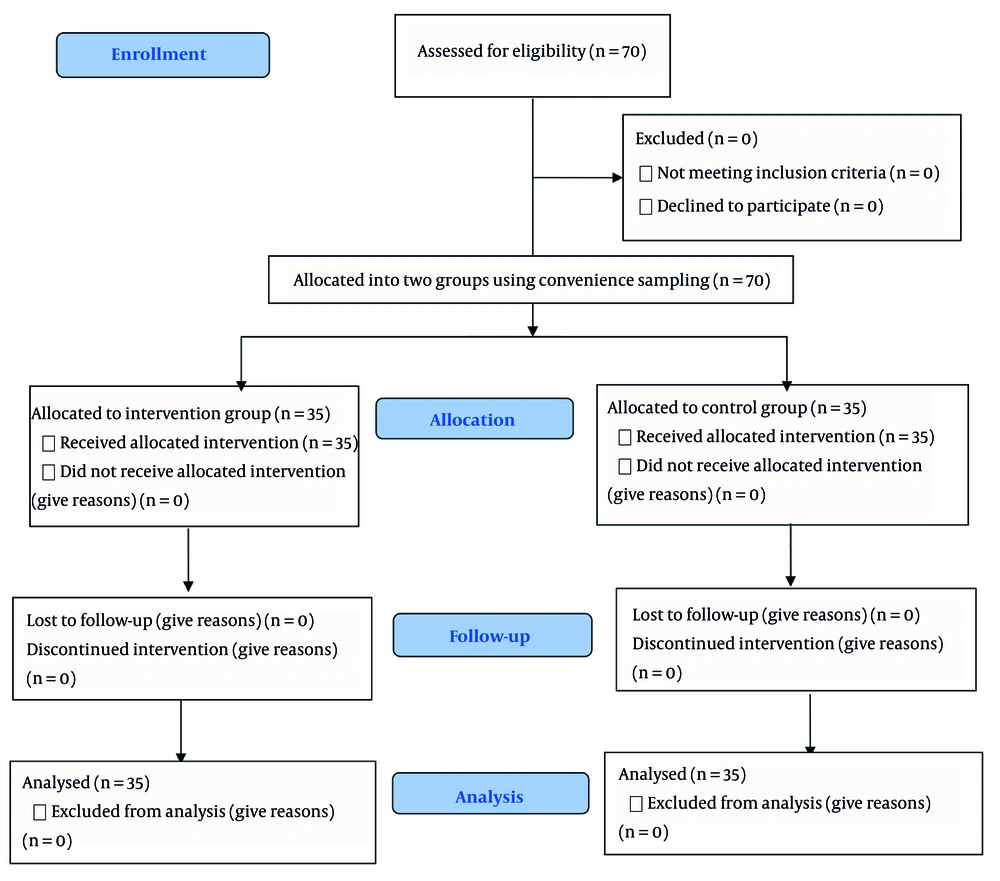
Figure 1.
The CONSORT flow diagram of patients participating in the study
4.1. Baseline Demographic and Clinical Characteristics
The normality of continuous data was assessed using the Kolmogorov-Smirnov test, and the data were normally distributed. Baseline demographic and clinical characteristics, including age, APACHE II score, GCS score, sex, and primary diagnosis, were comparable between the 2 groups, with no statistically significant differences (P > 0.05 for all comparisons; Table 2). The demographic characteristics of nurses in both ICUs were also comparable. The mean age of nurses was 31.82 ± 5.45 years in ICU1 and 29.41 ± 4.94 years in ICU2 (P = 0.083); mean ICU work experience was 8.82 ± 5.35 years and 6.37 ± 4.40 years, respectively (P = 0.062). Overall, 24.1% of nurses were male and 75.9% were female, with an identical sex distribution in both ICUs (7 males and 22 females each; P = 1.000). Most nurses (91.4%) held a bachelor's degree, whereas 8.6% had education beyond a bachelor's degree (master's), with a similar distribution across units (ICU1: 27 bachelor's and 2 higher degrees; ICU2: 26 bachelor's and 3 higher degrees; P = 0.640).
Table 2.
Baseline Demographic and Clinical Characteristics of ICU Patients (N = 70) a
| Variables | EBN Group (n = 35) | Control Group (n = 35) | Test Statistic | P-Value |
|---|---|---|---|---|
| Age (y) | 40.45 ± 18.33 | 39.00 ± 16.76 | t = 0.347 | 0.730 |
| APACHE II | 35.45 ± 2.87 | 34.45 ± 2.83 | t = 1.46 | 0.147 |
| GCS | 7.80 ± 1.54 | 7.71 ± 1.40 | t = 0.242 | 0.809 |
| Gender | χ2 = 0.347 | 0.556 | ||
| Male | 30 (85.7) | 29 (82.9) | ||
| Female | 5 (14.3) | 6 (17.1) | ||
| Primary diagnosis | χ2 = 0.321 | 0.571 | ||
| Traumatic | 21 (60.0) | 16 (45.7) | ||
| Medical conditions | 14 (40.0) | 19 (54.3) |
a Values are expressed as mean ± SD or No. (%). Abbreviations: EBN, evidence-based nursing; ICU, intensive care unit; SD, standard deviation; APACHE II, Acute Physiology and Chronic Health Evaluation II; GCS, Glasgow Coma Scale.
4.2. Primary and Secondary Outcomes
The independent-samples t-test showed that the EBN group had significantly shorter ICU stay (P = 0.001), mechanical ventilation duration (P = 0.001), and delirium duration (P = 0.043) than the control group (Table 3).
Table 3.
Comparison of ICU Length of Stay, Mechanical Ventilation Duration, and Delirium Duration Between Groups a
| Variables | EBN Group (n = 35) | Control Group (n = 35) | t | df | P-Value |
|---|---|---|---|---|---|
| Length of ICU stay (d) | 18.00 ± 8.21 | 26.88 ± 12.40 | -3.53 | 68 | 0.001 |
| Duration of mechanical ventilation (d) | 14.88 ± 7.87 | 23.74 ± 12.06 | -3.63 | 68 | 0.001 |
| Duration of delirium (d) | 9.40 ± 5.37 | 14.20 ± 6.04 | -2.12 | 68 | 0.043 |
a Values are expressed as mean ± SD. Abbreviations: ICU, intensive care unit; SD, standard deviation; EBN, evidence-based nursing.
The chi-square test showed that the incidences of sepsis (P = 0.002), VAP (P = 0.001), delirium (P = 0.029), and UTI (P = 0.001) were significantly lower in the EBN group than in the control group. Although ICU mortality was lower in the intervention group (28.6% vs. 45.7%), the difference was not statistically significant (P = 0.138; Table 4).
Table 4.
Comparison of the Incidence of Sepsis, VAP, Delirium, UTI, and ICU Mortality Between Groups a
| Variables | EBN Group (n = 35) | Control Group (n = 35) | χ2 | df | P-Value |
|---|---|---|---|---|---|
| Sepsis | 9.78 | 1 | 0.002 | ||
| Happened | 9 (25.7) | 22 (62.9) | |||
| Not happened | 26 (74.3) | 13 (37.1) | |||
| VAP | 11.66 | 1 | 0.001 | ||
| Happened | 14 (40.0) | 28 (80.0) | |||
| Not happened | 21 (60.0) | 7 (20.0) | |||
| Delirium | 4.76 | 1 | 0.029 | ||
| Happened | 10 (28.6) | 19 (54.3) | |||
| Not happened | 25 (71.4) | 16 (45.7) | |||
| UTI | 11.20 | 1 | 0.001 | ||
| Happened | 11 (31.4) | 25 (71.4) | |||
| Not happened | 24 (68.6) | 10 (28.6) | |||
| ICU mortality | 2.20 | 1 | 0.138 | ||
| Happened | 10 (28.6) | 16 (45.7) | |||
| Not happened | 25 (71.4) | 19 (54.3) |
a Values are expressed as No. (%). Abbreviations: VAP, ventilator-associated pneumonia; UTI, urinary tract infection; ICU, intensive care unit; EBN, evidence-based nursing.
Table 5 presents the results of repeated-measures ANOVA comparing Braden Scale score trends between the 2 groups over 7 days (7 time points). The overall time x group interaction was significant (P < 0.001). Therefore, within-group changes were examined separately and were significant in both the control group (P < 0.001) and the EBN group (P < 0.001). However, based on partial η2 values, the magnitude of change was greater in the control group (partial η2 = 0.306) than in the EBN group (partial η2 = 0.256). As shown in Figure 2, Braden Scale scores in the EBN group increased from day 1 to day 7, indicating a reduced risk of pressure injury. In contrast, the trend in the control group was downward, reflecting decreasing scores and an increased risk of pressure injury over time.
Table 5.
Repeated-Measures ANOVA Results for Braden Scale Scores Over Seven Days a
| Models and Sources | Group | Sum of Squares | df | Mean Square | F | P-Value | Partial η2 |
|---|---|---|---|---|---|---|---|
| Overall model | |||||||
| Time (within subjects) | Both | 2.057 | 6 | 0.343 | 0.280 | 0.946 | 0.004 |
| Time × group (interaction) | Both | 190.857 | 6 | 31.810 | 25.945 | < 0.001 | 0.276 |
| Error (within) | Both | 500.229 | 408 | 1.226 | - | - | - |
| Group (between subjects) | Both | 409.600 | 1 | 409.600 | 17.499 | < 0.001 | 0.205 |
| Within-group changes | |||||||
| Time | EBN group | 97.143 | 6 | 16.190 | 11.689 | < 0.001 | 0.256 |
| Error | EBN group | 282.571 | 204 | 1.385 | - | - | - |
| Time | Control group | 95.771 | 6 | 15.962 | 14.960 | < 0.001 | 0.306 |
| Error | Control group | 217.657 | 204 | 1.067 | - | - | - |
a Mauchly's test of sphericity was significant (P < 0.05); degrees of freedom were corrected using the Greenhouse-Geisser method (ε = 0.72). Partial η2 is reported as a measure of effect size.
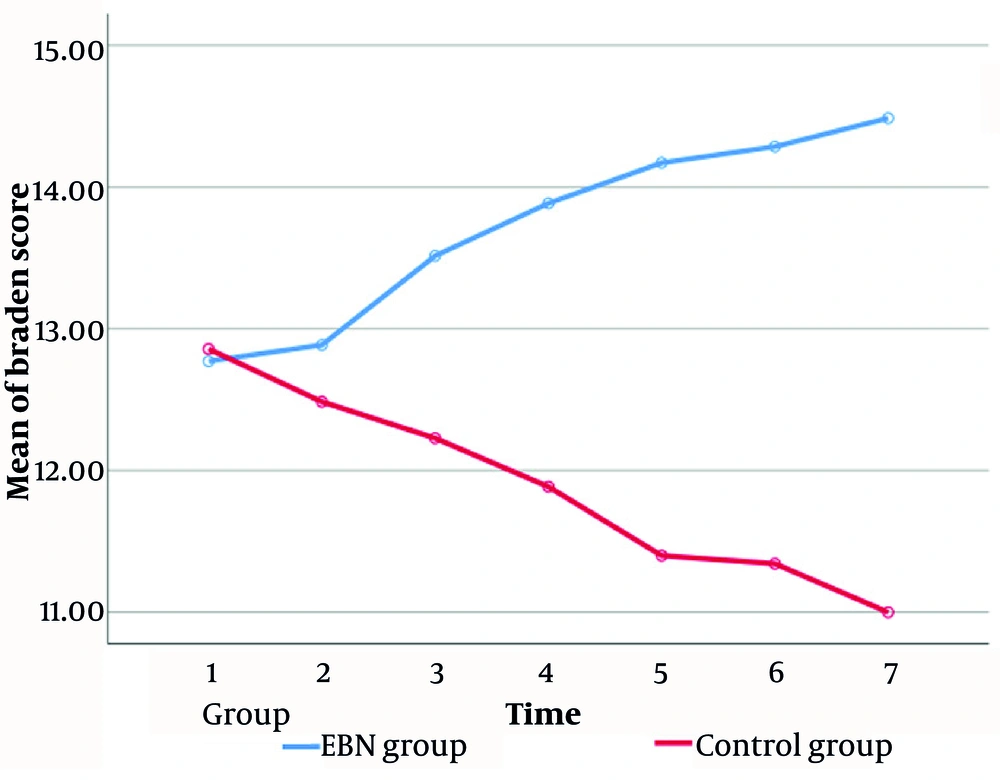
Figure 2.
Trend of mean Braden scores over seven days in the evidence-based nursing (EBN) and control groups
To further control for potential confounding variables, multiple linear regression analysis was performed with ICU length of stay (primary outcome) as the dependent variable, adjusting for baseline characteristics (age, sex, APACHE II score, GCS score, and primary diagnosis). The results demonstrated that the model explained 19.4% of the variance (adjusted R2 = 0.194), and group allocation (EBN vs. control) remained a significant independent predictor of ICU length of stay (B = -10.257, P < 0.001), even after adjusting for potential confounders (Table 6).
Table 6.
Multiple Linear Regression Analysis for Predicting ICU Length of Stay a
| Parameters | B | Standard Error | t | P-Value | 95% Confidence Interval | |
|---|---|---|---|---|---|---|
| Upper Bound | Lower Bound | |||||
| Intercept | -11.861 | 18.574 | -0.639 | 0.525 | 25.255 | -48.978 |
| Group (EBN vs. Control) | -10.257 | 2.569 | -3.992 | < 0.001 | -5.122 | -15.39 |
| Gender (Male vs. Female) | -3.514 | 3.694 | -0.951 | 0.345 | 3.867 | -10.896 |
| Diagnosis (Traumatic vs. Medical) | 3.265 | 3.882 | 0.841 | 0.403 | 11.022 | -4.491 |
| Age | -0.147 | 0.116 | -1.271 | 0.208 | 0.084 | -0.379 |
| APACHE II | 1.150 | 0.482 | 2.386 | 0.020 | 2.113 | 0.187 |
| Initial GCS | 0.815 | 0.868 | 0.940 | 0.351 | 2.549 | -0.919 |
a R2 = 0.264, Adjusted R2 = 0.194.
5. Discussion
Structured implementation of an EBN program, combined with targeted education and active clinical guidance, significantly improved several outcomes in critically ill patients. The intervention had 2 components: 1) blended EBN education delivered through face-to-face and virtual sessions and 2) continuous clinical supervision with real-time feedback to facilitate the translation of evidence into practice. This model differs from previous studies that focused on isolated outcomes (10, 11) or assessed nurses' knowledge rather than patient outcomes (27, 28). The overall improvement may reflect a synergistic effect of education and supervision, helping to bridge the know-do gap that often limits isolated educational interventions.
The shorter ICU length of stay and reduced duration of mechanical ventilation observed in the EBN group are consistent with findings from a previous randomized clinical trial (11). In that study, an EBN cluster intervention significantly reduced both mechanical ventilation duration and ICU stay, without a significant difference in mortality. This similarity is likely due to the multicomponent and coordinated nature of the interventions, as both studies emphasized optimization of routine nursing care. However, a key distinction lies in the mode of implementation. That study focused primarily on a clustered care bundle, whereas the present study provided structured EBN education before data collection, followed by care implementation under continuous clinical supervision and active guidance from the researcher. In addition, unlike that study, which focused primarily on delirium and ICU stay, our program achieved broader improvements across infections, ventilation duration, and pressure injury risk. This broader effectiveness is likely attributable to the comprehensive, multitopic curriculum combined with active supervisory support and may explain the concurrent improvement across multiple treatment outcomes in the present study. These findings suggest that practical adherence to EBN is pivotal to intervention effectiveness.
The lower delirium incidence in the EBN group aligns with previous research showing significant reductions in delirium incidence and duration with evidence-based care (11). A systematic review also found that theory- and evidence-based nursing interventions, especially multicomponent strategies, reduce delirium and other adverse ICU outcomes (10), although it was narrative and had substantial heterogeneity in interventions, populations, and outcomes. Nurse training in regular CAM-ICU assessment and preventive nonpharmacological interventions, explicitly taught during the sessions, appears to be key to the observed reduction. This aspect has mostly been recommended rather than operationally implemented in previous studies (10, 11, 27, 28). Consistent with earlier findings (11), we also observed reduced delirium duration, likely due to regular CAM-ICU screening and evidence-based nonpharmacological measures taught and supervised during the sessions.
The lower incidence of VAP in the EBN group is consistent with previous studies showing that evidence-based education significantly improves nurses' knowledge and performance in caring for mechanically ventilated patients (27, 28). However, a key distinction is that, in those studies, the primary outcomes were assessed at the level of nurses' knowledge and performance rather than direct patient outcomes. In contrast, the present study translated enhanced nurse knowledge through evidence-based education into objective patient outcomes, including reduced VAP incidence and shorter mechanical ventilation duration. This difference highlights the critical importance of translating knowledge into clinical practice.
The lower incidence of UTIs and sepsis in the EBN group can be attributed to more rigorous implementation of evidence-based practices related to catheter management, infection monitoring, and timely clinical decision-making. Improvements in nursing performance, when accompanied by continuous supervision and practical application of care, can lead to tangible treatment outcomes. These findings align with previous research showing that nurses' knowledge and attitudes are key predictors of evidence-based care implementation (13). In the present study, enhancing nurses' knowledge and attitudes through ongoing, participatory education created the conditions necessary for the effective application of evidence-based guidelines.
The reduced risk of pressure injuries in the EBN group is comparable with previous findings reporting that evidence-based measures had a significant but relatively modest effect on reducing pressure injuries, with policy-level factors playing a more prominent role (29). The difference between our findings and those of that study may be attributable to differences in the level of intervention. That study examined the impact of policies and organizational interventions at a macro level, whereas the present study implemented individualized, daily nursing interventions with direct monitoring of pressure injury risk. This suggests that, even without large-scale policy changes, rigorous bedside implementation of evidence-based care can yield clinically meaningful effects.
The lack of a significant reduction in ICU mortality, despite other improvements, warrants consideration. Several factors may explain this finding. First, mortality in critically ill patients is multifactorial and influenced by nursing care quality, initial illness severity, comorbidities, organ failure, and treatment response. Most patients had APACHE II scores of 30 - 40, indicating a high baseline mortality risk that may have attenuated the effect of the nursing intervention. Second, the sample size, while adequately powered for secondary outcomes such as infection rates, may have been insufficient to detect a meaningful difference in mortality given the low event rate. Third, the short follow-up, limited to ICU stay, may have missed survival benefits emerging after discharge. These explanations align with previous research reporting no significant mortality reduction despite other improvements (11). Future studies with larger samples and longer follow-up are needed to clarify the impact of EBN programs on long-term survival.
Overall, considering the positive effect of the intervention on other patient outcomes, our findings are consistent with previous studies that demonstrated the positive impact of EBN education on care quality and on nurses' knowledge and competence (30-32). However, those investigations primarily examined educational outcomes at the nurse level. By focusing on patient clinical outcomes, the present study suggests that EBN education is most effective when accompanied by practical implementation, clinical supervision, and continuous feedback. Clinically, the observed reductions, approximately 8 fewer ICU days, 9 fewer ventilation days, 37% - 40% lower infection rates, nearly 5 fewer delirium days, and a sustained improvement in pressure injury risk scores, represent meaningful improvements in patient recovery and resource utilization beyond statistical significance.
5.1. Limitations
This study has several limitations. First, the quasi-experimental design and lack of randomization may have introduced selection bias; however, the 2 ICUs were comparable in environment, staffing, acuity, and physician coverage. Second, blinding of patients and bedside nurses was not feasible due to the nature of the intervention, potentially introducing performance bias and a Hawthorne effect. Nevertheless, outcome assessors and data analysts were blinded. Third, the single-center design and short follow-up, limited to ICU stay, limit generalizability and long-term outcome assessment. Fourth, changes in nurses' knowledge, practice, or attitudes were not directly measured, nor could adherence variability and clinical judgment be fully controlled. Fifth, a potential clustering effect cannot be excluded because allocation was by ICU admission; although the ICUs were comparable, patients within the same unit may have shared contextual influences. Accordingly, the results should be interpreted cautiously, and future studies should account for clustering. Finally, although regression analysis confirmed group allocation as an independent predictor of the primary outcome, the model's limited explanatory power suggests that other unmeasured factors, such as comorbidities, medical management quality, and organizational variables, may have influenced the results. Multicenter studies with larger samples and more comprehensive data are recommended to validate these findings.
5.2. Conclusions
These quasi-experimental findings suggest that a structured EBN program integrating targeted education, guided practice, and continuous supervision may improve several outcomes in critically ill ICU patients. Reductions in ICU stay, ventilation duration, and incidences of delirium, VAP, sepsis, UTI, and pressure injuries highlight the value of translating evidence into routine care. However, due to the single-center, quasi-experimental design and short-term follow-up, the findings should be interpreted cautiously and should not be generalized definitively. Future multicenter randomized controlled trials with extended follow-up are needed to assess sustainability and long-term outcomes, along with economic evaluations of cost-effectiveness. Additionally, standardized adherence tools would facilitate more robust fidelity evaluation. Nevertheless, integrating such structured programs into routine ICU care, supported by ongoing education and supervision, appears to be a promising strategy worthy of further investigation.