1. Background
Breast cancer has been the second most common cancer among women in China since 2022 (1, 2). Advances in personalized and multidisciplinary treatment, including surgery, chemotherapy, targeted therapy, immunotherapy, and endocrine therapy, have substantially improved survival outcomes among patients with breast cancer (3-5). However, these patients frequently experience physical and psychological problems that adversely affect their spiritual well-being, particularly when chemotherapy causes intolerable toxicity (6-8).
Spirituality, a cognitive and emotional state, encompasses an individual's sense of well-being, self-worth, and healthy social connections (9, 10). Patients with cancer generally have lower levels of spiritual well-being than healthy individuals. This disparity is primarily attributable to psychological distress and unfavorable expectations about antitumor treatment, which can diminish their sense of purpose and quality of life (11-13). A strong sense of meaning in life has been reported to improve spiritual health among patients with cancer, with positive effects on antitumor therapy and prognosis (14). In clinical settings, spiritual care is frequently neglected, although multiple guidelines emphasize its role in enhancing the overall well-being of patients with cancer (14). Moreover, the spiritual needs of patients with breast cancer receiving antitumor treatment remain unclear because existing studies have focused on lung and digestive cancers (11, 15-17). This gap underscores the importance of exploring spiritual health among patients with breast cancer.
2. Objectives
Chemotherapy-related toxicity exacerbates physical and psychological distress, which may impair spiritual well-being. Therefore, this study aimed to evaluate spiritual health, quality of life, and meaning in life among Chinese patients with breast cancer undergoing chemotherapy and to clarify the potential correlations among these variables. We also sought to identify key factors associated with spiritual health to inform clinical management. A theory-driven structural equation model (SEM) was constructed to examine the partial mediating role of quality of life in the relationship between meaning in life and spiritual health. These findings may provide a theoretical basis for individualized spiritual care, help address a gap in breast cancer supportive care, and ultimately improve the overall well-being of patients receiving chemotherapy.
3. Methods
3.1. Study Design
This was a cross-sectional study with prospective data collection and cross-sectional analysis. Patients were selected by simple random sampling from the National Cancer Center (NCC) between January and December 2023. The sampling frame comprised female patients with breast cancer who were hospitalized for chemotherapy at the NCC during the study period.
The sample size was determined based on the principle that multiple linear regression requires 5 - 10 participants per independent variable. Based on Cohen's criteria for regression models, the prespecified type I error rate was α = 0.05, statistical power was 1 - β = 0.80, and the medium effect size was f2 = 0.15. Twenty-one variables were included, 4 of which were predefined as the main independent variables: occupational status, monthly household income per capita, quality of life measured using the European Organization for Research and Treatment of Cancer Quality of Life Questionnaire-C30 (EORTC QLQ-C30), and meaning in life measured using the Meaning of Life Scale for Cancer Patients (MiLS). The minimum sample size was therefore 210. To allow for a potential nonresponse rate of 20.0%, 250 questionnaires were distributed. Item-level missingness was prespecified to be < 2%, consistent with the final sample. Complete-case analysis was used without imputation because missing data were minimal and randomly distributed. The a priori precision goals were 95% confidence interval (CI) widths of ≤ 0.15 for key correlations (r) and ≤ 0.5 for regression β coefficients. Reporting followed the Strengthening the Reporting of Observational Studies in Epidemiology (STROBE) checklist for cross-sectional studies (18) (Table S1), addressing participants, variables, bias, and the sample size rationale.
3.2. Setting and Sample
The inclusion criteria were: 1) a pathological diagnosis of breast cancer; 2) female sex; 3) age > 18 years; 4) consciousness confirmed by physical examination; 5) elementary education or above, with basic reading and writing skills; and 6) hospitalization for breast cancer chemotherapy.
The operationalized exclusion criteria were: 1) severe cognitive dysfunction or a history of psychosis diagnosed by a psychiatrist; 2) a history of other malignant tumors; 3) metastasis or disease progression confirmed by imaging (computed tomography or magnetic resonance imaging) or pathology reports; and 4) other serious complications confirmed by laboratory tests, including abnormal liver, kidney, or bone marrow function at baseline, hematologic disorders, or concurrent malignancies.
3.3. Ethical Considerations
The study was approved by the Ethics Committee of the National Cancer Center/Cancer Hospital, Chinese Academy of Medical Sciences and Peking Union Medical College (approval code: 23/139 - 3883; http://ncc.ctims.com.cn/). All participants provided written informed consent.
3.4. Measurements
3.4.1. Chinese Version of the European Quality of Life in Cancer Treatment and Research-Spiritual Health Scale
The Chinese version of the European Quality of Life in Cancer Treatment and Research-Spiritual Health Scale (EORTC QLQ-SWB27) was adapted according to World Health Organization guidelines. Two bilingual translators translated the original English version into Chinese, and 2 translators who were blinded to the original version subsequently back-translated it into English. An expert panel comprising oncologists, psychologists, and methodologists resolved discrepancies. Pilot testing was conducted among 30 patients with breast cancer (Cronbach's α = 0.78; item-total correlations > 0.30). Reliability was assessed using internal consistency (Cronbach's α and McDonald's ω) and item-total correlations. In the current sample, Cronbach's α was 0.79 and McDonald's ω was 0.81 (both > 0.70), indicating good internal consistency. Item-total correlations ranged from 0.32 to 0.61 (all > 0.30), supporting item reliability. Confirmatory factor analysis (CFA) fit indices were χ2/df = 2.37, root mean square error of approximation (RMSEA) = 0.076, comparative fit index (CFI) = 0.91, and Tucker-Lewis index (TLI) = 0.90. The scale contains 27 items across 4 dimensions, with 4 items excluded. The standardized score was calculated as (Original score - 22)/(107 - 22) × 100 (higher scores = better spiritual health), with higher scores indicating better spiritual health.
3.4.2. Chinese version of the European Organization for Research and Treatment of Cancer Quality of Life Questionnaire-C30
The Chinese version of the EORTC QLQ-C30 was validated by Zhao and verified in the current sample (19). Translation, back-translation, and cross-cultural adaptation followed EORTC guidelines. Reliability was evaluated using internal consistency (Cronbach's α and McDonald's ω) and item-total correlations. In the current sample, Cronbach's α ranged from 0.77 to 0.88 and McDonald's ω ranged from 0.79 to 0.89 (all > 0.70), demonstrating good internal consistency. Item-total correlations for the functional and symptom scales ranged from 0.31 to 0.72 (all > 0.30), supporting item reliability. The CFA fit indices were χ2/df = 2.15, RMSEA = 0.068, and CFI = 0.92. The questionnaire contains 30 items assessing function, symptoms, and overall quality of life. The standardized total score was calculated as (Original score - 30)/(126 - 30) × 100. Symptom scales were reverse-scored, with higher scores indicating better quality of life.
3.4.3. Chinese Version of the Meaning of Life Scale for Cancer Patients
Translation, back-translation, and expert review were conducted as described for the EORTC QLQ-SWB27, following World Health Organization guidelines. Pilot testing was conducted among 25 patients with breast cancer (Cronbach's α = 0.72). Reliability was assessed using internal consistency (Cronbach's α and McDonald's ω) and item-total correlations. In the current sample, Cronbach's α was 0.73 and McDonald's ω was 0.75 (both > 0.70), indicating acceptable internal consistency. Item-total correlations ranged from 0.30 to 0.58 (all ≥ 0.30), supporting item reliability. The CFA fit indices were χ2/df = 2.45, RMSEA = 0.079, and CFI = 0.89. The scale contains 28 items across 6 dimensions, with scores ranging from 28 to 140; higher scores indicate a stronger sense of meaning in life.
3.5. Procedure
Eligible patients provided written informed consent and independently completed paper questionnaires, with assistance if needed. Patients with complete questionnaires and no missing items were enrolled. Clinical and demographic data were collected. Item-level missingness was < 2%, and no imputation was required. Two researchers entered and verified the data to ensure accuracy. A participant-flow table is provided in Table S2.
Patients who completed all 3 scales and answered all questions were enrolled. Clinical characteristics included age, marital status, educational level, religion, occupation, income, and medical insurance. All data were analyzed by the researcher or trained nursing staff.
3.6. Data Analysis
Descriptive statistics were used to characterize the distributions of study variables. The t-test or analysis of variance (ANOVA) was used to compare general characteristics and core outcomes among patient groups. Pearson correlation analysis was used to explore associations among spiritual health, quality of life, and meaning in life. Multiple linear regression analysis was used to identify key factors associated with spiritual health. To assess regression model assumptions, quantile-quantile plots were used to evaluate residual normality, and plots of residuals against fitted values were used to visually assess homoscedasticity (Figures S1-S2). If heteroscedasticity was present, robust standard errors would be used to ensure the reliability of the results. Model assumption checks indicated that there was no heteroscedasticity (Breusch-Pagan test, P = 0.12) and that residuals were normally distributed. Variance inflation factors (VIFs) were < 2 for all predictors, indicating no severe multicollinearity.
Common-method bias (CMB) was assessed using Harman's single-factor test. The first factor explained 32.7% of the total variance (< 40%), indicating no severe CMB. The CFA marker method was also applied by specifying a common method factor, simultaneously loading the error terms of all observed variables onto this factor, and comparing model fit with and without the factor. A significant improvement in model fit after adding the common method factor was considered evidence of CMB (10).
In addition, a theory-driven SEM was constructed with meaning in life (MiLS total score) as the independent variable, quality of life (EORTC QLQ-C30 standardized score) as the mediator, and spiritual health (EORTC QLQ-SWB27 total score) as the dependent variable. Overall model fit indices were used instead of traditional multiple bivariate tests. Maximum likelihood estimation was used for SEM analysis. Key fit indices included χ2/df, RMSEA, CFI, and TLI. The model was considered to fit well if χ2/df < 3, RMSEA < 0.08, CFI > 0.90, and TLI > 0.90.
All analyses were performed using SPSS version 26.0 and R version 4.3.1, with the lavaan package for SEM and the car package for heteroscedasticity testing. The anonymized data dictionary and analysis syntax are available upon request.
4. Results
4.1. Participants and Baseline Characteristics
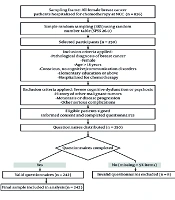
Figure 1 shows the questionnaire screening flowchart. Simple random sampling was implemented by numbering all eligible patients (n = 836) and selecting 250 participants using a random number table in SPSS version 26.0. Of the 250 questionnaires distributed, 8 were invalid because key items were incomplete, with > 5% of all items missing. After these questionnaires were excluded, 242 valid questionnaires remained, yielding an effective response rate of 96.8%. This process followed the predefined missing-data protocol. Post hoc precision analysis showed that the sample (n = 242) met the a priori precision goals, with post hoc power > 0.85 to detect the prespecified medium effect size. Baseline characteristics are presented in Table 1. Most patients were aged < 60 years (91.3%), married (85.1%), nonreligious (89.7%), urban residents (94.6%), and unemployed or retired (92.6%). A monthly household income per capita > 5000 RMB was reported by 48.4% of patients.
Table 1.
Baseline Characteristics and Spiritual Health, Quality-of-Life, and Meaning-in-Life Scores Among Patients with Breast Cancer a
| Characteristics | Values | Spiritual Health | P value | Quality of Life | P value | Meaning in Life | P value |
|---|---|---|---|---|---|---|---|
| Age (y) | 0.316 | 0.489 | 0.876 | ||||
| < 60 | 221 (91.3) | 62.44 ± 11.06 | 97.88 ± 15.55 | 109.28 ± 14.54 | |||
| ≥ 60 | 21 (8.7) | 59.86 ± 13.12 | 100.33 ± 14.84 | 108.76 ± 16.75 | |||
| Marital status | 0.828 | 0.364 | 0.668 | ||||
| Unmarried | 12 (5.0) | 59.50 ± 10.42 | 105.33 ± 11.22 | 104.33 ± 9.84 | |||
| Married | 206 (85.1) | 62.26 ± 11.13 | 97.60 ± 15.47 | 109.43 ± 14.86 | |||
| Divorced | 18 (7.4) | 63.33 ± 12.02 | 99.78 ± 16.39 | 110.72 ± 16.55 | |||
| Widowed | 6 (2.5) | 62.83 ± 16.46 | 95.67 ± 19.75 | 108.33 ± 12.94 | |||
| Religious belief | 0.324 | 0.782 | 0.457 | ||||
| No | 217 (89.7) | 61.97 ± 11.19 | 98.19 ± 15.57 | 109.00 ± 14.74 | |||
| Yes | 25 (10.3) | 64.32 ± 11.73 | 97.28 ± 14.94 | 111.32 ± 14.61 | |||
| Current address | 0.617 | 0.610 | 0.224 | ||||
| Cities and towns | 229 (94.6) | 62.30 ± 11.08 | 97.97 ± 15.71 | 108.97 ± 14.38 | |||
| Countryside | 13 (5.4) | 60.69 ± 14.31 | 100.23 ± 10.92 | 114.08 ± 19.75 | |||
| Children | 0.729 | 0.732 | 0.129 | ||||
| Has children | 218 (90.1) | 61.46 ± 10.90 | 99.13 ± 16.58 | 104.92 ± 11.86 | |||
| No children | 24 (9.9) | 62.30 ± 11.31 | 97.98 ± 15.39 | 109.72 ± 14.94 | |||
| Occupation | 0.158 | 0.747 | 0.242 | ||||
| Farmers | 18 (7.4) | 57.61 ± 10.38 | 98.67 ± 12.92 | 105.17 ± 15.75 | |||
| Workers | 39 (16.1) | 60.62 ± 12.59 | 97.82 ± 15.03 | 106.64 ± 17.30 | |||
| Civil servants | 76 (31.4) | 63.70 ± 11.10 | 96.61 ± 16.77 | 111.37 ± 14.68 | |||
| Other | 109 (45.0) | 62.51 ± 10.87 | 99.14 ± 15.19 | 109.37 ± 13.44 | |||
| Occupational status | 0.035 | 0.170 | 0.040 | ||||
| Employed | 18 (7.4) | 63.64 ± 11.11 | 98.99 ± 15.36 | 111.08 ± 14.08 | |||
| Unemployed | 115 (47.5) | 59.20 ± 11.043 | 100.00 ± 13.06 | 106.57 ± 13.97 | |||
| Retired | 109 (45.0) | 60.12 ± 11.24 | 94.88 ± 16.64 | 105.93 ± 16.04 | |||
| Educational attainment | 0.083 | 0.191 | 0.274 | ||||
| Junior high school or below | 24 (9.92) | 56.92 ± 9.22 | 95.33 ± 13.09 | 106.04 ± 13.71 | |||
| High school/secondary school | 102 (42.2) | 62.11 ± 12.49 | 99.97 ± 15.33 | 107.98 ± 16.00 | |||
| College/bachelor's degree | 97 (40.1) | 63.36 ± 10.51 | 96.13 ± 16.30 | 111.35 ± 14.03 | |||
| Master's degree or higher | 19 (7.9) | 63.63 ± 8.62 | 101.53 ± 13.80 | 109.37 ± 11.09 | |||
| Monthly household income per capita (RMB) | 0.016 | 0.302 | 0.748 | ||||
| < 1000 | 9 (3.7) | 57.10 ± 7.78 | 98.70 ± 13.84 | 107.10 ± 15.28 | |||
| 1000 - 3000 | 38 (15.7) | 58.89 ± 11.45 | 94.27 ± 16.45 | 107.51 ± 12.55 | |||
| 3001 - 5000 | 78 (32.2) | 61.21 ± 10.86 | 100.14 ± 14.42 | 108.94 ± 15.31 | |||
| > 5000 | 117 (48.4) | 64.38 ± 11.32 | 97.89 ± 15.92 | 110.18 ± 14.99 | |||
| Medical insurance | 0.544 | 0.792 | 0.339 | ||||
| Urban medical insurance | 211 (87.2) | 62.50 ± 11.21 | 98.02 ± 15.69 | 109.00 ± 14.82 | |||
| Rural cooperative medical care | 25 (10.3) | 60.64 ± 10.37 | 97.72 ± 12.63 | 112.60 ± 13.72 | |||
| Self-funded | 6 (2.5) | 58.67 ± 16.46 | 102.33 ± 20.40 | 103.83 ± 14.15 |
a Values are expressed as No. (%) or mean ± SD.
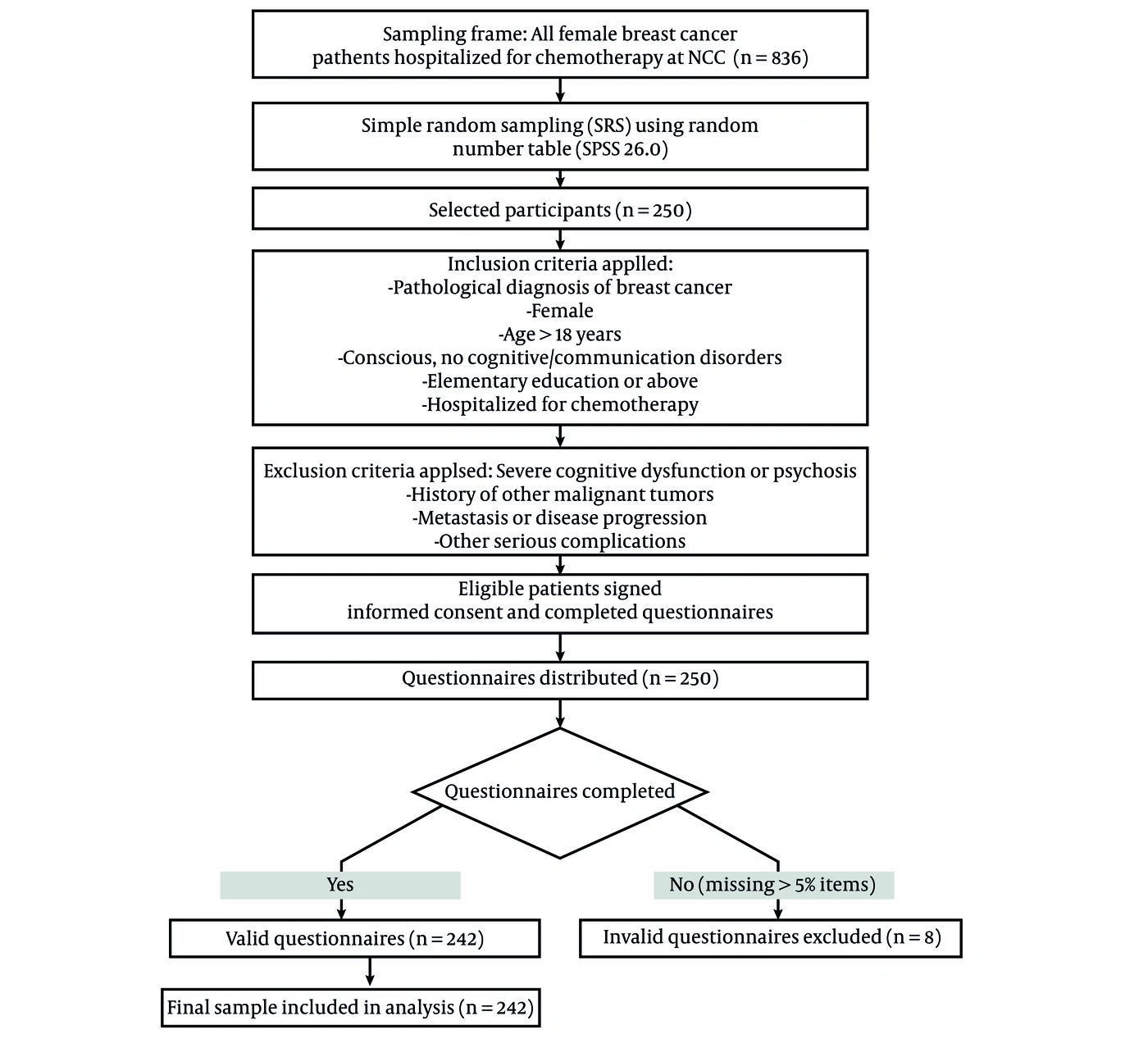
Figure 1.
Questionnaire screening flowchart
4.2. Core Outcome Scores
Following standardization, the spiritual health score (EORTC QLQ-SWB27) was 62.21 ± 11.25 on a scale of 0 - 100, indicating a moderate level. The quality-of-life score (EORTC QLQ-C30) was 65.40 ± 10.32 on a scale of 0 - 100, indicating a high level. The meaning-in-life score (MiLS) was 109.24 ± 14.71 on a scale of 28 - 140, also indicating a high level. Detailed dimension scores are shown in Table 2.
Table 2.
Spiritual Health, Quality-of-Life, and Meaning-in-Life Scores Among Patients with Breast Cancer Receiving Chemotherapy a
| Scale and Dimension | Original Score | Standardized Score (0 - 100) |
|---|---|---|
| EORTC QLQ-SWB27 (total score) | 62.21 ± 11.25 | 62.21 ± 11.25 |
| Dimension I: Presence | 23.19 ± 5.30 | 64.97 ± 14.86 |
| Dimension II: Relationship with others | 15.67 ± 2.87 | 62.68 ± 11.48 |
| Dimension III: Relationship to what matters | 12.74 ± 3.22 | 59.71 ± 15.33 |
| Dimension IV: Relationship to self | 10.61 ± 2.46 | 58.94 ± 13.67 |
| EORTC QLQ-C30 (total score) | 98.10 ± 15.48 | 65.40 ± 10.32 |
| Functional scales | ||
| Physical function | 17.17 ± 2.48 | 74.65 ± 10.78 |
| Role function | 6.35 ± 1.70 | 52.92 ± 14.17 |
| Emotional function | 11.98 ± 3.09 | 66.56 ± 17.17 |
| Cognitive function | 6.41 ± 1.36 | 53.42 ± 11.33 |
| Social function | 5.93 ± 1.70 | 49.42 ± 14.17 |
| Overall quality of life | 10.24 ± 2.59 | 68.27 ± 17.27 |
| MiLS (total score) | 109.24 ± 14.71 | Not applicable (scale-specific scoring) |
| Will to make sense | 16.43 ± 3.35 | Not applicable |
| Frustration exists | 19.14 ± 3.88 | Not applicable |
| Meaning and fulfillment of life | 15.55 ± 2.92 | Not applicable |
| Life control | 29.7 ± 4.63 | Not applicable |
| Suffering | 15.15 ± 2.69 | Not applicable |
| Acceptance of death | 13.29 ± 3.47 | Not applicable |
a Values are expressed as mean ± SD. Standardized scores were calculated as follows: EORTC QLQ-SWB27, (Original score - 22)/(107 - 22)×100; EORTC QLQ-C30 total score: (Original score - 30)/(126 - 30)×100. Original scores for the EORTC QLQ-C30 functional scales were already standardized to a scale of 0 - 100. Cronbach's α coefficients for all scales are reported in the Methods section and indicate good reliability. Abbreviations: EORTC QLQ-SWB27, European Quality of Life in Cancer Treatment and Research-Spiritual Health Scale; EORTC QLQ-C30, European Organization for Research and Treatment of Cancer Quality of Life Questionnaire-C30; MiLS, Meaning of Life Scale for Cancer Patients.
4.3. Correlations Among Core Outcomes
Pearson correlation analysis with false discovery rate adjustment showed significant positive correlations among all 3 core variables and their dimensions (Table 3). The strongest correlation was between spiritual health and quality of life (r = 0.63; 95% CI, 0.54 - 0.71; P < 0.001), followed by meaning in life and quality of life (r = 0.61; 95% CI, 0.52 - 0.69; P < 0.001), and spiritual health and meaning in life (r = 0.58; 95% CI, 0.48 - 0.66; P < 0.001). Among the quality-of-life dimensions, emotional function showed the strongest correlation with spiritual health (r = 0.55; 95% CI, 0.45 - 0.64; P < 0.001).
Table 3.
Correlation Coefficients (R) Among Spiritual Health, Quality of Life, and Meaning in Life, Adjusted for the False Discovery Rate
| Variables | Spiritual Health (Total Score) | Quality of Life (Total Score) | Meaning in Life (Total Score) |
|---|---|---|---|
| Spiritual health (total score) | 1.00 (Reference) | 0.63 (95% CI, 0.54 - 0.71; P < 0.001) | 0.58 (95% CI, 0.48 - 0.66; P < 0.001) |
| Quality of life (total score) | 0.63 (95% CI, 0.54 - 0.71; P < 0.001) | 1.00 (Reference) | 0.61 (95% CI, 0.52 - 0.69; P < 0.001) |
| Meaning in life (total score) | 0.58 (95% CI, 0.48 - 0.66; P < 0.001) | 0.61 (95% CI, 0.52 - 0.69; P < 0.001) | 1.00 (Reference) |
| Quality of life - Physical function | 0.49 (95% CI, 0.38 - 0.59; P < 0.001) | 0.78 (95% CI, 0.71 - 0.84; P < 0.001) | 0.45 (95% CI, 0.34 - 0.55; P < 0.001) |
| Quality of life - Role function | 0.42 (95% CI, 0.30 - 0.53; P < 0.001) | 0.72 (95% CI, 0.64 - 0.79; P < 0.001) | 0.39 (95% CI, 0.27 - 0.49; P < 0.001) |
| Quality of life - Emotional function | 0.55 (95% CI, 0.45 - 0.64; P < 0.001) | 0.81 (95% CI, 0.75 - 0.86; P < 0.001) | 0.53 (95% CI, 0.42 - 0.62; P < 0.001) |
| Quality of life - Cognitive function | 0.41 (95% CI, 0.29 - 0.52; P < 0.001) | 0.70 (95% CI, 0.62 - 0.77; P < 0.001) | 0.38 (95% CI, 0.26 - 0.49; P < 0.001) |
| Quality of life - Social function | 0.51 (95% CI, 0.40 - 0.60; P < 0.001) | 0.75 (95% CI, 0.68 - 0.81; P < 0.001) | 0.47 (95% CI, 0.36 - 0.57; P < 0.001) |
4.4. Factors Associated with Spiritual Health
Multiple linear regression analysis identified 3 significant positive predictors of spiritual health (Table 4), as described below.
Table 4.
Multiple Linear Regression Analysis of Factors Associated with Spiritual Health
| Predictor | Reference Category | β Coefficient (points) | 95% CI (points) | P value | Variance Inflation Factor |
|---|---|---|---|---|---|
| Monthly household income per capita (RMB) | < 1000 | - | - | - | 1.23 |
| 1000 - 3000 | < 1000 | 1.79 | 0.21 - 3.37 | 0.026 | - |
| 3001 - 5000 | < 1000 | 4.11 | 2.05 - 6.17 | < 0.001 | - |
| > 5000 | < 1000 | 7.28 | 5.03 - 9.53 | < 0.001 | - |
| Quality of life (standardized score) | - | 0.32 | 0.18 - 0.46 | < 0.001 | 1.56 |
| Meaning in life (total score) | - | 0.25 | 0.12 - 0.38 | < 0.001 | 1.49 |
| Occupational status | Unemployed | - | - | - | 1.18 |
| Employed | Unemployed | 4.44 | 0.82 - 8.06 | 0.017 | - |
| Retired | Unemployed | 0.92 | -2.21 - 4.05 | 0.564 | - |
| Age (≥ 60 y) | < 60 y | -0.53 | -3.21 - 2.15 | 0.698 | 1.05 |
| Marital status (married) | Unmarried | 1.27 | -2.35 - 4.89 | 0.488 | 1.12 |
| Religious belief (yes) | No | 0.89 | -1.98 - 3.76 | 0.542 | 1.03 |
Monthly household income per capita: Compared with the reference group (< 1000 RMB), the β coefficients for 1000 - 3000 RMB, 3001 - 5000 RMB, and > 5000 RMB were 1.79 (P = 0.026), 4.11 (P < 0.001), and 7.28 (P < 0.001), respectively, indicating a dose-response relationship between income and spiritual health.
Quality of life (standardized score): The β coefficient was 0.32 (95% CI, 0.18 - 0.46; P < 0.001), indicating that each 1-point increase in quality of life was associated with a 0.32-point increase in spiritual health.
Meaning in life (total score): The β coefficient was 0.25 (95% CI, 0.12 - 0.38; P < 0.001), indicating that each 1-point increase in meaning in life was associated with a 0.25-point increase in spiritual health.
Model assumption checks indicated no heteroscedasticity (Breusch-Pagan test, P = 0.12), and residuals were normally distributed. All VIFs were < 2, indicating no severe multicollinearity.
4.5. Structural Equation Model Results
A theory-driven SEM was constructed to examine whether quality of life mediated the relationship between meaning in life and spiritual health (Figure 2). The model fit indices were satisfactory: χ2/df = 2.53, RMSEA = 0.078, CFI = 0.91, and TLI = 0.90, indicating a good fit to the data. Meaning in life had a significant direct effect on spiritual health (β = 0.18; 95% CI, 0.05 - 0.31; P = 0.008) and a significant indirect effect through quality of life (β = 0.19; 95% CI, 0.10 - 0.28; P < 0.001). The total effect of meaning in life on spiritual health was β = 0.37 (95% CI, 0.25 - 0.49; P < 0.001), confirming the partial mediating role of quality of life in this relationship.
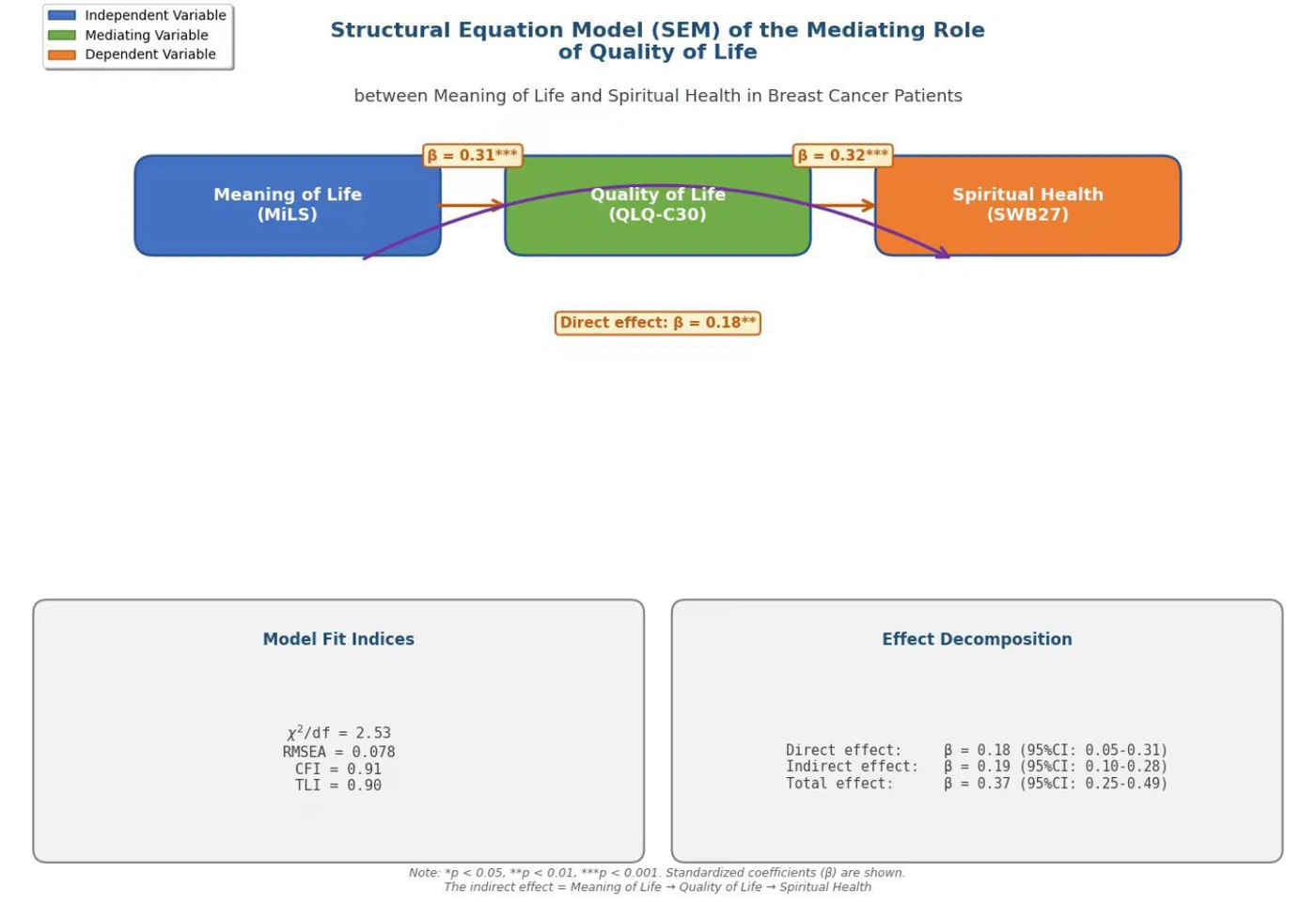
Figure 2.
Mediating role of quality of life in the relationship between meaning in life and spiritual health, assessed using a theory-driven structural equation model (SEM)
5. Discussion
Chemotherapy is a principal treatment option for patients with breast cancer and frequently causes physical symptoms and negative emotional responses, such as anxiety and depression (20, 21). The spiritual health of these patients has been reported to be considerably poorer than that of the general population (21, 22). Prompt psychological interventions and spiritual care can substantially improve spiritual health among patients with cancer (23-26). We therefore examined spiritual health among Chinese patients with breast cancer receiving chemotherapy to inform individualized spiritual care and improve psychological health.
Spiritual health, quality of life, and meaning in life were assessed using scales administered to a relatively large sample of patients in a real-world setting. The mean spiritual health score indicated a moderate level, with the highest score for the dimension reflecting relationships with others. Total quality-of-life scores indicated a high level of well-being among eligible participants. This finding was generally consistent with that of Akbari (12) but higher than that reported by Al-Natour et al. (13). Physical function had the highest score among the quality-of-life dimensions, suggesting that many patients maintained good self-care, freedom of physical activity, and minimal somatic symptoms. A similarly high mean score was observed for meaning in life. This score was higher than that reported in the multinational study of patients with advanced cancer by Connolly et al. (14) but consistent with the finding of Dos Santos et al. among breast cancer survivors (15). Across the 6 dimensions, patients scored highest in life control and lowest in acceptance of death. These positive outcomes may be largely attributable to the development of humanistic wards at the NCC, where medical staff provide comprehensive education about specific treatment regimens to enhance patients' quality of life. Regular health education, including lectures and support group meetings, helps patients acquire general knowledge about breast cancer and chemotherapy and gain confidence in overcoming potential challenges. Consequently, participants in this study had satisfactory quality-of-life and meaning-in-life scores.
We also explored factors associated with spiritual health, quality of life, and meaning in life. Patients with formal employment and higher monthly household income per capita had better spiritual health and meaning-in-life scores. Multiple linear regression analyses further demonstrated the predominant association of household income with spiritual health among patients receiving chemotherapy. Emerging evidence has shown that occupational status and average household income substantially affect spiritual health among patients with cancer receiving highly toxic chemotherapy (16, 27). These results suggest that economic circumstances play a critical role in patients' psychological health and highlight the importance of understanding their backgrounds before implementing individualized care strategies.
Significant positive correlations were also observed between each pair of the variables: spiritual health, quality of life, and meaning in life. Similar findings have been reported in previous studies (13, 28, 29). Patients with higher quality-of-life scores were more likely to report greater spiritual well-being, and vice versa. Spiritual health was also closely associated with meaning in life; both reflect individual perceptions and experiences at a spiritual level. Previous studies have shown that addressing negative emotions and meeting patients' spiritual needs can enhance their sense of meaning in life and quality of life (15, 26, 30). These findings suggest that timely assessment of psychological health is as essential as medical management of chemotherapy-related adverse events in clinical practice.
5.1. Study Limitations
This study has several limitations. First, data were collected at a single cancer hospital in China, which may limit the generalizability of the findings. Second, all core variables were self-reported by patients, introducing a risk of CMB. To address this limitation, we used Harman's single-factor test and the CFA marker method. The first common factor in Harman's test explained 32.7% of the total variance (< 40%). Adding the common method factor in the CFA marker method did not significantly improve model fit (Δχ2 = 18.26; Δdf = 12; P = 0.103), indicating no severe CMB. Moreover, compared with traditional multiple linear regression and bivariate correlation analysis, the SEM constructed in this study was more consistent with the theoretical assumptions. Evaluation of the complex relationships among variables using overall fit indices confirmed the partial mediating role of quality of life in the relationship between meaning in life and spiritual health, further supporting the validity of the study conclusions. Future validation in a larger, multicenter sample is warranted.
5.2. Conclusions
This study evaluated spiritual health, quality of life, and meaning in life using 3 established scales in a large sample of Chinese patients receiving chemotherapy for breast cancer. Participants had moderate spiritual health scores and high quality-of-life and meaning-in-life scores. Meaning in life had a significant direct effect on spiritual health and a significant indirect effect through quality of life. Quality of life partially mediated the relationship between meaning in life and spiritual health. Three key factors associated with spiritual health were identified: monthly household income per capita, which had the greatest weight; quality of life; and meaning in life. These findings suggest that economic circumstances should be considered when planning individualized care in Chinese clinical practice and may inform spiritual care for patients with breast cancer receiving chemotherapy.