
1. Background
Quality-of-life measurement in oncology has a long-standing validated framework, and research has also examined spiritual health, quality-of-life decision-making, emotion-regulation strategies, spirituality, religious coping, spiritual interventions, and adaptation to breast cancer (1-9). Recent global cancer estimates and psycho-oncology research further underscore the burden of breast cancer and the relevance of rumination, biopsychosocial adjustment, positive emotional processes, and spirituality for coping and health (10-14). Foundational work on emotion regulation, together with subsequent studies of spiritual well-being, adaptive and maladaptive regulation, and related cognitive processes, provides an important theoretical basis for understanding adjustment (15-20). Clinical and observational breast cancer research has also investigated quality of life, mindfulness, cognitive emotion regulation, and spiritual or religious interventions (21-26). Research on rumination, meaning-making, spiritual well-being measurement, and emotion-regulation or mindfulness-based interventions further informs the conceptual model used in the present study (27-33). Methodological work on cancer-specific quality-of-life modules, biopsychosocial-spiritual care, global cancer burden, repetitive thought, spirituality and quality of life, and general quality-of-life theory provides additional context (34-39).
Breast cancer is the most prevalent cancer among women worldwide (10, 36). Although survival rates have improved, patients often experience long-term psychological and functional consequences. Accordingly, research has increasingly focused on quality of life and psychological adaptation (1, 21, 22).
Quality of life refers to individuals’ perceptions of their position in life within their cultural and value contexts (39). In cancer populations, psychological processes play a central role in adjustment, consistent with biopsychosocial and biopsychosocial-spiritual models (12, 35).
Cognitive appraisal significantly influences psychological outcomes. One maladaptive cognitive process is rumination, defined as repetitive negative thinking about distressing experiences (27, 28, 37). Rumination is associated with prolonged distress and impaired adjustment, including in cancer populations (11, 28).
From the perspective of emotion regulation theory, emotional responses are shaped by processes through which individuals modify the experience and expression of affect in response to situational demands (15, 16). Within this framework, rumination is conceptualized as a maladaptive pattern characterized by repetitive, passive attention to negative thoughts, whereas cognitive reappraisal reflects a more adaptive strategy involving the reinterpretation of emotional situations in a more constructive manner (4, 17, 19, 20).
Previous research indicates that cognitive reappraisal is associated with better psychological outcomes, including among women with breast cancer (8, 24, 31).
Spiritual well-being represents an important psychological resource encompassing meaning, peace, and connection with transcendence (9, 14, 30, 38). Studies in women with breast cancer and other cancer populations have linked spirituality or spiritual well-being with quality of life and coping (5, 18, 26). Spiritual or religious interventions have also been examined in breast cancer populations (7, 25, 33). Meaning-making theory supports the proposition that spirituality may be associated with lower levels of distress through processes related to coherence in global meaning systems (29).
Despite this theoretical and empirical support, the psychological mechanisms linking spiritual well-being to quality of life remain insufficiently integrated. In particular, the potential mediating roles of rumination and cognitive reappraisal have not been examined within a unified structural model.
2. Objectives
The present study aimed to examine the mediating roles of rumination and cognitive reappraisal in the relationship between spiritual well-being and quality of life in women with breast cancer.
3. Methods
3.1. Study Design and Setting
This study employed a cross-sectional, correlational design and a PLS-SEM approach. The target population consisted of women diagnosed with breast cancer who attended Imam Reza and Omid hospitals in Mashhad, Iran, between April and September 2025. These two tertiary oncology referral centers provide specialized cancer care and serve patients from Mashhad and surrounding regions, thereby providing access to a relatively diverse clinical population.
3.2. Participants and Sampling
Participants were recruited consecutively during routine outpatient visits and treatment sessions. A total of 562 patients were initially approached. Of these, 432 met the eligibility criteria, whereas 130 were excluded because they did not meet the eligibility criteria (e.g., disease stage, cognitive or physical condition, or incomplete medical records). Among the eligible patients, 20 declined participation, and 12 were excluded because of incomplete questionnaire responses or withdrawal during data collection. The final sample comprised 400 women with breast cancer who completed all study measures and were included in the final analysis.
Participants were recruited using consecutive sampling (a form of convenience sampling), with enrollment during routine outpatient visits and treatment sessions. Eligible patients were invited to participate and were informed about the study objectives before providing written informed consent.
Data were collected in clinical settings using standardized self-report questionnaires. Trained researchers were present during data collection to ensure completeness and address participants’ questions. Participants completed the instruments during scheduled hospital visits.
3.2.1. Eligibility Criteria
Participants were included if they had a confirmed medical diagnosis of stage I-III breast cancer, were aged 30 - 65 years, had been diagnosed at least 6 months previously, were able to read and complete the questionnaires independently, had no severe psychiatric or cognitive disorders, were not concurrently participating in structured psychological interventions, and were willing to participate. Individuals were excluded if more than 10% of their responses were incomplete or if they withdrew because of physical or psychological discomfort.
3.2.2. Sample Size
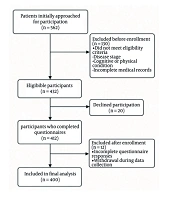
The final analytical sample comprised 400 participants (Figure 1). Figure 1 presents the participant recruitment and selection process in accordance with STROBE recommendations.
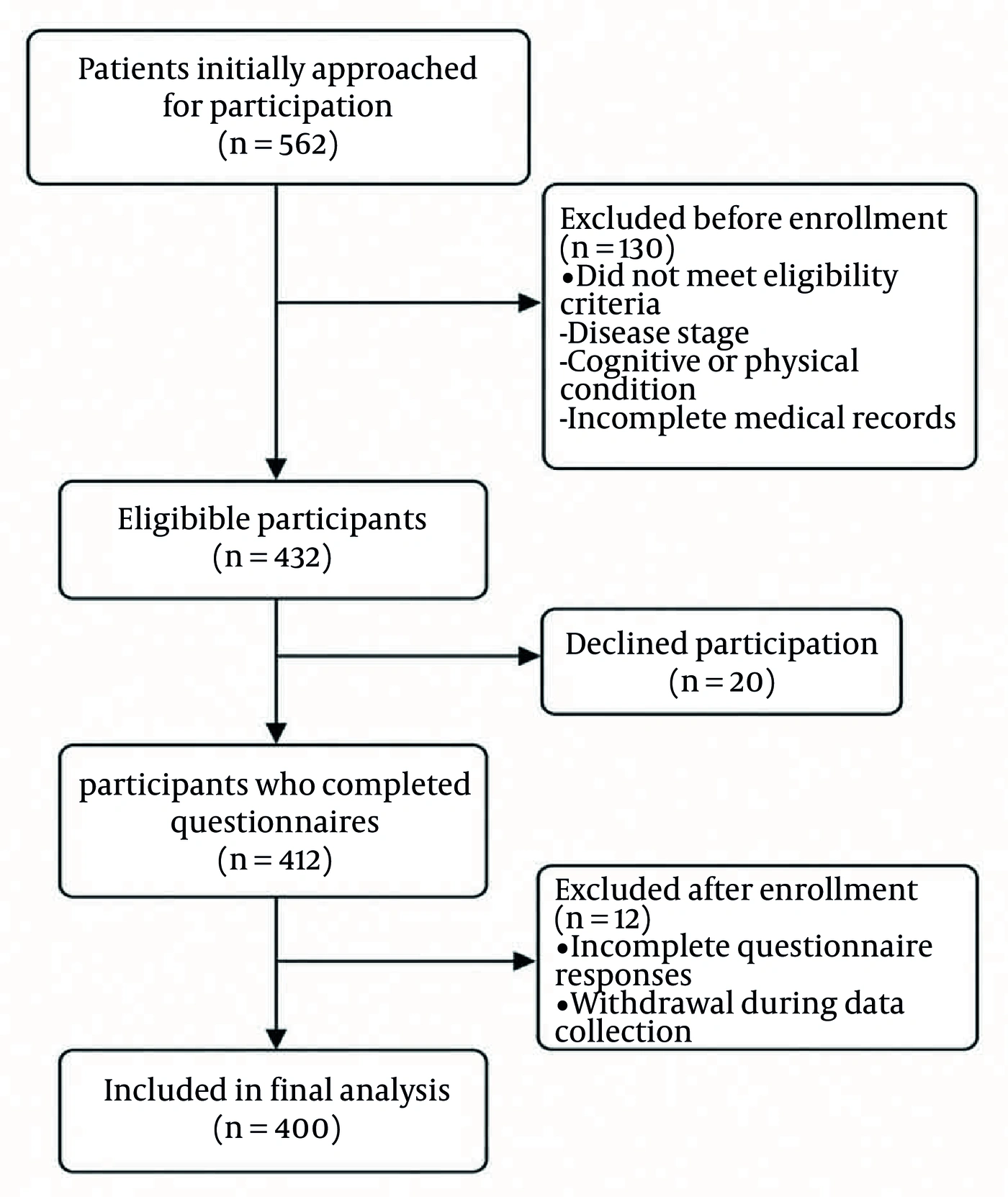
Figure 1.
Flow diagram of participant recruitment and inclusion in the study
Figure 1 shows the study flow from initial eligibility assessment through screening, exclusion, and final inclusion in the analysis. A total of 562 patients were initially approached. Of these, 130 were excluded because they did not meet the eligibility criteria, including disease stage, cognitive or physical condition, or incomplete medical records. Among the 432 eligible participants, 20 declined participation. Of the remaining participants, 12 were excluded because of incomplete questionnaire responses or withdrawal during data collection, resulting in a final analytical sample of 400 participants.
3.3. Data Collection and Instruments
3.3.1. Quality of Life
Quality of life was assessed using selected functional subscales of the EORTC QLQ-C30 (1). The domains included physical, emotional, and social functioning, as well as global health status. Scores were transformed according to standardized EORTC guidelines to a 0 - 100 scale, with higher scores indicating better perceived quality of life. Symptom-related items were reverse-scored to ensure consistent interpretation.
The EORTC QLQ-BR23 was also administered to obtain descriptive information regarding breast cancer-specific symptoms and functioning. However, QLQ-BR23 domains were not included in the structural equation model because the present study aimed to operationalize quality of life primarily through general functional and global health domains derived from the QLQ-C30. This approach was adopted to maintain conceptual consistency and reduce heterogeneity within the latent quality-of-life construct. The use of cancer-specific EORTC modules is consistent with the modular approach to quality-of-life assessment (34).
3.3.2. Spiritual Well-Being
Spiritual well-being was measured using the Functional Assessment of Chronic Illness Therapy-Spiritual Well-Being 12-item scale (FACIT-Sp-12), which evaluates meaning, peace, and faith (30). The instrument comprises 12 items rated on a Likert-type scale, with higher scores indicating greater spiritual well-being.
3.3.3. Rumination
3.3.4. Cognitive Reappraisal
Cognitive reappraisal was assessed using the cognitive reappraisal subscale of the Emotion Regulation Questionnaire (ERQ). This subscale measures the extent to which individuals reinterpret emotional experiences in a more adaptive manner (17).
3.3.5. Data Collection Procedure
All data were collected during clinical visits to oncology wards using standardized psychometric instruments. Participants completed the questionnaires in a quiet hospital setting. The research team supervised the process to ensure clarity and completeness of responses.
3.4. Statistical Analysis
Before structural modeling, all variables were screened and prepared for analysis. Quality-of-life indicators were standardized and aligned so that higher scores consistently reflected better health status.
PLS-SEM was used because of its suitability for predictive modeling, complex mediation structures, and data that may deviate from normality assumptions. Analyses were performed using SmartPLS version 4.
To improve model parsimony and reduce indicator complexity, item parceling was applied to the FACIT-Sp-12 and RRS. Items were grouped into conceptually coherent parcels according to the theoretical structure of each instrument and recommendations for PLS-SEM. Composite scores were calculated for each parcel and used as reflective indicators in the measurement model. This approach reduced the number of indicators and improved model parsimony while maintaining the conceptual representation of the original constructs and adequate measurement validity.
The PLS-SEM model was evaluated in 2 stages. First, the measurement model was assessed for indicator reliability, internal consistency reliability, convergent validity, and discriminant validity. Second, the structural model was evaluated using path coefficients, the coefficient of determination (R2), predictive relevance (Q2), and effect sizes.
3.4.1. Model Evaluation
Reliability was evaluated using Cronbach alpha and composite reliability. Convergent validity was assessed using average variance extracted (AVE), whereas discriminant validity was evaluated using both the Fornell-Larcker criterion and heterotrait-monotrait (HTMT) ratios. Collinearity diagnostics were performed using the variance inflation factor (VIF), with values below established thresholds indicating no multicollinearity concerns.
3.4.2. Structural Model and Mediation Testing
Structural relationships were estimated using bootstrapping with 5,000 resamples to determine the significance of direct and indirect effects. Bias-corrected confidence intervals were used to evaluate mediation effects.
A serial mediation model was tested based on theoretical assumptions. Alternative mediation structures, including parallel mediation and reverse-order serial mediation, were conceptually considered during model development. However, the present serial pathway was selected based on theoretical perspectives derived from meaning-making and emotion regulation frameworks, suggesting that maladaptive repetitive thinking may interfere with adaptive cognitive reappraisal processes (15-20, 27-29). Because all constructs were measured cross-sectionally, alternative directional pathways remain plausible and should be examined in future longitudinal research.
Because this study employed a cross-sectional design, the observed structural pathways should be interpreted as correlational associations rather than evidence of causal relationships. Accordingly, the proposed mediation model reflects theoretically informed associations among the study variables without establishing temporal precedence or causal effects.
Clinical and demographic covariates were not included in the primary structural model because the study aimed to evaluate the hypothesized psychological associations within a parsimonious exploratory framework. Nevertheless, residual confounding by factors such as age, cancer stage, treatment status, marital status, and time since diagnosis cannot be excluded.
3.5. Ethical Considerations
Ethical approval for this study was obtained from the Ethics Committee of Mashhad University of Medical Sciences before data collection. In accordance with the institutional procedures in effect at the time of approval, no formal ethics approval code was assigned; however, the study received full ethical and administrative approval before participant recruitment. Written informed consent was obtained from all participants before enrollment. All study procedures were conducted in accordance with the ethical principles of the Declaration of Helsinki. Participant confidentiality and anonymity were maintained throughout the study, and participants were informed of their right to withdraw at any time without consequences for their medical care.
4. Results
Table 1.
Outer Loadings of Measurement Model a
| Constructs and Indicators | Loading |
|---|---|
| Spiritual well-being | |
| SWB1 | 0.78 |
| SWB2 | 0.81 |
| SWB3 | 0.75 |
| SWB4 | 0.83 |
| SWB5 | 0.77 |
| SWB6 | 0.80 |
| SWB7 | 0.74 |
| SWB8 | 0.79 |
| Rumination | |
| RUM1 | 0.76 |
| RUM2 | 0.79 |
| RUM3 | 0.72 |
| RUM4 | 0.75 |
| Cognitive reappraisal | |
| CR1 | 0.77 |
| CR2 | 0.81 |
| CR3 | 0.73 |
| CR4 | 0.76 |
| Quality of life (EORTC QLQ-C30 domains) | |
| QoL-Physical | 0.84 |
| QoL-Emotional | 0.86 |
| QoL-Social | 0.79 |
| QoL-Global Health | 0.82 |
a Quality of life was modeled using selected functional domains of the EORTC QLQ-C30, with higher scores indicating better quality of life. Symptom scales were excluded to maintain construct purity of functional quality of life.
Table 2.
Reliability and Convergent Validity a
| Construct | Cronbach alpha | CR | AVE |
|---|---|---|---|
| Spiritual well-being | 0.88 | 0.91 | 0.56 |
| Rumination | 0.84 | 0.88 | 0.53 |
| Cognitive reappraisal | 0.86 | 0.89 | 0.55 |
| Quality of life | 0.87 | 0.92 | 0.69 |
a Abbreviations: CR, composite reliability; AVE, average variance extracted.
Table 3.
Discriminant Validity (Fornell-Larcker Criterion) a
| Construct | 1 | 2 | 3 | 4 |
|---|---|---|---|---|
| Spiritual well-being | 0.76 | |||
| Rumination | -0.48 | 0.75 | ||
| Cognitive reappraisal | 0.52 | -0.36 | 0.75 | |
| Quality of life | 0.67 | -0.49 | 0.54 | 0.84 |
a Diagonal values indicate the square root of the AVE for each construct, whereas off-diagonal values represent correlations between constructs. Discriminant validity is supported when diagonal values exceed interconstruct correlations.
Table 4.
HTMT Ratios a
| Constructs | HTMT |
|---|---|
| Spiritual well-being - Rumination | 0.69 |
| Spiritual well-being - Cognitive reappraisal | 0.74 |
| Spiritual well-being - Quality of life | 0.81 |
| Rumination - Cognitive reappraisal | 0.63 |
| Rumination - Quality of life | 0.77 |
| Cognitive reappraisal - Quality of life | 0.77 |
a HTMT values below 0.85 (strict criterion) or 0.90 (lenient criterion) indicate adequate discriminant validity.
Table 5.
Collinearity Assessment Using Variance Inflation Factor a
| Endogenous Constructs and Predictor Constructs | VIF |
|---|---|
| Rumination | |
| Spiritual well-being | 1.32 |
| Cognitive reappraisal | |
| Spiritual well-being | 1.48 |
| Rumination | 1.41 |
| Quality of life | |
| Spiritual well-being | 1.76 |
| Rumination | 1.58 |
| Cognitive reappraisal | 1.44 |
a All VIF values were below the conservative threshold of 3.3, indicating no multicollinearity issues among predictor constructs in the structural model.
Table 6.
Results of Structural Model Analysis a
| Path | β | t | P | 95% CI |
|---|---|---|---|---|
| Spiritual well-being → Rumination | -0.48 | 21.10 | P < 0.001 | [-0.56, -0.40] |
| Spiritual well-being → Cognitive reappraisal | 0.52 | 10.05 | P < 0.001 | [0.42, 0.61] |
| Spiritual well-being → Quality of life | 0.41 | 12.80 | P < 0.001 | [0.33, 0.49] |
| Rumination → Cognitive reappraisal | -0.38 | 8.60 | P < 0.001 | [-0.47, -0.29] |
| Rumination → Quality of life | -0.33 | 5.40 | P < 0.001 | [-0.45, -0.21] |
| Cognitive reappraisal → Quality of life | 0.29 | 7.10 | P < 0.001 | [0.21, 0.37] |
a β, standardized path coefficient; t, bootstrap t value; P, significance level based on bootstrapping with 5,000 resamples.
Table 7.
R2 and Q2 Values a
| Construct | R2 | Q2 |
|---|---|---|
| Rumination | 0.23 | 0.17 |
| Cognitive reappraisal | 0.44 | 0.26 |
| Quality of life | 0.58 | 0.39 |
a R2, coefficient of determination; Q2, predictive relevance.
Table 8.
Indirect Effects (Bootstrapping)
| Indirect Path | β | t | P | 95% CI |
|---|---|---|---|---|
| Spiritual well-being → Rumination → Quality of life | 0.16 | 4.88 | < 0.001 | [0.10, 0.23] |
| Spiritual well-being → Cognitive reappraisal → Quality of life | 0.15 | 5.94 | < 0.001 | [0.09, 0.21] |
| Spiritual well-being → Rumination → Cognitive reappraisal → Quality of life | 0.05 | 3.41 | < 0.001 | [0.02, 0.09] |
4.1. Sample Characteristics
A total of 400 women with breast cancer participated in this study. The mean age was 48.72 years (SD = 8.94). Regarding disease stage, 38.5% were in stage I, 41.0% were in stage II, and 20.5% were in stage III. Regarding marital status, 62.3% were married, 21.7% were single, and 16.0% were widowed or divorced. The mean duration since diagnosis was 2.84 years (SD = 1.76).
4.2. Measurement Model Assessment
The measurement model was evaluated before hypothesis testing. All constructs were specified as reflective latent variables. Indicator reliability was assessed using outer loadings; all retained indicators exceeded the recommended threshold of 0.70, indicating adequate reliability. Convergent validity was established through AVE, with all constructs exceeding the minimum criterion of 0.50. Internal consistency reliability was confirmed using composite reliability indices, all of which exceeded the acceptable threshold. Discriminant validity was assessed using the HTMT ratio and the Fornell-Larcker criterion. All HTMT values were below 0.85, indicating satisfactory discriminant validity. Collinearity was assessed using VIF, which indicated no multicollinearity among the predictor constructs.
Spiritual well-being was measured using 8 indicators (SWB1-SWB8), rumination using 4 indicators (RUM1-RUM4), and cognitive reappraisal using 4 indicators (CR1-CR4). Quality of life was modeled as a reflective latent construct based on selected functional domains of the EORTC QLQ-C30, including physical, emotional, and social functioning and global health status. All scores were standardized according to the EORTC scoring manual to a 0 - 100 scale, with higher scores indicating better quality of life. The symptom scales of the EORTC QLQ-C30 were used exclusively for descriptive analysis and were not included in the structural equation model.
The square root of the AVE for each construct exceeded its correlations with other constructs, confirming discriminant validity.
All HTMT values were below 0.85, indicating adequate discriminant validity.
4.3. Structural Model Analysis
Bootstrapping with 5,000 resamples was used to estimate path coefficients and test the significance of direct and indirect effects. Inner VIF values ranged from 1.32 to 1.76, indicating no multicollinearity.
Path coefficients were estimated using bootstrapping with 5,000 resamples to assess the significance of the hypothesized relationships. Bootstrapped t values indicated strong statistical significance, consistent with the relatively large sample size (n = 400).
4.3.1. Coefficient of Determination and Predictive Relevance
The model explained 58% of the variance in quality of life, indicating substantial explanatory power. Positive Q2 values confirmed predictive relevance.
4.4. Mediation Analysis
The mediation analysis indicated that rumination and cognitive reappraisal partially mediated the relationship between spiritual well-being and quality of life. This serial mediation reflects a statistical sequence rather than a temporal or causal process because of the cross-sectional design.
The indirect effects were significant, confirming partial mediation. Spiritual well-being was significantly associated with quality of life both directly and indirectly through lower rumination and higher cognitive reappraisal.
5. Discussion
The present study examined associations among spiritual well-being, cognitive emotion regulation strategies, rumination, and quality of life in women with breast cancer using structural equation modeling. The findings indicated statistically meaningful relationships among the study constructs in a cross-sectional dataset analyzed using PLS-SEM for predictive and exploratory modeling.
Spiritual well-being was positively associated with quality of life and cognitive reappraisal and negatively associated with rumination. These results suggest that individuals with higher levels of meaning, peace, and transcendence tend to report more adaptive emotion regulation strategies and lower levels of repetitive negative thinking. This pattern is consistent with previous findings on spirituality, quality of life, coping, and meaning-making (2, 5-7, 9, 14, 18, 25, 26, 29, 33, 38).
Consistent with cognitive and emotion regulation theories, rumination was negatively associated with quality of life, reflecting the detrimental role of repetitive negative thinking in psychological adjustment (11, 27, 28, 37). In contrast, cognitive reappraisal was positively associated with quality of life, supporting its adaptive role in reframing emotional experiences and enhancing psychological well-being (4, 8, 15-17, 19, 20, 24, 31). These findings are also consistent with broader biopsychosocial models of health (12, 35).
The results further indicated that rumination and cognitive reappraisal functioned as statistical mediators in the relationship between spiritual well-being and quality of life. These indirect effects should be interpreted as associative pathways within a cross-sectional framework rather than as evidence of temporal or causal mechanisms.
From a theoretical perspective, the findings are consistent with meaning-making models, suggesting that spiritual resources may be associated with more adaptive cognitive-emotional processes, which in turn relate to better perceived quality of life (29). Related intervention and observational research in breast cancer populations has examined mindfulness, spiritual therapy, spiritual interventions, cognitive emotion regulation, and quality of life (21-26, 31-33).
From a clinical perspective, these psychological variables may be associated with better psychological adjustment in this population; however, any implications for intervention should be interpreted cautiously given the observational nature of the data.
5.1. Study Limitations
This study has several limitations. First, the cross-sectional design precludes causal inference and does not allow conclusions regarding temporal ordering among variables. Longitudinal or experimental studies are needed to clarify the directionality of these relationships. Second, participants were recruited using convenience sampling from 2 hospitals in Mashhad, Iran, which may limit generalizability to other cultural and clinical contexts. Third, all variables were assessed using self-report measures, which may introduce response biases such as social desirability or recall bias. Fourth, only cognitive reappraisal was examined as an emotion regulation strategy. Other relevant strategies, such as suppression and acceptance, were not included and should be considered in future research to develop a more comprehensive model. Finally, the study did not adjust for potential confounding variables such as age, cancer stage, treatment status, marital status, or time since diagnosis, which may have influenced the observed associations. Future studies should examine whether the observed associations remain stable after adjustment for these demographic and clinical variables.
5.2. Conclusions
Spiritual well-being was positively associated with quality of life among women with breast cancer. These associations were partially explained by lower levels of rumination and greater use of cognitive reappraisal. The findings should be interpreted in light of the cross-sectional design. They may provide a basis for future intervention studies focusing on spiritual resources and adaptive cognitive emotion regulation strategies in women with breast cancer.