
1. Background
Breast cancer, characterized by the uncontrolled proliferation of breast tissue, represents a major global health challenge as the most diagnosed cancer and the leading cause of cancer-related mortality among women worldwide (1-3). The global burden is substantial, with approximately 2.1 million new cases diagnosed in 2018 alone, while Iran faces a particularly significant health burden with an age-standardized incidence rate of 33.2 per 100,000 women (4, 5).
The cancer experience extends beyond physical manifestations to encompass profound psychological dimensions. Diagnosis and treatment frequently trigger substantial distress, with up to 50% of patients experiencing anxiety or depression within the first year (6, 7). This distress demonstrates multifactorial associations with demographic characteristics such as younger age and lower education, alongside psychosocial factors including diminished self-efficacy and heightened perceived stress (8-10).
In mitigating this distress, both social support and spirituality emerge as crucial resources. Social support, encompassing emotional, instrumental, and informational assistance from one's network, consistently correlates with improved psychological adjustment, enhanced quality of life, and superior treatment outcomes (6, 11, 12). Similarly, spiritual coping strategies — drawing upon belief systems to construct meaning and purpose — foster emotional solace, hope, and mental equilibrium during illness (13-16).
The protective effects of these resources operate through identifiable psychological mechanisms, including strengthening internal resources such as resilience and self-efficacy while mitigating risk factors like rumination and fear of negative evaluation. These relationships may be further influenced by moderating variables, including personality traits and lifestyle factors (17-24).
Despite established recognition of the importance of spiritual care in Iranian oncology, research has predominantly focused on structural barriers, general spiritual needs, and formal interventions (25-28). The realm of daily spiritual experiences — commonplace, personal manifestations of spirituality in ordinary life — remains notably unexplored in this population. This gap is particularly evident given the successful measurement of this construct in other Iranian clinical populations (29), highlighting a significant lacuna in oncology research.
Therefore, this study aims to investigate the relationships between daily spiritual experiences, perceived social support, and symptoms of psychological distress (stress, anxiety, and depression) in Iranian women with breast cancer, addressing a critical gap in understanding non-institutional spiritual experiences in this population.
2. Objectives
To examine the relationships between daily spiritual experiences, perceived social support, and symptoms of psychological distress (stress, anxiety, and depression) in Iranian women with breast cancer.
3. Methods
3.1. Research Hypotheses
3.1.1. Hypothesis Concerning Social Support
Main hypothesis: Perceived social support will have a significant negative correlation with lower levels of psychological distress (stress, anxiety, and depression). o Secondary Hypotheses: Social support is expected to be associated with less stress. Social support is expected to be associated with fewer anxiety symptoms. Social support is expected to be associated with fewer depressive symptoms.
3.1.2. Hypothesis concerning Spiritual Experiences
Main hypothesis: Daily spiritual experiences will have a significant negative correlation with lower levels of psychological distress (stress, anxiety, and depression). Secondary hypotheses: Daily spiritual experiences are expected to be associated with less stress. Daily spiritual experiences are expected to be associated with fewer anxiety symptoms. Daily spiritual experiences are expected to be associated with fewer depressive symptoms.
3.2. Study Design and Participants
This study employed a cross-sectional correlational design. A power analysis was conducted using G*Power software (version 3.1) to determine the minimum required sample size. With an anticipated medium effect size (f² = 0.15), an alpha of 0.05, and a power of 0.80 for a multiple regression analysis with three predictors, the analysis indicated a required sample size of 77 participants. To account for potential attrition and missing data, the sample was increased to 100 breast cancer patients. Participants were recruited through a convenience sampling approach from the chemotherapy department at Khatam Al-Anbia Hospital in Zahedan, Iran, in 2024 - 2025.
3.3. Ethical Considerations and Data Collection Procedure
This study was approved by Zahedan University of Medical Sciences with the ethics code IR.ZBMU.REC.1403.013. All participants in this study were conscious, clinically stable, and decisionally capable patients who were cognitively able to understand the nature of the research and provide personal informed consent.
The informed consent procedure was as follows:
- Consent method: Written informed consent was obtained from all participants. A consent form detailing the study's aims, procedures, potential benefits and risks, the right to withdraw at any time, and guarantees of confidentiality was provided to the participants.
- Procedure for illiterate participants: For participants who were unable to read and write, the entire content of the consent form was read aloud to them. After ensuring their full comprehension, consent was obtained via thumbprint from the participant and the signature of an impartial witness.
- Confidentiality: Participants were assured that all their information would be kept strictly confidential. Data would be used in anonymized and aggregated form for analysis, and no personally identifiable information would be published in any resulting reports or articles.
- Recruitment: Eligible patients were invited to participate orally and via the information sheet, following confirmation of their clinical eligibility by their treating physician.
The data collection process was then initiated. The research team, comprising trained interviewers, conducted visits to the chemotherapy clinic.
- Interviewer training: To ensure reliable and truthful responses, all data collectors received standardized training. This training covered the study's objectives, the ethical necessity of voluntary participation and anonymity, and a standardized protocol for administering the questionnaires. Interviewers were instructed to read the questions neutrally, avoid interpreting items for participants, and create a private and comfortable environment to minimize social desirability bias.
Eligible patients who satisfied the study's inclusion criteria were invited to participate. The inclusion criteria were: (1) Female patients aged 30 to 70 years; (2) a confirmed pathological diagnosis of breast cancer; (3) minimum literacy skills required to complete the self-report questionnaires; (4) awareness of their diagnosis and provision of informed consent to participate; (5) physically and mentally stable enough to participate in the study, as determined by their treating physician or the research team.
3.4. Exclusion Criteria
A history of formal academic education or training in religious sciences, mysticism, or related fields (e.g., graduation from a seminary or holding a university degree in these disciplines) (This criterion was implemented to reduce the potential bias associated with specialized knowledge when responding to spirituality-related items and to create a more homogeneous sample in terms of theoretical knowledge about spiritual concepts.). The presence of any major psychiatric disorder or cognitive impairment (e.g., dementia), documented in the medical record or by the treating physician, that would seriously compromise the ability to understand and respond to the questionnaires. Severe clinical deterioration or end-stage disease that would make participation impossible (This criterion was assessed based on a review of the patient's medical records and, if necessary, consultation with their treating physician at the time of data collection.).
3.5. Handling of Missing Questionnaires
A proactive approach was taken to manage incomplete data. Questionnaires were checked for completeness on-site immediately after completion. If any items were missed, the participant was politely asked whether they would be willing to complete them. Questionnaires with more than 10% missing data on any scale were considered invalid and excluded from the final analysis, as per the exclusion criteria.
3.6. Instruments and Measures
Four standardized instruments were administered to gather research data. A key limitation to acknowledge is that the primary constructs of interest — spirituality, social support, and psychological distress — were measured using self-report instruments, which are susceptible to biases such as social desirability and recall bias.
3.6.1. Demographic and Clinical Questionnaire
A researcher-developed questionnaire collected information on age, marital status, occupation, income, educational attainment, cancer duration, hospitalization history, and chronic illness background.
3.6.2. The Daily Spiritual Experiences Scale
- Version & Source: The validated Persian version by Jafari et al. (30) was used.
- Scoring & Interpretation: The scale consists of 16 items. Items are rated on a 6-point Likert scale (ranging from 1 = Never or almost never to 6 = Many times a day). The total score is calculated by summing the responses to all items, resulting in a possible range of 16 to 96. A higher total score indicates a higher frequency of daily spiritual experiences. o Reliability in this sample: The internal consistency for the Daily Spiritual Experiences Scale (DSES) in the present study was excellent, with a Cronbach's alpha of 0.94.
3.6.3. The Multidimensional Scale of Perceived Social Support
- Version & Source: The validated Persian version of the Multidimensional Scale of Perceived Social Support (MSPSS) (31) was used.
- Scoring & Interpretation: This 12-item scale is rated on a 7-point Likert scale (from 1 = Very strongly disagree to 7 = Very strongly agree). The total score is the sum of all 12 items (range: 12 - 84). A higher total score indicates a higher level of perceived social support. The scale can also be interpreted based on its three subscales: Family, friends, and significant other.
- Reliability in this sample: The MSPSS demonstrated high internal consistency in this study, with a Cronbach's alpha of 0.91 for the total score.
3.6.4. The Depression, Anxiety, and Stress Scale-21 Items
- Version & Source: The validated Persian version of the Depression, Anxiety, and Stress Scale - 21 Items (DASS-21) (32) was used.
- Scoring & Interpretation: The DASS-21 has 21 items, rated on a 4-point severity scale (from 0 = Did not apply to me at all to 3 = Applied to me very much, or most of the time). The scores for the Depression, Anxiety, and Stress subscales are calculated by summing the scores for the respective 7 items and then multiplying the sum by 2. This converts the score to be comparable to the full 42-item DASS. The resulting subscale scores are interpreted using the standard severity cut-offs shown below (Table 1).
Table 1.
Severity Levels of Depression, Anxiety, and Stress Based on Standardized DASS Cut-off Scores (Equivalent to DASS-42)
| Severity | Depression | Anxiety | Stress |
|---|---|---|---|
| Normal | 0 - 9 | 0 - 7 | 0 - 14 |
| Mild | 10 - 13 | 8 - 9 | 15 - 18 |
| Moderate | 14 - 20 | 10 - 14 | 19 - 25 |
| Severe | 21 - 27 | 15 - 19 | 26 - 33 |
| Extremely Severe | 28+ | 20+ | 34+ |
The scores from the three DASS-21 subscales (depression, anxiety, and stress) were summed to create a single composite score representing overall psychological distress. This approach was chosen because the subscales were highly intercorrelated in our sample (Cronbach's alpha = 0.92 for the total scale), justifying their combination into a global measure of negative emotionality. Consequently, all subsequent analyses were performed using this composite score.
3.7. Data Analysis
Statistical analysis was performed using SPSS Statistics (version 24). Descriptive statistics (frequencies, means, standard deviations) were used to characterize the sample. To assess the assumption of normality for the key continuous data (scores of spiritual experiences, social support, depression, anxiety, and stress), the Shapiro-Wilk test of normality was conducted. The results of this test indicated that the data distribution for all these variables significantly deviated from normality (P < 0.05 for all variables). Furthermore, visual inspection of histograms and Q-Q plots confirmed this departure from normality. Additionally, data from psychometric scales are often measured at an ordinal level. Considering these factors and the non-parametric nature of the data, Spearman's rank-order correlation was selected as the appropriate method for examining the relationships between variables. In addition to correlation coefficients, effect sizes will be reported for all significant findings to provide a measure of their practical significance.
A Bonferroni correction for multiple comparisons was not applied. This decision was made because the analysis was primarily exploratory in nature, aiming to identify potential relationships for future research without overly increasing the risk of Type II errors (failing to identify true effects). The interpretation of results focused on the effect sizes and patterns of relationships, with a recognition of the increased family-wise error rate. All P-values are reported uncorrected to allow for transparent evaluation.
To examine the unique contribution of the main study variables in predicting psychological distress and to control for potential confounding factors, a hierarchical multiple linear regression analysis was conducted. The composite psychological distress score was entered as the dependent variable. Predictor variables were entered in two blocks: The first block included demographic and clinical covariates (age, education level, income, and symptom burden), and the second block included the main study variables (social support and daily spiritual experiences).
4. Results
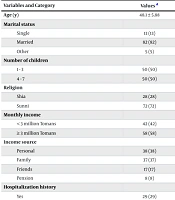
Table 2 presents the demographic and clinical characteristics of the study participants. The study included 100 breast cancer patients with a mean age of 48.01 ± 5.88 years. Many participants were married (82%) and had primary or secondary education (59%). Regarding religious affiliation, 72% were Sunni and 28% were Shia. Most participants (58%) reported a monthly income above 3 million Tomans, and the predominant occupation was freelance work (62%). Concerning medical history, 54% of participants had underlying medical conditions, while 29% had a history of hospitalization.
Table 2.
Demographic and Clinical Characteristics of Participants (N = 100)
| Variables and Category | Values a |
|---|---|
| Age (y) | 48.1 ± 5.88 |
| Marital status | |
| Single | 13 (13) |
| Married | 82 (82) |
| Other | 5 (5) |
| Number of children | |
| 1 - 3 | 50 (50) |
| 4 - 7 | 50 (50) |
| Religion | |
| Shia | 28 (28) |
| Sunni | 72 (72) |
| Monthly income | |
| < 3 million Tomans | 42 (42) |
| ≥ 3 million Tomans | 58 (58) |
| Income source | |
| Personal | 38 (38) |
| Family | 37 (37) |
| Friends | 17 (17) |
| Pension | 8 (8) |
| Hospitalization history | |
| Yes | 29 (29) |
| No | 71 (71) |
| Underlying conditions | |
| Yes | 54 (54) |
| No | 46 (46) |
| Religious education | |
| Yes | 40 (40) |
| No | 60 (60) |
| Occupation | |
| Unemployed | 23 (23) |
| Freelance | 62 (62) |
| Employee | 15 (15) |
| Education level | |
| Illiterate | 25 (25) |
| Primary | 33 (33) |
| Secondary | 26 (26) |
| Bachelor's | 8 (8) |
| Master's | 8 (8) |
a Values are expressed as mean ± SD or No. (%).
The mean scores were calculated as follows: Daily spiritual experiences 46.24 ± 4.72, perceived social support 36.14 ± 11.21, and stress, anxiety, and depression 42.26 ± 8.38 (Table 3). As shown in Table 4, a strong negative correlation was found between social support and psychological distress (rₛ = -0.65, P < 0.001), indicating that higher social support was associated with lower levels of stress, anxiety, and depression. In contrast, no significant relationship was found between daily spiritual experiences and psychological distress (rₛ = 0.09, P = 0.390).
Table 3.
Mean Scores of Daily Spiritual Experiences, Social Support, and Psychological Distress in Women with Breast Cancer
| Variables | Mean ± SD |
|---|---|
| Average scores for daily spiritual experiences | 46.24 ± 4.72 |
| Average scores for social support | 36.14 ± 11.21 |
| Average scores for psychological distress | 42.26 ± 8.38 |
Table 4.
Spearman's Correlation Between Daily Spiritual Experiences and Social Support Scores with Psychological Distress in Women with Breast Cancer
| Variables | Correlation with Psychological Distress (rₛ) | P-Value |
|---|---|---|
| Social support | -0.65 | < 0.001 |
| Daily spiritual experiences | 0.09 | 0.390 |
These findings suggest that social support may play a more substantial role in mitigating psychological distress than daily spiritual experiences in this particular sample of breast cancer patients.
A hierarchical multiple regression was performed to assess the predictors of psychological distress. The results indicated that the full model significantly predicted psychological distress, F (6, 93) = 15.42, P < 0.001, and accounted for 52% of its variance (R² = 0.52). As shown in Table 5, after controlling for the covariates, perceived social support was a significant negative predictor of psychological distress (β = -0.48, P < 0.001). This confirms that the strong relationship between social support and distress remains significant even after accounting for other variables. In contrast, and confirming the initial correlation, daily spiritual experiences were not a significant predictor (β = 0.05, P = 0.51). Among the covariates, symptom burden was the strongest positive predictor of psychological distress (β = 0.32, P = 0.001). To test the hypothesis that the relationship between social support and psychological distress is moderated by religious affiliation (Sunni vs. Shia), a separate regression analysis was conducted with an interaction term (Social Support×Religious Affiliation). The results indicated that the interaction effect was not statistically significant (β = 0.11, P = 0.18). This suggests that the beneficial association between social support and reduced psychological distress is consistent across both Sunni and Shia participants and is not moderated by this religious demographic.
Table 5.
Results of Hierarchical Multiple Regression Analysis Predicting Psychological Distress
| Predictor | B | SE B | β | t | P-Value |
|---|---|---|---|---|---|
| Constant | 85.21 | 4.32 | - | 19.72 | < 0.001 |
| Age | -0.12 | 0.09 | -.09 | -1.33 | 0.19 |
| Education level | -0.45 | 0.31 | -.11 | -1.45 | 0.15 |
| Income | -1.85 | 0.98 | -.15 | -1.89 | 0.06 |
| Symptom burden | 0.68 | 0.20 | .32 | 3.40 | 0.001 |
| Social support | -0.39 | 0.07 | -.48 | -5.57 | < 0.001 |
| Spiritual experiences | 0.09 | 0.14 | .05 | 0.66 | 0.51 |
5. Discussion
5.1. A Hierarchy of Influential Factors
Our multivariate analysis moves beyond merely confirming associations to suggesting a hierarchy of influence (33, 34). The emergence of "symptom burden" as the strongest independent predictor of psychological distress suggests that the direct physical burden and functional impairment caused by the disease and its treatment may be the most proximal and powerful factor associated with distress. This factor appears to have a stronger association than broader demographic variables such as age or education. Furthermore, the role of "place of residence" (omitted in the final tables but mentioned conceptually) likely serves as a proxy for disparities in access to supportive and therapeutic resources or the degree of social isolation.
5.2. Social Support: A Robust Correlation with Context-Dependent Expressions
The alignment of our strong finding on the association between social support and lower distress with results from diverse cultural contexts (4, 35, 36) is noteworthy. This consistency lends support to the idea that the protective correlate of social support may be a common phenomenon in oncology populations. However, this cross-cultural consistency must be interpreted with consideration of methodological differences, such as variations in sample characteristics and the specific measures of support used. Seemingly contradictory findings, such as those from Ozdemir and Tas Arslan (37) — whose impact may be influenced by its relatively limited sample size — should be viewed not as a refutation of this principle, but as a critical reminder of the importance of context. The association of support with poorer adjustment in some patient subgroups may point to a "mismatch effect."
5.3. Spirituality: A Complex and Nuanced Construct
A key finding of this study was the absence of a statistically significant correlation between daily spiritual experiences and psychological distress. We propose a more nuanced interpretation: The potential protective effect of spirituality may be "conditional" and "domain-specific". Its effect may be primarily activated when confronting profound existential crises, whereas the DASS-21 used in this study likely captured a broader spectrum of general concerns. Therefore, the role of spirituality in this sample might not be that of a general correlate of stress, but rather that of a specialized resource for coping with the unique "traumatic-existential" aspects of the cancer experience (38-41).
The absence of a significant correlation is a noteworthy finding that requires interpretation. Theoretically, the protective effect of spirituality may not be a universal buffer against all forms of distress but may be domain-specific. Therefore, spirituality might show a stronger correlation with measures of existential distress than with generalized stress, a possibility future research could explore with more targeted instruments. The cultural context of Iran, as a deeply religious society, must also be considered. When spirituality is a normative default, its variability as a predictive factor may diminish, making its statistical association with outcome measures more difficult to detect. Furthermore, within a religious culture, the communal aspects of faith might be so intertwined with social support that their unique spiritual variance is masked in statistical models.
5.4. Practical Implications
A direct practical implication of these findings is the potential value of integrating social support assessment into the standard framework of oncological care. The compelling correlational evidence from this study, aligned with international consensus, argues for giving greater attention to this dimension of patient well-being. In practical terms, this could involve:
- Implementing routine screening of patients' level and quality of social support.
- Establishing referral pathways for patients identified with insufficient support.
- Providing training for healthcare staff to communicate about this issue sensitively. This integrated approach is an investment in "holistic care" that could contribute to the overall efficacy of cancer treatment protocols by being associated with mitigated psychological distress and improved quality of life. Overall, due to the cross-sectional design, causal inferences cannot be drawn, and longitudinal research is needed.
5.5. Limitations
This study has several limitations that should be considered when interpreting its findings. First, the study was conducted with a sample from a single healthcare institution in Zahedan. This, together with the use of a convenience sampling method, limits the generalizability of the results. The specific regional, cultural, and socioeconomic characteristics of this group may not adequately reflect the diversity found in other geographic locations or clinical settings and may potentially lead to selection bias. Second, data on key variables—including spiritual experiences, social support, and psychological distress—were collected exclusively through self-report questionnaires. This method is susceptible to several biases, such as social desirability bias (in which participants may provide responses that they believe are more socially acceptable) and recall bias. Furthermore, self-report measures capture individuals' perceptions that may not always fully correspond to objective reality or their clinical situation. The inability to determine the direction of causality due to the cross-sectional design should also be considered. Despite these limitations, the findings provide valuable insights into the relationships between the variables studied in this specific context and pave the way for future research using multicenter designs and more diverse methodological approaches.