
1. Background
Chronic kidney disease (CKD) is a progressive condition characterized by a gradual decline in renal function (1, 2), with end-stage renal disease (ESRD) and cardiovascular complications as its most critical outcomes (3). The global prevalence of CKD is estimated at 13.4% (2), and, because of rising rates of diabetes, hypertension, and population aging, the number of affected individuals is projected to increase substantially over the next decade (2, 4). The World Health Organization has projected that CKD will become the fifth leading cause of mortality worldwide by 2040 (3). Despite this high burden, public awareness remains alarmingly low (3). As CKD progresses to ESRD, kidney replacement therapy becomes necessary to sustain life (3). Hemodialysis (HD) remains the most widely used modality, accounting for approximately 78% of dialysis treatments worldwide (4). Although HD is life-sustaining, it imposes substantial physical, psychological, and social burdens on patients (5, 6), often compromising their quality of life (4). Patients undergoing HD must adapt to profound lifestyle changes, including strict dietary and fluid restrictions, dependence on dialysis machines and healthcare providers, and frequent interruptions to daily routines, work, and social activities (4). Many patients experience psychological distress, including anxiety, depression, fatigue, and a diminished sense of identity and self-worth (5, 6). Recent evidence indicates that patients receiving HD experience significantly higher levels of anxiety and depression than healthy individuals, challenges further exacerbated by environmental stressors such as the COVID-19 pandemic (7). Beyond clinical and physiological challenges, long-term HD can profoundly disrupt patients' autonomy, identity, and social relationships. Previous research has shown that individuals undergoing dialysis often struggle with dependency, altered life priorities, and ongoing emotional stress (3). Although a large body of quantitative research has focused on biomedical outcomes and survival, the psychosocial and experiential dimensions of living with HD remain less well understood (8, 9). In particular, evidence is limited regarding how patients interpret and cope with the complex emotional, social, and existential challenges of long-term dialysis, especially in low- and middle-income countries, where healthcare systems face substantial constraints in resources, infrastructure, and psychosocial support (3, 10).
Understanding patients' lived experiences is essential for delivering holistic, patient-centered care. Qualitative research provides a valuable methodological approach for exploring complex human experiences and capturing the meanings that individuals attribute to illness and treatment. Through in-depth exploration of patients' perspectives, qualitative studies can reveal how individuals adapt to the demands of HD, negotiate changes in identity and daily life, and develop coping strategies (11). Such insights are often difficult to capture through quantitative measures alone and are therefore critical for understanding the broader impact of HD on patients' lives (12). Furthermore, findings from qualitative research can inform patient-centered care, improve psychosocial support, and guide the development of culturally sensitive interventions (3, 9). Nurses, who maintain continuous contact with HD patients, play a central role in recognizing psychological and social needs and supporting adaptation to long-term treatment (8). A deeper understanding of patients' experiences may assist healthcare professionals in designing supportive strategies, improving communication, and enhancing overall quality of care (13). Given the growing global burden of CKD and the limited qualitative evidence addressing the lived experiences of HD patients—particularly in resource-limited settings—there is a clear need for studies that explore patients' perspectives in greater depth.
2. Objectives
This qualitative study aimed to explore the perceived challenges and lived experiences of patients undergoing hemodialysis, with particular emphasis on the psychological, social, and existential dimensions of long-term treatment.
3. Methods
3.1. Study Design and Setting
This qualitative study used a conventional qualitative content analysis approach as described by Graneheim and Lundman (1). This methodological approach is grounded in a constructivist epistemological orientation, which recognizes that reality and experiences are socially constructed and context-dependent, and that the researcher plays an active role in interpreting participants' narratives (12). Conventional content analysis is particularly suitable when existing knowledge about a phenomenon is limited because it allows categories and themes to emerge directly from the data without imposing preconceived theoretical frameworks. The study was conducted between February 2023 and December 2024 at the dialysis center of Imam Reza Educational and Medical Hospital in Kermanshah, Iran, a major referral center for patients with end-stage kidney disease (ESKD). Participants were selected using criterion-based purposive sampling, whereby individuals are chosen according to predetermined eligibility criteria relevant to the research objectives (14). This approach was appropriate because it ensured the inclusion of individuals with sufficient hemodialysis experience who could provide rich, detailed accounts of their lived experiences. To capture diverse perspectives within the target population, we also used maximum variation sampling in terms of age, gender, and duration of dialysis treatment, enabling a comprehensive exploration of shared and unique challenges across different patient profiles.
3.2. Participants and Sampling
Inclusion criteria were: a confirmed diagnosis of ESKD and receipt of hemodialysis; at least three months of hemodialysis experience to ensure sufficient familiarity with the treatment process; age 18 years or older; ability to communicate and express personal experiences; willingness to participate and provide informed consent for audio recording; regular attendance at the center (two to three sessions per week); and sufficient cognitive ability to respond to questions. Exclusion criteria were severe cognitive or psychiatric disorders; less than three months of treatment; unwillingness to continue participation; substantial communication barriers (eg, deafness/inability to speak); acute or unstable medical conditions; and receipt of other renal replacement therapies.
3.3. Data Collection
Data were collected through semi-structured, face-to-face, in-depth interviews conducted in a private, quiet room within the dialysis center, separate from the main treatment area. This setting was selected to ensure participants' privacy and comfort, allowing them to speak freely without interruption or concern about being overheard by other patients or staff. Interviews were scheduled during the middle hours of dialysis sessions to minimize disruption to patients' treatment routines and to ensure that they were not fatigued.
The interview guide was developed based on a comprehensive literature review and informed by established qualitative research guidelines for developing semi-structured interview protocols (15). The initial guide was refined through pilot interviews with two patients who met the inclusion criteria, which helped assess the clarity, relevance, and appropriateness of the questions. Based on pilot feedback, minor wording adjustments were made, and redundant or ambiguous questions were removed. The final interview guide included demographic questions followed by open-ended guiding questions designed to explore participants' lived experiences, including "Can you describe your experience of living with hemodialysis?", "How has hemodialysis affected your daily life?", and "What psychological or social challenges have you experienced since starting dialysis?" Probing questions such as "Can you explain more about that?" and "How did that experience affect you?" were used consistently to elicit deeper, more detailed descriptions.
All interviews were conducted by the first author (F.H.), a female PhD candidate in nursing with a master's degree in critical care nursing. She had completed formal training in qualitative research methods, including interview techniques and qualitative data analysis, through university workshops and coursework. Before the study, she had no established relationship with the participants because she was not involved in their clinical care. This was intended to minimize potential power imbalances and encourage participants to speak openly about their experiences. To further reduce researcher bias, several reflexive strategies were used: 1) the interviewer maintained a reflexive journal throughout the study, documenting personal assumptions, potential biases, and reflections after each interview; 2) regular peer debriefing sessions were held with research team members who were not involved in data collection to review interpretations and challenge assumptions; and 3) the interviewer used open-ended, non-leading questions to ensure that participants' narratives were not constrained by leading prompts. Participants were informed that the researcher had no clinical role in their care and that participation was voluntary and confidential. All interviews were recorded and transcribed verbatim shortly after completion.
Data collection continued until thematic saturation was achieved, defined as the point at which no new themes, categories, or subcategories emerged from the data (16, 17). Saturation was assessed continuously throughout data collection using an iterative approach. After each interview, the interviewer transcribed and reviewed the data, and emerging codes and categories were discussed with the research team during regular meetings. Thematic saturation was determined when three consecutive interviews yielded no new codes or categories, and additional data only confirmed or refined existing patterns. To ensure the robustness of this determination, three additional interviews were conducted after the initial saturation point, confirming that no new themes emerged and yielding a total of 18 interviews. This approach is consistent with recommendations for rigorous qualitative research, which suggest verifying saturation through additional sampling beyond the initial saturation point (17).
3.4. Data Analysis
Data were analyzed using the conventional qualitative content analysis method proposed by Graneheim and Lundman (1). The analytical process included several rigorous steps: 1) transcribing interviews verbatim and reading them multiple times for immersion; 2) identifying and extracting meaning units; 3) condensing these units while preserving the core meaning; 4) labeling condensed units with initial codes; and 5) grouping codes with similar meanings into subcategories and categories based on conceptual similarities. Themes and subthemes were then developed through further abstraction to capture the latent underlying meanings embedded in the data. Data organization and coding were facilitated using MAXQDA software.
3.5. Trustworthiness and Reporting
The trustworthiness of the findings was ensured using the criteria proposed by Lincoln and Guba. Credibility was enhanced through prolonged engagement with the data, member checking (participants reviewed their transcripts and initial interpretations), and peer debriefing with qualitative research experts. Dependability was established by meticulously documenting the research procedures and maintaining an audit trail of all analytical decisions. Transferability was supported by providing a thick, detailed description of the study context, participants, and the data collection process. Confirmability was strengthened through transparent documentation of the coding process and independent review of the categorization by two researchers to ensure that the findings were grounded directly in participants' accounts.
This study was reported in accordance with the Consolidated Criteria for Reporting Qualitative Research (COREQ) guidelines to ensure comprehensive and transparent reporting of the research process (18).
3.6. Ethical Considerations
This study was conducted in accordance with the ethical principles outlined in the Declaration of Helsinki. Ethical approval was obtained from the Ethics Committee of Kermanshah University of Medical Sciences (approval code: IR.KUMS.REC.1402.495). All participants provided written informed consent before participation and were assured of their right to withdraw from the study at any time without any consequences for their care or treatment. Participants' confidentiality and anonymity were maintained throughout the study. All audio recordings and transcripts were assigned unique identification codes rather than participant names to protect identity. Audio recordings were stored on a password-protected computer accessible only to the research team, and transcripts were stored in encrypted files with restricted access. Participants were informed that their data would be used solely for research purposes and that their identities would remain anonymous in all publications and presentations. Written informed consent included explicit permission for audio recording and data storage.
4. Results
In total, 18 participants took part in the study. The mean age was 57.33 years (range: 34 - 78 years). The mean duration of dialysis was 46 ± 11 months (range: 6 - 72 months). The majority of participants were male (n = 11, 61.1%), and female participants constituted 38.9% (n = 7) of the sample.
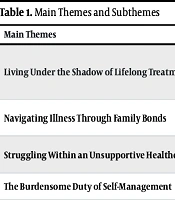
The analysis yielded 182 initial codes from 18 interviews. Through abstraction and comparison, these codes were condensed into 27 subcategories, which were then grouped into 9 subthemes based on conceptual similarities. Through further abstraction to capture latent meanings, the subthemes were organized into 4 main themes: 1) Living Under the Shadow of Lifelong Treatment, 2) Navigating Illness Through Family Bonds, 3) Struggling Within an Unsupportive Healthcare System, and 4) The Burdensome Duty of Self-Management. Table 1 presents an overview of the thematic structure.
Table 1.
Main Themes and Subthemes
| Main Themes | Subthemes |
|---|---|
| Living Under the Shadow of Lifelong Treatment | Physical and Functional Impairment |
| Psychological Distress | |
| Mobility and Travel Restriction | |
| Navigating Illness Through Family Bonds | Patient Care and Support |
| Family Attitudes Toward the Disease | |
| Struggling Within an Unsupportive Healthcare System | Quality of Hospital Services |
| Financial Burden and Insurance Limitations | |
| The Burdensome Duty of Self-Management | Nutritional Adherence |
4.1. Living Under the Shadow of Lifelong Treatment
This theme captures participants' pervasive sense of being trapped in a life in which every aspect of daily existence is shaped by the dialysis schedule, physical decline, and treatment demands. Three subthemes emerged: Physical and Functional Impairment, Psychological Distress, and Mobility and Travel Restriction.
4.1.1. Physical and Functional Impairment
Participants described a wide range of physical symptoms that adversely affected their quality of life. Fatigue was the most commonly reported symptom, followed by pain, vascular swelling, and generalized weakness. These physical limitations extended beyond the immediate post-dialysis period and contributed to a diminished sense of independence.
"After each dialysis session, I feel completely drained. I can barely walk to the bathroom and spend most of the day in bed recovering." (Male, 72 years, 48 months on HD)
"The pain in my arm where the needle goes in never really goes away. Sometimes it swells so much that I cannot use my hand for hours." (Female, 52 years, 36 months on HD)
"I used to be able to work in my garden, but now I cannot even stand for more than a few minutes." (Male, 65 years, 60 months on HD)
4.1.2. Psychological Distress
Participants reported substantial emotional challenges associated with their diagnosis and treatment. Fear of death, feelings of hopelessness, and anxiety about the future were commonly reported, particularly in the early stages of treatment.
"When I first started dialysis, I was terrified. I thought I was going to die. The fear never fully goes away." (Female, 37 years, 12 months on HD)
"Some days I feel like giving up. You go to the hospital three times a week, and you never feel better afterward." (Male, 65 years, 60 months on HD)
"I feel like a burden to my family. They have to take care of me, and I cannot do anything for myself anymore." (Female, 68 years, 18 months on HD)
4.1.3. Mobility and Travel Restriction
Participants reported considerable distress regarding their inability to travel freely. The rigid dialysis schedule, typically requiring three sessions per week, and the need to locate dialysis centers in other cities created substantial barriers to mobility. For many participants, the inability to travel was not merely a logistical inconvenience but a profound source of emotional distress, as it severed connections with family members living in distant cities and limited participation in important social and family events.
Participants described how the dialysis schedule dictated nearly every aspect of their lives, leaving little room for spontaneity or flexibility. Even short trips required extensive planning, including contacting dialysis centers in advance, coordinating schedules, and ensuring that medical records were transferred. Uncertainty about whether a dialysis center would accept them as temporary patients increased anxiety and often discouraged them from attempting to travel altogether.
Furthermore, fear of unfamiliar healthcare settings or equipment, combined with physical exhaustion following dialysis sessions, intensified reluctance to travel. Many participants reported feelings of isolation and loss because they could no longer visit their children or grandchildren, attend family gatherings, or engage in activities that had previously brought them joy. These mobility restrictions contributed to a broader sense of being trapped, both physically and emotionally, within the confines of their illness and treatment regimen.
"I used to love traveling, but now I cannot go anywhere. Even a short trip requires planning around dialysis, and finding a center that will accept me is difficult." (Male, 57 years, 24 months on HD)
"My daughter lives in another city, but I have not visited her in two years. I am afraid to travel because I do not know if I can get dialysis there." (Female, 68 years, 18 months on HD)
4.2. Navigating Illness Through Family Bonds
This theme reflects the dual nature of family involvement in the illness experience, as both a source of strength and, at times, an additional burden. Two subthemes emerged: Patient Care and Support and Family Attitudes Toward the Disease.
4.2.1. Patient Care and Support
Participants consistently identified family members as their primary source of practical and emotional support. Spouses and children were reported to play crucial roles in providing daily care, accompanying patients to appointments, and offering emotional reassurance.
"My wife does everything for me—she cooks special meals, takes me to the hospital, and helps me when I am too weak to move. Without her, I do not know how I would manage." (Male, 72 years, 48 months on HD)
"My daughter accompanies me to every dialysis session. She sits with me the whole time and makes sure I am comfortable." (Female, 75 years, 72 months on HD)
However, participants also acknowledged the burden their illness placed on family members. Economic strain and caregiver fatigue were common concerns.
"I feel guilty that my children have to support me financially. They have their own lives, but they are always worried about me." (Male, 65 years, 60 months on HD)
4.2.2. Family Attitudes Toward the Disease
Family members' emotional responses significantly influenced participants' psychological adjustment. Supportive and understanding attitudes facilitated adaptation, whereas negative or judgmental responses increased distress.
"My family is always asking questions—'Are you feeling better?' 'Will you ever get better?' 'When will this end?' I know they mean well, but it only reminds me that I am sick." (Female, 37 years, 12 months on HD)
"Some relatives treat me differently now. They look at me like I am already dead. It makes me feel terrible." (Male, 54 years, 42 months on HD)
4.3. Struggling Within an Unsupportive Healthcare System
This theme conveys participants' experiences of frustration, powerlessness, and perceived neglect when confronted with systemic barriers to accessing quality care. Two subthemes emerged: Quality of Hospital Services and Financial Burden and Insurance Limitations.
4.3.1. Quality of Hospital Services
Participants frequently expressed dissatisfaction with the quality of hospital services. Equipment malfunctions, staff shortages, and inadequate facilities were common complaints. Many participants described how frequent breakdowns of dialysis machines disrupted their treatment sessions, leading to extended waiting times, shortened dialysis duration, and heightened anxiety. These disruptions not only caused physical discomfort but also eroded trust in the reliability of the healthcare system.
Staff shortages were another major concern. Participants reported that limited nursing staff resulted in rushed care, insufficient attention to their needs, and a lack of emotional support during sessions. Many felt that their concerns about symptoms or complications were not adequately addressed, leaving them feeling neglected and undervalued. Inadequate facilities, including insufficient beds, outdated equipment, and crowded waiting areas, further compounded dissatisfaction. The physical environment of the dialysis center was described as unwelcoming and dehumanizing, with limited privacy and constant noise contributing to a sense of impersonal care. The cumulative effect of these systemic shortcomings was a profound disillusionment with the healthcare system and a reduced willingness to engage actively in their care.
"The dialysis machines break down frequently. Sometimes we sit and wait for hours while they fix them. It is exhausting and frustrating." (Female, 50 years, 30 months on HD)
"There are not enough beds. When you come for your session, you never know if they will have a machine available for you." (Male, 54 years, 42 months on HD)
"The nurses are overworked. They try their best, but there are too many patients and not enough staff." (Female, 68 years, 18 months on HD)
4.3.2. Financial Burden and Insurance Limitations
The financial burden of hemodialysis emerged as a dominant concern. Participants reported that existing insurance plans provided minimal coverage, leaving them to bear substantial out-of-pocket costs for medications and ancillary services.
"Insurance covers almost nothing. I pay for most of my medications myself, and they are very expensive." (Female, 75 years, 72 months on HD)
"The cost of transportation to the hospital three times a week adds up. It is a constant financial worry." (Male, 57 years, 24 months on HD)
"Even with insurance, I cannot afford all my medications. I sometimes have to choose between buying food and buying my drugs." (Female, 52 years, 36 months on HD)
4.4. The Burdensome Duty of Self-Management
This theme captures the continuous and demanding nature of self-management for hemodialysis patients. Two subthemes emerged: Nutritional Adherence and Medication Adherence Challenges.
4.4.1. Nutritional Adherence
Participants described the prescribed dialysis diet as highly restrictive and disruptive to daily life. The constant need to monitor food intake, avoid certain foods, and prepare special meals created substantial challenges. Many participants noted that the diet limited their consumption of dairy products, certain meats, and a variety of fruits and vegetables, leaving a narrow range of acceptable foods. These restrictions often led to feelings of deprivation, frustration, and diminished enjoyment of meals.
Beyond the physical challenges, dietary restrictions substantially affected participants' social lives. Eating with family members or dining out became sources of stress, as participants felt excluded from shared meals or were unable to participate in social gatherings centered around food. The constant vigilance required to adhere to the diet further contributed to psychological distress, as participants described feeling preoccupied with food choices and anxious about inadvertently consuming restricted items. This persistent dietary burden reinforced the overarching sense that their lives were dictated by the demands of treatment.
"The diet is very difficult. I cannot eat dairy, and only certain fruits are allowed. It is like being a prisoner in my own body." (Female, 50 years, 30 months on HD)
"I have to think about everything I eat. I cannot just sit and have a meal with my family like I used to." (Male, 62 years, 54 months on HD)
"Sometimes I get so tired of the restrictions that I just eat what I want. I know it is bad for me, but I cannot help it." (Female, 45 years, 24 months on HD)
4.4.2. Medication Adherence Challenges
Participants reported challenges related to medication management, primarily related to the financial burden of essential medications rather than physical access. While most participants noted that medications were generally available at pharmacies, rising drug costs created a substantial barrier to consistent adherence. Many participants described having to choose between purchasing their prescribed medications and meeting other essential needs, such as food, transportation, or household expenses.
The financial strain associated with medication costs was a persistent source of anxiety and stress. Participants expressed frustration that even when medications were partially covered by insurance, out-of-pocket expenses remained substantial. Some participants admitted to reducing doses or skipping doses to make their supplies last longer, despite knowing the potential health consequences. This difficult trade-off between financial survival and treatment adherence highlighted the broader economic vulnerability faced by patients undergoing long-term hemodialysis.
"I can get the drugs, but paying for them is the real challenge. The costs keep rising." (Male, 54 years, 42 months on HD)
"I have to take so many pills every day. Sometimes I forget, or I just do not have the energy to take them all." (Female, 68 years, 18 months on HD)
5. Discussion
This qualitative study explored the lived experiences of patients undergoing hemodialysis, identifying four interconnected themes that illuminate the profound and multifaceted impact of long-term dialysis on patients’ lives. Rather than simply confirming existing knowledge, these findings offer a deeper interpretive understanding of how patients navigate the physical, psychological, social, and systemic dimensions of their illness.
The theme “Living Under the Shadow of Lifelong Treatment” captures a sense of existential entrapment that extends beyond immediate physical symptoms such as fatigue, pain, and functional decline. The findings indicate that hemodialysis is not merely a medical procedure but a totalizing experience that reshapes patients’ identities, routines, and futures. This aligns with Bury’s concept of “biographical disruption,” which describes how chronic illness fundamentally disrupts individuals’ taken-for-granted assumptions about their bodies, identities, and life trajectories (19). Participants’ accounts of fear of death, hopelessness, and loss of autonomy reflect a profound biographical disruption that is not merely a psychological response to illness but a fundamental reconfiguration of selfhood. This existential dimension has been less emphasized in quantitative studies, which tend to focus on symptom prevalence rather than the meanings patients attach to their experiences (5, 9).
Persistent fatigue—described by participants as overwhelming and unrelenting—emerged as a central feature of this treatment burden. Unlike transient tiredness, dialysis-related fatigue was experienced as a chronic state of depletion that undermined participants’ sense of agency and control. This finding extends previous research by highlighting the temporal and existential dimensions of fatigue: it is not simply a symptom to be managed but a condition that dictates the rhythm and possibilities of daily life (6).
The theme “Navigating Illness Through Family Bonds” reveals the paradoxical role of family in the illness experience. Families were simultaneously a source of strength and an additional burden. This duality is consistent with the concept of “family-centered burden” in the chronic illness literature, in which family involvement is both protective and stressful (8, 20). The findings extend this understanding by highlighting the emotional strain associated with patients’ perceptions of being a financial and emotional burden on their families. This dynamic creates a cycle of guilt, dependency, and emotional distress that is rarely captured in conventional quality-of-life measures. The study suggests that nursing interventions should address not only the practical aspects of family support but also the emotional complexities of family caregiving (21).
An important insight from the data is the role of “judgmental family attitudes” in exacerbating psychological distress. Participants described how well-meaning inquiries from relatives about their treatment progress often reinforced their sense of illness and inadequacy. This finding suggests that family communication patterns—not only the presence or absence of support—are critical determinants of patient adaptation. Interventions that educate families about supportive communication may be as important as those that provide practical caregiving training (8).
The theme “Struggling Within an Unsupportive Healthcare System” illuminates participants’ experiences of systemic neglect and resource constraints. The frequent equipment malfunctions, staff shortages, and financial burdens described by participants reflect a healthcare system that, despite its life-sustaining role, falls short of providing dignified, patient-centered care (3, 22). This finding aligns with the concept of “structural vulnerability,” which refers to the ways in which social, economic, and institutional forces shape individuals’ health experiences (23). In the context of hemodialysis, structural vulnerability manifests as persistent barriers to care that erode patients’ trust in the healthcare system and exacerbate their psychological distress. The findings suggest that policy interventions should prioritize equitable access to quality care and financial protection for dialysis patients (3, 24).
The moral dimension of these systemic failures is particularly noteworthy. Participants described not merely inconvenience but a sense of injustice and powerlessness in the face of systemic barriers. This moral distress—the feeling of receiving substandard care despite one’s vulnerability—adds a layer of suffering that is rarely acknowledged in clinical or policy discourse. Addressing this requires not only technical improvements but also a commitment to recognizing patients’ dignity and agency (22).
The theme “The Burdensome Duty of Self-Management” indicates that dietary and medication adherence is not simply a matter of patient education but a continuous, emotionally taxing process embedded in everyday life (4, 13). Participants’ accounts of navigating restrictive diets and high medication costs highlight the gap between clinical recommendations and patients’ lived realities. This finding challenges the assumption that non-adherence is primarily a behavioral issue, instead pointing to structural and economic factors that constrain patients’ choices (25). The study suggests that self-management support should move beyond education to include practical strategies for managing financial barriers, emotional distress, and social isolation (21).
The intersection of dietary and financial burden is particularly significant. Participants described being caught between the imperative to follow a restrictive diet and the economic impossibility of doing so. This tension reflects a broader structural issue: the cost of healthy food and essential medications in resource-limited settings often exceeds patients’ financial capacity, creating a “treatment paradox” in which adherence is compromised not by lack of knowledge or motivation but by lack of resources (4, 25).
A key theoretical contribution of this study is the concept of “treatment entrapment,” which emerged from the integration of the study themes. Treatment entrapment captures the sense of being caught in a life-sustaining yet life-limiting treatment with no viable alternatives. We propose that treatment entrapment has three interconnected dimensions:
Physical entrapment: Dependence on dialysis machines and rigid treatment schedules that restrict mobility, autonomy, and the ability to engage in normal life activities (9).
Psychological entrapment: Loss of hope, diminished identity, and persistent fear and uncertainty that erode psychological well-being and agency (5, 6).
Economic entrapment: Financial instability driven by high out-of-pocket costs, limited insurance coverage, and the inability to work, creating a cycle of poverty and illness (3, 24).
These dimensions are mutually reinforcing, creating a cascade of disadvantage that is difficult to escape. The concept of treatment entrapment builds on existing work on biographical disruption and structural vulnerability by foregrounding the unique constraints of renal replacement therapy in low-resource settings (19, 23). It offers a framework for understanding why patients may struggle with adherence, experience diminished quality of life, and express feelings of hopelessness, even when they are receiving technically adequate care (25).
5.1. Clinical Implications
These findings have several practical implications for nursing practice. First, they underscore the importance of integrating psychosocial and existential assessment into routine dialysis care. Nurses are uniquely positioned to identify and address the emotional and existential distress experienced by patients; however, this aspect of care is often overshadowed by clinical tasks (9, 23). Second, the findings highlight the need for family-centered interventions that address both the practical and emotional dimensions of family involvement, including communication training and support for caregivers. Third, the systemic barriers identified by participants suggest a need for advocacy at the policy level to improve resource allocation and financial protection for dialysis patients (22, 24).
In addition, the findings suggest the need for tailored self-management support that recognizes the structural and economic constraints faced by patients. Interventions should move beyond educational approaches to include practical support for overcoming barriers, such as financial counseling, meal planning on a budget, and peer support groups that address the social isolation associated with dietary restrictions (13, 23).
5.2. Strengths and Limitations
The strength of this study lies in its qualitative design, which enabled an in-depth exploration of participants’ lived experiences and the meanings they attach to their illness. The use of conventional qualitative content analysis ensured that themes emerged directly from the data, and the rigor of the analytical process was enhanced through member checking, peer debriefing, and independent coding. However, the study has limitations. The single-center design and the specific cultural and healthcare context of Iran may limit the transferability of the findings to other settings. The sample, while diverse in age and dialysis duration, was predominantly male; future research should examine whether similar themes emerge in different contexts, including larger samples and varied healthcare systems.
5.3. Conclusions
This study provides a rich, interpretive account of the lived experiences of patients undergoing hemodialysis. By moving beyond descriptive findings to conceptual integration, we have illuminated the profound and multidimensional nature of the treatment burden in hemodialysis. The introduction of “treatment entrapment” as a theoretical concept offers a framework for understanding the interconnected physical, psychological, and economic dimensions of patients’ experiences. Addressing these challenges requires a combination of clinical, psychosocial, and policy-level strategies that recognize the interconnectedness of physical health, psychological well-being, social relationships, and systemic factors. By attending to patients’ voices, we can move toward more compassionate, effective, and equitable care for individuals living with end-stage kidney disease.