Neonatal Resuscitation Knowledge and Practices of Moroccan Midwives and Nurses at a Tertiary Hospital: A Cross-sectional Study

Author(s):
Sara AlaouiSara Alaoui1,*, Kamal TakhdatKamal Takhdat2, Mohamed LoukidMohamed Loukid1, Widad LhminiWidad Lhmini3, Saloua LamtaliSaloua Lamtali2
1Pharmacology, Neurobiology, Anthropobiology and Environment Laboratory, Faculty of Sciences Semlalia, Cadi Ayyad University, Marrakesh, Morocco
2Higher Institute of Nursing Professions and Health Techniques of Marrakesh, Marrakesh, Morocco
3Faculty of Medicine and Pharmacy, Cadi Ayyad University, Marrakech Morocco
*Corresponding Author: Faculty of Sciences Semlalia, Cadi Ayyad University, Marrakech Morocco. Email: [email protected]

Journal of Nursing and Midwifery Sciences:Vol. 13, issue 3; e171119
Published online:Jul 28, 2026
Article type:Rapid Communication
Received:Mar 25, 2026
Accepted:Jul 18, 2026
How to Cite:Alaoui S, Takhdat K, Loukid M, Lhmini W, Lamtali S. Neonatal Resuscitation Knowledge and Practices of Moroccan Midwives and Nurses at a Tertiary Hospital: A Cross-sectional Study. J Nurs Midwifery Sci. 2026;13(3):e171119. doi: https://doi.org/10.5812/jnms-171119

Abstract

Context:

Neonatal resuscitation (NR) is a critical competency for midwives and nurses. Gaps in knowledge and practice contribute to neonatal mortality, particularly in low- and middle-income countries.

Objectives:

This study aimed to assess NR knowledge and self-reported practices among midwives and nurses working in the delivery room and the pediatric emergency department.

Evidence Acquisition:

A descriptive cross-sectional study was conducted in 2024 at a public university hospital in central Morocco. A total of 46 eligible nurses and midwives were recruited using convenience sampling. Data were collected using a structured, self-administered questionnaire assessing participants’ demographic characteristics, knowledge, and practice. Data were analyzed using descriptive statistics, independent-samples t tests, and chi-square tests.

Results:

Only 13.0% of participants demonstrated good NR knowledge, whereas 50.0% had moderate knowledge and 36.9% had low knowledge. Participants who received continuous training had significantly higher knowledge and practice scores than those who did not (mean difference = 10.6%, P = 0.008; and mean difference = 9.4%, P = 0.016, respectively). Important practice gaps were identified in thermoregulation (22.0% correct), compression depth (52.2% correct), and adrenaline administration via the umbilical vein (37.0% correct).

Conclusions:

NR knowledge and self-reported practices among Moroccan midwives and nurses were suboptimal. Continuous training was associated with greater competency, supporting the implementation of regular simulation-based training and standardized NR education programs.

1. Background

The neonatal period, defined as the first 28 days of life, is the most vulnerable phase for newborn survival (1). Approximately 2.3 million neonatal deaths occur globally each year, with the highest burden in sub-Saharan Africa and South Asia (2). In Morocco, the neonatal mortality rate was 11.1 deaths per 1,000 live births in 2021 (1).
Neonatal resuscitation (NR) is a critical intervention for reducing neonatal mortality. The International Liaison Committee on Resuscitation (ILCOR) emphasizes evidence-based guidelines, effective provider training, and regular skills practice as essential components of high-quality resuscitation (2). Nevertheless, substantial gaps in NR knowledge and practice persist among healthcare providers, particularly in low- and middle-income countries (3).
Studies from Africa have reported inadequate NR competency among midwives and nurses despite existing training programs (3, 4). In Morocco, however, data on NR knowledge and practices remain scarce, limiting the development of evidence-based educational strategies.

2. Objectives

In this context, the aim of the present study was to assess NR knowledge and self-reported practices among midwives and nurses at a public university hospital in central Morocco.

3. Methods

3.1. Study Design and Setting

This descriptive cross-sectional study was conducted at the Mother and Child Hospital of a public university in central Morocco between March and May 2024.

3.2. Participants and Sampling

The study population comprised midwives and nurses working in the delivery room and the pediatric emergency department. The inclusion criteria were: 1) current employment in the relevant department; 2) direct involvement in neonatal care; and 3) provision of written informed consent. Administrative staff without clinical duties were excluded. All eligible healthcare providers who met the inclusion criteria were invited to participate, and 46 consented.

3.3. Data Collection Instrument

Data were collected using a structured, self-administered questionnaire adapted from a previously validated instrument used in Egypt (3) and based on the latest American Heart Association (AHA) and American Academy of Pediatrics (AAP) Neonatal Resuscitation Program (NRP) guidelines. The content and face validity of the French version were confirmed. Internal consistency reliability was acceptable (Cronbach's alpha = 0.78 for the knowledge subscale and 0.74 for the practice subscale).
The final instrument consisted of 39 items covering sociodemographic characteristics, NR knowledge, and self-reported practices. Knowledge and practice were scored separately. Each correct response received 1 point, and incorrect or uncertain responses received 0 points. Scores were converted to percentages and categorized as low (< 60%), moderate (60% - 80%), or good (> 80%).

3.4. Data Collection Procedure

The principal investigator distributed anonymous questionnaires during scheduled shifts. Completed questionnaires were returned directly to the investigator to ensure confidentiality.

3.5. Statistical Analysis

Data were analyzed using IBM SPSS Statistics version 25.0. Analyses included frequencies, means, standard deviations, independent-samples t tests, and chi-square tests. Statistical significance was set at P < 0.05.

3.6. Ethical Considerations

Ethical approval was obtained from the Institutional Ethics Committee (Approval No. 103/2024). Written informed consent was obtained from all participants. All data were anonymized and handled confidentially.

4. Results

4.1. Participants' Characteristics

A total of 46 midwives and nurses participated in this study. Participants' sociodemographic and professional characteristics are presented in Table 1.
Table 1.Sociodemographic and Professional Characteristics of Midwives and Nurses (N = 46) a
Variables and CategoriesNo. (%)
Professional categories
Midwife26 (56.5)
Generalist nurse17 (36.6)
Emergency nurse3 (6.5)
Gender
Female40 (87.0)
Male6 (13.0)
Age (y)
< 2521 (45.7)
25 - 3019 (41.3)
> 306 (13.0)
Neonatology experience (y)
< 25 (10.9)
2 - 520 (43.5)
5 - 1013 (28.3)
> 108 (17.3)
Initial NR training
Yes34 (73.9)
No12 (26.1)
Continuous NR training
Yes21 (45.7)
No25 (54.3)
NR use (last 3 months)
0 - 5 times12 (26.1)
6 - 10 times13 (28.3)
> 10 times21 (45.7)

a Abbreviation: NR, neonatal resuscitation.

4.2. Knowledge of Neonatal Resuscitation

Overall NR knowledge was suboptimal (Table 2). Participants who had received continuous training (n = 21) had a significantly higher mean knowledge score (72.4%, SD = 11.2) than those without continuous training (n = 25; mean = 61.8%, SD = 13.5; P = 0.008).
Table 2.Knowledge Level of Neonatal Resuscitation Among Midwives and Nurses (N = 46)
Knowledge levelNo. (%)
Low (< 60%)17 (36.9)
Moderate (60% - 80%)23 (50.0)
Good (> 80%)6 (13.0)

4.3. Self-reported Practices

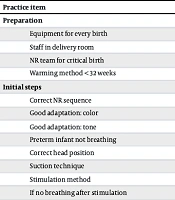
Self-reported NR practices varied across domains (Table 3). Similarly, participants with continuous training had significantly higher practice scores (70.1%, SD = 10.8) than those without continuous training (60.7%, SD = 12.3; t = 2.51; P = 0.016; Cohen's d = 0.76).
Table 3.Self-Reported Neonatal Resuscitation (NR) Practices Among Midwives and Nurses a
Practice itemCorrect responseNo. (%)
Preparation
Equipment for every birthAll items listed28 (60.9)
Staff in delivery roomAt least 1 qualified provider36 (78.3)
NR team for critical birthAt least 2 qualified providers35 (76.1)
Warming method < 32 weeksPolyethylene bag10 (22.0)
Initial steps
Correct NR sequenceWarm-dry-stimulate-position-PPV43 (93.5)
Good adaptation: colorPink46 (100.0)
Good adaptation: toneTonic, limbs flexed43 (93.5)
Preterm infant not breathingPlace on radiant warmer20 (43.5)
Correct head positionNeutral/sniffing25 (54.3)
Suction techniqueMouth then nose32 (69.6)
Stimulation methodGentle tactile stimulation32 (69.6)
If no breathing after stimulationStart PPV42 (91.3)
PPV
PPV indicationsApnea/gasping or HR < 100 bpm36 (78.3)
PPV preparationAll steps correct41 (89.1)
Mask fitting precautionsAvoid pressure on eyes/neck29 (63.0)
Appropriate mask sizeCorrect mask40 (87.0)
CC
Initiate chest compressionsHR < 60 bpm42 (91.3)
Compression depthOne-third AP diameter24 (52.2)
CC:PPV ratio3:131 (67.4)
Adrenaline routeUmbilical vein17 (37.0)

a Abbreviations: PPV, positive pressure ventilation; HR, heart rate; CC, chest compression.

5. Discussion

This study evaluated neonatal resuscitation (NR) knowledge and self-reported practices among midwives and nurses in a tertiary hospital in Morocco. The findings revealed important gaps in both knowledge and practice, particularly in advanced resuscitation procedures, consistent with reports from other low- and middle-income countries (3, 4).
Participants who had received continuous training demonstrated significantly better knowledge and practices, consistent with findings from other studies and supporting international recommendations for regular refresher training to maintain NR competency (2, 5). Similarly, as reported in other studies, the identified deficiencies in thermoregulation, chest compressions, and medication administration highlight the need for simulation-based education that combines theoretical instruction with repeated hands-on practice (4, 6, 7).
This study is limited by its single-center design, relatively small sample size, and reliance on self-reported practices. Nevertheless, it provides valuable baseline evidence on NR competency among Moroccan midwives and nurses and underscores the need to strengthen both pre-service and continuing education programs.

5.1. Conclusions

This study demonstrated suboptimal neonatal resuscitation (NR) knowledge and self-reported practices among midwives and nurses in a Moroccan tertiary hospital, with notable deficiencies in thermoregulation, chest compressions, and medication administration. Continuous training was associated with significantly better competency, highlighting the importance of ongoing education.
These findings support the implementation of regular simulation-based NR training and the integration of standardized NR education into pre-service and continuing professional development programs. Further multicenter studies are needed to generate nationally representative evidence and inform neonatal care policies in Morocco.
Footnotes

  • AI Use Disclosure:The authors declare that no generative AI tools were used in the creation of this article.

  • Authors' Contribution:Study concept and design: S. A. and S. L. Analysis and interpretation of data: S. A. and K. T. Drafting of the manuscript: M. L. Critical revision of the manuscript for important intellectual content: W. L., S. L., and M. L. Statistical analysis: K. T. All authors reviewed and approved the final manuscript.

  • Conflict of Interests Statement:The authors have no conflict of interest.

  • Data Availability:The dataset presented in the study is available on request from the corresponding author during submission or after publication. The data are not publicly available due to privacy and ethical restrictions concerning participant confidentiality.

  • Ethical Approval:The study was approved by the Ethics Committee (N° 103/2024) and authorized by the university hospital administration.

  • Funding/Support:This research received no external funding.

  • Informed Consent:Written informed consent was obtained from all participants prior to their inclusion in the study. Participation was voluntary, anonymous, and participants were free to withdraw at any time without justification.

References

  • 1.
    Lawn JE, Blencowe H, Oza S, You D, Lee AC, Waiswa P, et al. Every newborn: progress, priorities, and potential beyond survival. Lancet. 2014;384(9938):189-205. [PubMed ID: 24853593]. https://doi.org/10.1016/S0140-6736(14)60496-7.
  • 2.
    American Academy of Pediatrics. Textbook of Neonatal Resuscitation. American Academy of Pediatrics; 2021. https://doi.org/10.1542/9781610025256.
  • 3.
    Elsayed AM, Eldakhakhny AM, Mohamed BM, et al. Nurses' knowledge and practices regarding neonatal resuscitation at Zagazig University Hospitals, Egypt. J Nurs Educ Pract. 2020;10(12):34-42. https://doi.org/10.5430/jnep.v10n12p34.
  • 4.
    Shikuku DN, Milimo B, Ayebare E, Gisore P, Nalwadda G. Quality of care during neonatal resuscitation in Kakamega County General Hospital, Kenya: a direct observation study. Biomed Res Int. 2017;2017:2152487-12. [PubMed ID: 29214159]. [PubMed Central ID: PMC5682044]. https://doi.org/10.1155/2017/2152487.
  • 5.
    Ding X, Wang L, Msellem MI, Hu Y, Qiu J, Liu S, et al. Evaluation of a neonatal resuscitation training programme for healthcare professionals in Zanzibar, Tanzania: a pre-post intervention study. Front Pediatr. 2021;9. 693583. [PubMed ID: 34262890]. [PubMed Central ID: PMC8273261]. https://doi.org/10.3389/fped.2021.693583.
  • 6.
    Brathwaite KP, Bryce F, Moyer LB, Engmann C, Twum-Danso NAY, Kamath-Rayne BD, et al. Evaluation of two newborn resuscitation training strategies in regional hospitals in Ghana. Resusc Plus. 2020;1 - 2. 100001. [PubMed ID: 34223288]. [PubMed Central ID: PMC8244248]. https://doi.org/10.1016/j.resplu.2020.100001.
  • 7.
    Namuguzi M, Drake K, Ekong EN, Asuquo EF. Evaluating neonatal resuscitation skills of practicing nurses and midwives in selected hospitals in Central Uganda [preprint]. Research Square. 2020. [PubMed Central ID: PMC7442213]. https://doi.org/10.21203/rs.2.20482/v1.

Copyright

Copyright © 2026, Alaoui et al. This open-access article is available under the Creative Commons Attribution 4.0 (CC BY 4.0) International License (https://creativecommons.org/licenses/by/4.0/), which allows for unrestricted use, distribution, and reproduction in any medium, provided that the original work is properly cited.

Similar Articles

6
Feb
2021
J Compr Ped

The Prevalence of Neonate Resuscitation and Some Related Factors in an Academic Center in the North of Iran

Mandana Mansour Ghanaie,
Zahra Rafiei Sorouri,
Farnoush Farzi,
Gelareh Biazar,
Reyhaneh Shahrokhi Rad,
Mohadese Ahmadi
,et al.

Mansour Ghanaie M, Rafiei Sorouri Z, Farzi F, Biazar G, Shahrokhi Rad R, et al. The Prevalence of Neonate Resuscitation and Some Related Factors in an Academic Center in the North of Iran. J Compr Ped. 2021;12(1):e109316. doi: https://doi.org/10.5812/compreped.109316

21
Feb
2013

Knowledge of nursing staff about principles of Cardiopulmonary Resuscitation in selected hospitals of ‎Kermanshah University of Medical Sciences, 2009

Soraya Mahdavi,
Jahangir Rezaie,
Bahareh Dehghani,
Behzad Teimouri,
Farah Seifi,
Alireza Abdi

Mahdavi S, Rezaie J, Dehghani B, Teimouri B, Seifi F, et al. Knowledge of nursing staff about principles of Cardiopulmonary Resuscitation in selected hospitals of ‎Kermanshah University of Medical Sciences, 2009. J Clin Res Paramed Sci. 2013;1(4):e82317. doi:

1
Mar
2023
Med Surg Nurs J

Cardiopulmonary-Cerebral Resuscitation (CPCR) Training for Nurses in Iran: A Review Study

Zahra Raisi,
Mojgan Jahantigh,
Sakineh Sabzevari

Raisi Z, Jahantigh M, Sabzevari S. Cardiopulmonary-Cerebral Resuscitation (CPCR) Training for Nurses in Iran: A Review Study. Med Surg Nurs J. 2022;11(4):e135718. doi: https://doi.org/10.5812/msnj-135718

27
Dec
2019

The effect of video-assisted training given to midwifery and nursing students about pain and its management in newborns on students' level of knowledge

Esra Tural Büyük

Tural Büyük E. The effect of video-assisted training given to midwifery and nursing students about pain and its management in newborns on students' level of knowledge. J Nurs Midwifery Sci. 2020;7(1):e140813. doi: https://doi.org/10.4103/jnms.jnms_56_18

17
Feb
2019
Image credit: pxhere

The Comparative Study on Pediatric Triage Decision-Making Power in Nurses and Nursing Students: A Cross Sectional Study

Somaye Pouy,
Zahra Taheri Ezbarami,
Seyyed Zahra Shafipour

Pouy S, Taheri Ezbarami Z, Shafipour SZ. The Comparative Study on Pediatric Triage Decision-Making Power in Nurses and Nursing Students: A Cross Sectional Study. J Compr Ped. 2019;10(1):e80846. doi: https://doi.org/10.5812/compreped.80846

Download PDF125.95 KB

Crossmark

Crossmark

Checking

Share on
Cited by
Metrics

Ordering Reprints

Articles are published under the Creative Commons license stated on each article. No permission or royalty fee is required for uses permitted by that license. CCC handles optional bulk and customized reprint orders. Any quotation covers production and delivery services only, not copyright permission. > Request Reprints from CCC 

Search Relations

Author(s):

Related Articles