The Depigmentation Effect of Hydroquinone-loaded Nanostructured Lipid Carriers (NLCs) on the Rat Skin
Authors

Abstract
The goal of this research is the localization of hydroquinone (HQ) to the epidermis for the treatment of
hyperpigmentation in rat skin. For this purpose, nanostructured lipid carrier (NLC) was selected for the
dermal delivery of HQ. A 2 3 factorial design was used in this study, and eight NLCs were prepared with
a cold homogenization technique. HQ entrapment efficiency (EE %), particle size, morphology, thermal
behavior of NLCs, and permeability parameters through rat skin with NLC in comparison with HQ aqueous
solution (HQ-S) with Franz diffusion cells were evaluated. Based on the optimization technique, the best
NLC was selected and in the in vivo experiment, the depigmentation effect of optimized NLC in comparison
with that of HQ-S was evaluated. The results showed that the main problem for HQ permeability was fast
permeation and low concentration in the site of action. Partitioning from aqueous donor phase into skin
rate was the limiting step for drug flux, and this can be solved using NLC. The decrease in maximum
flux obtained by NLC was according to formulation 8. Regression analysis suggested a significant and
direct effect of the S/L ratio and the percentage of liquid lipids on the drug loading. NLC decreased drug
permeation through rat skin basically due to sustained release properties.
Highlights
Copyright
© 2022, Author(s). This open-access article is available under the Creative Commons Attribution 4.0 (CC BY 4.0) International License (https://creativecommons.org/licenses/by/4.0/), which allows for unrestricted use, distribution, and reproduction in any medium, provided that the original work is properly cited.
Similar Articles
Superoxide Dismutase-Loaded Solid Lipid Nanoparticles Prepared by Cold Homogenization Method: Characterization and Permeation Study Through Burned Rat Skin
Karami MA, Sharif Makhmal Zadeh B, Koochak M, Moghimipur E. Superoxide Dismutase-Loaded Solid Lipid Nanoparticles Prepared by Cold Homogenization Method: Characterization and Permeation Study Through Burned Rat Skin. Jundishapur J Nat Pharm Prod. 2016;11(4):e33968. doi: https://doi.org/10.17795/jjnpp-33968
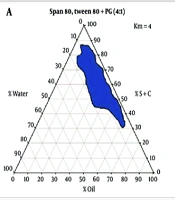
Preparation, Characterization, and Skin Permeation Evaluation of Naproxen Microemulsions for Transdermal Delivery
Jamali N, Moghimipour E, Hedayatipour N, Salimi A. Preparation, Characterization, and Skin Permeation Evaluation of Naproxen Microemulsions for Transdermal Delivery. Jundishapur J Nat Pharm Prod. 2024;19(3):e145137. doi: https://doi.org/10.5812/jjnpp-145137
Formulation and Evaluation of Liposomes for Transdermal Delivery of Celecoxib
Moghimipour E, Salami A, Monjezi M. Formulation and Evaluation of Liposomes for Transdermal Delivery of Celecoxib. Jundishapur J Nat Pharm Prod. 2015;10(1):e17653. doi: https://doi.org/10.17795/jjnpp-17653
Design, Preparation, and ex vivo Skin Permeation of Naringenin Liposomal Formulation for Topical Delivery
Javadiyeh A, Heidari Kaydan H, Bagheri F, Goodarzi S, Salimi A. Design, Preparation, and ex vivo Skin Permeation of Naringenin Liposomal Formulation for Topical Delivery. Jundishapur J Nat Pharm Prod. 2026;21(1):e168429. doi: https://doi.org/10.5812/jjnpp-168429
Optimization of Ibuprofen Delivery through Rat Skin from Traditional and Novel Nanoemulsion Formulations
Sharif Makhmalzadeh B, Torabi S, Azarpanah A. Optimization of Ibuprofen Delivery through Rat Skin from Traditional and Novel Nanoemulsion Formulations. Iran J Pharm Res. 2012;11(1):e125785. doi: https://doi.org/10.22037/ijpr.2012.1062
More by these authors
- Scopus by DOI: 4
Last Update: 1 month ago
- Scopus by Title: 2
Last Update: 1 month ago
- Scopus by Title (Ref): 0
Last Update: 1 month ago
- CrossRef: 0
Last Update: 6 days ago
- OpenAlex: 5
Last Update: 10 hours ago
- OpenCitations: 5
Last Update: 4 days ago
