Active Fractions of Dichloromethane Extract of Artemisia turanica Inhibit Proliferation of HeLa and KB Cell Lines Via Apoptosis Induction
Authors
Abstract
Purpose: Artemisia is an important genus of Iranian flora. The current study on the aerial parts of A. turanica was conducted to determine the most potent extract and its fractions in the cytotoxic assays.
Materials and Methods: The cytotoxic effects of 13 fractions (1–13) from dichloromethane extract on three cancer cell lines (KB, HeLa, and U87MG) were assessed. Preliminary phytochemical analysis of more potent cytotoxic fractions was carried out using thin-layer chromatography (TLC) and different spray reagents.
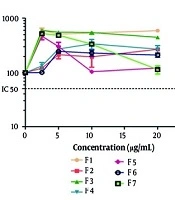
Results: Dichloromethane extract showed the best bioactivity against cancerous cell lines. Fractions 4, 6, 7, and 9 of this extract had potential effective components in the inhibition of the proliferation of KB cancer cells. In addition, fractions 4 and 6 were able to inhibit the growth of HeLa cell line. The active fractions decreased the mitochondrial membrane potential level, and played a critical role in caspase-3 and 9 activation and generation of reactive oxygen species. The cytotoxic activity of these fractions was found to be not significant toward U87MG cells. TLC analysis suggested the probable presence of terpenoids as the main component of most of the selected fractions.
Conclusion: The species is suggested as the potential source of cytotoxic phytochemicals.
Highlights
Copyright
© 2022, Author(s). This open-access article is available under the Creative Commons Attribution 4.0 (CC BY 4.0) International License (https://creativecommons.org/licenses/by/4.0/), which allows for unrestricted use, distribution, and reproduction in any medium, provided that the original work is properly cited.
Similar Articles
The Antiproliferative Effects of Petroleum Ether Extract of Artemisia Aucheri on Human Cancerous Cell Lines
Ghazi-Khansari M, Mojarrab M, Ahmadi F, Hosseinzadeh L. The Antiproliferative Effects of Petroleum Ether Extract of Artemisia Aucheri on Human Cancerous Cell Lines. J Rep Pharm Sci. 2013;2(2):e147748. doi:
In vitro Cytobiological Effects of Phytochemicals from Artemisia turanica
Taherkhani M. In vitro Cytobiological Effects of Phytochemicals from Artemisia turanica. J Rep Pharm Sci. 2019;8(1):e147486. doi: https://doi.org/10.4103/jrptps.jrptps_37_18
Cytotoxic and Apoptogenic Sesquiterpenoids from the Petroleum Ether Extract of Artemisia aucheri Aerial Parts
Hosseinzadeh L, Shokoohinia Y, Arab M, Allahyari E, Mojarrab M. Cytotoxic and Apoptogenic Sesquiterpenoids from the Petroleum Ether Extract of Artemisia aucheri Aerial Parts. Iran J Pharm Res. 2019;18(1):e126154. doi: https://doi.org/10.22037/ijpr.2019.2350
Isolation of Two Isochlorogenic Acid Isomers from Phenolic Rich Fraction of Artemisiaturanica Krasch.
Moradi-Afrapoli F, Saremi G, Nasseri S, Emami SA, Mojarrab M. Isolation of Two Isochlorogenic Acid Isomers from Phenolic Rich Fraction of Artemisiaturanica Krasch.. Iran J Pharm Res. 2020;19(4):e124666. doi: https://doi.org/10.22037/ijpr.2019.15182.12919
Cytoprotective Effect of Ethyl Acetate Extract of Artemisia turanica
Hosseinzadeh L, Jamshidi N, Mohammadi S, Mojarrab M. Cytoprotective Effect of Ethyl Acetate Extract of Artemisia turanica. Jentashapir J Cell Mol Biol. 2025;16(4):e161752. doi: https://doi.org/10.5812/jjcmb-161752
- Scopus by DOI: 0
Last Update: 1 month ago
- Scopus by Title: 0
Last Update: 1 month ago
- Scopus by Title (Ref): 0
Last Update: 1 month ago
- CrossRef: 0
Last Update: 6 days ago
- OpenAlex: 1
Last Update: 7 hours ago
- OpenCitations: 1
Last Update: 4 days ago
