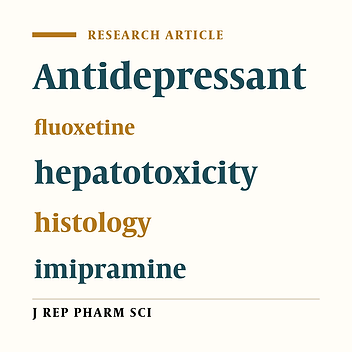
Chronic Antidepressant Use: Effects on Various Organ Histology and Blood Cell Counts in Adult Albino Rats
Authors
Abstract
Background: Chronic use of antidepressant drugs often results in drug-induced organ damage, which is mostly undetected and under-reported. The study aimed at evaluating the effect of selected antidepressants on organs and blood cell counts in adult albino rats.
Materials and Methods: Adult rats were divided into four groups (n = 5): Group 1 (5 mL/kg of body weight/day normal saline), Group 2 (1 mg/kg of body weight/day risperidone), Group 3 (5 mg/kg of body weight/day fluoxetine), and Group 4 (15 mg/ kg of body weight/day imipramine) for 14 days. The animals experienced different stressors during the treatment period to simulate physiological state of depression. On the 14th day, the animals were exposed to the forced swimming test 1 h after the respective treatments. On the 15th day, the animals were sacrificed under halothane anesthesia. Blood sample was collected. Liver and kidney were excised for histological examination. Results were analyzed using one-way analysis of variance.
Results: Kidney histology was normal for all groups. Risperidone-exposed rats presented with hepatotoxicity with areas of zonal necrosis and partial central vein congestion. Neutrophil (%) was significantly reduced (P < 0.01) in all treatment groups when compared with controls. White blood cell count was significantly increased (P < 0.01) in the imipramine and risperidone treatment groups but significantly reduced (P < 0.01) in the fluoxetine treatment group when compared with controls. Also, the platelet count was significantly increased (P < 0.01) in the fluoxetine group but decreased in imipramine-and risperidone-treated groups.
Conclusion: Chronic antidepressant use can cause changes in blood cell counts and drug-induced organ damage; hence, frequent organ function tests and blood count are required in patients undergoing chronic antidepressant therapy.
Highlights
Copyright
© 2022, Author(s). This open-access article is available under the Creative Commons Attribution 4.0 (CC BY 4.0) International License (https://creativecommons.org/licenses/by/4.0/), which allows for unrestricted use, distribution, and reproduction in any medium, provided that the original work is properly cited.
Similar Articles
Co-Administration of Morphine and Naloxone: Histopathological and Biochemical Changes in the Rat Liver
Peirouvi T, Mirbaha Y, Fathi-Azarbayjani A, Shalizar Jalali A. Co-Administration of Morphine and Naloxone: Histopathological and Biochemical Changes in the Rat Liver. Int J High Risk Behav Addict. 2020;9(3):e100594. doi: https://doi.org/10.5812/ijhrba.100594
Anti-inflammatory Effect of Amitriptyline on Ulcerative Colitis in Normal and Reserpine-Induced Depressed Rats
Fattahian E, Hajhashemi V, Rabbani M, Minaiyan M, Mahzouni P. Anti-inflammatory Effect of Amitriptyline on Ulcerative Colitis in Normal and Reserpine-Induced Depressed Rats. Iran J Pharm Res. 2016;15(Suppl):e125104. doi: https://doi.org/10.22037/ijpr.2016.1813
Zinc Chloride Reverse Influence on Dexamethasone Depressant Effects in Adult Male Rats
Navabi SP, Eshagh Harooni H, Moazedi AA, Khajehpour L. Zinc Chloride Reverse Influence on Dexamethasone Depressant Effects in Adult Male Rats. Jentashapir J Cell Mol Biol. 2015;6(6):e24297. doi: https://doi.org/10.17795/jjhr-24297
Morphine Sulphate Toxicity on Liver Function Tests in Fructose-Induced Insulin Resistant Male Rats
Shahraki MR, Shahraki E, Mirshekari H, Shahraki AR. Morphine Sulphate Toxicity on Liver Function Tests in Fructose-Induced Insulin Resistant Male Rats. Zahedan J Res Med Sci. 2014;16(2):. doi:
Hepatic Inflammation and Apoptosis in Socially Isolated Rats: Effects of Vortioxetine Treatment
Arı NS, Akkuş M, Solak H, Özen Koca R, Solak Görmüş I. Hepatic Inflammation and Apoptosis in Socially Isolated Rats: Effects of Vortioxetine Treatment. Iran J Pharm Res. 2026;25(1):e170887. doi: https://doi.org/10.5812/ijpr-170887
More by these authors
- Scopus by DOI: 0
Last Update: 1 month ago
- Scopus by Title: 0
Last Update: 1 month ago
- Scopus by Title (Ref): 0
Last Update: 1 month ago
- CrossRef: 0
Last Update: 6 days ago
- OpenAlex: 0
Last Update: 8 hours ago
- OpenCitations: 0
Last Update: 4 days ago
