The Randomized Clinical Trial of Safety and Efficacy of Oral Tramadol in Patients Undergoing Colonoscopy
Authors

Abstract
Background and Study Aims: Colonoscopy is a wide-spreading procedure with pain as a habitual challenge for the therapeutic team. The aim of this study is to evaluate safety and efficacy of oral tramadol in patients undergoing colonoscopy.
Patients and Methods: This randomized controlled trial was performed in 124 consecutive patients who completed total colonoscopy, which is randomly divided into two groups, receiving either 100 mg single dose oral tramadol or placebo. Pain intensity during colonoscopy is evaluated by numerical rating scale (NRS) criteria in four levels: no pain, mild, moderate, and severe pain. This study was registered in www.IRCT.ir, number: IRCT2015010820610N1.
Results: Two groups were matched in age, sex, and colonoscopy indication. The pain intensity in patients receiving tramadol was significantly lower than that in patients receiving placebo (P <0.05). Nausea, sweating, moaning, and palpitation during colonoscopy were significantly lower, and desire to do a colonoscopy without sedation was significantly higher in the tramadol group.
Conclusion: Oral tramadol in patients undergoing colonoscopy is effective in reducing pain and symptoms.
Highlights
Copyright
© 2021, Author(s). This open-access article is available under the Creative Commons Attribution 4.0 (CC BY 4.0) International License (https://creativecommons.org/licenses/by/4.0/), which allows for unrestricted use, distribution, and reproduction in any medium, provided that the original work is properly cited.
Similar Articles
Analgesic Effect and Hemodynamic Changes Due to Dexmedetomidine Versus Fentanyl During Elective Colonoscopy: A Double-Blind Randomized Clinical Trial
Amri P, Nahrini S, Hajian-Tilaki K, Hamidian M, Alipour SF, et al. Analgesic Effect and Hemodynamic Changes Due to Dexmedetomidine Versus Fentanyl During Elective Colonoscopy: A Double-Blind Randomized Clinical Trial. Anesth Pain Med. 2018;8(6):e81077. doi: https://doi.org/10.5812/aapm.81077
Comparing the Effect of Dexmedetomidine Versus Intravenous Lidocaine on Colonoscopy Candidates Under Sedation with Propofol-Fentanyl: A Clinical Trial
Moftakhar F, Akhondzadeh R, Hosseininejad F, Alizade Ahvazi S. Comparing the Effect of Dexmedetomidine Versus Intravenous Lidocaine on Colonoscopy Candidates Under Sedation with Propofol-Fentanyl: A Clinical Trial. Anesth Pain Med. 2023;13(6):e138929. doi: https://doi.org/10.5812/aapm-138929
The Effect of Local Tramadol Injection in Post Appendectomy Pain
Khazaei A, Arbabi Kalati F, Borumand S, Rooshanravan R. The Effect of Local Tramadol Injection in Post Appendectomy Pain. Zahedan J Res Med Sci. 2015;17(4):-. doi: https://doi.org/10.17795/zjrms973
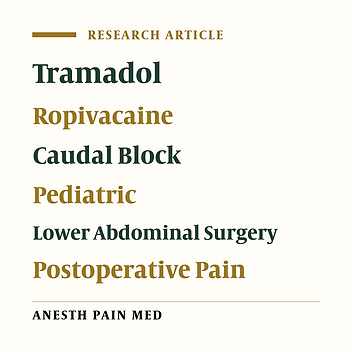
Postoperative Pain Management: Efficacy of Caudal Tramadol in Pediatric Lower Abdominal Surgery: A Randomized Clinical Study
Farahmand Rad R, Imani F, Emami A, Salehi R, Ghavamy AR, et al. Postoperative Pain Management: Efficacy of Caudal Tramadol in Pediatric Lower Abdominal Surgery: A Randomized Clinical Study. Anesth Pain Med. 2021;11(4):e119346. doi: https://doi.org/10.5812/aapm.119346
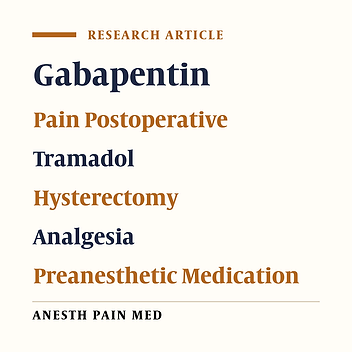
Postoperative Pain After Abdominal Hysterectomy: A Randomized, Double-Blind, Controlled Trial Comparing the Effects of Tramadol and Gabapentin as Premedication
Farzi F, Naderi Nabi B, Mirmansouri A, Fakoor F, Atrkar Roshan Z, et al. Postoperative Pain After Abdominal Hysterectomy: A Randomized, Double-Blind, Controlled Trial Comparing the Effects of Tramadol and Gabapentin as Premedication. Anesth Pain Med. 2016;6(1):e32360. doi: https://doi.org/10.5812/aapm.32360
- Scopus by DOI: 0
Last Update: 1 month ago
- Scopus by Title: 0
Last Update: 1 month ago
- Scopus by Title (Ref): 0
Last Update: 1 month ago
- CrossRef: 0
Last Update: 35 minutes ago
- OpenAlex: 0
Last Update: 12 hours ago
- OpenCitations: 0
Last Update: 4 days ago
