Cover image of the article: Yoga: An Indian Ergonomic Tool to Enhance Productivity of Hair Transplant Surgeons

Image Credit:J Skin Stem Cell

Yoga: An Indian Ergonomic Tool to Enhance Productivity of Hair Transplant Surgeons

Authors

Amit S. Kerure1, Shashank Bansod2,*, Nikita Deshmukh3, Aseem Sharma4
1Amit Kerure Skin Clinic, Navi Mumbai, Maharashtra, India
2Hi-tech Skin Clinic and Hair Transplant Centre, Nagpur, Maharashtra, India
3BJ Govt Medical College and Sassoon Hospital, Pune, Maharashtra, India
4Consultant Dermatologist, Maharashtra, India
*Corresponding Author: Hi-tech Skin Clinic and Hair Transplant Centre, Nagpur, Maharashtra, India. Email: [email protected]

Journal of Skin and Stem Cell:Vol. 9, issue 3; e122771
Published online:Dec 19, 2022
Article type:Rapid Communication
Received:Nov 16, 2022
Accepted:Nov 25, 2022
How to Cite:Kerure AS, Bansod S, Deshmukh N, Sharma A. Yoga: An Indian Ergonomic Tool to Enhance Productivity of Hair Transplant Surgeons. J Skin Stem Cell. 2022;9(3):e122771. doi: https://doi.org/10.5812/jssc-122771

Abstract

Hair transplantation is a physically and mentally demanding field for surgeons. In order to cope with demands, physical and mental fitness is required. Indian ergonomics or yoga asanas serve this purpose fully without taking a heavy toll on the body.

1. Background

The life of a hair transplant (HT) surgeon in today’s demanding and commercial world is physically and mentally exhausting. Yoga and meditation serve as a retreat from their chaotic and busy lives. The HT practice is a skill and practice-oriented field where a surgeon needs to deliver results persistently with the same perfection. Long-standing tedious hours of surgery can increase an HT surgeon’s mental and physical suffering. Therefore, it is crucial for HT surgeons to maintain a perfect balance between the body, mind, and soul.
Ergonomics is a scientific discipline concerned with designing types of equipment and techniques for achieving maximum efficiency and safety to optimize human well-being and overall system performance in the work area (1). The HT surgeons often adopt uncomfortable asymmetric stooped postures while performing various steps of HT surgeries. Yoga can prove to be a simple ergonomic tool for HT surgeons and help them deliver improved work efficacy while maintaining its psycho-physical benefits for the body.

2. Problem

Improper postures while operating might lead to chronic orthopedic and neuronal issues in HT surgeons, as mentioned in the subsequent section. These physical problems might be temporary but rarely can bring about permanent work disability.

2.1. Upper Limb Problems

• Operating in a standing position with an unsupported arm for too long or raising the elbow too high can lead to rotator cuff injury.
• The micromotor used during hair transplant produces substantial vibration. If used for a long period of time recurrently, there might be a vibrational injury to the nerves leading to damage to the myelin sheath. This may lead to Raynaud’s disease, carpel tunnel syndrome, tennis elbow, and other disorders of nerves and microvasculature, such as compartment syndrome and peripheral neuropathies.

2.2. Back Problems

• Inappropriate forward or lateral bending and stooped posture while extraction or implantation might lead to loss of normal vertebral curvature and can cause kyphoscoliosis, degenerative lumbar spinal injuries, intervertebral disc prolapse, nerve compression, and entrapment syndromes (2).
• Constant forward or lateral bending of the neck can cause degenerative cervical spinal injury or brachial plexus injury.

2.3. Lower Limb Problems

• Long-standing hours of surgery, whether in a sitting posture or standing position, can lead to varicose veins and sciatica in the lower segment of the body.

3. Solution

Although there is no quick fix to these problems, applying ergonomics, diet, and yoga exercises can help. Yoga is the science of right living and is intended to be incorporated into daily life. It works on all aspects of the individual’s health, including physical, mental, emotional, psychic, and spiritual health.
A few minutes from a busy surgeon’s timetable invested in the below-enlisted asanas can make a big difference in his/her quality of life. These asanas not only improve flexibility but also enhance concentration and help maintain composure in difficult times. They take care of the neck and back muscles and maintain the correct body posture.

3.1. Marjariasana

Marjariasana is a movement that combines forward bends with back arches giving the back the complete movement it needs (Figure 1). Vertebrae become mobile, and movement in the cervical, thoracic, and lumbar spine releases all the tension trapped in it. The spine becomes flexible and healthy. It relieves backache and neckache resulting from overwork. It helps overcome lethargy and makes the mind fresh. It is good for those suffering from spondylitis, slipped disc, and chronic lower back pain (3).
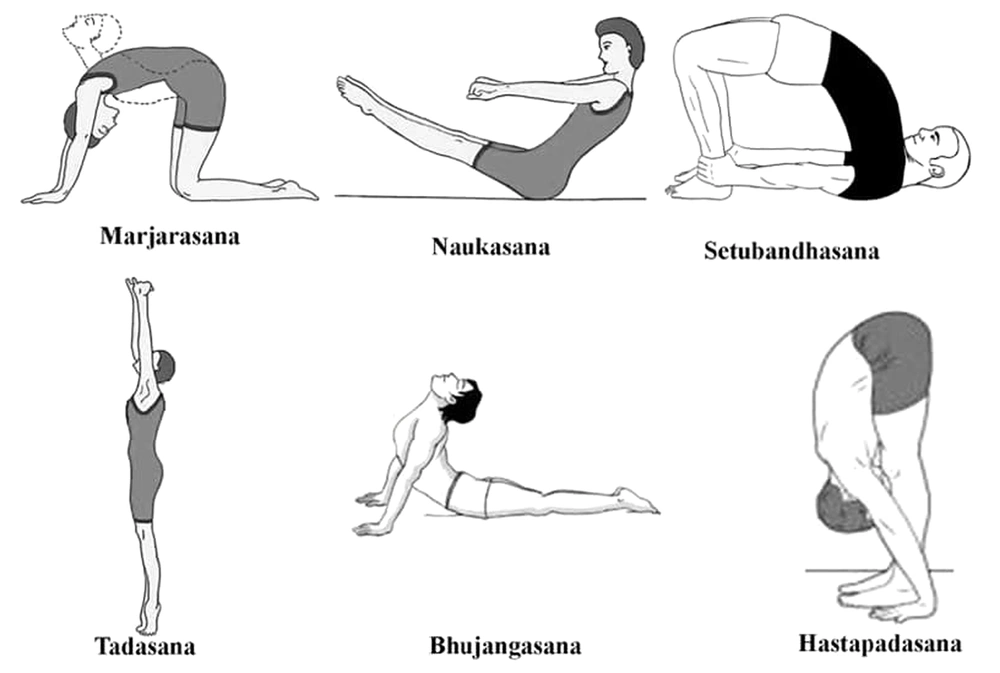
Schematic diagram of various asanas for hair transplant surgeons (<a href="#A122771REF4">4</a>).
Figure 1.
Schematic diagram of various asanas for hair transplant surgeons (4).

3.2. Bhujangasana

Bhujangasana is a cobra pose (Figure 1). It opens up the shoulders and the neck and strengthens the entire back and shoulders. It improves the flexibility of the upper and middle back. It reduces fatigue and stress related to long hours of surgery. This asana helps tone the abdomen and strengthens the spine (3, 5).

3.3. Setubandhasana

This pose resembles a bridge (Figure 1). It strengthens the back muscles and relaxes tired and spastic back muscles instantly. It gives a good stretch to the chest, neck, and spine (3, 6).

3.4. Uttan Vakrasana

It is also called a twisted pose because the spine is twisted in this asana. It reduces backaches and rigidity in the spine. The spine attains elasticity, and the flat on the lateral side of the abdomen gets reduced (3, 6).

3.5. Tadasana

It is a palm tree pose (Figure 1). By practicing it, the individual gets rid of lethargy and feels fresh and energetic. This asana improves the functioning of the veins of the legs. It improves the flexibility of the spinal column and reduces the undesirable pressure on vertebrae. Balancing asana training has potential benefits to improve attention and concentration.

3.6. Naukasana

It is a boat pose where both hands and legs are raised while lying on the stomach (Figure 1). In this asana, the neck, back, and waist muscles are strengthened. The tone of the back and hip muscles are improved. It also improves the health and strength of the spinal column. Abdominal fat can be reduced by daily practice of this asana.

3.7. Hastapadasana

This hand-to-feet posture gives a stretch to the back muscles and vertebral column (Figure 1). Back muscles, hamstring muscles, and waist muscles become flexible. Lumbago, sciatica, and other painful conditions can be corrected by daily practice of this asana (6).

3.8. Practicing Meditation

Practicing meditation for 10 - 15 minutes a day reduces stress and mental fatigue and improves concentration ability.

4. Conclusions

With proper exercises, HT surgeons can increase their efficiency and productivity in the long run. A successful HT practice requires a positive, focused mind and a healthy body. Yoga and meditation are ancient Indian practices that can help a surgeon achieve these goals and maintain poise between mental, physical, and spiritual health. Yoga improves the range of motion and flexibility, strengthens weakened muscles, alleviates pain symptoms, and enhances function in general.
Footnotes

  • Authors' Contribution: Study concept and design: AK. Acquisition of the data: ND. Drafting of the manuscript: SB. Critical revision of the manuscript for important intellectual content: SB.

  • Conflict of Interests: The authors did not receive any employment, funding, or research support. The authors had no personal financial interest. The authors do not have stocks or shares in companies. No consultation fees. No patents. The authors do not have any personal or professional relations with organizations and individuals. The authors do not have unpaid membership in a government or non-governmental organization. The authors are not editorial board members or reviewers of this journal.

  • Funding/Support: The authors did not receive any funding support from any organization for this study.

References

  • 1.
    Gupta A, Bhat M, Mohammed T, Bansal N, Gupta G. Ergonomics in dentistry. Int J Clin Pediatr Dent. 2014;7(1):30-4. [PubMed ID: 25206234]. [PubMed Central ID: PMC4144062]. https://doi.org/10.5005/jp-journals-10005-1229.
  • 2.
    Patwardhan N, Kirane V, Mysore V. Complications of Hair Restoration Surgery: An Overview. Hair Transplantation. 1st ed. New Delhi, India: Jaypee Brothers Medical Publishers; 2016. p. 428-30.
  • 3.
    Holtzman S, Beggs RT. Yoga for chronic low back pain: a meta-analysis of randomized controlled trials. Pain Res Manag. 2013;18(5):267-72. [PubMed ID: 23894731]. [PubMed Central ID: PMC3805350]. https://doi.org/10.1155/2013/105919.
  • 4.
    Nimbhalkar S. E.A.T techniques of yogic practices. In: Nimbhalkar S, editor. Yoga for health and peace. 8th ed. Mumbai, India: Yoga Vidya Niketan; 2018. 301 p.
  • 5.
    Gangwal J, Kholiya S, Bhatnagar V, Lahange SM. Importance of Bhujangasana in Daily Life. Int J Trend Sci Res Dev. 2019;4:647-51.
  • 6.
    Bussing A, Ostermann T, Ludtke R, Michalsen A. Effects of yoga interventions on pain and pain-associated disability: a meta-analysis. J Pain. 2012;13(1):1-9. [PubMed ID: 22178433]. https://doi.org/10.1016/j.jpain.2011.10.001.

Copyright

Copyright © 2022, Journal of Skin and Stem Cell. This is an open-access article distributed under the terms of the Creative Commons Attribution-NonCommercial 4.0 International License (http://creativecommons.org/licenses/by-nc/4.0/) which permits copy and redistribute the material just in noncommercial usages, provided the original work is properly cited.

Similar Articles

4
Jul
2021

In Memoriam of Dr Dinesh Mohan: A Tribute to a Competent Scholar, a Visionary Thinker, and an Exceptional Human Being

Mehdi Shafieian,
Kamran Bagheri Lankarani

Shafieian M, Bagheri Lankarani K. In Memoriam of Dr Dinesh Mohan: A Tribute to a Competent Scholar, a Visionary Thinker, and an Exceptional Human Being. Shiraz E-Med J. 2021;22(7):e117153. doi: https://doi.org/10.5812/semj.117153

24
Jan
2015

The Effects of Interventional Health Education on the Conditions of Hairdressing Salons and Hairdressers Behaviors

Mohammad Nassaji,
Shahin Kamal,
Raheb Ghorbani,
Mahnaz Moalem,
Batool Karimi,
Hossein Habibian
,et al.

Nassaji M, Kamal S, Ghorbani R, Moalem M, Karimi B, et al. The Effects of Interventional Health Education on the Conditions of Hairdressing Salons and Hairdressers Behaviors. Middle East J Rehabil Health Stud. 2015;2(1):e24645. doi: https://doi.org/10.17795/mejrh-24645

28
Oct
2024
The Impact of Smoking and Lifestyle Factors on Hair Transplant Outcomes in Patients with Androgenic Alopecia

The Impact of Smoking and Lifestyle Factors on Hair Transplant Outcomes in Patients with Androgenic Alopecia

Mohammad Ali Nilforoushzadeh,
Elham Pourebrahim

Nilforoushzadeh MA, Pourebrahim E. The Impact of Smoking and Lifestyle Factors on Hair Transplant Outcomes in Patients with Androgenic Alopecia. Compr Health Biomed Stud. 2024;2(3):e150466. doi: https://doi.org/10.5812/chbs-150466

19
Jul
2026
Post-War Cognitive and Psychosocial Challenges in the Academic Workplace: An Interdisciplinary Perspective on Occupational Health and Psychiatry

Post-War Cognitive and Psychosocial Challenges in the Academic Workplace: An Interdisciplinary Perspective on Occupational Health and Psychiatry

Edris Soltani,
Omran Ahmadi,
Seifollah Gharib,
Saman Ayar,
Parsa Fooladi

Soltani E, Ahmadi O, Gharib S, Ayar S, Fooladi P. Post-War Cognitive and Psychosocial Challenges in the Academic Workplace: An Interdisciplinary Perspective on Occupational Health and Psychiatry. Iran J Psychiatry Behav Sci. 2026;20(3):e172939. doi: https://doi.org/10.5812/ijpbs-172939

22
Jan
2019
Mind’s Relaxation and Diaphragmatic Respiration on the Basis of Scientific Yoga and Its Application in Neurodegenerative Diseases

Mind’s Relaxation and Diaphragmatic Respiration on the Basis of Scientific Yoga and Its Application in Neurodegenerative Diseases

Masoud Eslami,
Behnam Jameie,
Raheleh Mollajani,
Jinous Manouchehri

Eslami M, Jameie B, Mollajani R, Manouchehri J. Mind’s Relaxation and Diaphragmatic Respiration on the Basis of Scientific Yoga and Its Application in Neurodegenerative Diseases. Thrita J Neu. 2019;7(2):e64633. doi: https://doi.org/10.5812/thrita.64633

More by these authors

Amit S. KerurePubMedScholar
Shashank BansodPubMedScholar
Nikita DeshmukhPubMedScholar
Aseem SharmaPubMedScholar
Share
Cited by
Metrics