
1. Introduction
Freckles (Ephelides) are common pigmented lesions frequently observed on the face and other sun-exposed areas of the skin (1). Ephelides have an autosomal dominant inheritance, indicating that melanocyte activity in the basal epidermal layer and sun exposure are significant risk factors for these lesions (2). Freckles and solar lentigines are pigmented lesions on skin surfaces, mainly in Asian and European races (3). The prevalence of ephelides in different populations ranges from 16% to 47.8% (4). Ephelides have genetic bases, while sunlight creates solar lentigo. This condition was classified as a hyperpigmentation disease in cosmetics (5, 6). It also affects the patient’s quality of life (7). Treatment includes regular daily use of sunscreens (8), chemical peeling, cryotherapy, and laser therapy for their removal (9), which may lead to complications (10). The use of complementary medicine in dermatology is increasing worldwide (11).
Some studies have shown that herbal, complementary, and alternative medicine treatments can be effective for dermatological diseases, and the popularity of these therapies are increasing among patients with skin diseases (12). Persian medicine (PM) school is one of the oldest and richest medical approaches (13). It is a collection of theoretical and practical knowledge for diagnosing, preventing, and treating diseases that have been used since its creation. The disease prevention strategy is the primary mission of this school (14).
This study was designed to discuss PM views about freckles to obtain treatment strategies from ancient medical textbooks and manuscripts.
2. Methods
This research was a narrative review study. Significant ancient traditional medical manuscripts were searched and reviewed using two keywords, "Barash" and "Namash", endorsed by academic experts as equivalents of freckles. The types, causes, internal and external predisposing factors, relief factors, and general management principles were separately extracted and recorded. Then, a complete search was performed in Google Scholar, PubMed, and Scopus databases to investigate the effectiveness of the recommended treatment approaches.
This study was designed to discuss the PM viewpoints about freckles. The clinical presentations of freckles are very similar to those of "Namash & Barash" and the academic experts confirmed this in the field to represent freckles. Thus, the Barash & Namash were selected as the search keywords in the ancient manuscripts, sources, and references. The research subjects were selected from the collection of Persian medical textbooks written in Persian or Arabic by Iranian physicians. A software called the "Comprehensive Medicine Library (Traditional and Islamic)" was used to search through the selected books. The capabilities of this software are as follows: (1) provision of texts as an electronic library; (2) ability to do research in texts through the list of words, a combined search of words, and indexing; (3) ability to simultaneously search multiple books and display the texts; (4) possibility of categorization of the books by subject and result; (5) presenting the bibliography, codicology, and biography of authors with pictures on the cover; (6) ability to transfer texts to the Word software for editing and writing; (7) ability to annotate, change the text colors, and highlight.
The target group of this research includes doctors and pharmacists, history of science researchers (particularly in the history of traditional and Islamic medicine), botanists, zoologists, and mineralogists.
The keywords "Namash & Barash" in this software were searched among selected Iranian medical textbooks. The mentioned words were reviewed in each of the selected books, and results were categorized in 3 tables containing keywords, signs and symptoms, predisposing and relieving factors, inflicted areas, and treatments. In this study, " Canon of medicine" (Avicenna, 11th), "Teb-e-Akbari" (Hakim Arzani, 18th century), "Exir-e-Azam" (Nazem Jahan, 19th century), "Zakhirah - E- Kharazm Shahi" (Jorjani, 12th), "Kamil al-Sinaā al Tibbiya" (Majosi Ahwazi, 10th), "Moalejat Aghili" (Aghili, 17th), and "Kholasat al-Tajarob" (Baha'ul-Dawlah Razi, 15th) were reviewed. The articles used to validate the prescriptions of traditional medicine sources in various aspects were retrieved and studied from credible databases, including Pubmed, Scopus, Google Scholar, and Iranmedex.
3. Results
Regarding the clinical presentations of freckles, two keywords of "Namash" and "Barash" in PM medical textbooks had clinical symptoms similar to freckles. The number of repetitions of the keywords of "Namash" and "Barash" in the medical literature studied is presented in Table 1.
Table 1.
Number of Keywords of Namash and Barash in the References
| Manuscripts and References (PM Textbooks) | Authors | Repeat of Keyword | |
|---|---|---|---|
| Namash | Barash | ||
| The canon of medicine (15) | Avicenna | 34 | 8 |
| Teb-e-Akbari (16) | Akbarshah Arzani | 6 | 4 |
| Exir-e-Azam (17) | Azamkhan Cheshti | 39 | 23 |
| Kamil al-Sinaā al Tibbiya (18) | Ali Ibn-Al’Abbas Al-Majusi | 15 | 3 |
| Moalejat Aghili (19) | Seyyed Mohammadhosein Aghili | 5 | 5 |
| Kholasat al-Tajarob (20) | Baha'al-Dawlah Razi | 3 | 4 |
| Zakhirah - E- Kharazm Shahi (21) | Seyyed Esmaeel | 10 | 5 |
According to the humoral theory approach in PM, the human body consists of four fundamental humors: blood, phlegm, yellow bile, and black bile. Based on this theory, humors exist with specific proportions in the structure of all body organs in the human. The ratio of these humors and their amount in each organ is quite clear. It means that these humors are proportionate in quantity and quality in a healthy person. Therefore, any imbalance and disturbance of these humors can cause illness (22, 23). From the PM perspective, the human body is a dynamic system that constantly consumes nutrients and excretes waste materials. These waste materials are excreted and removed through different excretory routes such as stool, urine, semen, menstrual bleeding, sweating, and skin evaporations. Therefore, the human skin is also considered one of the body's excretion pathways. In diseases, the quality and quantity disturbance occurs mainly in the black bile and needs to be removed from the body. The intelligent nature of the body, which is a regulating system, excretes excess black bile to the skin to maintain the health of the internal organs that are more important than the skin. Hence, freckle forms due to the accumulation of excessive black bile in the skin. The causes of freckles are divided into two groups of external and internal factors. The external factors related to lifestyle are called six essential principles from the PM perspective. They should be observed to maintain health and prevent diseases. These basic principles include air, nutrition, movement and stillness, sleep and waking, retention and vomiting, and emotional and mental states (24). Nutrition and the ambient air are the leading causes of diseases. Nutritional factors that generate black bile, such as beef, eggplant, lentils, salted and spicy snacks, long-term exposure to cold air or sunlight, and stressful environment are the most influential external causes.
The internal causes leading to dystemperament and production of unhealthy and abnormal black bile include pregnancy, amenorrhea, depression, and weakness of the stomach, liver, and spleen.
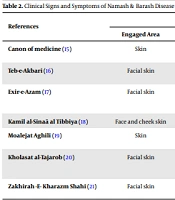
The clinical manifestations of freckles are similar to the clinical symptoms and locations of "Namash & Barash" diseases in PM (Table 2). Recommended treatments and predisposing and reliving factors of the disease are listed in Table 3.
Table 2.
Clinical Signs and Symptoms of Namash & Barash Disease in PM Textbooks
| References | Namash | Barash | ||
|---|---|---|---|---|
| Engaged Area | Sign and Symptom | Engaged Area | Sign Symptom | |
| Canon of medicine (15) | Skin | Reddish macules Most often accompanied by dry lips | Skin | Blackish macules |
| Teb-e-Akbari (16) | Facial skin | Spherical black or black reddish spots (macules) | Facial skin | Small black or red spots |
| Exir-e-Azam (17) | Facial skin | Spherical black or black reddish spots (macules) Most often accompanied by dry lips | Facial skin | Black spots |
| Kamil al-Sinaā al Tibbiya (18) | Face and cheek skin | Sign (macules) | Face and cheek skin | Sign (macules) |
| Moalejat Aghili (19) | Skin | Spherical black or black reddish spots (macules) | Skin | Blackish spots |
| Kholasat al-Tajarob (20) | Facial skin | Reddish interconnected spots- macules most often accompanied by dry lips | Facial skin | Blackish wide interconnected spots |
| Zakhirah -E- Kharazm Shahi (21) | Facial skin | Red spots | - | Reddish interconnected spots macules |
Table 3.
Predisposing and Reliving Factors and Treatment of Namash & Barash in PM Textbooks
| References | Predisposing Factor | Reliving Factor | Treatment | |
|---|---|---|---|---|
| Internal | External | |||
| Canon of medicine (15) | - | Trauma or any manipulation on skin; Sun exposure; Cold weather and wind; Salty foods | Covering the skin with sun blockers and topical barriers; Regular consumption of nutricosmetics such as yellow pea, egg yolk, lamb broth and figs | Needling a removing skin lesions with very thin needles) Tela b |
| Teb-e-Akbari (16) | Pregnancy; Gastrointestinal disease; Periodic fevers | - | - | Phlebotomy; Oral medicinal compounds such as whey protein with cuscuta epithymum decoction; Tela |
| Exir-e-Azam (17) | Weakness of the stomach, spleen, liver; Pregnancy; Amenorrhea for any reason; Periodic spike fevers; Sexual intercourse when menstruating or lactating | Cold weather and long-term exposure to sunlight; Canned foods generating black bile; Mushrooms and salted meat | Avoiding cold weather and long-term exposure to sunlight; Avoiding the use of food producing black bile such beef meat, eggplant, lentil | Phlebotomy; Oral medicinal compounds such as whey protein with Cuscuta epithymum decoction; Tela of warm water and topical lotion such as rose extract or fenugreek decoction |
| Kamil al-Sinaā al Tibbiya (18) | Weakness of the stomach, spleen, liver; Pregnancy | Foods generating black bile | Avoiding foods generating black bile | Phlebotomy; Oral medicinal plants such as C. epithymum; Tela |
| Moalejat Aghili (19) | - | - | Foods producing fresh blood such as chickpea extract, soft-boiled eggs; Regular bathing | Phlebotomy; Oral medication which removes abnormal black bile from body; Tela of warm water and Myrtus extract; Needling |
| Kholasat al-Tajarob (20) | Weakness of gastrointestinal system; Pregnancy; Aging and poor digestion | Long-term exposure to sunlight | Avoiding prolonged exposure to sunlight | Oral medicinal compounds which excrete abnormal black bile from body Tela |
| Zakhirah - E- Kharazm Shahi (21) | - | - | - | Oral medicine Such Terminalia chebula and whey protein; Topical peeling agent such as topical mask of seeds of Cucumis melo L. |
a Removing skin lesions with very thin needles.
b Topical peeling lotions.
4. Discussion
Sun‐induced freckles are pigmented skin lesions classified into two types of ephelides and solar lentigines in a review study by Praetorius in 2014. Ephelides are pigmented brownish macules or spots of 1 - 2 mm and larger, located on the sun-exposed areas such as the face, neck, arms, and forearms in people with bright skin and red hair (3, 5, 25). Solar lentigines, on the other hand, are pigmented macules which are a few millimeters to a centimeter in size, and dark brown, mostly seen on the face, back of the hands, and the anterolateral part of the forearm (3, 26, 27). According to our study, the freckles symptoms are similar to those of Namash & Barash disease in PM. They are black, red, or brown circular spots that commonly appear on the face. On the other hand, there are two congenital and acquired types of Namash & Barash. The congenital type is believed to be incurable, but some treatments for the acquired type exist. The etiology of the acquired Namash & Barash is black bile dystemperament. It means that when the amounts of black bile increase in the body due to different predisposing factors, the intelligent nature of the body, which is a kind of regulating system, excretes black bile into the skin to protect the internal organs.
However, there is no excreting pathway for this abnormal black bile. Therefore, it accumulates in the skin and creates skin patches called Namash & Barash. Internal and external predisposing factors for Namash & Barash are listed below. External factors: (1) cold or windy weather; (2) long-term exposure to sunlight; (3) foods that produce abnormal black bile humor like beef meat, eggplant, and lentil; (4) canned or salted foods. Internal factors: (1) weakness of the major organs like stomach, liver, and spleen; (2) pregnancy and amenorrhea; (3) sexual intercourse when menstruating or lactating; (4) periodic fevers.
Sun‐induced freckles are pigmented skin lesions that are classified into two types ephelides and solar lentigines.
In conventional medicine, based on a review study by Praetorius in 2014, sun‐induced freckles are categorized into two types of ephelides and solar lentigines, the former is autosomal dominant, and the latter is acquired. As a result of the stimulation of ultraviolet rays of the sunlight (UV), the synthesis of melanin is increased (3). Melanin synthesis is a complex, multi-enzymatic process, and one of the related enzymes is Tyrosinase. This enzyme is stimulated by UV radiation, and during melanin production, the expression and activity of the tyrosinase enzyme are upregulated by α melanocyte-stimulating hormone (α-MSH) (28, 29). Various factors such as increased estrogen levels in pregnancy, diabetes, and advanced ages are involved in this upregulating pathway. Immune, inflammatory, endocrine, and nervous systems are effective in melanogenesis, and the skin acts as a neuroendocrine organ (30). In this melanin production and regulation mechanism, the cause of freckles can be traced back to the Persian Medicine perspective. Several studies have concluded that extra-skin melanogenic systems can be found in visceral organs such as the liver and spleen in the form of macrophage cells called Kupffer Cells. These cells synthesize a specific type of melanin that is different from skin melanin and called indole with a tyrosinase enzyme different from the tyrosinase present in the melanocytes. The expression of the tyrosinase gene in these cells is affected by α-MSH (31). From a PM perspective, this can be a turning point in the development of freckles due to visceral organ weakness like the liver and spleen.
In conventional medicine, ephelides usually appear at the age of two to three, increase in adolescence, gradually disappear with age, and become more intense in color during the summer. Lentigo increases with age and becomes constant, and is common after the age of 50 years. Lentigo is not affected by weather changes in different seasons (3, 32). According to Traditional Medicine, pregnant women and the elderly are most commonly affected. From a PM perspective, the treatment of freckles is based on three principles: Lifestyle modification, medication, and manipulation. Observing the six essential schemes for maintaining health in the lifestyle modification approach is crucial. These six principles of health maintaining factors include climate, eating and drinking, retention and excretion, repose and movement, sleep and wakefulness, and emotional and mental states. According to the PM, among these factors, nutrition, climate, and sunlight have the most prominent roles in the development of freckles. As the initial step of treatment, avoiding consumption of black bile-producing foods (such as mushrooms, eggplants, lentils, beef, and salted fish) can prevent the development of the lesions. Recent studies have shown that consuming a fungus called Inonotus hispidus facilitates the process of melanogenesis by activating tyrosinase on cultured melanoma B16 cells (33). This is in accordance with the PM notion that nutrition and some foods can influence the appearance or intensify freckles lesions.
From the PM perspective, sunlight and cold or windy weather can also create or exacerbate freckles (18). As conventional medicine studies consider sunlight the most influential factor in the formation of freckles, sunscreen is recommended to control this factor and prevent disease progression. The treatment in conventional medicine involves the use of topical medications and manual intervention. The topical treatments include: (1) retinoids (by inhibiting tyrosinase, increasing turn-over of keratinocytes); (2) chemical peel (by removing melanin from the thinning of stratum); (3) azelaic acid (tyrosinase inhibition); (4) hydroquinone (inhibitors of tyrosinase); (5) laser (thermal degradation of melanin); (6) cryotherapy (6, 7, 9, 34).
The treatment of freckles in Persian medicine is as follows: (1) oral medications; (2) local or topical medications; (3) manual intervention.
Oral medicines in PM for freckles treatment are aimed at contributing to the removal, excretion, and cleansing of the body from abnormal black bile, which is the leading cause of the disease. Accordingly, three edible drugs, namely whey protein, Cuscuta epithelium, and Agaricus, are among the recommended oral treatments for this purpose. The action mechanism of whey protein is inhibition of tyrosinase which was demonstrated in a study in 1996. It acts as a melanogenesis suppressing modulator inhibitor (35). There is a need for further studies on the mechanisms of the action of Cuscuta epithymum and Agaricus herbs.
4.1. Topical Medications
From a PM perspective, topical lightening lotions exist with the scientific name "Tela" which contain herbs like Lupinus, horseradish, barley flour, and common fig (Ficus carica), and brightening the skin through peeling and depigmentation mechanisms. A conventional medicine study showed that a cream containing the extract of figs is effective on hyperpigmentation, wrinkles, and facial acne (36).
In original phytotherapy studies, the effects of different plants on melanogenesis are investigated. Some polyphenol plants with photoprotective properties, such as grapeseed, and green tea (37), inhibit melanogenesis through either absorption of UV or antioxidant mechanisms (36-38). Some herbal foods, like licorice, can inhibit tyrosinase (39).
In the manual intervention section in PM, needling can be mentioned, which aims to remove the substances accumulated under the skin and increase the blood flow supply. Another treatment is "phlebotomy" or "bloodletting". A study was conducted in 2009 based on Traditional Chinese Medicine on Melasma disease indicated that acupuncture and blood-letting treatments had significant therapeutic impacts (40).
4.2. Conclusions
Clinically, freckles resemble skin lesions called Namash and Barash in the PM resources. From a PM perspective, the underlying cause of freckle can be traced to the mechanisms of production and regulation of melanin in conventional medicine. There are effective ways to prevent and treat the disease in the PM resources. Thus, clinical trial studies should be designed and conducted to study the impact of various prevention and treatment methods recommended by medical sources on freckles.