
Dear Editor,
Common viral warts on the skin may be troublesome for approximately 35% of patients and require intervention. Various interventions such as keratolytics, imiquimod, curettage, electrocautery, cryotherapy, and laser have been effectively utilized for wart removal (1, 2). However, these interventions may be costly, time-consuming, and unsuitable for satellite clinics.
The feeding capillaries of naturally-resolving warts may become thrombosed and visualized as brown to black dots on their surfaces.
Observing naturally-resolving warts, for their removal, the feeding capillaries of the wart can be topically cauterized with trichloroacetic acid (TCA). Firstly, under aseptic conditions without local anesthesia, the viral warts were caught, crushed, and then pulled up with a mosquito artery forceps to remove their hyperkeratotic part (Figure 1A and B). Most of the warty growth was detached with forceps, and the feeding capillaries of the wart became exposed. Subsequently, the site was hemostasized with pressure or hypertonic saline (35.9%). Then the remnants of warts in the lesion’s periphery and the capillaries were cauterized lightly with 100% TCA. After the procedure, topical antibiotics and moisturizers were prescribed 4 to 5 times a day for 7 to 10 days to avoid dryness and scab formation and to promote better and faster healing. The patients were followed up weekly for six weeks. The excised warts completely disappeared in 7 to 10 days (Figure 1C), and the local skin completely healed in 3 to 4 weeks (Figure 1D). Five patients with exophytic viral warts on the body were successfully managed by this method. Therefore, the combination of crushing (debulking) and TCA cauterization of the wart appears to be a fast and simple method for treating recalcitrant viral warts. However, it is important to avoid deep TCA cauterization, and after the procedure, the lesion should be kept moist and uninfected. Therefore, compared to alternative options, cauterizing and crushing warts appears to be a fast, simple, and low-cost procedure.
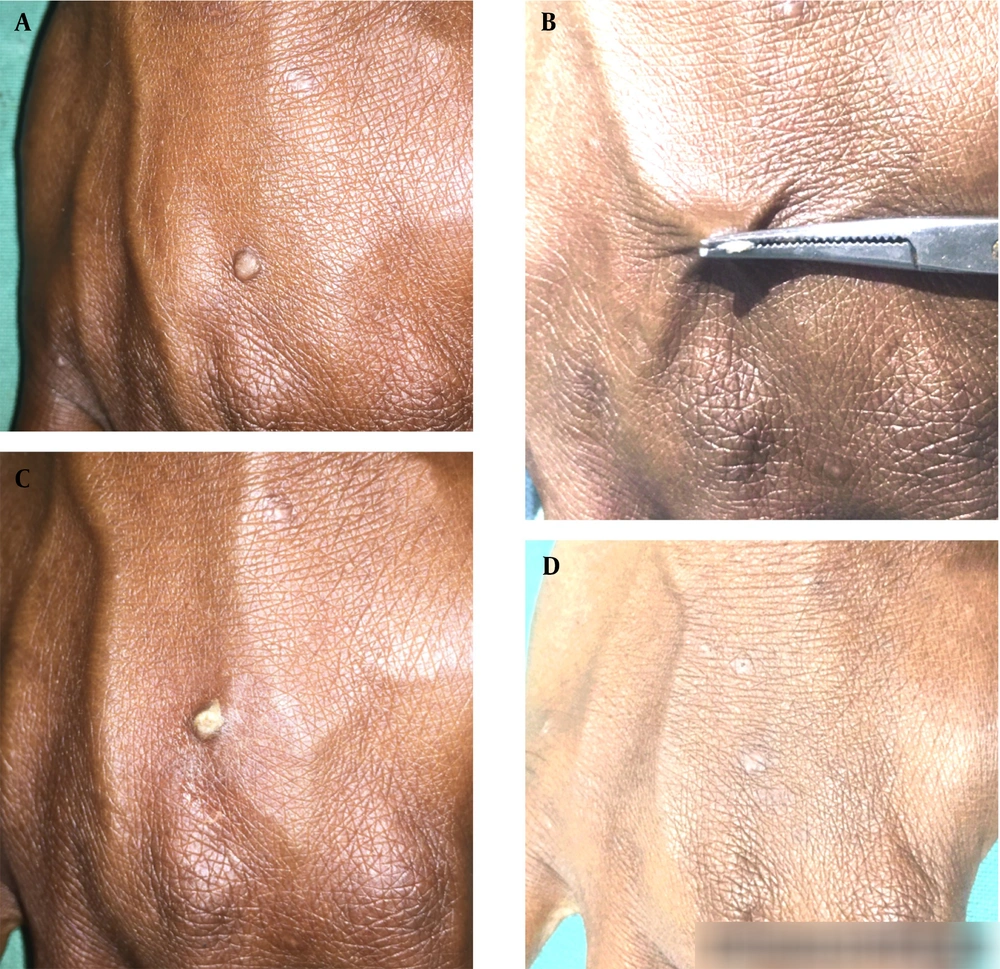
Figure 1.
Different stages of cauterized viral wart (pre- and post-TCA cauterization)
Important points of the technique are highlighted below:
(1) This technique can be applied for body exophytic warts (but not on the face for cosmetic reasons).
(2) When the wart is debulked, cauterization is easier, faster, less costly, and more efficient.
(3) Feeding capillaries and any remaining parts of warts in the margins should be thoroughly cauterized.
(4) The region should be kept infection-free and needs scabbing for better healing and cosmetic results.
(5) This method can be practical for clinics with limited resources, particularly satellite clinics.