Journal of Semnan University of Medical Sciences
Image Credit:Koomesh
Outline
Effect of perceptual motor interventions on dexterity of mentally retarded children
Authors
Abstract
Introduction: Given the importance of the development of gross and fine motor activities and coordination between in performing activities of daily life, improving the hand function in mentally disabled children is one of the priorities of occupational therapists. Perceptual motor deficit in children with intellectual disability result in hand dysfunction such as dexterity. Considering the importance of dexterity and the consequences of problems on the activities of daily living, as well as its reliance on a person;#39s ability to perform fine motor, coordination, speed, gross motor and perceptual abilities, in this study were considered the effect of perceptual motor intervention on dexterity of children with mental retardation. Materials and Methods: Using simple non-probability method for sampling, based the pattern of monitoring and sample size, we selected 10 children for treatment and 10 children for control groups. The treatment group was trained for perceptual motor intervention for 10 weeks, 3 sessions of 60 min per week. Both groups were trained by an occupational therapiest. After 10 weeks, all subjects were re-evaluated. Purdopeg board test used to assess dexterity. Statistical analysis was performed, using SPSS software. Results: One way analysis of variance showed that the scores of Purdopeg board test between the two groups was not significant (P ≥ 0/05), though there was a significant correlation between full scores of Bruininks – Oseretsky Test and Purdopeg board test except assembly test (P ≤ 0/05). Conclusion: Results of present study showed that although the speed test in the left hand was affected by perceptual motor intervention more than any other tests of dexterity, the intervention did not significantly affect the dexterity of mentally retarded children
Highlights
References
- 1.Case-smith J. Occupational therapy for children. 4th ed. Louis: Mosby; 2001.
- 2.Guyton A. Textbook medical physiology. 10th ed. Tehran: Chehr Co; 2000. (Persian).
- 3.Eliasson AC, Forssberg H, Hung YC, Gordon AM. Development of hand function and precision grip control in individuals with cerebral palsy: a 13-year follow-up study. Pediatrics 2006; 118: e1226-1236.
- 4.Bagheri H, Abdolvahab M, Dehghan L, jalili M, S.Z B. The effect of task oriented training on upper extremity function in children with spastic diplegia (8-12 years old). Novin J 2009; 3: 56-61. (Persian).
- 5.Kahrizsangi GG, Salehi H, Heidari L. Effect of a program of rhythmic movements on motor perceptual abilities of children with Educable mental retardation. Develop Motor Learn 2011; 9: 75-92. (Persian).
- 6.Rafiei H, Arjomand M, Hamidpor H. Hilgards Introduction to Psychology. 3th ed. Tehran: Arjomand; 2011. (Persian).
- 7.Carmeli E, Bar-Yossef T, Ariav C, Levy R, Liebermann DG. Perceptual-motor coordination in persons with mild intellectual disability. Disabil Rehabil 2008; 30: 323-329.
- 8.Farahbod M. Occupational therapy in mental retardation. first ed. Tehran: Institute for exceptional Children; 2005. (Persian).
- 9.Mohammadi M, Abdolvahab M, Hadian MR, OlyaeI GR, Jalili M, Karimi H. The investigation of effects of simultaneous stimulation of exteroception and proprioception on dexterity of 6-7 years old educable children with Downs syndrome. Novin Rehabil 2008; 2: 27-32. (Persian).
- 10.Duruz MT. Hand function: a practical guide to assessment. Istanbul, Turkey: Springer; 2014.
- 11.Abasi S, Hadian MR. The effect of eye-hand coordination activities on hand skills of 7-10 year-old educable students with down syndrome. J Mazand Univ Med Sci 2011; 21: 54-85. (Persian).
- 12.Case-Smith J. Fine motor outcomes in preschool children who receive occupational therapy services. Am J Occup Ther 1996; 50: 52-61.
- 13.Harris SR. Effects of neurodevelopmental therapy on motor performance of infants with Down's syndrome. Dev Med Child Neurol 1981; 23: 477-483.
- 14.Stratford B. Perception and perceptual-motor processes in children with Down's syndrome. J Psychol 1980; 104: 139-145.
- 15.Uyanik M, Bumin G, Kayihan H. Comparison of different therapy approaches in children with Down syndrome. Pediatr Int 2003; 45: 68-73.
- 16.Enander AE. Effects of thermal stress on human performance. Scand J Work Env Health 1989; 97: 27-33.
- 17.Waldron EM, Anton BR. Effects of exercise on dexterity. Percept Mot Skills 1995; 80: 883-889.
- 18.Adams KJ, Barnard KL, Swank AM, Mann E, Kushnick MR, Denny DM. Combined high-intensity strength and aerobic training in diverse phase II cardiac rehabilitation patients. J Cardiopulm Rehabil 1999; 19: 209-215.
- 19.Izawa K, Hirano Y, Yamada S, Oka K, Omiya K, Iijima S. Improvement in physiological outcomes and health-related quality of life following cardiac rehabilitation in patients with acute myocardial infarction. Circ J 2004; 68: 315-320.
- 20.Lee-Valkov PM, Aaron DH, Eladoumikdachi F, Thornby J, Netscher DT. Measuring normal hand dexterity values in normal 3-, 4-, and 5-year-old children and their relationship with grip and pinch strength. J Hand Ther 2003; 16: 22-28.
- 21.Abasi S, Hadian MR, Abdolvahab M, Jalili M, Jalaei S. Correlation between pinch and grip strenghts with dexterity in adult hemiplegic patients. J Babol Univ Med Sci 2011; 31: 64-69. (Persian).
- 22.Ada L, O'Dwyer N, Green J, Yeo W, Neilson P. The nature of the loss of strength and dexterity in the upper limb following stroke. Hum Mov Sci 1996; 15: 671-687.
- 23.Soyupek F, Bolukbafil N, Yorganciolu ZR, Gokolu F. The effect of Aerobic exercise on hand strength and dexterity of patients with coronary artery disease. Turk J Phys Med Rehab 2006; 52: 72-75.
- 24.Lin Kc, Wu Yf, Chen Ic, Tsai Pl, Wu Cy, Chen Cl. Cognitive tasks and daily functioning in people with schizophrenia: a pilot study. Am J Occup Ther 2015; 69: 1-7.
- 25.Song CS. Relationship between visuo-perceptual function and manual dexterity in community-dwelling older adults. J Phys Ther Sci 2015; 27: 1871-1874.
- 26.Brorsson S, Nilsdotter A, Thorstensson C, Bremander A. Differences in muscle activity during hand-dexterity tasks between women with arthritis and a healthy reference group. BMC Musculoskelet Disord 2014; 15: 154.
- 27.Rafiei S, Taghizadeh G, Edrese M, Ashrafi M. Test-retest reliability of the Purdue Pegboard test for chidren with Down syndrome. Koomesh 2011; 1: 35-43. (Persian).
- 28.Beigi MK, Fahimi MA, Ashayeri H, Doustdar H. The effect of musical activities on executive function in patients with schizophrenia. J Army Univ Med Sci 2013; 11: 120-129. (Persian).
- 29.Lezak MD. Neuropsychological Assessment. 4, editor. USA: Oxford University Press; 2004.
- 30.Yancosek KE, Howell D. A narrative review of dexterity assessments. J Hand Ther 2009; 22: 258-270.
- 31.Lindstrom-Hazel DK, Veenstra NV. Examining the purdue pegboard test for occupational therapy practice. Open J Occup Ther [serial on the Internet] 2015; 3: Available from: http://dx.doi.org/10.15453/2168-6408.1178.
- 32.Wuang YP, Su CY. Reliability and responsiveness of the Bruininks-Oseretsky test of motor proficiency-second edition in children with intellectual disability. Res Dev Disabil 2009; 30: 847-855.
- 33.Wilson BN, Polatajko HJ, Kaplan BJ, Faris P. Use of the Bruininks-Oseretsky test of motor proficiency in occupational therapy. Am J Occup Ther 1995; 49: 8-17.
- 34.Duger T, Bumin G, Uyanik M, Aki E, Kayihan H. The assessment of Bruininks-Oseretsky test of motor proficiency in children. Pediatr Rehabil 1999; 3: 125-131.
- 35.Bruininks RH, Bruininks BD. Bruininks-Oseretsky test of motor proficiency owner's manual. Occup Phys Ther 1982.
- 36.Karper WB. Effects of gross motor training on attention-deficit behavior in one learning-disabled child. Percept Mot Skills 1986; 63: 219-225.
- 37.McGuine TA, Keene JS. The effect of a balance training program on the risk of ankle sprains in high school athletes. Am J Sports Med 2006; 34: 1103-1111.
- 38.Chasey WC, Wyrick W. Effect of a gross motor developmental program on form perception skills of educable mentally retarded children. Res Q 1970; 41: 345-352.
- 39.Enander AE. Effects of thermal stress on human performance. Scand J Work Environ Health 1989; 15: 27-33.
- 40.Liubicich ME, Magistro D, Candela F. Physical activity, fine manual dexterity and a Coachs self-efficacy in a physical activity program for older persons living in residential care facilities. Psychology 2012; 3: 384-392.
Copyright
© 2016, Author(s). This open-access article is available under the Creative Commons Attribution 4.0 (CC BY 4.0) International License (https://creativecommons.org/licenses/by/4.0/), which allows for unrestricted use, distribution, and reproduction in any medium, provided that the original work is properly cited.
Similar Articles
Impact of Mental Imagery Training on the Upper Limb Functions and Motor Skills in Children with Cerebral Palsy
Mohammadi Z, Hajloo N, Seifi Skishahr F. Impact of Mental Imagery Training on the Upper Limb Functions and Motor Skills in Children with Cerebral Palsy. J Motor Control Learn. 2024;2(2):e146512. doi: https://doi.org/10.29252/ijmcl.2.2.24
Comparision of visual perceptual skills in children with cerebral palsy based on the severity of gross motor function
Dalvand H, Eghlimi M, Fatoorechi S, Haghgoo HA, Biglarian A. Comparision of visual perceptual skills in children with cerebral palsy based on the severity of gross motor function. J Clin Res Paramed Sci. 2016;5(2):e81466. doi:
Comparison between normal and mental retard children with mental aged 6-7 on motor skills
Pahlevanian A, RasolZadeh M, AmozadehKhalili M. Comparison between normal and mental retard children with mental aged 6-7 on motor skills. koomesh. 2012;13(4):e152536. doi:
Relationship between sensory processing and motor skills in children with cerebral palsy
Ahmadizadeh Z, Mokhlesin M, Rasolzadeh M, Yaghobi M, Nobariyan F. Relationship between sensory processing and motor skills in children with cerebral palsy. koomesh. 2016;18(2):e151138. doi:
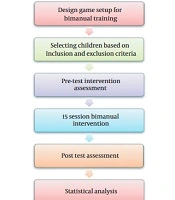
A New Training Protocol Based on Bimanual Playing a Computer Game for Motion-Cognitive Rehabilitation in Children with Spastic Hemiparetic Cerebral Palsy
Hosseini P, Kobravi HR, Tahami E, Zeinalzadeh A, Hashemi N, et al. A New Training Protocol Based on Bimanual Playing a Computer Game for Motion-Cognitive Rehabilitation in Children with Spastic Hemiparetic Cerebral Palsy. Inn J Pediatr. 2023;33(5):e136889. doi: https://doi.org/10.5812/ijp-136889
- Scopus by DOI: 0
Last Update: 4 days ago
- Scopus by Title: 0
Last Update: 4 days ago
- Scopus by Title (Ref): 0
Last Update: 4 days ago
- CrossRef: 0
Last Update: 4 hours ago
- OpenAlex: 0
Last Update: 6 hours ago
- OpenCitations: 0
Last Update: 4 days ago